The Polykatoikia: What Makes the Athenian Apartment Building...
The Goethe Institute's exhibition explores Athens'...

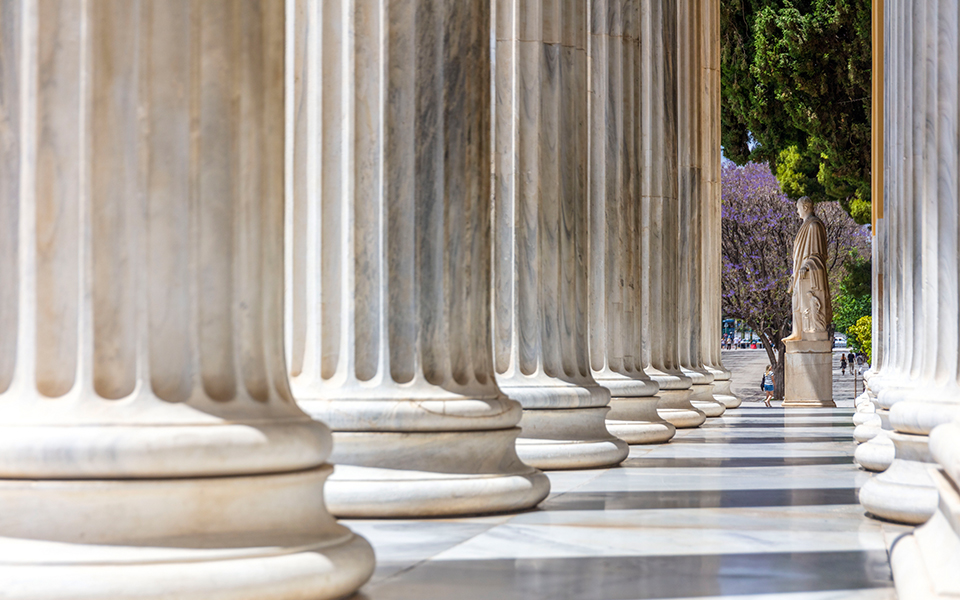
The impressive columns of the Zappeion (begun 1874-1888).
© Perikles Merakos
In Athens, we are clearly at the epicenter of ancient Greek history and its cultural legacy. While many people today are familiar with Pericles’ great 5th-century BC Doric Parthenon temple on the Acropolis, what about the countless neoclassical-style public buildings and residences seemingly sewn everywhere into the fabric of contemporary Athens’ cityscape? Where did this architectural style come from? Directly through local appreciation for the Parthenon and similar ancient relics? No, ancient Greek art and architecture had to find its way abroad first, before later returning to its birthplace in a neoclassical movement that has made a meaningful, aesthetically charming contribution to modern-day Greek identity and the Athens experience.
Ancient literature has been an important thread through the historical eras since antiquity, including not only the works of Homer, Plato and Aristotle, but also those of Virgil and Vitruvius, too. By definition, the classical world constitutes both ancient Greece and Rome. The material remains of these two civilizations may have been covered by the dust of time, but many writings of ancient authors persevered. Ancient Rome, being more recent and relatively accessible, left more traces – both literary and architectural. This fact played a role in the rise of the Renaissance (14th-early 16th centuries), when classical culture first reemerged from the “darkness” of the Middle Ages.
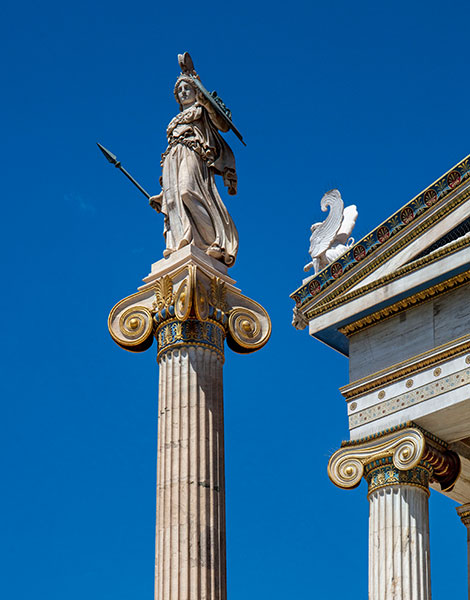
The warrior goddess Athena.
© Perikles Merakos
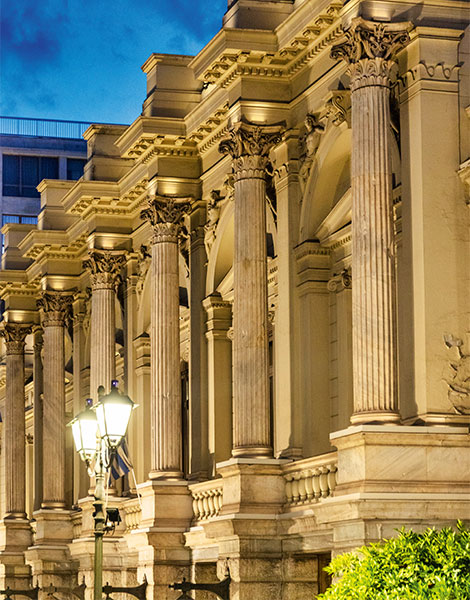
The elaborate facade of the National Theater echoes the scaenae frons of an ancient Roman theater.
© Perikles Merakos
Renaissance humanists and architects in Italy were naturally influenced by ancient Rome’s ubiquitous ruins. De Architectura, the Augustan architect Vitruvius’ seminal work in Latin, was revived in the early 1400s. Architecture in the Renaissance era, as envisioned by such great figures as Leon Battista Alberti, Donato Bramante, Michelangelo and Andrea Palladio, thus evoked more of the building methods and styles of the ancient Romans than of the Greeks.
Palladio, working in the Veneto region and particularly in Vicenza, employed various architectural orders in his designs of “classical” churches, palaces, urban villas and country houses. In their own buildings, the ancient Roman architects who inspired him had adopted, and adapted, the three Greek orders (Doric, Ionic, Corinthian) while also employing a native Tuscan order and a fifth style later identified in the Renaissance as “Composite” – a more elaborate form of Corinthian. Hallmark features of Renaissance classical buildings include the Tuscan style’s simplicity, frequent arcades (arch-enclosed walkways), arched windows, loggias (colonnaded walkways set into a building’s facade), decorative dentils and intricately adorned Corinthian entablatures. Palladio’s designs were especially influential, later contributing to the architecture of country houses in England.
Following the Renaissance, a fashion arose among well-to-do western Europeans with a love for history and the arts to travel on grand tours across Europe to Italy. In the early 18th century, young British aristocrats and intellectuals of the Society of Dilettanti began adding Ottoman-ruled Greece to their itinerary, as it offered fresh, challenging adventures to their grand tour. The Parthenon in Athens was, as it is today, a star attraction, often sketched and painted with varying degrees of precision by travelers that included Richard Pococke (1745), Richard Dalton (1751) and Julien-David Le Roy (1758).
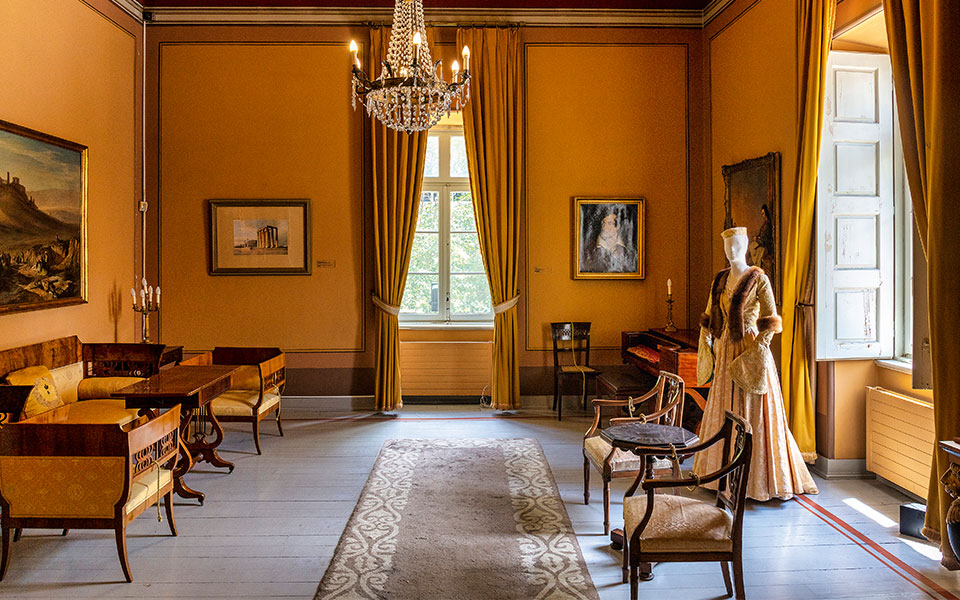
The “Old Palace" (1833-1834), now the City of Athens Museum.
© Perikles Merakos
As Greece’s landscape and antiquities became more familiar to westerners, a strong rivalry developed between ancient Greek and Roman enthusiasts. The poet John Milton extolled Athens in 1671 as “the eye of Greece, mother of Arts and Eloquence.” Nevertheless, Greek antiquities were still viewed as curiosities, relates architectural historian Lena Lambrinou (NTUA), with the English clergyman and travel writer George Wheler writing in 1678 that he preferred them “almost” as much as Roman antiquities.
Ancient literary appreciation for Greek nature, beauty and, in particular, the mythical land of Arcadia, as expressed par excellence in Virgil’s 4th and 10th Eclogues, was picked up by Renaissance and subsequent authors and painters. During the Enlightenment, this newfound admiration and romantic vision of Arcadia contributed significantly to the development of the neoclassical Greek Revival in architecture and the Romantic movement of artists and intellectuals in the 18th and 19th centuries. The picturesque sketches and paintings of Greek antiquities by early travelers stirred artists, antiquarians and architects to produce a diverse array of Greece-inspired works, to collect Greek artifacts and to design fanciful gardens adorned with pseudo-classical “follies” (small ornamental buildings). As the Scottish history painter Gavin Hamilton stated in 1779, “the most valuable acquisition a man of refined taste can make is a piece of fine Greek sculpture.” British builders at this time, however, generally viewed Grecian architecture as a decorative style only suitable for garden adornment, not for mainstream projects.
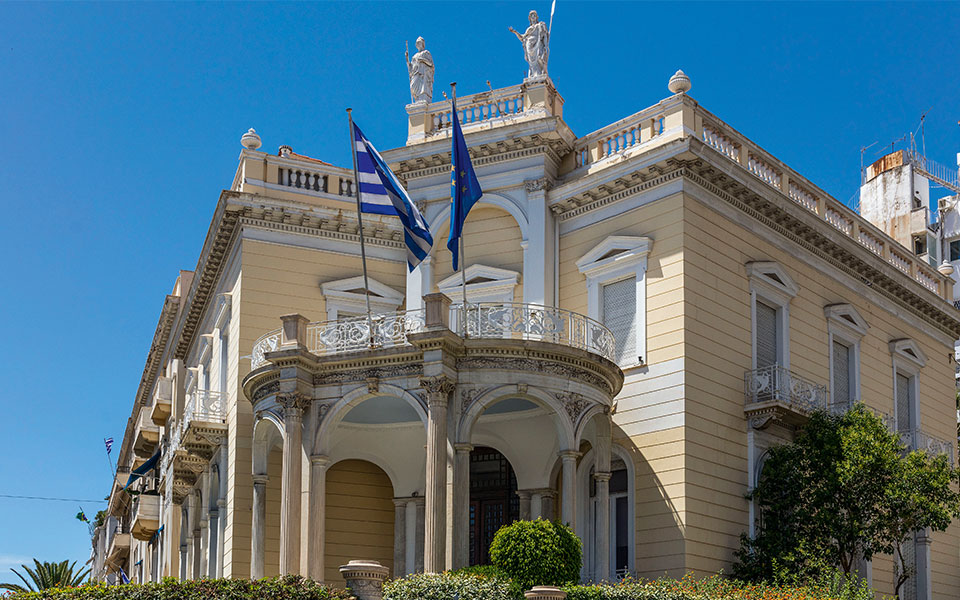
The elegant Stathatos Mansion (1895), now the Museum of Cycladic Art.
© Perikles Merakos
The visit to Athens by British architects James Stuart and Nicholas Revett in 1751-1753 proved a defining moment for the advance of neoclassical architecture. Never before had such fine drawings been made and so impressively published (4 vols., 1762-1816). These highly precise drawings continue to be important today, according to Lambrinou, as some of them remain the only proper architectural documentation we have for certain Athenian antiquities – such as the Doric Gate of Athena Archegetis at the entrance to the Roman Agora.
Following the publication of Stuart and Revett’s second volume in 1789, the Parthenon and other Athenian antiquities became closely studied models, whose Doric, Ionic and Corinthian features would be incorporated into a wide range of neoclassical designs. No longer did architects need to travel to Greece themselves to gain familiarity with the relics of ancient Greece. The Parthenon, perhaps due to its imposing proportions, continued for a time to be considered an inappropriate archetype for residences, although now more-true-to-life classical elements from the facades of smaller Athenian structures and temples (e.g., Propylaia, Hephaisteion) were incorporated into British garden temples beginning in the late 1750s.
The mid-18th century also marked a pivotal point in neoclassicism thanks to Johann Joachim Winckelmann, a pioneering German art historian and expert on Roman sculpture. As he famously opined in 1755, “the only way for us to become great or … inimitable … is to imitate the ancients … especially the Greeks. One must become as familiar with them as with a friend.” Winckelmann’s views on the works of ancient Greek sculptors, which exhibited “a noble simplicity and quiet grandeur, both in posture and expression,” kindled greater popular appreciation for classical styles in both art and architecture. His writings, furthermore, gave wide exposure to recent archaeological discoveries at newly unearthed Herculaneum (1738) and neighboring Pompeii.

© Perikles Merakos
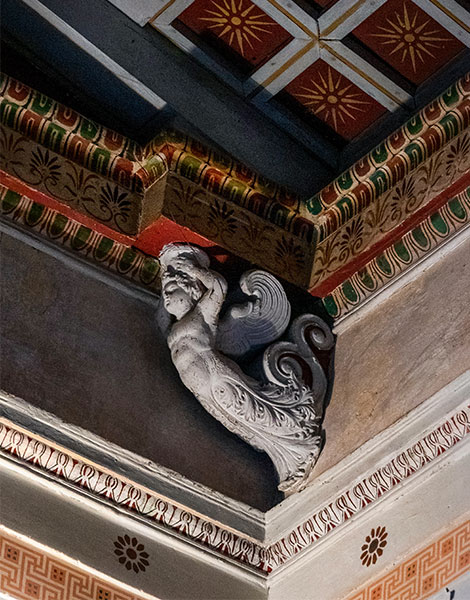
© Perikles Merakos
The arrival of the Parthenon sculptures in London in 1803 served as a further catalyst for the public’s growing taste for Greek antiquities. Purchased from Lord Elgin by the British Museum in 1816, one year after the Battle of Waterloo, the collection from Classical Greece now took on great meaning, according to the museum’s late curator Ian Jenkins: “Just as the Parthenon had once commemorated Athens’ victory over the Persians at the Battle of Marathon, so now its sculptures would commemorate England’s triumph.”
As international conflicts came to a head and great political changes occurred in the dynamic late 18th and early 19th centuries, neoclassicism in France likewise evolved through a series of successive styles (Louis XIV, XV, XVI; Directory; Consulate), culminating in the Empire style during the lead-up to the Napoleonic Wars (1803-1815). Envisioning himself as a new Caesar, Napoleon embraced this strongly Rome-evoking neoclassical architecture, which for him operated as visual propaganda. After Waterloo, however, European tastes turned away from imperial France, while the Greek Revival movement, combining Greek and Roman elements, reached new heights.
Beauty and the picturesque were no longer enough; now a neoclassical style reflecting grandeur and dignity was called for amid a new age of republicanism and national struggle. Periclean Athens and the Parthenon were equated with democracy and national unity. In Bavaria, Ludwig I, father of Greece’s future king Otto, commissioned the Walhalla, a national monument inspired by rising nationalist feeling and the Germans’ recent triumph over Napoleon at Leipzig (1813), which would be designed by architect Leo von Klenze and modeled on the Parthenon.
Before the Walhalla was completed (1842), the Parthenon, a timeless symbol of democratic independence over an invading imperialistic force, also came to be viewed as a national icon by the Greeks fighting to free themselves from the Ottoman Empire during the Greek Revolution (1821-1829). As the philhellenic movement intensified, the Periclean temple became a focus for the budding Greek nation’s historical identity, according to Lambrinou.
In Scotland, as well, the city of Edinburgh, the self-styled “Athens of the North,” decided to erect a Parthenon-inspired monument commemorating the fallen heroes of the Napoleonic Wars. Designed by Charles Robert Cockerell and William Henry Playfair, it was left uncompleted in 1829, its twelve Doric columns still standing today.

A statue of philhellene William Ewart Gladstone stands in front of the National University.
© Perikles Merakos
Spreading through Western Europe, neoclassicism eventually crossed the Atlantic with the Hellenophile architect Benjamin Henry Latrobe in 1796. Known for redesigning and completing the US Capitol Building (1811), Latrobe also helped to restore the building (1815) after it burned during the War of 1812. The Parthenon’s symbolism inspired many American designers, as did other Athenian structures (e.g., Thrasyllos Monument) and the Pantheon in Rome. By the 1840s, the Greek Revival style had become a common choice for banks, state capitols and other government buildings around the country, including the Second Bank of the United States (Philadelphia, 1824) and Federal Hall on Wall Street (New York, 1842). Grecian architecture was also popular among affluent mansion owners in the South.
Intriguingly, in Washington DC, one can find an original orthostate block from the Parthenon, donated by the Greek government in 1856, set into a wall inside the Washington Monument. In addition, an exact, full-scale replica of the Parthenon stands in Nashville, Tennessee, completed in concrete in 1925 in consultation with architectural historian William Dinsmoor. Another replica, this one of the chryselephantine cult statue of Athena herself, was installed in the Nashville temple in the 1990s.
On the other side of the globe, Australia’s neoclassical Shrine of Remembrance, built in Melbourne in 1928-1934, combines inspiration from the Parthenon, the Lysicrates Monument and the Mausoleum of Halicarnassus. Like the original Parthenon, its Doric columns exhibit swelling (entasis) and lean inward, while all its vertical lines incline to a theoretical point of convergence high above the building.

Once a private residence, the Harokopos-Benakis Mansion became a museum in 1929.
© Perikles Merakos
As neoclassical styles blossomed in Europe, Athens itself became a center of Greek Revival architecture over the course of the 19th century. A multinational array of architects, including the Danish brothers Christian and Theophil Hansen and numerous Germans, especially the prolific Ernst Ziller, were drawn to the city from as early as the 1830s. Many of their buildings are Athenian neoclassical monuments that can still be seen today.
Visitors exploring central Athens around Syntagma Square, Omonia Square and the Acropolis will find amazing neoclassical buildings at almost every turn. A good starting point for an architectural walking tour might be the Old Palace (1833-1834), now the City of Athens Museum (5-7 Ioanni Paparrigopoulou, Klafthmonos Square), where King Otto and Queen Amalia first resided (1836-1843). Directly overlooking Syntagma Square is the Hellenic Parliament. This imposing building with its Doric porches was originally constructed (1836-1842) as a palace for the royal couple. On Vasilissis Sofias Avenue across from the Parliament stands the neoclassical Syngrou Mansion (after 1872), now the Foreign Ministry, while the nearby Harokopos/Benaki Mansion (1860s, first expanded 1911), now the Benaki Museum, and the Stathatos Mansion (1895), now the Museum of Cycladic Art, can be seen further along the same avenue.
Neoclassical buildings equally reflective of the affluence of Athenian society in the era of King George I (reigned 1863-1913) include the Presidential Mansion (1897) and the Zappeion (begun 1874-1888), located respectively east and south of the National Gardens. On Panepistimiou Street, Heinrich Schliemann established his private residence, the Iliou Melathron (1880), now the Numismatic Museum. Today, this must-see monument allows you to walk in the footsteps of the “father of Greek archaeology,” marvel at the home’s luxurious interiors and trace Greek history through fascinating gold, silver and bronze coins.
Greatest among the city’s neoclassical treasures is perhaps the “trilogy” of Athens, also on Panepistimiou Street, comprising Athens University (center, 1839), the Academy of Athens (right, 1859) and the National Library (left, 1888). Here neoclassicism and ancient Greek antiquity are on full display, with the academy’s temple-like pediment showcasing a sculptural scene depicting the Birth of Athena (echoing the Parthenon’s east pediment). Seated beside the entrance are the philosophers Plato and Socrates, while standing majestically above on tall Ionic columns are Athena, the warrior goddess and Athens’ divine patroness, and Apollo, protector of the arts and leader of the Muses.
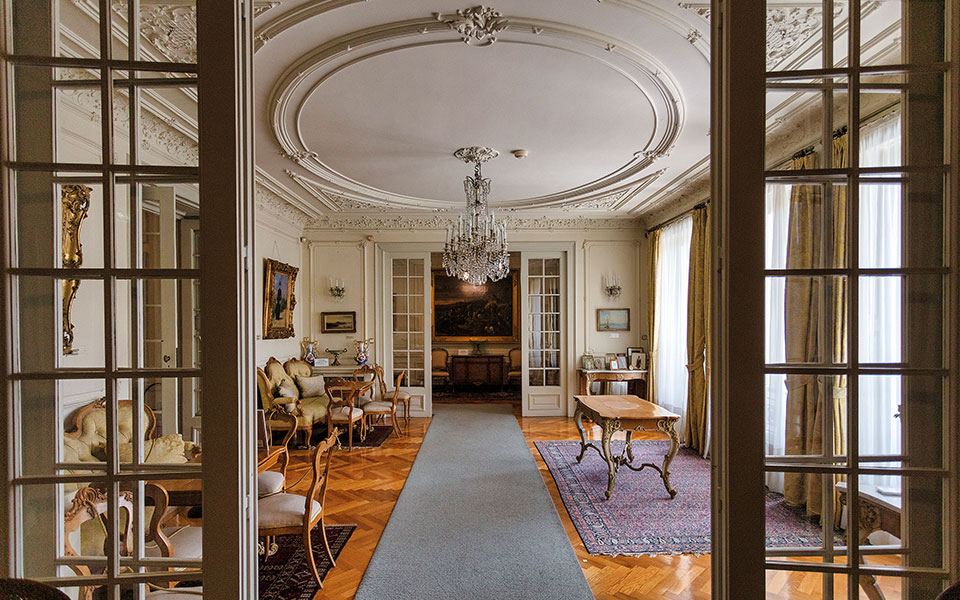
The City of Athens Museum, first residence of King Otto.
© Perikles Merakos
Beyond, near Omonia Square, one finds the National Theater (1895-1901) on Aghiou Konstantinou Street. Designed by Ziller, it was inspired in part by Vienna’s Burgtheater. Adjacent to the Acropolis, the National Observatory (1846) stretches skyward beside Pnyx Hill, where the ancient astronomer Meton (5th cent. BC) reportedly determined the dates of equinoxes and solstices for his eponymous lunisolar calendar by observing sunrise.
These are only the most prominent of Athens’ neoclassical gems; many more, great and small, can be sleuthed out, not only in the capital city but across Greece. Ziller himself contributed to over 500 public and private neoclassical buildings from 1870 to 1914. Sometimes his most humble but elegant designs lie in plain sight, including the diminutive train station at Ancient Olympia. Caryatids evoking the Athenian ladies of the Erechtheion have long been popular neoclassical elements, and today’s eagle-eyed explorer in Athens’ Psyrri district will find the “House with the Caryatids” (45-47 Aghion Asomaton) – an example of the city’s early 20th-century folk architecture. Now the heritage-listed headquarters of the Association of Greek Olympic Winners, its former owner, sculptor Ioannis Karakatsanis (1857-1906), is said to have employed his wife and her sister as models for his decorative sculptures.
One of the most recent Athenian neoclassical monuments to be restored and revitalized is the Athinogenis Mansion (1875-1880, 50 Stadiou). Its opulent, sophisticated facade reveals both neoclassical and then-up-and-coming French Baroque Revival styles. Left in a state of ruin and severely damaged by fire in 2004, the mansion is now part of a newly constructed, multi-use complex expected to open in 2026.
Athens’ neoclassical buildings are truly cultural treasures that deserve to be explored, preserved and cherished. For the curious, let the hunt begin!
The Goethe Institute's exhibition explores Athens'...
Recycling is an age-old tradition in...
Six Athenians tell us about their...

Cultural leaders reflect on Thessaloniki’s layers...