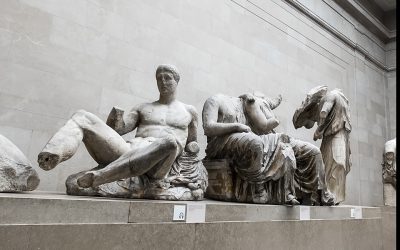
Hope Rises for Parthenon Deal
The British Museum hints at a…

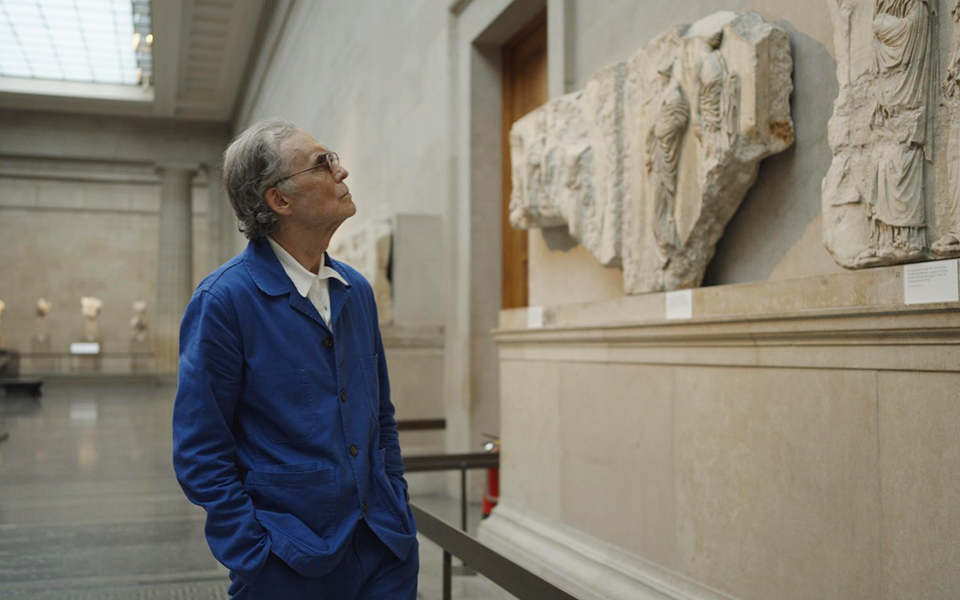
In Greece, he’s best known for his role as the formidable media mogul in Succession. But long before that, Brian Cox stepped into ancient Greek sandals as Agamemnon in Troy. Now, in a striking turn off-screen, the celebrated Scottish actor reveals a personal connection to ancient Greece, emerging as a passionate advocate for the return of the Parthenon Marbles to their rightful home in a new documentary about the Parthenon Marbles.
The documentary’s creator, British director David Wilkinson, explains to Kathimerini: “Brian Cox is particularly adamant that the Marbles should not be here,” he says. “When I was looking for prominent Scots to participate in the documentary – given Scotland’s progressive record on repatriation – he immediately agreed. In the film, he says that if Elgin had given the Marbles to a museum in Edinburgh, they would have been returned long ago.”

A scene from David Wilkinson's documentary showing him in the Duveen Gallery of the British Museum.
This is one of the central narratives of The Marbles, which will premiere in October at the Central Scotland Documentary Festival. Scotland has been a leader in the repatriation of cultural artifacts for decades. For example, it was the first to return part of the Benin Bronzes to Nigeria. Additionally, the city of Glasgow returned to the American Sioux tribe a ceremonial garment worn by its warriors during the “Wounded Knee Massacre” in 1890.
What does all this have to do with Elgin? “He is the only ‘villain’ in the documentary, and ironically, his own country becomes the hero,” says Wilkinson, adding: “We highlight governments that are resolving issues of repatriation. In doing so, the British government begins to appear like a government from a bygone era.”
The documentary The Marbles also features members of the British Committee for the Reunification of the Parthenon Marbles (Janet Suzman, Paul Cartledge, Victoria Hislop), along with experts on repatriation and related issues. Archival research, including contemporary newspaper accounts, reveals that even Elgin himself appeared uncertain about the legality of his actions. “We address this in detail in the documentary,” Wilkinson notes, adding that this was one of the reasons many British aristocrats of the time disapproved of the Scottish lord. “Among the upper classes, it was very fashionable to travel to Greece at the time, as part of the so-called Grand Tour. To them, Elgin was a thief and a looter.”

The actor Brian Cox.
Today, however, Wilkinson expresses disappointment with a different elite. Despite the documentary’s cultural significance, it received little financial backing from the wealthier echelons of society, whether from Greek shipowners or London’s British and American elites. “They said there were more important problems in the world,” he says. In contrast, many Greeks of modest means contributed what they could. Wilkinson also encountered obstacles from the British Museum, particularly before its current chairman, George Osborne, assumed his role. With unanswered emails piling up, the director resorted to hand-delivering letters at the museum’s doors.
His determination, however, has never wavered. The seed was planted in the 1970s, when Wilkinson first encountered Greek antiquity through lunchtime lectures at the British Museum. His formal research for the film began in 2008, and production officially kicked off on March 25, 2021. In the early stages, he recalls, most Britons believed the Marbles had been acquired legally. “Now, fewer and fewer believe they belong here, especially once they learn the truth. That’s why I made the film,” the director adds.
For Wilkinson, the return of the Marbles is also a matter of moral principle. “Even if only ten people were to view them at the Acropolis Museum – which, of course, is far from the truth – it would still be the right thing to do.” It’s also a matter of basic decency. “The British pride themselves on good manners. But keeping stolen property for over 200 years? That’s not good manners. It’s a disgrace.”
This article was previously published in Greek at kathimerini.gr
The British Museum hints at a…
Join archaeologists on a journey through…
Fresh polling shows growing UK support…

The British Committee for the Reunification…