High Visitor Satisfaction Found at Greece’s Arachaeological Sites
A nationwide survey highlights improved services,…

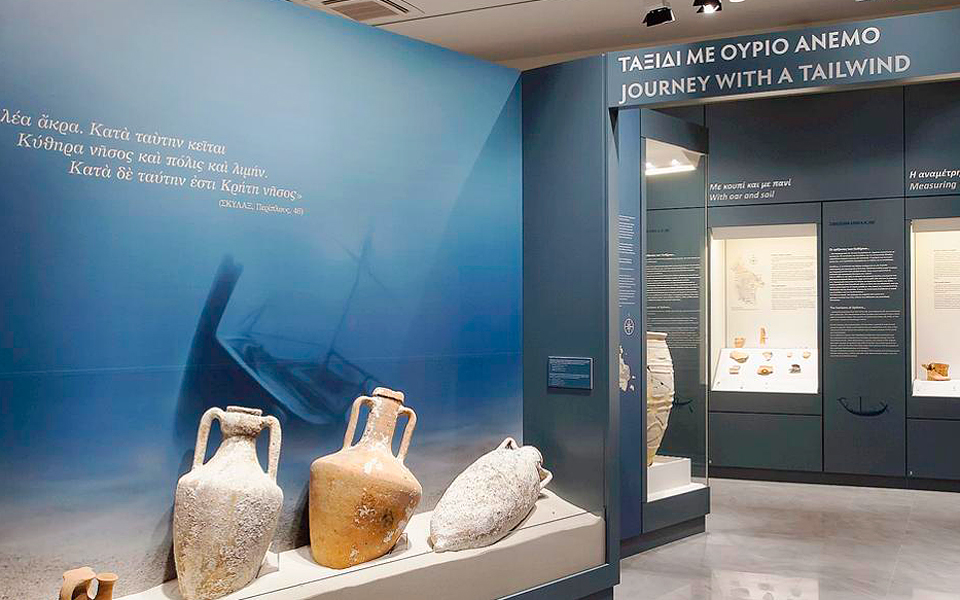
Kythira archaeological museum houses finds from excavations dating back to 6500 BC through to the 3rd century AD
The Archeological Museum of Kythira opened its doors to the public on Saturday, May 7, after nine years of closure following damage from an earthquake in 2006. Culture Minister Aristidis Baltas was present for the ribbon-cutting ceremony that was attended by the island’s local officials, religious leaders and foreign dignitaries from Ireland and Japan.
It comes as no surprise that world interest in this small museum is high. The island of Kythira’s strategic location at the south-eastern tip of the Peloponnese, at a crossroads of civilizations and cultures, has ensured its rich history. Prone to tempests and earthquakes, the area is also famous for artifacts fished from its seas, such as the Antikythera Mechanism that was the world’s first analog, to the Mentor shipwreck which resulted in the sinking of the Parthenon Marbles that Kythira’s sponge divers recovered for Lord Elgin.
The museum houses some of the most important finds from excavations on Kythira and the neighboring islet of Antikythera dating back to 6500 BC through to the 3rd century AD. Centerpieces of the display include Minoan-era and Mycenaean period pottery and stone utensils from Paleopolis, the archaic Lion of Kythira, marble sculptures, ceramics, inscriptions, coins and a Roman period marble head of a youth.
“The walk through the museum is like a cyclical narration that unwinds as visitors follow a fleet of boats, each one related to a time in history”
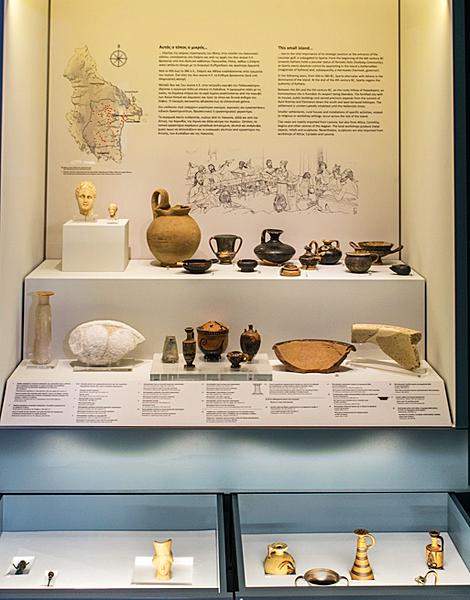
The exhibits displayed date from Prehistoric to Byzantine era

The archaic lion of Kythira couldn't be omitted from the museum's exhibition
Despite the limited size of the museum, the exhibition space of just 100 square meters has been so artfully thought out that it has turned the disadvantage into an advantage, driving home the layers upon layers of history. At the opening, archeologist Stella Chrysoulaki said that the walk through the museum is like a cyclical narration that unwinds as visitors follow a fleet of boats, each one related to a time in history e.g. prehistory, Minoan-era, classical, Roman, Byzantine, etc. The ships travel in various directions depending on the interest that the outward-looking island had during each era. In this way, the little museum transcends limitations, allowing visitors to how the building blocks of time have shaped the little island where it is housed.
The institution gives the residents of Kythira cause to feel proud. Its renovation wasn’t just a question of repairing the damage caused by the magnitude 6.7 quake that struck the island in January 2006, but a case of giving it a new lease of life with new technology. No small feat during an economic crisis.
The old building was home to a housekeeping school in 1911 and later, the base of the Kythira Association before being donated for use as a museum in 1975. It has now been refurbished and is a state-of-the-art facility with touch screens, tablets, amenities for the disabled, including Braille signage and replicas from the display for the blind.
Despite the fact that 1.5 million euros was benchmarked for the program from the National Strategic Reference Framework (NSRF), they managed to build it within 28 months using two thirds the amount. From the way in which it was created, to the carefully thought out display, the little museum packs a punch and sends a positive message about Greece to the world.
Ask for the family pack that lets kids have fun exploring the museum with the archaic Lion of Kythira as their guide.
•The Archeological Museum of Kythira is located at Hora.
•Tel. (+30) 27360.31.739
•Hours: Tuesday to Friday 08:00-15:00 (liable to change).
•Admission is free
A nationwide survey highlights improved services,…
Four mysterious Bronze Age artifacts from…
The removal marks a rare moment…

Twenty-nine rare antiquities spanning 5,000 years…


