Lonely Planet Names Sarakiniko Beach in Milos Among…
Lonely Planet names Sarakiniko Beach on…

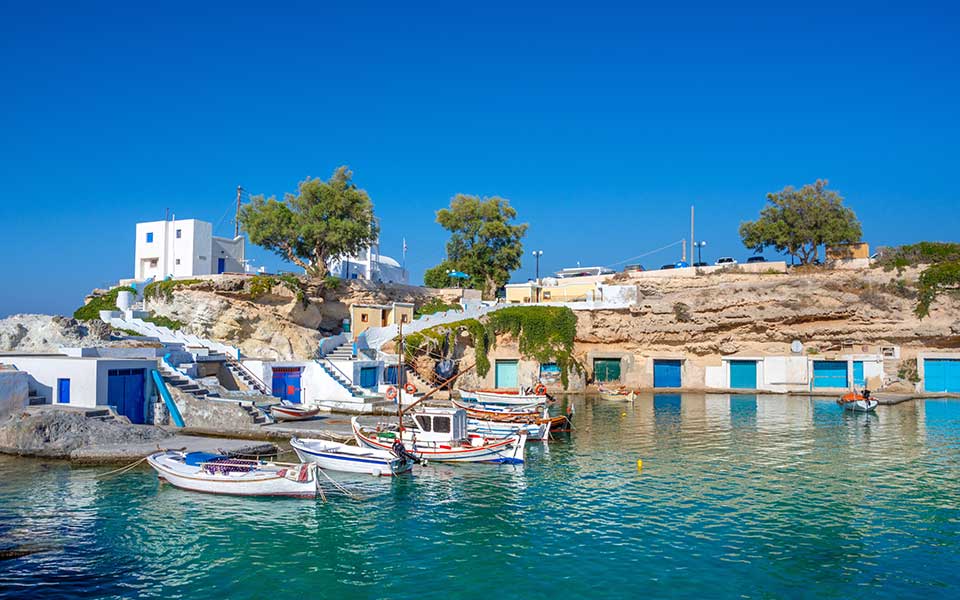
The settlement of Mandrakia, Milos, is home to one of the best-preserved sets of traditional boathouses on the island.
© Shuttestock
It is one of the most characteristic images of Milos: a line of traditional whitewashed square buildings nestled by the sea with colorful doors and balconies, once used by fishermen on the island to store their boats and known locally as “syrmata.” These boathouses are rapidly being converted into tourist accommodations – often with intrusive interventions in their architectural characteristics. In an effort to stop such alterations, the Ministry of Maritime Affairs and Island Policy decided to classify them as protected architecture, starting with a first group of 58 buildings.
The effort to record and protect the syrmata of Milos was begun many years ago by the Department of Protected Sites and Natural Beauty at the ministry, but was never completed. It recently restarted at the initiative of Secretary General of the Aegean and Island Policy Manolis Koutoulakis, and recently, the declaration of the first 58 boathouses in the Mandrakia area as listed was published in the Government Gazette.
The main consequence of declaring these boathouses as protected is that it prohibits their conversion into tourist accommodation or residences. The declaration states that, in addition to their initial use as boat stations, the syrmata can only be used to house cultural facilities (exhibitions, folklore museum, art workshops) as well as offices of local associations. Residence is permitted in three of them, which already had a residential area for the fisherman. Regarding their morphology, the original building (underground or not) is classified as protected as are the communal formations (alleys, platforms, steps) in the natural formations surrounding the buildings.
Later external additions and constructions (shelters, pergolas, terraces, newer fences and built-in seating areas), which alter their original form, should be removed. In fact, the decision indicates 12 specific boathouses, requesting that they be restored to their original form – without, however, giving a deadline for this.
The new law also bans the huge glass doors that have replaced the original entrance door in some tourist conversions, stating that glazing, as well as pergolas and canopies, are prohibited, and must be removed. However, the use of a white fabric awning of limited size is permitted. Finally, owners are not allowed to extend the space in front of the boathouses toward the sea, or create boat mooring platforms.
While recording the syrmata of Mandrakia, the ministry’s team found that most of them were still used as boathouses. “Few are used as tourist accommodation and do not have major morphological interventions that alter their external morphology and typology,” the report states. Despite all this, it also notes some interventions, such as the addition of a glass door behind the wooden one (in those that have been converted into a residence or tourist accommodation), a barbecue, a pergola, or other electrical/mechanical installations in the rooftop room.
Mandrakia is one of the 14 areas in Milos where groups of boathouses are found. Most of them are located in the northern and eastern parts of the island, in the areas of Agios Konstantinos, Alogomandra, Embourios, Kaminia, Mytakas, Pachaina, Provatas, Schinopi, Fyriplaka, Fyropotamos and in the traditional settlements of Klima, Areti and Fourkovouni. They were constructed radially on the shore, following the relief of a naturally protected bay, and either carved or semi-carved into a rock and big enough to store a boat in the winter (usually 6 meters long).
It should be noted that the ministry’s decision discreetly avoids the issue of ownership, by not mentioning an owner for each property, as these buildings were constructed on the seashore and are therefore illegal. Their location, after all, is one of the main reasons why their conversion into tourist properties must be stopped, as otherwise a “message would be sent” for the creation of a large number of studios on the beach, to the detriment of the architectural heritage and cultural identity of the island. In the newly formed land registry, however, the boathouses have declared owners, an issue that remains to be clarified.
Originally published in Greek at kathimerini.gr
Lonely Planet names Sarakiniko Beach on…
The UK newspaper explores 16 serene…