Out This Weekend: Greece Is Athens Winter 2025-2026
Pick up a copy of our…

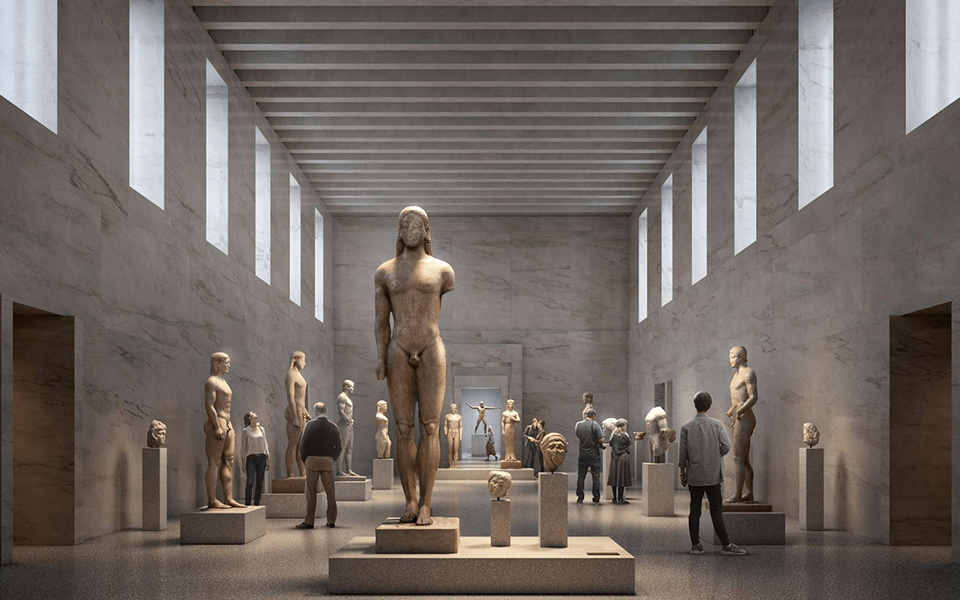
Photorealistic rendering of the National Archaeological Museum following its upgrade. Shown here is the Archaic Gallery, dominated by the Kouros of Sounion.
© Hellenic Ministry of Culture
The preliminary architectural design for the expansion and upgrade of the National Archaeological Museum in Athens envisions the project as two undertakings brought together to create a single, unified museum, rather than two separate entities. Prepared by the architectural practices of Chipperfield–Tombazis, the study received unanimous approval earlier this week from both the Central Council for Modern Monuments and the Central Archaeological Council, during two separate sessions of the Ministry of Culture’s advisory bodies. British architect David Chipperfield attended both meetings.
Presenting the study to council members, Chipperfield explained that its central aim is to ensure compatibility and harmony between the existing building and the new construction, alongside their functional and spatial integration. Above all, the goal is to present the National Archaeological Museum’s unique collection in a way that is engaging and handled with sensitivity.
“The expansion should strengthen the museum as a whole,” Chipperfield said, “with the new building working in harmony with the old, so that the collections themselves take center stage.” He also stressed the importance of a sense of continuity in how the exhibits are experienced.
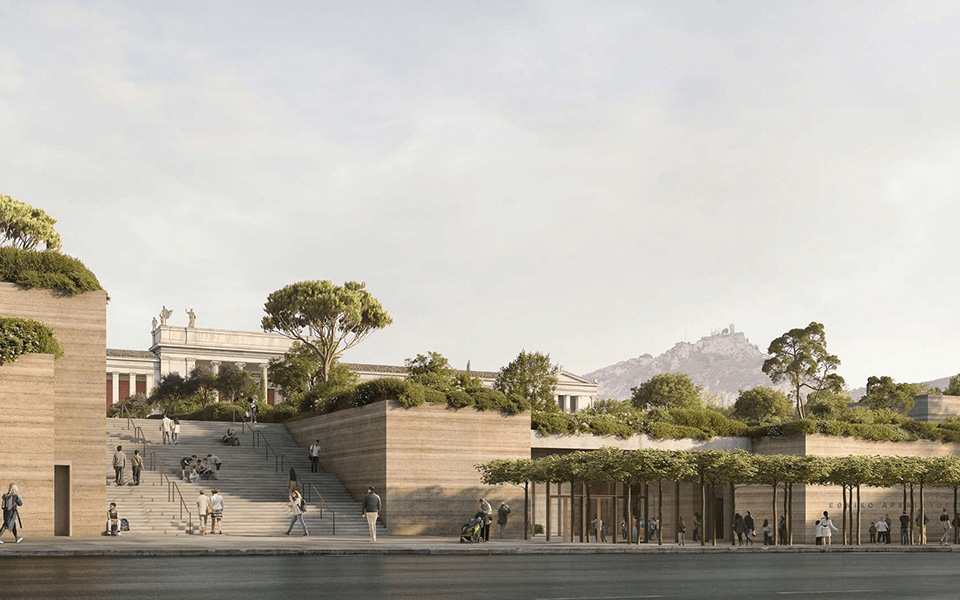
Around 400 additional trees will be planted in the new garden surrounding the museum complex.
© Hellenic Ministry of Culture
With this in mind, the existing 19th-century building – designed by Lange, Kalkos, Vlachos and Ernst Ziller, and already expanded in the 1930s and 1950s – is set to undergo a series of significant new interventions. As the design team explained to the councils, the building’s multiple construction phases mean it “must be understood as a hybrid monument, one that we recognize and seek to highlight.”
Among other measures, the Chipperfield–Tombazis preliminary design proposes the renovation of galleries created in the 1950s to designs by P. Karantinos, including the Epigraphic Museum. One of the most substantial interventions concerns the central exhibition axis of the existing building, which will lead from the Archaic collection – described as the “heart” of the museum, where the Mycenaean antiquities are currently displayed – through to the Hellenistic period.
At the end of this axis, the gallery that currently houses the Artemision Jockey will be refurbished using the concept of a “room within a room” and will in future accommodate the celebrated Artemision Bronze, representing either Poseidon or Zeus.
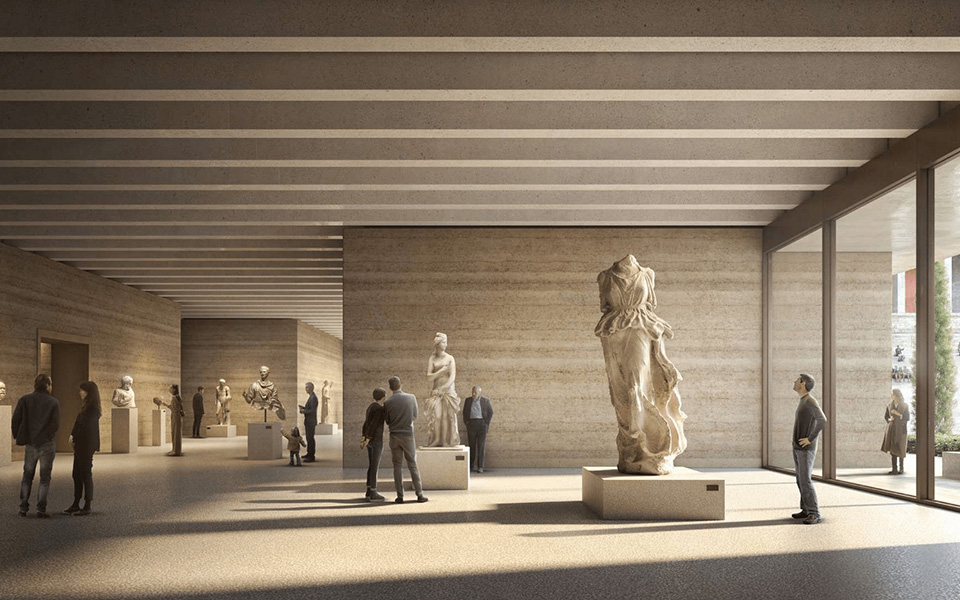
Interior views of spaces within the planned museum extension.
© Hellenic Ministry of Culture
The current Altar Room will then be reconstructed as a space for Classical and Hellenistic sculpture, where the Artemision Jockey will also be installed. This gallery will form the boundary between the historic core of the museum and the two-storey wing added in the 1930s on the Bouboulinas Street side, designed by G. Nomikos. This so-called “Nomikos Wing” will house a research center and administrative services.
“The expansion should act as a reinforcement of the institution,” Chipperfield reiterated, “with the new building working alongside the old to enhance the presentation of the collections.”
The seismic performance of the historic building will also be improved, while new underground spaces will be created, making use of areas formed during the years of the German Occupation, when statues were buried to protect them from the Nazis. The roof of the western section will undergo structural renovation, and later additions will be removed, including the rooftop space currently housing exhibits from prehistoric Thera.
New areas will also be constructed, such as an attic to accommodate technological equipment, and full accessibility will be ensured throughout the museum. In terms of seismic protection, if deemed necessary, the possibility of seismic isolation for certain galleries housing particularly important exhibits will also be examined. The installation of photovoltaic panels on the non-visible side of the roof is likewise proposed, with the aim of reducing energy consumption.
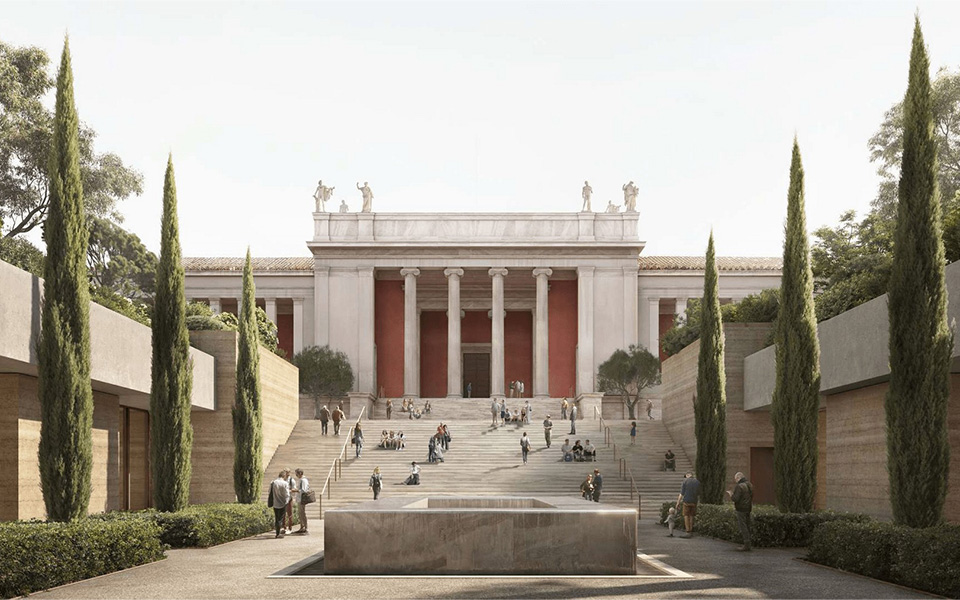
Photorealistic rendering of the exterior of the new extension.
© Hellenic Ministry of Culture
Chipperfield also stressed that special emphasis will be placed on the courtyards of the existing building. Part of the presentation focused on the two-storey extension of the museum toward Patission Street – at ground and basement level – largely to be constructed from a mix of rammed earth and concrete, as well as on the garden that will sit above it.
According to the presenting directorate, excavations for the extension will reach depths of between 10 and 14 meters, while the overall height of the new building will range from approximately 16 to 18 meters.
Members of both councils raised concerns about the scale of the outdoor staircase on the façade of the new building, which will lead up to the garden and could potentially compete visually with the main entrance of the historic structure. Chipperfield responded that the two axes would be composed together, noting that the garden entrance would function as a kind of antechamber to the existing museum.
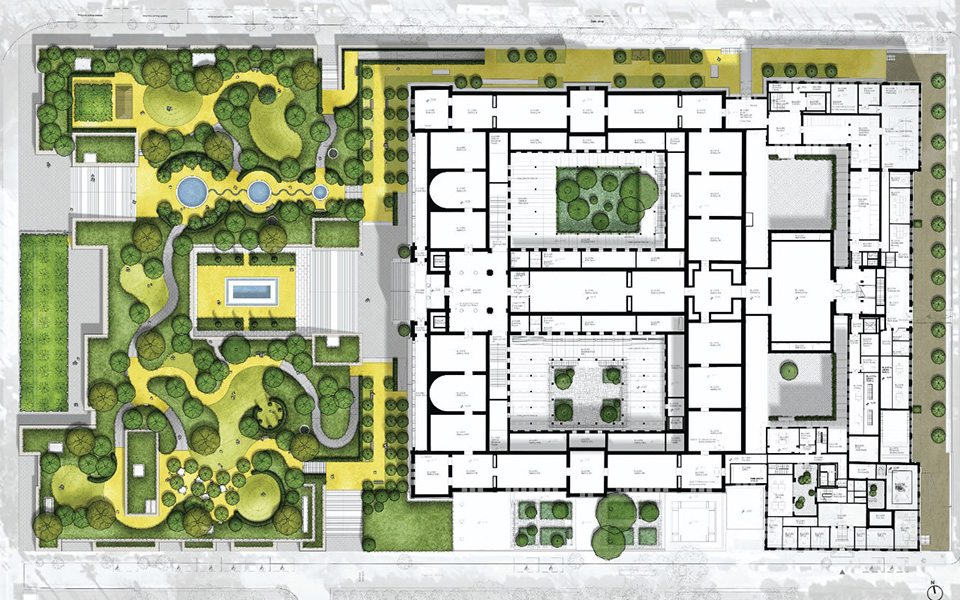
Landscape design plan for the gardens of the new museum.
© Hellenic Ministry of Culture
Peter Wirz, who is responsible for the landscape architecture study, explained that this visual ambiguity was identified and deliberately “embraced” by the design team. He added that around 400 additional trees will be planted in the garden, some of which will grow to heights of up to 14 meters. The garden itself draws inspiration from the idyllic parks of 19th-century Romanticism.
A courtyard incorporating a water feature, planned as part of the extension, will link the new construction with both the garden and the historic building. The design also includes staircases, elevators, and connections to the Epigraphic Museum, as well as entrances on all sides of the complex.
Overall, the expansion and upgrade of the National Archaeological Museum are expected to increase its total floor area by around 23,000 square meters. Spaces devoted to the Prehistoric Collections will grow from 1,100 to 2,500 square meters, while the area for temporary exhibitions will more than double, from 429 to approximately 1,033 square meters. Storage areas will increase from 3,367 to 4,296 square meters, and conservation laboratories will reach 1,707 square meters, compared to 856 today.
The museum is expected to close for works in 2027. One of the most critical challenges of the project will be finding suitable space to store the collections during the renovation period, as well as transporting large-scale sculptures – such as the Kouros of Sounion – among other logistical hurdles.
This article was previously published in Greek at kathimerini.gr.
Pick up a copy of our…
Reconstructing the lost polychromy and meaning…
A nationwide survey highlights improved services,…
The Acropolis Museum unveils its festive…