Monsters, Gods, and the Edge of the World
In Homer’s “Odyssey,” the farther Odysseus...

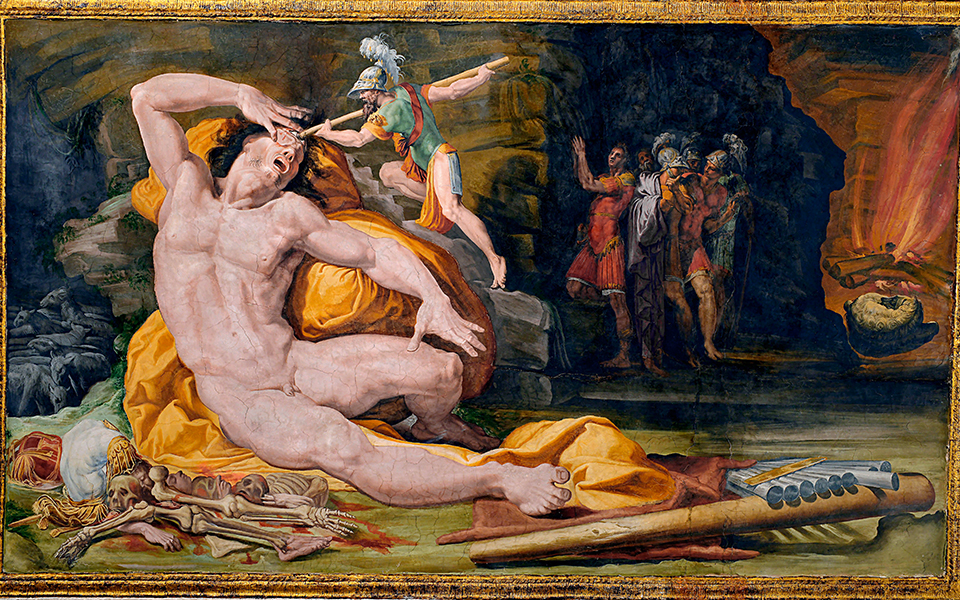
“The Blinding of Polyphemus,” by Pellegrino Tibaldi (1527-1596). Odysseus overcomes
the Cyclops through “metis” – intelligence and ingenuity triumphing over brute strength.
© AFP / VISUALHELLAS.GR
Shrouded in mist, the stranger appeared on the rocky shore in the guise of a young shepherd, “as refined as a prince’s son,” watching intently as a gaunt, weather-beaten man struggled to his feet. Behind the wretched figure lay a calm sea that belied the twenty years of war, shipwrecks, monsters, temptations, storms and divine grudges he had surmounted to return here.
Long-haired, salt-stained, and haggard, Odysseus gazed across the fogbound coastline before him and failed to recognize it. The Phaeacians, he thought, must have tricked him and abandoned him in some foreign land. Surely this could not be Ithaca …
Suspicious as ever, he turned to the shepherd and demanded to know where he was. The young stranger assured him that this was indeed Ithaca. No tricks. No deception.
Overjoyed, Odysseus immediately began lying.
He launched into an elaborate tale about being a fugitive from Crete, a man fleeing justice after killing someone who had tried to rob him. The Phaeacians, he claimed, had taken pity on him and brought him here while he slept.
Of course, the story was complete fiction, and the shepherd knew it.
Disguised in mortal form, “bright-eyed” Athena listened patiently as Odysseus spun his absurd invention. The goddess smiled. At last, her favorite mortal had returned home, and he had not changed at all. “Resolute man,” she told him, revealing her true identity, “even in your own country you will always be full of guile and the lying tales you love so much.”
This episode, recounted in Book XIII of Homer’s Odyssey, is one of the most revealing encounters in the nearly 3,000-year-old epic. Athena does not admire Odysseus despite his cunning but because of it. The goddess of wisdom and strategy recognizes something of herself in the wandering king of Ithaca. Throughout the poem, her interventions are rarely dramatic. Instead, she helps him think more clearly, plan more carefully, and survive against daunting odds.
That divine-mortal relationship lies at the very heart of the Odyssey. It also offers an intriguing – and perhaps unexpected – way to think about the city of Athens and how it came to be the foremost power in the Classical Greek world. Although Odysseus belonged to a small island kingdom in the Ionian Sea, he embodied many of the qualities later Athenians admired in themselves: wisdom, adaptability, diplomacy, creativity, and strategic insight.
As Christopher Nolan’s much-anticipated adaptation of the Odyssey prepares to bring Homer back to cinema screens this summer, it is worth asking why Odysseus continues to captivate us nearly three millennia later – and what his relationship with Athena might reveal about the ancient city that bore her name.

“Athena Appearing to Odysseus to Reveal the Island of Ithaca,” by Giuseppe Bottani (1717-1784). Athena welcomes home the mortal whose gifts for disguise and strategy reflect her own.
© VISUALHELLAS.GR
Without exception, the great heroes of Greek mythology are larger than life characters. “Swift-footed” Achilles, the undoubted star of the “Iliad,” is nearly invincible in battle and consumed by the pursuit of glory. He belongs firmly to the realm of legend, a warrior of almost superhuman proportions. Odysseus, on the other hand, belongs to the realm of hard knocks. Homer presents a hero defined not by a single virtue but by his ability to become many things at once – “polytropos,” the Greek word that opens the Odyssey, often translated as “many-sided” or “of many turns.” He is a warrior, a sailor, a storyteller, a trickster, a diplomat and a king. He gets lost. He makes mistakes. He lies through his teeth. He changes plans, adapts to setbacks, and somehow muddles through disasters that would destroy lesser men. In many ways, his greatest strengths are inseparable from his greatest flaws.
Nowhere is this clearer than in his famous encounter with the Cyclops Polyphemus in Book IX of the Odyssey. Trapped inside the giant’s cave with no obvious means of escape, Odysseus devises one of the most ingenious schemes in Greek myth. He gets the Cyclops drunk on strong wine, tells him that his name is “Nobody,” blinds him with a sharpened olive-wood stake, and escapes by clinging to the undersides of the monster’s sheep as they leave the cave at dawn. It is a masterclass in intellect triumphing over brute strength, and a reminder that Odysseus’ greatest weapon is neither spear nor sword, but his ability to think several moves ahead.
And then he proceeds to ruin everything.
As his ship pulls away from the shore, Odysseus cannot resist one final flourish. Safe at last, he taunts the blinded Cyclops and reveals his true name. In a moment of pure arrogance, his outsized ego gets the better of him. Polyphemus raises his hands to the sky and calls upon his divine father, Poseidon, to avenge him.
The sea god answers.
The long years of wandering that follow – the storms, shipwrecks and endless delays on the journey home – can all be traced, at least in part, to Odysseus’ inability to keep silent when it mattered most. Homer presents him not as a flawless hero but as a complicated one, capable of brilliance and folly in equal measure. That ambiguity fascinated ancient audiences – and not everyone admired him.
In Sophocles’ tragedy Philoctetes, first performed at the City Dionysia festival in Athens in 409 BC, when the city was locked in a decades-long war with Sparta, Odysseus appears calculating and manipulative rather than heroic. Determined to secure victory in the Trojan War, he persuades the young Neoptolemus (“New Warrior”), the red-haired son of Achilles, to help deceive the wounded archer Philoctetes, who had been abandoned on the island of Lemnos, into rejoining the Greek army. The strategy succeeds, but it leaves an uncomfortable moral residue in the air. Sophocles invites his audience to wrestle with a question that remains strikingly relevant: when does intelligence become manipulation, and when does the delicate art of persuasion shade into the darker arts of deception?
The Romans were even less forgiving. In Virgil’s Aeneid, composed in the late first century BC, Odysseus – known by his Latin name, Ulixes (Ulysses) – is transformed into something approaching a villain. Trojan characters remember him not as a resourceful survivor but as the architect of deception, the thief of the cult image of the Palladium, Troy’s protector, and the mastermind behind the Trojan Horse. He becomes the very embodiment of Greek treachery – a reputation neatly captured by Laocoön’s famous warning in Book II: “Timeō Danaōs et dōna ferentēs” (“Beware of Greeks bearing gifts”). Where Virgil’s hero Aeneas represents duty, order, and self-sacrifice, Ulixes stands for cunning, expediency and moral ambiguity.

Odysseus, disguised as a beggar, approaches Penelope. Melian terracotta plaque, c. 460-450 BC. Metropolitan Museum of Art, New York.
© Fletcher Fund, 1930 / THE MET
If Odysseus feels surprisingly modern, it is perhaps because he is the hero most like Athena herself.
The reason the goddess repeatedly comes to his aid throughout the Odyssey is not simply that she has chosen him as her favorite. Rather, the two share a similar approach to the world. Unlike her Olympian half-brother Ares, who embodies the fury, chaos and bloodlust of battle, Athena represents disciplined intelligence. She is the goddess of wisdom, strategy, craftsmanship, planning and civic order. Her victories, like those of Odyseeus, are won not through overwhelming force but through patience, foresight and ingenuity.
Throughout the poem, Athena’s interventions follow a remarkably consistent pattern. She rarely solves Odysseus’ problems directly. Instead, she helps him work his way through them, acting less as rescuer than as mentor, reinforcing qualities he already possesses.
The same dynamic appears in traditions beyond Homer. According to later accounts of the Trojan War, Athena assisted Odysseus and his companion Diomedes in one of Greek mythology’s most audacious covert operations: the theft of the Palladium, the ancient cult image of Athena that protected the city of Troy. Disguised as beggars, the two heroes slipped behind enemy lines under cover of darkness, infiltrated the city, entered Athena’s temple, and carried off the sacred object. Ancient prophecies held that Troy could never fall while the Palladium remained within its walls. Removing it was therefore not simply an act of theft but a strategic masterstroke, stripping the city of its divine protection and paving the way for its eventual destruction.
In many ways, the episode reads like mythology’s first special-forces mission. Victory depends not on battlefield heroics but on stealth, deception, and the sort of calculated risk-taking that defines Odysseus throughout the epic. It is precisely the kind of operation that Athena would admire: a victory won not through force, but through cunning.
The story of the Trojan Horse reflects the same principle. After ten years of failed siege warfare, Troy does not fall because the Greeks fight harder than their enemies. It falls because they think differently. The city’s mighty walls, which had resisted a decade of assaults, are overcome by deception, imagination and careful planning.
It is hard to imagine a more Athena-like victory.
When Odysseus finally reaches Ithaca after twenty years of wandering, Athena does not place a sword in his hand and urge him to storm his palace. Such a solution would have suited Ares. Instead, she devises a far subtler plan. Transforming the king into a frail old beggar, she sends him back into his own household in disguise. Before he can act, he must observe. Before he can reclaim his throne, he must gather information, test loyalties and discover who among his servants remains faithful. Even his reunion with his son Telemachus takes place in secret, carefully orchestrated by Athena before the final reckoning can begin. Planning comes first. Action follows.
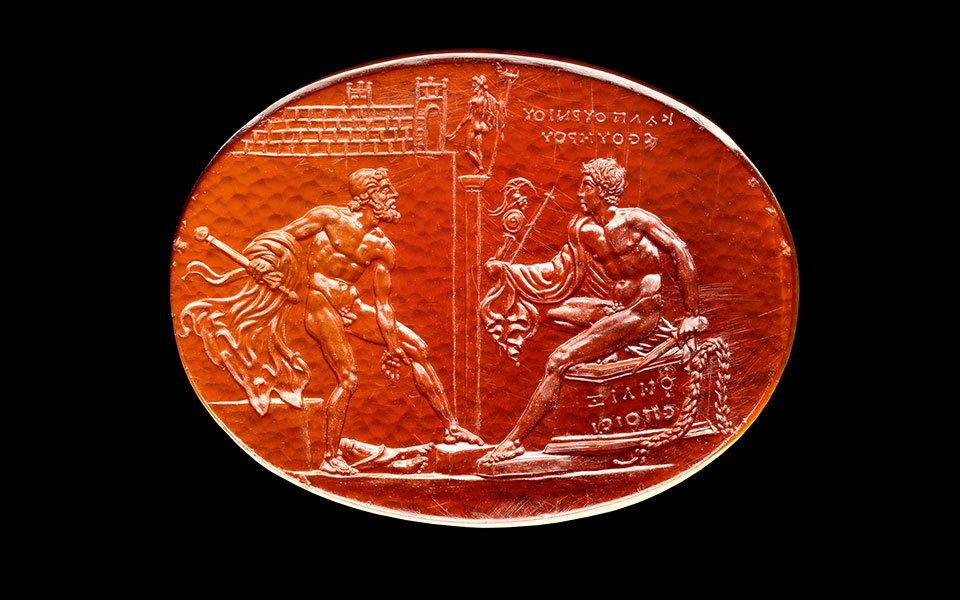
Diomedes and Odysseus Steal the Palladium, Felix gem, early 1st century AD. Ashmolean Museum, Oxford.
© GETTY IMAGES / IDEAL IMAGE
The connection between Athena and Odysseus also helps explain why later Athenians found so much to admire in Homer’s wandering king. Athens did not become the leading city of the Greek world because it consistently fielded the strongest army; that distinction belonged to Sparta. Nor did it possess the vast territory of Persia or the wealth of Egypt. Instead, Athens became famous for something less tangible but ultimately more powerful: its ability to outthink its rivals.
The city’s most successful leaders, from Themistocles to Pericles, built their reputations not through hereditary privilege or martial prowess, but through their ability to persuade fellow citizens, recognize opportunities, and imagine solutions others had overlooked. In Athens, the silver-tongued statesman and the successful general were often one and the same.
As you might expect, the ancient Greeks had a pithy word for this quality: µῆτις (“metis”) – a term that resists neat translation into English. It combines intelligence and practical wisdom (“phronesis”), adaptability, resourcefulness, foresight and the ability to navigate complex situations successfully. It is the quality that allows someone to see opportunities where others see obstacles, and solutions where others encounter dead ends. Odysseus is the supreme hero of “metis” in Greek mythology, and Athens eventually became the city most closely associated with its civic expression.
Again and again, Athens achieved its greatest successes not through overwhelming force, but through skill, ingenuity and strategic thinking. During the Greco-Persian Wars (499-449 BC), for example, the statesman Themistocles persuaded his fellow citizens to invest the profits from a newly discovered silver strike at Laurion in a fleet of warships (“triremes”) rather than distribute the money among the population. It was not an obvious decision.
Yet when the Persians launched their second invasion of Greece in 480 BC, that fleet proved decisive. At the Battle of Salamis, the Greeks lured the much larger Persian navy into the narrow strait west of Athens, where victory depended not on superior numbers but on local knowledge and tactical ingenuity – “metis” in action, a strategy that would not have been entirely unfamiliar to Odysseus.
Nor was such thinking confined to the battlefield. Pericles, the great architect of Athens’ Golden Age, transformed the Delian League from a defensive alliance into the foundation of an Athenian maritime empire (“thalassocracy”), while using its resources to fund an ambitious program of building and cultural patronage that reshaped the city itself. Like Odysseus, he understood that influence often depended less on force than on persuading others to see the world differently.
Of course, none of this means that Homer consciously created a “proto-Athenian” hero – the “Odyssey” emerged centuries before Classical Athens reached the height of its power – but later Athenians could look at Odysseus and recognize something familiar: a hero whose greatest victories were won not because he was the strongest man in the room, but because he understood the situation better than everyone else.

“Pericles’ Funeral Oration,” by Philipp von Folz (1805-1877). Like Odysseus, Pericles embodied the strategic thinking and powers of persuasion that defined Athens at its height.
© VISUALHELLAS.GR
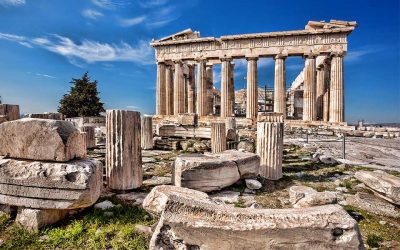
Today, visitors standing beneath the Acropolis tend to think first of democracy, philosophy, drama and the extraordinary flowering of culture that transformed Athens into one of the most influential cities in human history. The marble temples crowning the Sacred Rock seem to speak of certainty and permanence, of a civilization confident in its achievements.
Yet the goddess who watched over that city was also the protector of a wandering Ithacan king who spent much of his life lost. There is something revealing in that contrast.
Among the many heroes of Greek mythology, Athena did not choose the strongest warrior, the most handsome prince, or even the most honorable man. Her favorite mortal was a survivor: a man who relied upon intelligence, persuasion, disguise and adaptability in a world where brute force so often failed. Odysseus was never an Athenian, and Homer could never have imagined the democratic city that would one day rise beneath Athena’s gaze. Yet among all the heroes of Greek mythology, he may be the one who best captures something essential about the goddess herself: the belief that ingenuity, adaptability and careful judgment can achieve what brute strength cannot.
And perhaps that is why, for the city of Athena, Odysseus might just be the perfect, even if imperfect, hero.
In Homer’s “Odyssey,” the farther Odysseus...

Christopher Nolan's The Odyssey is already...