Don Dines in Athens: O Skoufias, Pangrati
A hidden gem in Pangrati where...

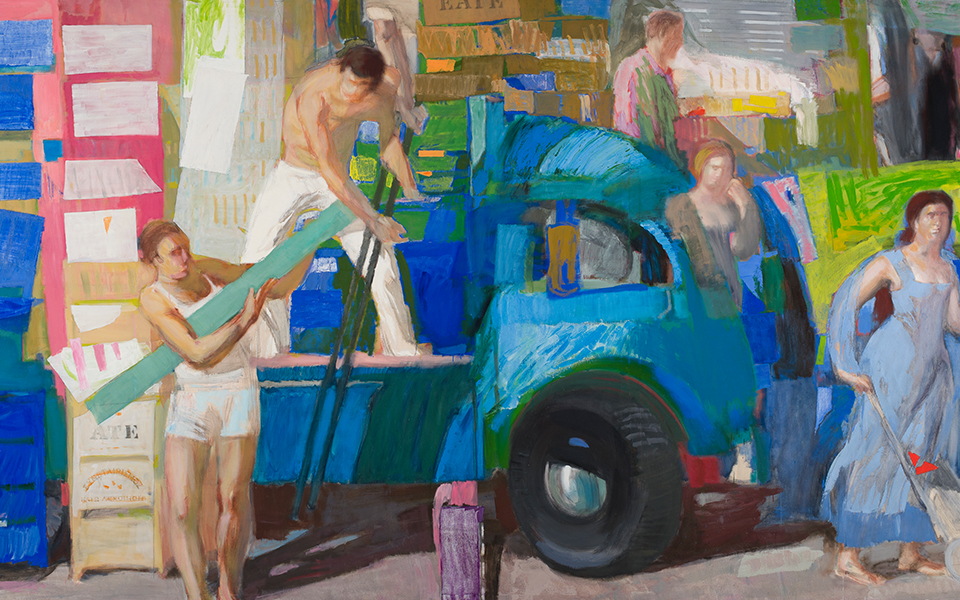
Panayiotis Tetsis (1925-2016), Street Market, 1981. Oil on canvas, a diptych.
© Collection of the Basil & Elise Goulandris Foundation
Even casual visitors to the National Gallery or to the Athens Basil & Elise Goulandris Foundation will recognize the work of Panayiotis Tetsis (1925-2016). Spanning the entire left side of the entry hall of the National Gallery is a painting over 12 meters long and two and a half meters high. Its many close to life-sized figures are coming together as a community at the “laiki,” the street markets that enliven urban neighborhoods each week. Another eight meters of the same series is usually on view at the Goulandris Foundation and is currently on loan for this show. In total, the “Street Market” series stretches an astonishing 58 meters, more than half the length of a city block.
As his son, Alexis, recalls, shipping the vast series back and forth between Athens and their summer home on Sifnos felt much like the market vendors’ own ritual of hauling produce and goods from place to place. Even without its impressive scale, “Street Market” would be unforgettable, thanks in large part to Tetsis’ signature use of color. Tetsis’ extraordinary palette often prioritizes the emotional impact of color over the constraints of naturalism, expressing the liveliness of the scene with unmatched immediacy. The expanse of canvas shows the joy of Mediterranean life with the volume turned up.
The street market that Tetsis painted was not imagined; it was right outside his studio on Xenokratous Street, in Kolonaki, near Evangelismos and just a short walk from the museum. Every Friday, that street transformed into a lively laiki, and it still does.
Tetsis didn’t just depict Greece; he saw it. His gaze captured both the sweeping drama of the country’s landscapes and seascapes and the intimate rhythms of everyday life. This deep attention makes the title of the exhibition, “The Obsession of the Gaze,” particularly apt.
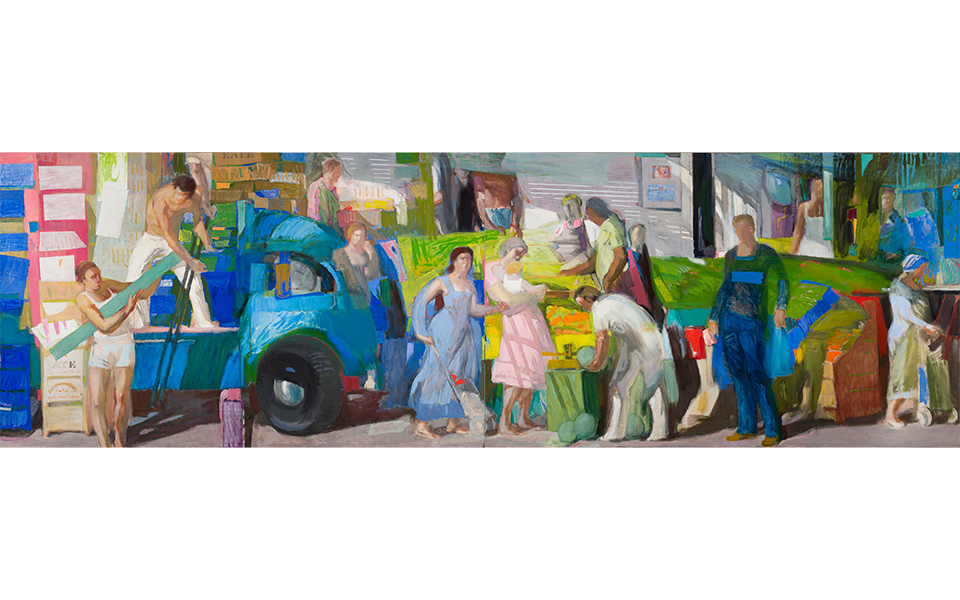
Panayiotis Tetsis (1925-2016), Street Market, 1981. Oil on canvas, a diptych.
© Collection of the Basil & Elise Goulandris Foundation
Tetsis was born on Hydra, an island known today as a hotspot for contemporary art largely because of the DESTE foundation. But even then it was a hub of creativity and modern culture. Hydra was the ancestral home of the seminal painter Nikos Hadjikyriakos-Ghika and a gathering place for an illustrious circle that included poet George Seferis, writer Patrick Leigh Fermor, and architect Dimitris Pikionis, among others. Even the American writer Henry Miller passed through.
But these were not the circles that Tetsis grew up in; his family ran a small grocery and taverna. Like many on the island, they lived with limited means and few educational opportunities, eventually moving to Piraeus in 1937. But Tetsis returned to Hydra each summer, and in the meantime, he had started painting. One summer in 1940, while at the beach, a 15-year-old Tetsis struck up a conversation with a foreigner who spoke Greek. The man mentioned he was a painter, and Tetsis told him that he was a painter, too. The man was Klaus Vrieslander, a German painter connected to the Greek cultural scene. Tetsis considered Vrieslander his first teacher: “… the first to speak to me about el Greco, Cézanne, form and composition….he introduced me to painting in a simple, clear, straightforward manner.”
Vrieslander also introduced him to other major figures, key among them Ghika and architect Dimitris Pikionis, whom Tetsis would come to consider his mentors. Their guidance made the idea of becoming a painter seem not just a dream but a real possibility.
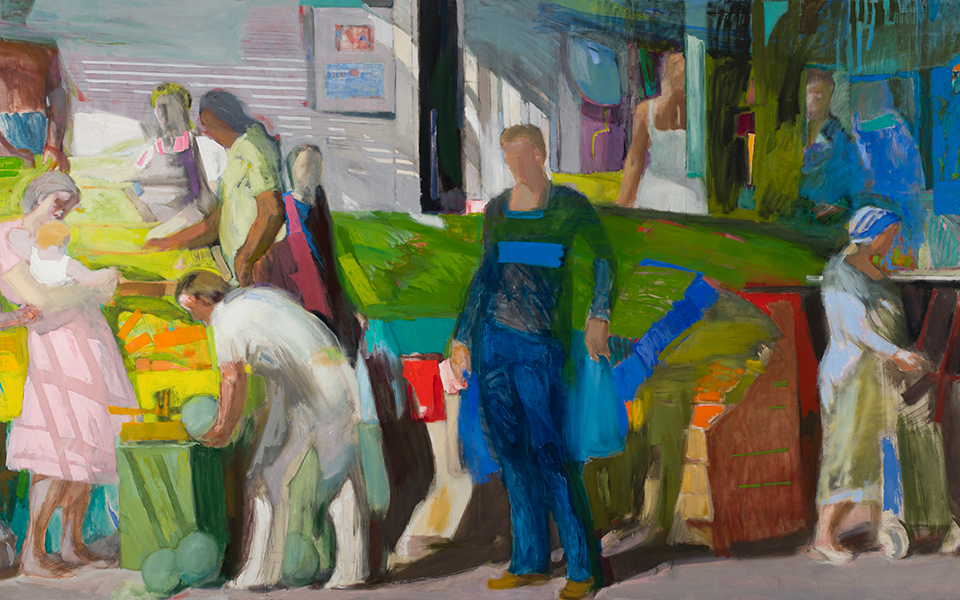
Panayiotis Tetsis (1925-2016), Street Market, 1981. Oil on canvas, a diptych.
© Collection of the Basil & Elise Goulandris Foundation
Tetsis returned to Athens on the eve of war but was still able to maintain contact with Ghika and Pikionis. In 1943, he enrolled in the preparatory course at the Athens School of Fine Arts, with the financial support of Ghika, and the following year started studying at the studio of Konstantinos Parthenis. One of his fellow students was Yannis Gaitis, who became a close friend. He began to exhibit his work and joined Armos, a group formed by his mentor Ghika alongside artists such as Yannis Tsarouchis and Yannis Moralis. When military service became compulsory in 1948, he was drafted into the Navy and he spent his service painting the church of the base where he was stationed.
In 1953, Tetsis left for Paris with the support of the State Scholarship Foundation. As for so many artists, Paris represented a key stage in his development as a painter. The work of the Neo-Impressionists and the Fauves impacted his own use of color, while the works of Chaim Soutine inspired a series of slaughterhouse works.
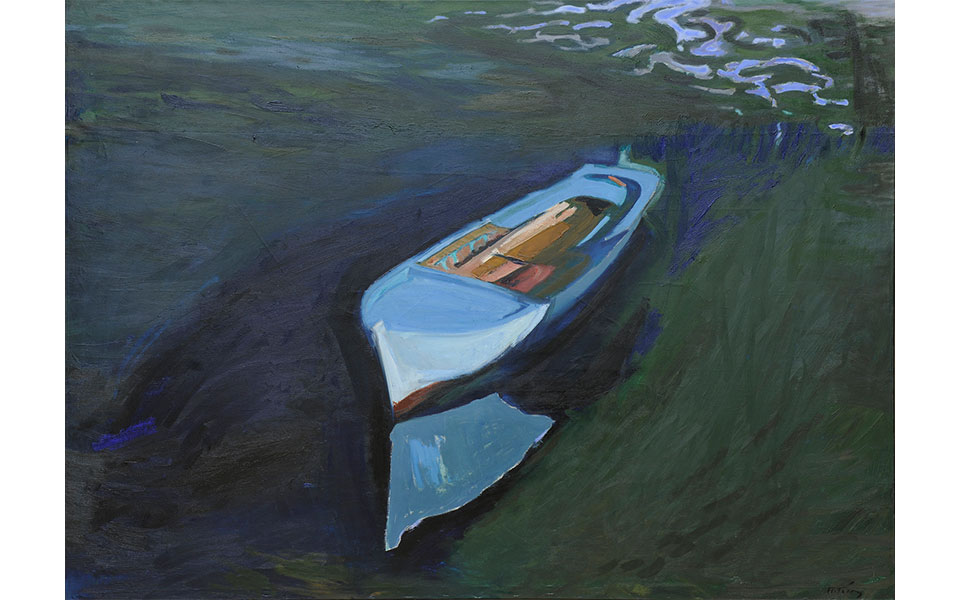
Boat, 1977-1978, oil on canvas
In 1951, before leaving for Paris, he took up a position as instructor of Free Drawing at the National Technical University of Athens, where his mentor Nikos Hadjikyriakos-Ghika had been Professor of Drawing since 1941. This was the beginning of his lifelong dedication to the cultural institutions of Greece. While continuing his own prolific artistic output, Tetsis remained deeply invested in fostering the country’s art scene. He became a professor at the Athens School of Fine Arts, eventually serving as Rector, and he was a member of the Academy of Athens and Chair of the Committee for Arts and Culture of the Hellenic Parliament. He also served as President of the Board of Directors of the National Gallery. Tetsis also gave generously; not just his time and influence, but his legacy. He donated his home and studio on Hydra to the Historical and Ethnological Society of Greece and gifted a significant number of works to the National Gallery. He also granted the museum the freedom to sell his works elsewhere to help fund the acquisition of pieces by younger artists, a gesture that reflects his deep commitment to Greek art and its future.
One of the most rewarding aspects of exploring modern Greek art is discovering the strong sense of community that binds it. Greece is a small country with a relatively recent modern history, and for the artists and writers who experienced the Asia Minor catastrophe, the question of national identity (Greekness, or Grécité) became a central concern. This group is known as the “Generation of the ’30s,” named for the decade when this cultural introspection crystallized. Many of today’s leading Greek artists are directly connected to this seminal group, and Tetsis is central to that connection as he was teacher and mentor to a number of them, including Timos Batinakis, Michalis Madenis, and Giorgos Rorris; two superb works of Rorris hang now in the National Gallery’s contemporary wing.
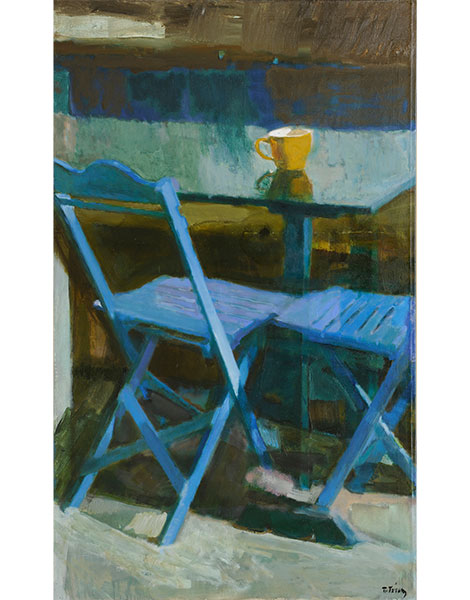
The Blue Chairs II, 1975-1976, oil on canvas
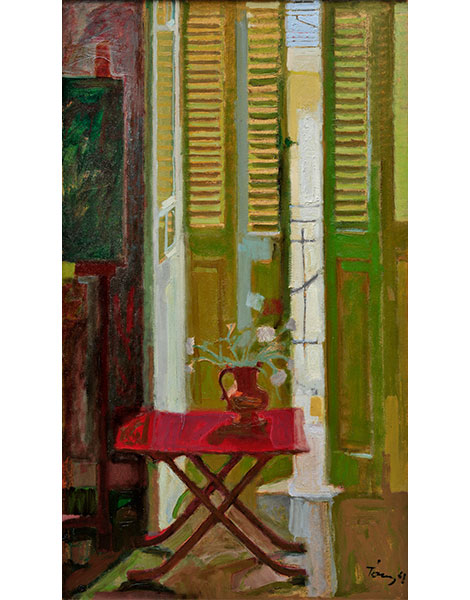
Balcony Door, 1961, oil on wood
Many of the works for which Tetsis is known and loved – like the monumental Street Market paintings – are the instantly recognizable scenes of everyday urban life. However, rather than focusing on grand facades, Tetsis often turned his gaze to the overlooked: the back balconies and inner courtyards of Athenian apartment blocks. He captured the simple beauty of a folding chair beside a metal table, bathed in morning light. He painted the tiled rooftops of neoclassical buildings, seen now from the elevated vantage points of newer apartments rising above them.
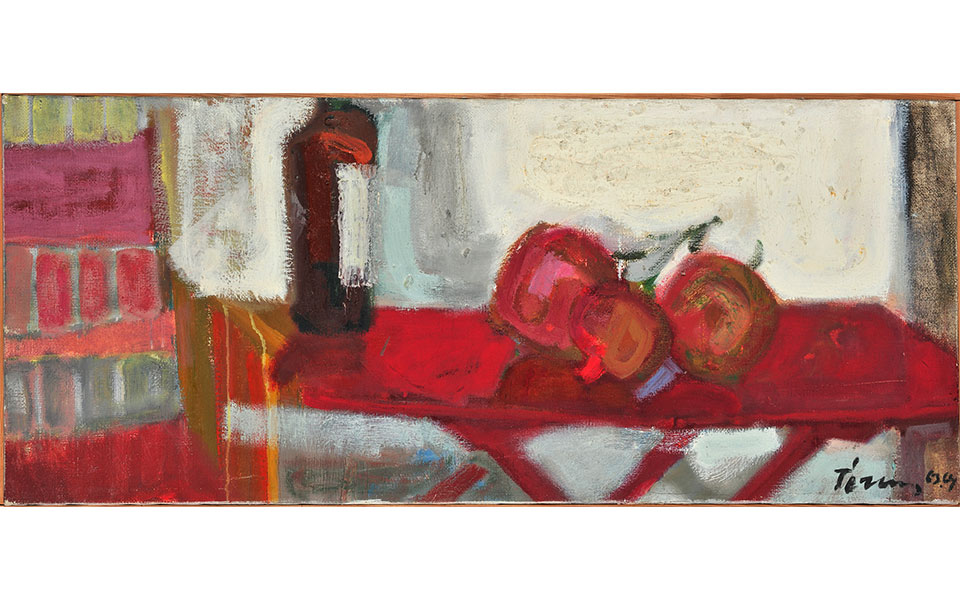
Still Life, 1963-1964, oil on canvas
“From my home in Hydra I would gaze endlessly at the sea. Even in the heart of Athens, I can sense at any given moment the exact hue the water might take, depending on the weather and the direction of the wind.” This remark, shared in what is a deeply personal exhibition, lingers in the mind. Hydra, his birthplace and the place of his first auspicious encounter, would remain a source of lifelong inspiration, wherever he found himself. Appointed to the Athens’ School of Fine Arts in 1976, he would return often to his home Island, where the school maintains an annex in the Tombazis Mansion in the port of Hydra. In the 1980s, he bought his childhood home and transformed it into a studio. Hydra remained so dear to him that among the many works bequeathed to the National Gallery, he included a large-scale painting of the island with the condition that he would not part with it while still alive.
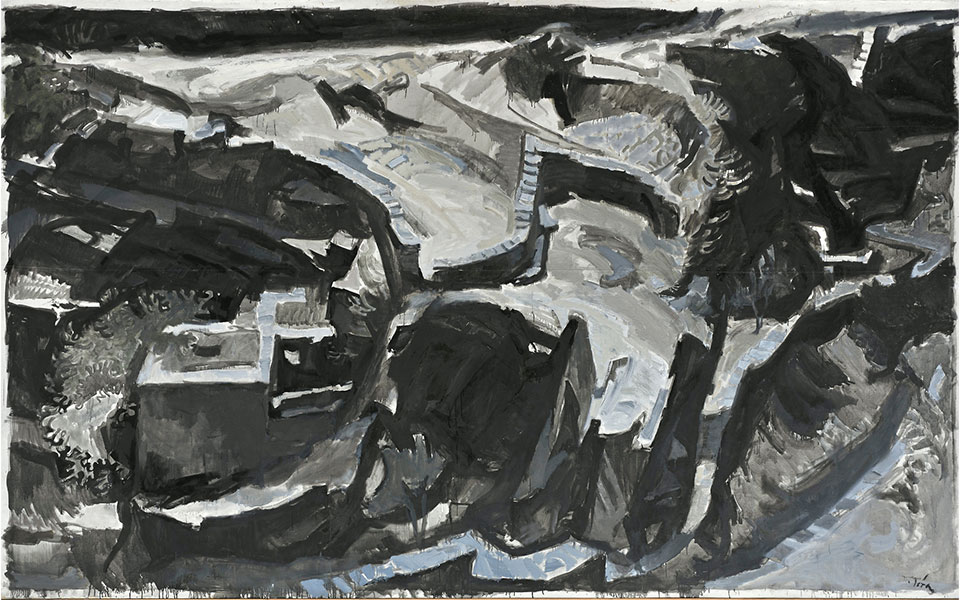
Sifnos in Plan View, 1968, oil on canvas
Tetsis started working on Sifnos in the summer of 1968, beginning a very interesting series of paintings. At first glance, the Sifnos paintings seem to veer toward abstraction, a noticeable shift from his more familiar style. In intent and in execution, they’re another example of the depth of his gaze. Detailed studies of the rugged topography of the island as seen from above highlight the elemental and uncompromising drama of the Cyclades. His usual vivid palette is changed for one that reflects the intensity of the Cycladic summer light, combined with the muted colors of the island’s largely dry and rocky landscape. In these works, the blacks, deep sepias, browns, and shades of white are handled with the same depth of expression that he applied to his more colorful canvases.
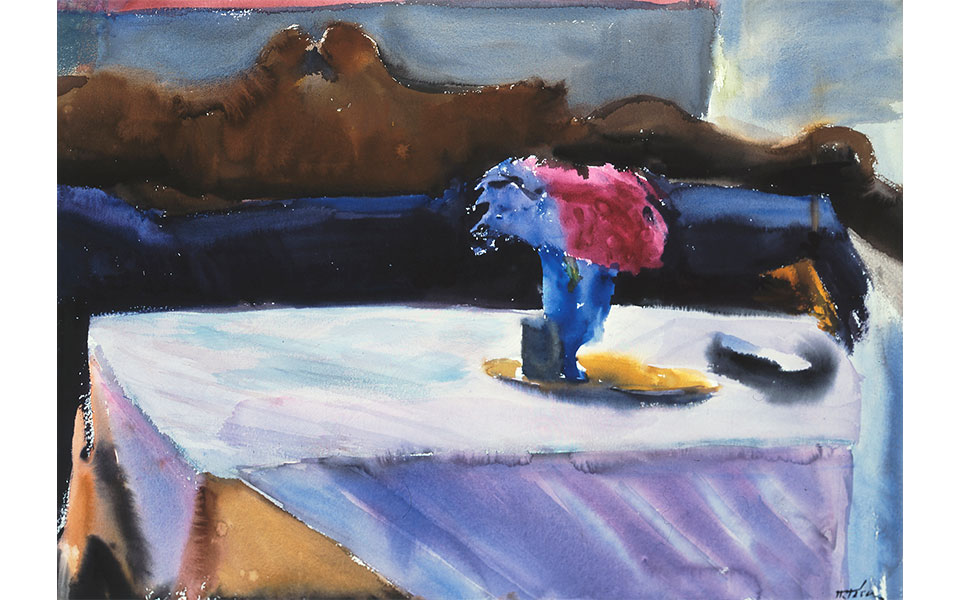
Still Life, 1998, watercolor on paper
Among the most captivating moments in the exhibition are a number of still lifes: oil paintings of bouquets given to him by friends. On loan from a private collection, these works showcase Tetsis’ mastery of oil as a medium: rich color, lustrous surfaces, and a tactile vibrancy that leaps off the canvas. They feel fresh, immediate, as though just painted, and that quality of presence seems even more powerful than the delicate flowers themselves. “Unfortunately, freshness and crispness are fleeting, and it is the flowers that lose it first. Thus, the bouquets given to me by friends became the reason, or even compelled me, to dare to prolong, if I could, that beauty with my paints.” For the contemporary viewer, he has also prolonged the moment of inspiration.
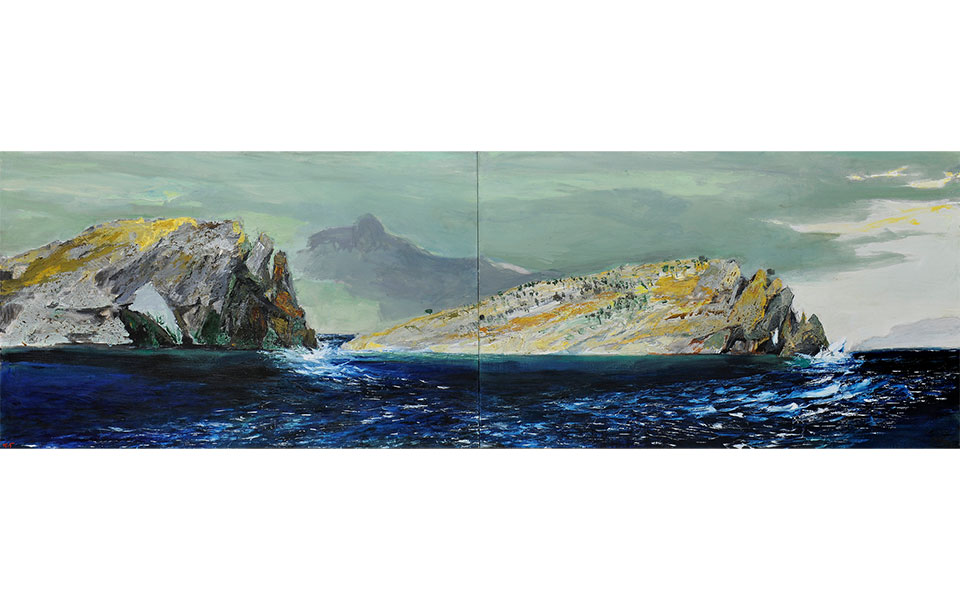
Cape Skylaion II, 2011-2014, oil on canvas
The rocks and seas of Greece inspired his most profound reflections: “Ever since I was born, all I saw were rocks and sea. I no longer need to gaze upon them to paint them – they are etched so deeply in my mind, in my skin… that it feels they are always before me.” Created between 2011 and 2014, these paintings capture not just the physical elements of sea and stone, but the profound, lifelong connection he felt to them.
Warmest thanks to the National Gallery-Alexandros Soutsos and the Basil & Elise Goulandris Foundation for the images.
“Tetsis: The Obsession of the Gaze,” conceived and curated by Efi Agathonikou, director of Collections and Museological Planning at the National Gallery – Alexandros Soutsos Museum, and sponsored by Island Oil Holdings, will be on view through October 31st, 2025. A generously-illustrated book of the same title accompanies the exhibition, featuring forwards by the Minister of Culture Dr. Lina Mendoni, the museum’s director Syrago Tsiara, and the sponsor, as well as essays by the curator, moving personal reflections by Anna Panagiotera, a brief biography by N. P. Paisios, and memories of the painter’s son, Alexis Tetsis.
Hours: Monday and Thursday-Sunday, 10:00-18:00, Wednesday 12:00-20:00. Last entrance one hour before close.
A hidden gem in Pangrati where...
Beyond souvlaki lies a carnivore’s paradise,...
A summer mix of cultural events...

A monument of memory and music,...