Mastiha: The Challenging Harvest that Keeps Chios Alive
From family traditions to modern innovation,...

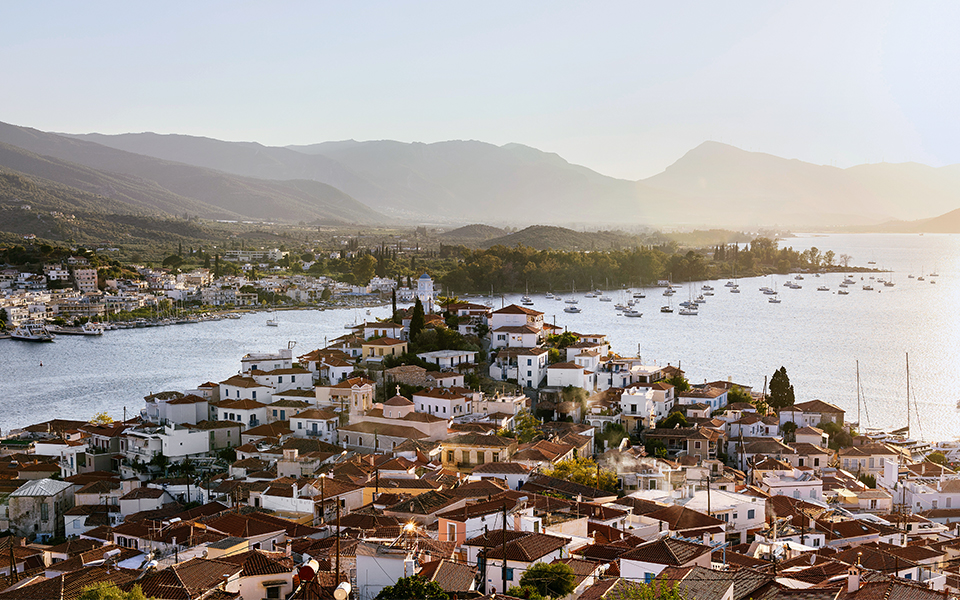
The island as seen from the chapel of Aghios Athanasios.
© Angelos Giotopoulos
Two tiny wooden boats, lashed tightly together. Two men rowing in unison, one grinning faintly at the absurdity of the scene, the other focused on the task at hand: to get across to Galatas, the mainland town that is visible in the distance. Perched precariously across the boats is a makeshift wooden platform, struggling under the weight of a Renault 4CV, the only car on the island at the time.
“This was Poros’ very first ferry,” laughs Dina Dagli, pointing to a black-and-white photo from the 1950s that hangs behind the counter of her family’s pastry shop, just above trays of snow-dusted almond sweets and spiced walnut confections. “Two rowboats joined together, with the local doctor’s car on top – Dr. Kounelis was his name. They’d row him across like that, car and all.” This charmingly improvised mode of transport says a lot about the nature of Poros itself, a pocket-sized island whose closeness to the mainland has always shaped its character. “C’mon, c’mon, nearly there,” you can almost hear the boatmen muttering in that old photo.
Today, while the modes of transport may differ, vacationers still arrive looking for a taste of the kind of summer they remember from childhood. Just five minutes by ferry from Galatas, Poros is also reachable from Piraeus in about an hour by hydrofoil (or two and a half hours by the slower, scenic route, which is perfect for spotting seagulls and glimpses of Aegina or the volcanic Methana peninsula).
Modest, pine-scented, and quietly nostalgic, Poros remains one of the lesser-known gems of the Saronic Gulf – and perhaps that’s exactly what keeps its charm intact.
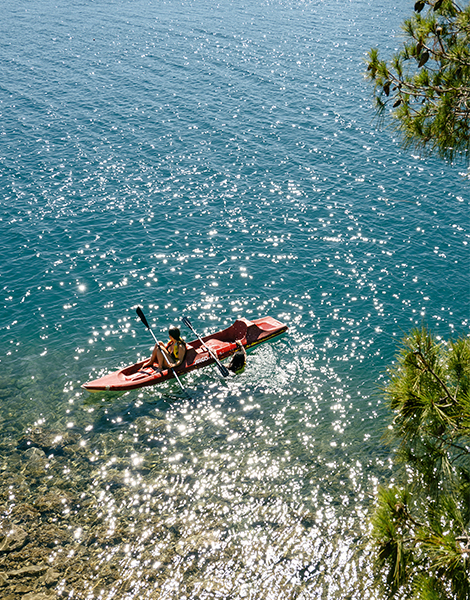
Turquoise waters at Love Bay, which, according to tradition, got its name from the fishermen who used to gather here to share their catch with the poor.
© Angelos Giotopoulos
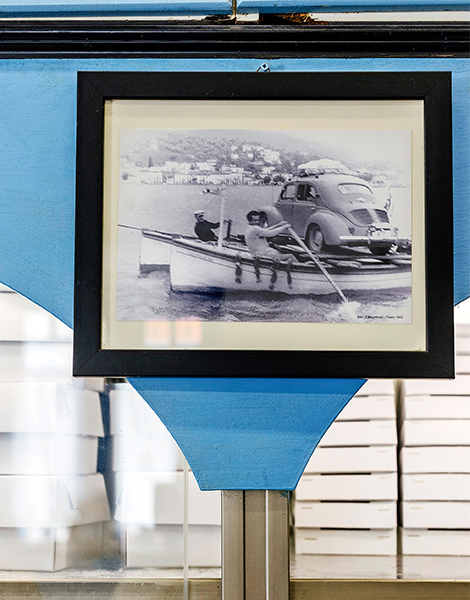
A photograph of the island’s first “ferry boat.”
© Angelos Giotopoulos
It’s hard to walk around Poros without bumping into a memory or, if you’re Greek, a familiar movie location. The island once served as the backdrop to “Alice in the Navy,” a classic ’60s Greek romantic comedy featuring the iconic Aliki Vougiouklaki, Greece’s “national star,” in a film full of capri pants, oversized hats and nautical flirts. Somewhere between the pine trees and the lapping sea, you can still imagine her bouncing a ball down the dockside.
But Poros has also drawn less flamboyant public figures. Nobel laureate George Seferis, one of Greece’s most revered 20th-century poets, spent long stretches here with his wife, Maro, at Villa Galini, a stunning neoclassical guesthouse that once hosted everyone from Henry Miller to Greta Garbo. In his diaries, Seferis wrote of “the scent of pine and silence” he found on the island, words that still seem to hang in the air, despite the occasional beat coming from a beach bar.
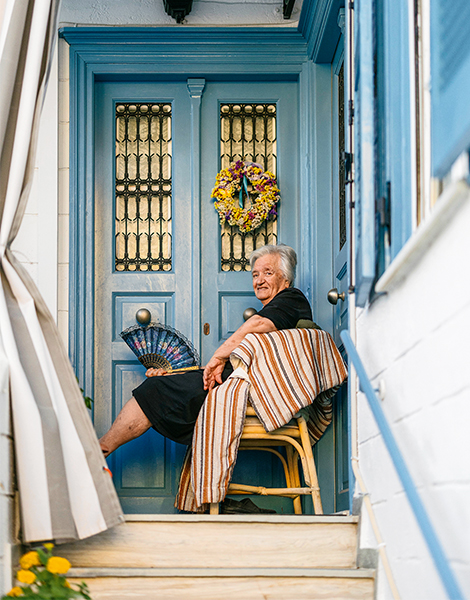
A local resident takes a break on the doorstep of her house, in the alleys of Poros Town.
© Angelos Giotopoulos
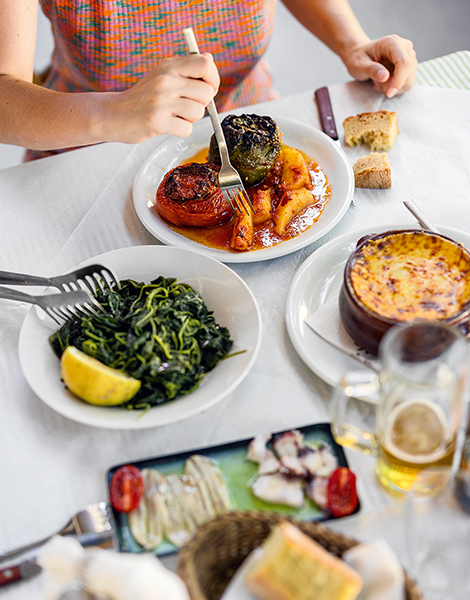
Traditional cuisine is on offer just steps from the shore at Petros Taverna.
© Angelos Giotopoulos
That quiet still exists, just steps from Poros’ livelier spots, in shady coves where pine trees almost touch the water, casting their green reflections across the sea, on the weathered little piers and flowering patios in Neorio, or at the chapel of Aghios Athanasios, perched above the harbor.
If you look closely, you might even spot real-life doubles of the fictional characters from “Kyuka,” the dreamy, off-beat film by Greek director Kostis Charamountanis, which premiered at ACID Cannes in 2024, lingering in the alleys or sunbathing on a stone wall.
Poros is still a place of slow afternoons and sandals kicked under the table. It’s a place where tavernas welcome you straight from the beach, and cafés don’t mind if you’re still in your swimsuit when you sit down. It’s warm, unpretentious and human in scale, like the summers we thought we’d forgotten.
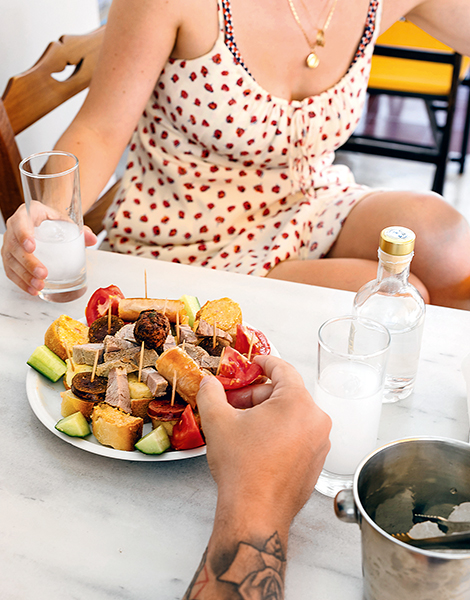
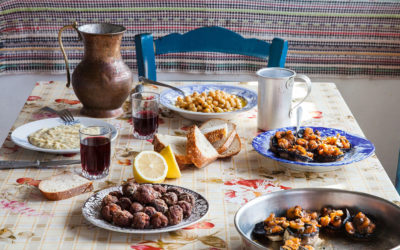
Ouzo meze at Plateia.
© Angelos Giotopoulos
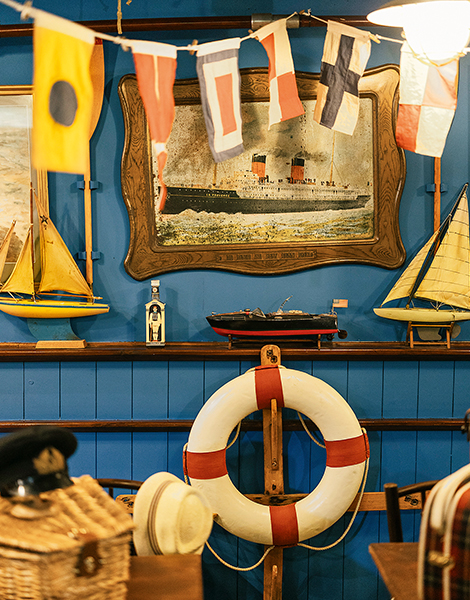
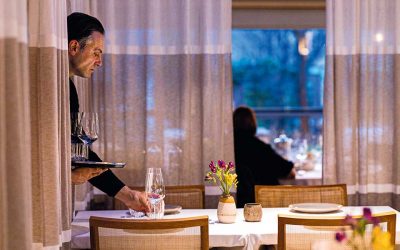
The interior decor of the Italian-Mediterranean restaurant Casanova evokes a vintage, nautical theme.
© Angelos Giotopoulos
Along the quieter stretch of sandy shoreline at Megalo Neorio, just before the romantic Love Bay and the picturesque (if occasionally boisterous) Russian Dockyard, local families paddle in the shallows under the pines. Behind them lies a strip of sand, a wooden bench, and just above, Petros Taverna (Leoforos Lambraki, Megalo Neorio, Tel. (+30) 22980.223.71).
This is where dreams of post-swim meals come true: stuffed tomatoes, moussaka, stewed green beans and slow-baked imam bayildi. It’s a strictly family-run affair: mother, daughter, grandmother and cousin all share the kitchen, still cooking with local olive oil and traditional care. Alongside home-style stews, you’ll find grilled sardines and larger fish, served with wild greens and zucchini.
“Poros is our paradise,” says Sophia, the mother of the family, smiling as she brings over cold slices of watermelon for dessert. “I’m so happy to live here. We’re close to Athens, Nafplio, Corinth … you can take day trips everywhere and still come back. Because Poros is so close to the mainland, it doesn’t isolate you. You never feel trapped.”
Back in town, the rhythm quickens but the authenticity endures. At the traditional kafeneio Plateia (Koryzi Square, Tel. (+30) 22980.223.75), locals gather for midday ouzo in the shade. A retired sea captain, Vetas opened the place in 1975, and most regulars still call it by his name. Today it’s run by his stepson Giorgos together with Giorgos’ wife Irini. They’ve kept it mostly as it was: a relaxed spot with a fine selection of local spirits best enjoyed while watching the boats drift in and out of the marina.
Order one of Irini’s meze plates – spicy meatballs, strong kopanisti cheese, cured sausage, crisp cucumber and sweet cherry tomatoes – and you’ll see why patrons keep coming back. In the evening, when the promenade fills with strolling visitors and the masts of the yachts bob in the harbor, they fire up the old machine by the door and serve loukoumades (Greek donut holes) the traditional way: hot, golden and irresistible.
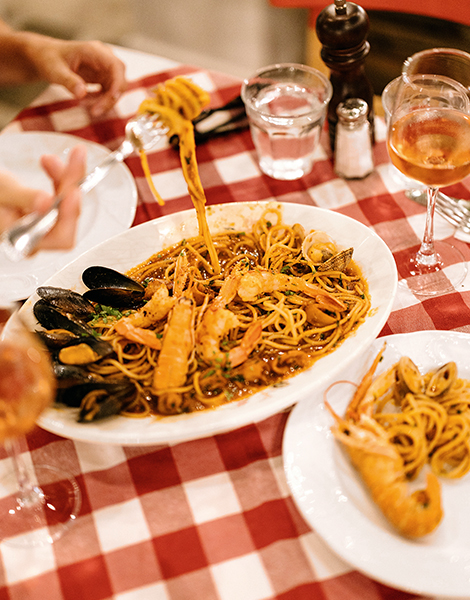
The frutti di mare spaghetti at Casanova.
© Angelos Giotopoulos
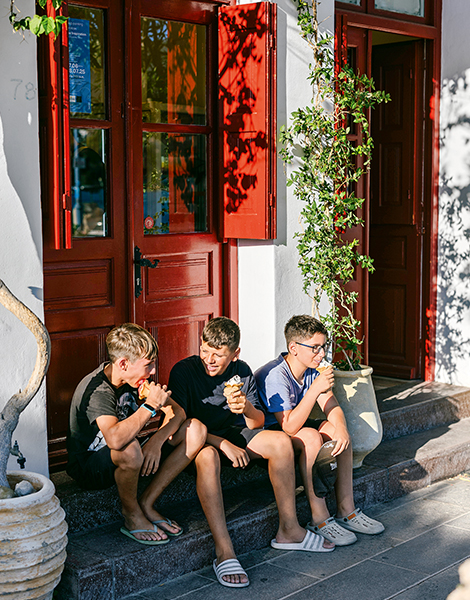
Fruits from the Lemonodasos, milk from a local cooperative – that’s how Vessala Pâtisserie makes its ice cream.
© Angelos Giotopoulos
Follow the coastal road toward Pounta, the old fishing quarter of Poros, and you’ll come across Casanova (36 Paraliaki Odos, Tel. (+30) 22980.352.94), an effortlessly charming trattoria with whitewashed walls, red-checkered tablecloths, and a menu you wish existed in downtown Athens.
Here, Mediterranean recipes meet Italian and local ingredients, guided by inspirations from the owners’ travels. One day, you might find vitello tonnato garnished with pickled caperberries; the next, tender octopus from nearby Methana, slow-cooked in Sicilian wine. Dishes such as lobster tortelloni in prawn and sage broth or gnocchi with salsiccia showcase a cuisine that’s confident and exacting in its simplicity.
With a well-made aperitivo in hand, you can nibble on pizza with smoky pancetta, gorgonzola and cracked black pepper; or dive straight into their legendary frutti di mare pasta, piled with shrimp, langoustines, mussels, clams, squid and a sauce so rich and briny you’ll want to spoon straight from the bowl. The tables fill with couples lingering over dinner, regulars laughing under the stars, and visitors from around the world, some fresh off the boat from Epidaurus, others stepping ashore from high-end yacht charters out of Athens.
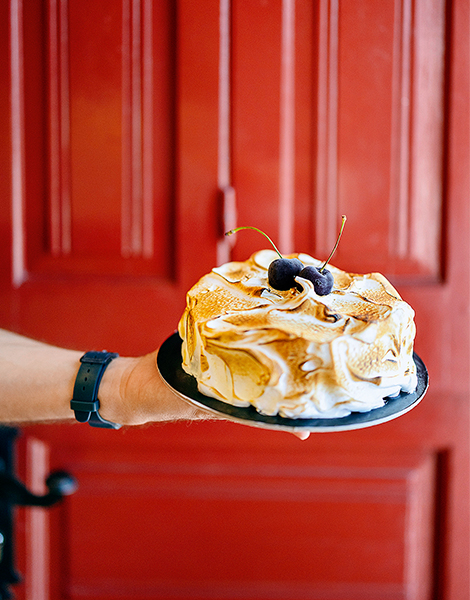
Ice cream cakes – one of Vessala’s big hits.
© Angelos Giotopoulos
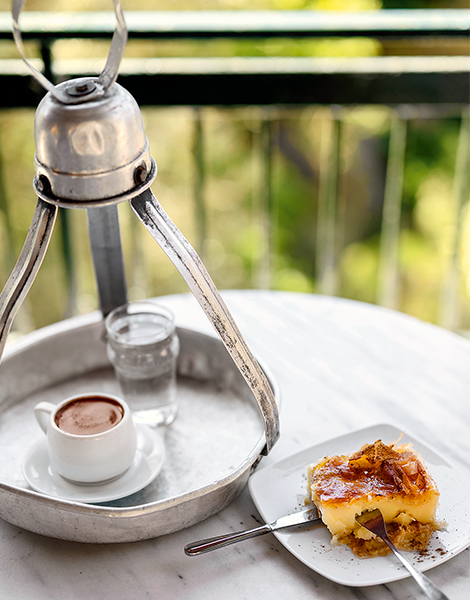
On the way to the monastery lies Melistakto Café.
© Angelos Giotopoulos
Just a few steps awayis a neoclassical building with the red door. It’s home to the Vessala Pâtisserie (Tel. (+30) 22980.258.90), where pastry chef Sotiria Aroni, a rising star of Greek confectionery, brings serious training and family tradition together in one immaculate kitchen.
After learning the craft beside her parents, Aroni studied chemical engineering with a focus on food science, mastered gelato at Carpigiani University in Bologna, explored viennoiserie in Paris, and trained in chocolate-making in the UK. Today, she continues to hone her skills while keeping her bakery strictly artisan: no ready-made mixes, no shortcuts.
She uses real eggs, milk from a cooperative near Nafplio, Aegina pistachios, and almonds from a trusted grower in Larissa. Her signature cakes, éclairs, custard pies and millefeuille with handmade puff pastry are all best-sellers, as is her ice cream: creamy kaimaki with mastic and floral notes, rich parfaits, and a bittersweet bergamot that lingers on the tongue.
From the family estate in Lemonodasos, the legendary “Lemon Forest” of Poros, she gathers the fruit for marmalades and traditional preserves. With the juices, she makes vibrant sorbets – including a refreshingly tangy blood orange – and slushy granitas that taste like summer preserved in ice.
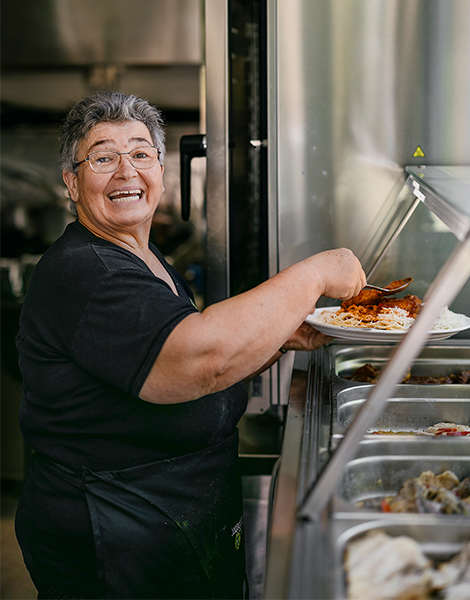
A generous serving of wine-braised rooster and a warm smile at Paradisos tavern.
© Angelos Giotopoulos
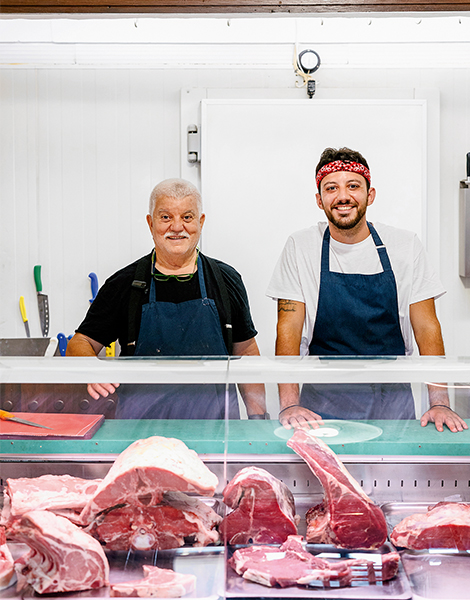
Father and son at the taverna-butcher shop O Dimitris.
© Angelos Giotopoulos
Poros might seem ideal for a weekend escape, but truthfully, the island resists being rushed. Two days aren’t nearly enough, particularly since you’ll probably spend your entire visit without ever getting in a car or on a scooter. Just walk between the neoclassical town of Poros and the pine-fringed Neorio Bay, dividing your time between swims, long lunches, and cultural detours to the Archaeological Museum (Koryzi Square, Tel. (+30) 22980.232.76) or the contemporary Citronne Gallery (Virvili Square, Tel. (+30) 697.998.9684), both small but rewarding.
You could, of course, venture farther. The island’s trails are laced with pine trees and scented by the sea breeze. Head north toward Vagionia Bay, a remote beach with crystalline waters, or to the Monastery of Zoodochos Pigi, an 18th-century landmark overlooking the coast. Walk up to the ruins of the Sanctuary of Poseidon, once a spiritual center of the ancient world. Each walk is short, scenic and best taken slowly, just like everything else here.
For a fitting start to the day, make a stop at Melistakto Café (Moni Zoodochou Pigis, Tel. (+30) 697.260.1190), just 200 meters from the monastery. Set on a leafy terrace under plane trees, it’s run by Meletis and his wife, Nektaria, who serve coffee with a side of local poetry and political passion. Meletis recites lines from Nobel laureate George Seferis by heart, discusses the community’s ongoing efforts to halt the expansion of fish farms in local waters, and tells stories that stretch from Demosthenes – who famously drank hemlock here – to Henry Miller, who once described walking through Poros as “floating.”
The blackboard menu is short and sweet: omelets, lemon preserves, homemade lemonade, a slice of savory pie, and a luscious galaktoboureko
(a custard and semolina pie) made with locally sourced goat’s milk. There’s even a spring nearby where you can splash your face with cold water before continuing toward Monastery Beach.
On the way to the Temple of Poseidon, make time for a meal at Paradeisos Taverna (Foussa, Tel. (+30) 22980.234.19), a much-loved spot in the woods. Under a canopy of grapevines and with beautiful sea views, they serve familiar classics such as lemony stews, dishes braised in red wine, and oregano-scented roasts, all perfect after a long swim or a slow afternoon hike.
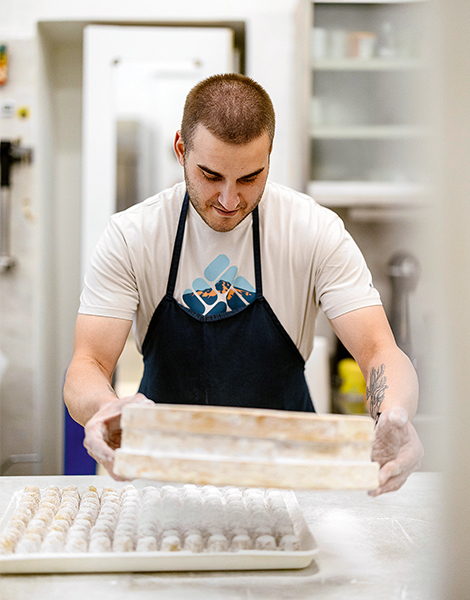
Final touches for the fragrant almond sweets at Daglis.
© Angelos Giotopoulos
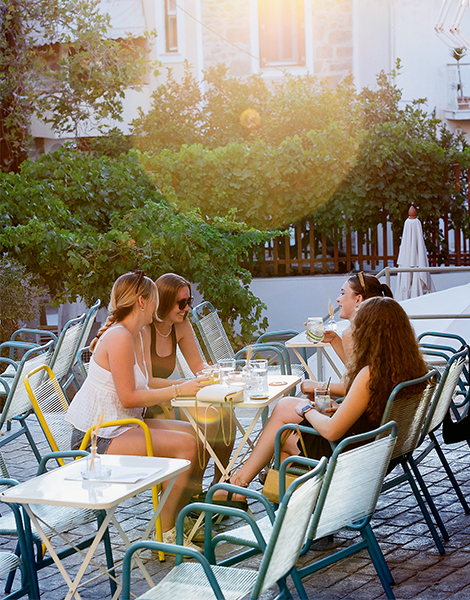
A stop for cocktails at Flotér Bar.
© Angelos Giotopoulos
Climb the alleys of Poros Town, starting from the blue-washed Clocktower, and you’ll soon come across Taverna Dimitris (12 25is Martiou, Tel. (+30) 697.450.6879), a beloved local spot that was once a butcher shop. The owner, Dimitris, is something of a character; a former seaman and radio operator, he knows a great deal about meat. Much of his expertise, he says, comes from an Irishman – descendant of a long line of butchers – who lived on the island for sixteen years and taught him the art of whole-animal butchery.
That’s why the taverna’s menu expanded beyond the usual lamb and pork chops to include robust T-bones, sirloins, and melt-in-your-mouth lamb fillet steaks. The grill still runs hot every night, with Dimitris’ nine children managing everything from service to the coals.
Just steps away, under the hanging lights of Flotér Bar (4 25is Martiou, Tel. (+30) 22980.238.21), you’ll find expertly mixed cocktails and what many say is the best gin and tonic on the island. It’s the perfect place to toast to the night as boats in the harbor glint under the stars.
Before heading to the ferry, there’s one last essential stop: Daglis Pâtisserie (G. & K. Kostelenou, Tel. (+30) 22980.245.31), a local institution since 1976, renowned for its “pear-shaped” almond sweets. Step inside and breathe deeply – the air is perfumed with rose water, and the glass cases are filled with hand-rolled walnut pastries, scented with cinnamon, and the famed honeyed almond treats.
The secret? Whole, unblanched Greek almonds, boiled, peeled by hand, left to dry, then ground and mixed with honey, sugar and rosewater. Laborious, yes, but that’s where the flavor lies. And if you need something cool for the trip home, grab a scoop of their signature almond ice cream, rich and subtly floral – a final, delicious souvenir of Poros.
From family traditions to modern innovation,...
A decades-old ritual, Sikinos’ ferry dives...
Locals share their memories of behind-the-scenes...
From kafeneia serving souma and meze...