Don Dines in Athens: O Skoufias, Pangrati
A hidden gem in Pangrati where...

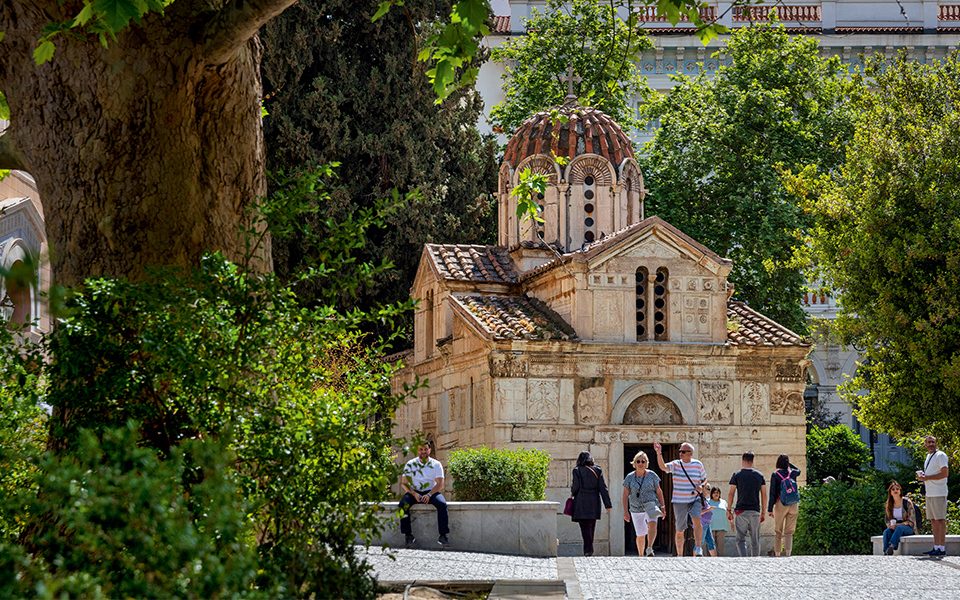
The Church of Panagia Gorgoepikoos and Aghios Eleftherios, also known as “The Little Metropolis.”
© Perikles Merakos
Whether you’re a believer or not, it’s impossible to stroll down the streets of Athens without noticing the beautiful little churches on nearly every street corner. Made of stone, bricks and marble, most are masterpieces of ecclesiastical architecture. But many of them have something else to show that can easily go unnoticed. They also incorporate pieces of ancient ruins in their structure or the immediate surrounding area.
Following a period of glory that made it the envy of its neighbors, Athens was ravaged by multiple invasions. First came the Romans, who stayed in Athens for over 180 years. Next were the Heruli, in AD 267, and then the Visigoths in 395. By the start of the Byzantine era, Athens was far from the glorious city that it had once been during the Golden Age of Pericles.
The Church of Panagia Gorgoepikoos.
© Perikles Merakos
The Church of Aghioi Anargyroi.
© Perikles Merakos
The city needed to be rebuilt. As was common practice at the time, Athens was reconstructed with spolia, materials salvaged from the ruins of destroyed buildings. This practice extended to the first churches constructed in the service of the new religion, Christianity, which was spreading rapidly. “There was a recycling process, and those building materials were reused indiscriminately without any problem. It could be a piece of a stone inscription, a piece of a statue, a chapiter, anything. Of course, not only were churches built with this material, but city walls, houses, public buildings – everything was,” says Georgios Pallis, associate professor of Byzantine and Post-Byzantine archaeology and art at the National and Kapodistrian University of Athens.
The first churches in Athens began to appear in the 5th century, but numbers really took off as the city flourished from the 10th century onward. At that time, a new era in architecture emerged in Byzantium, characterized by domes, cross-shaped roofs and the purely decorative combination of stone and brick on exteriors that gives these structures their distinct color. “Athens had quite a few of these new churches, at least 40 or 50, that were built from the 10th century and afterwards,” says Pallis. Due to their architectural design, they needed columns, capitals and marble. Athens had been a city full of marble since antiquity. “There were places in the city where one could obtain abundant amounts of marble: the Panathenaic stadium, for example, as all its seats, the benches, were made of marble. All of these disappeared. They were either made into lime, or the marble was reused to construct mainly new places of worship and decorative reliefs.”
The greater metropolitan area of the Greek capital is dotted with hundreds, if not thousands, of churches, around 20 of which date from the Byzantine era and remain in use to this day.
The Church of Aghios Nikolaos.
© Perikles Merakos
The Church of Aghios Nikolaos.
© Perikles Merakos
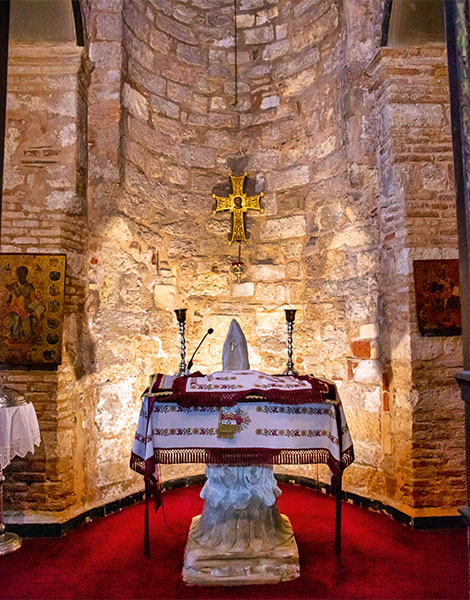
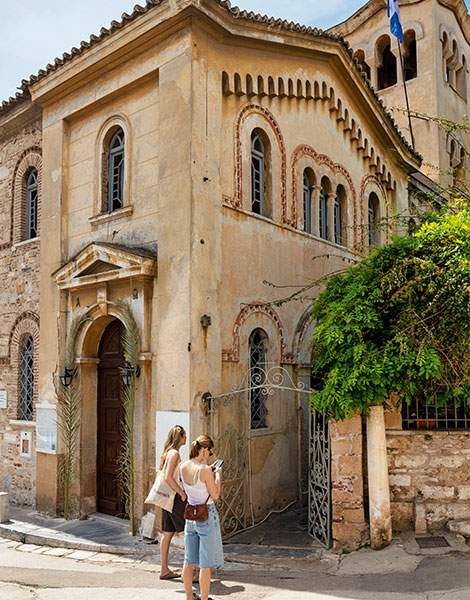
Not far from the Cathedral of Athens, in the heart of Plaka, one of the oldest neighborhoods in the world, sits one of the city’s most beautiful Byzantine churches. The Church of Aghios Nikolaos Ragavas, is one of many houses of worship constructed during the 11th century in an area which, in Byzantine times, was considered the most aristocratic part of the city.
Some churches around Athens bear a nickname; in this case, it is “Ragavas.” These names are believed to refer to the families that built these churches, or sometimes to the wealthy commoners or aristocrats who were buried in them. In 1979, during conservation work, architects and archaeologists discovered an inscription in Byzantine-era letters in the dome; it was a supplication to God signed by Leon Ragavas, who’s believed to have commissioned the church. It’s also believed that the Byzantine empresses Irene of Athens and Theophano of Athens resided in the parish of Aghios Nikolaos before they went to Constantinople.
The original church, which today makes up half of the current one, was a simple, four-column cruciform structure. Its construction used architectural pieces taken from ancient buildings, including an inverted chapiter on the northeast side, a column at the entrance to the courtyard, and an inverted marble chapiter in Corinthian style which supports the sanctuary.
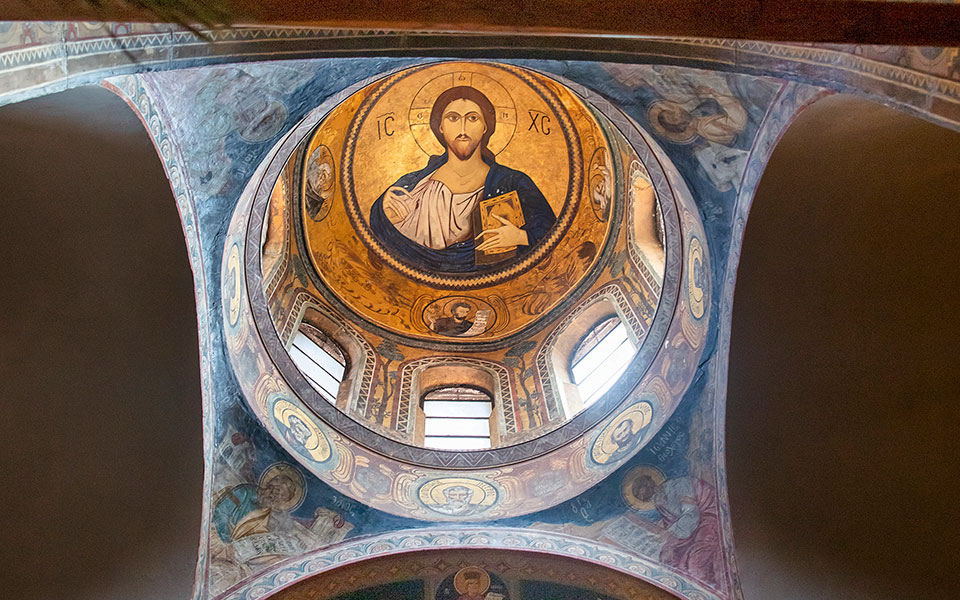
Detail from the upper dome at the Church of the Transfiguration of the Savior.
© Perikles Merakos
Like the Church of Ragavas, the Church of the Transfiguration of the Savior, also known as Sotira Kottaki, on Kydathineon Street that connects Monastiraki with Plaka, may have taken its nickname from its founder, possibly named Kottakis.
The church, constructed in the first half of the 11th century, was extended at least three times over the years in order to accommodate a burgeoning flock. “What we see of the original church is the eastern side and the dome,” says Pallis. “As Athens’ population grew and grew, these small Byzantine churches could not accommodate enough people, so they were gradually expanded. Walls were demolished and additions built; Sotira Kottaki has almost tripled its size, at the cost, of course, of the loss of three sides of the original building from its Byzantine phase.”
In its original form, the structure was a simple four-column cruciform Byzantine church with a dome; the dome is supported by the four columns. Those ancient columns stand out the moment you enter the building. In addition, in the western courtyard – today used for parking – also lie several ancient architectural fragments of unknown age. As Pallis points out, columns that do not have a relief or a design on them are hard to date, and therefore attract little attention these days. However, in the past, columns were considered valuable objects. “We have a record from the time of Venetian rule indicating that a wealthy man gave his daughter a dowry of five marble columns, which she could have either sold to raise a lot of money or used to build her own house,” he explains.
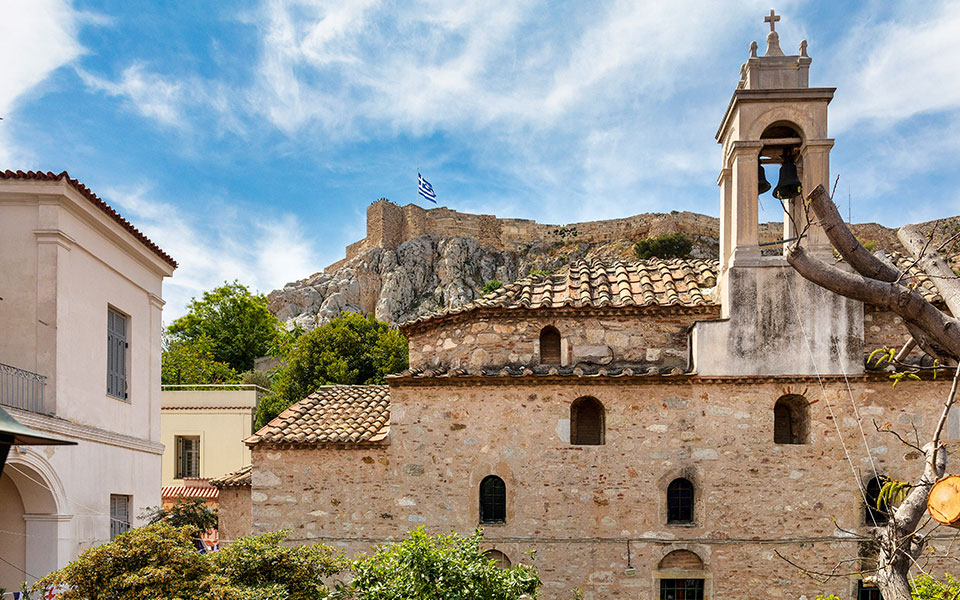
The Church of Aghioi Anargyroi.
© Perikles Merakos
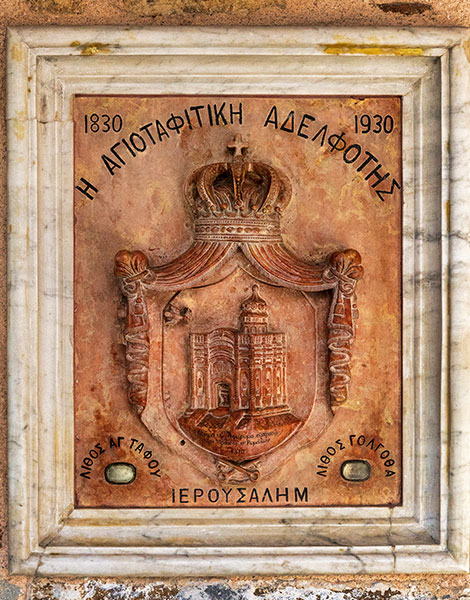
A ten-minute walk from the Acropolis in the direction of Plaka will bring you to one of the most important churches in modern Athens, the Metochi of the Holy Sepulcher, also dedicated to the Anargyroi (Saints Cosmas and Damian). This post-Byzantine church, constructed in the 16th or 17th century on the site of an ancient temple of Aphrodite, combines some characteristics of the architecture of mosques in the construction of the roof, something not uncommon in Athens at that time.
Inside the church and around the yard are several ancient pieces, including columns and capitals. “It’s hard to know where any of these objects came from,” says Pallis, as, basically, they could be found anywhere in Athens and might have been reused many times. This practice continued until the 19th century, when pieces with inscriptions and sculptures began to be protected.
In its early years, the church also served as a convent, and members of a wealthy Athenian family were buried on the grounds as well.
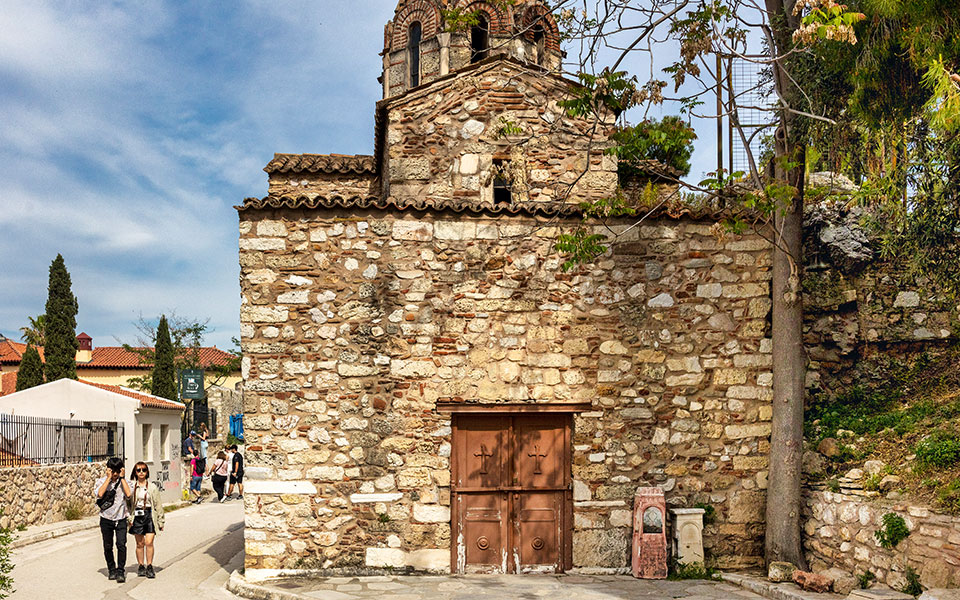
The Church of the Transfiguration of the Savior.
© Perikles Merakos
A ten-minute walk from the Acropolis in the direction of Plaka will bring you to one of the most important churches in modern Athens, the Metochi of the Holy Sepulcher, also dedicated to the Anargyroi (Saints Cosmas and Damian). This post-Byzantine church, constructed in the 16th or 17th century on the site of an ancient temple of Aphrodite, combines some characteristics of the architecture of mosques in the construction of the roof, something not uncommon in Athens at that time.
Inside the church and around the yard are several ancient pieces, including columns and capitals. “It’s hard to know where any of these objects came from,” says Pallis, as, basically, they could be found anywhere in Athens and might have been reused many times. This practice continued until the 19th century, when pieces with inscriptions and sculptures began to be protected.
In its early years, the church also served as a convent, and members of a wealthy Athenian family were buried on the grounds as well.
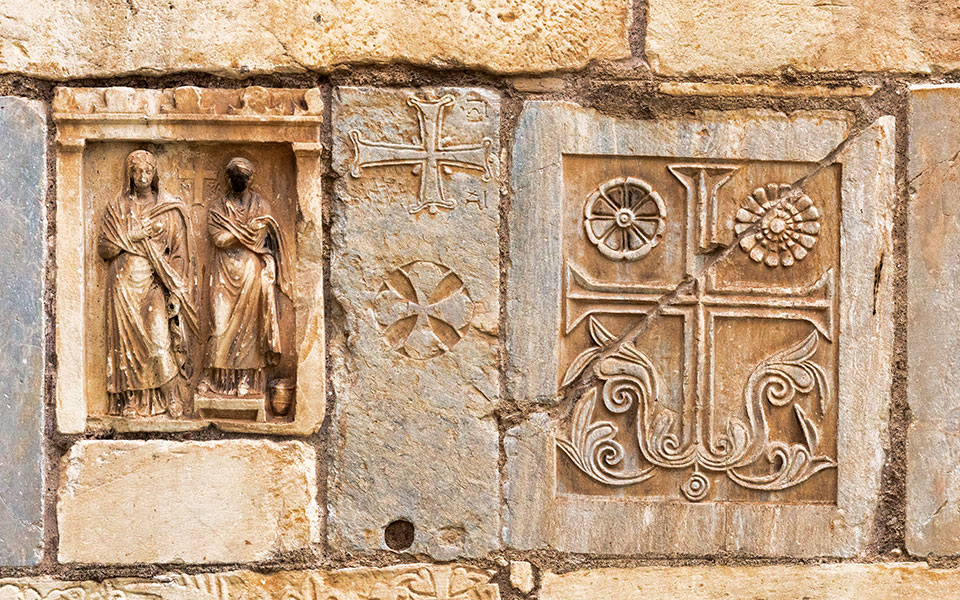
A detail from the Church of Panagia Gorgoepikoos and Aghios Eleftherios.
© Perikles Merakos
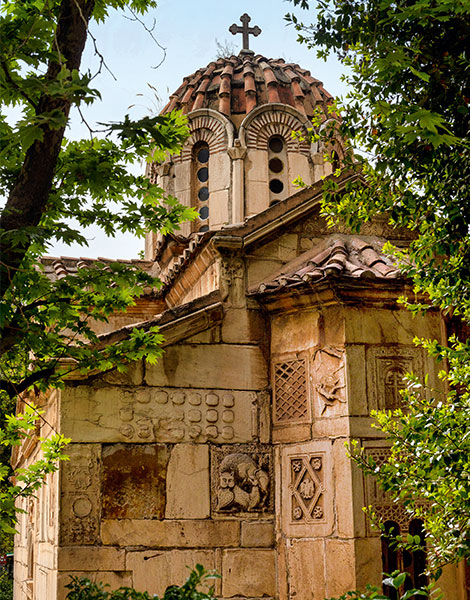
One of the greatest examples of the use of spolia can be found in the Church of Panagia Gorgoepikoos and Aghios Eleftherios, also referred to as “the Little Metropolis,” next to the Metropolitan Cathedral of Athens. “This is a building made entirely of marble,” says Pallis.
Constructed in the 11th or 12th century, the church was built on top of the ancient temple of the goddess of childbirth, Eileithyia. As described by the Archdiocese of Athens, the walls are built with “isodomic marble blocks, which come from ancient monuments, while in the upper parts of the building 90 ancient Greek, Roman, early Christian and Byzantine reliefs were used. The breastplates with the relief representations… were built into the wall in such a way as to form an impressive frieze, which runs around all sides of the building.” The relief on the western facade of the temple shows the Attic calendar, which is basically the seasons of the year depicted with human figures and their occupations.
According to Pallis, this could be a collection someone had already formed or one compiled from pieces from elsewhere for this express purpose. Either way, this little church resembles an ancient temple, which would have been very familiar to the people of the time, who used them to perform Christian services. The Parthenon, the Temple of Hephaestus, the Temple of Artemis Agrotera and other ancient Greek temples were all transformed into churches, and some of them remained as such until the era of Ottoman rule in Athens.
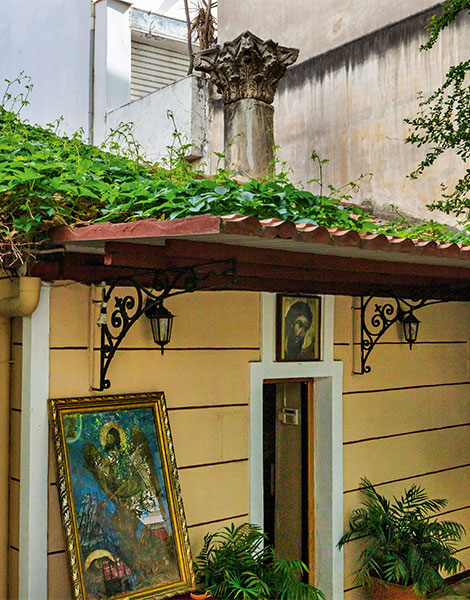
The Church of St John of the Column.
© Perikles Merakos
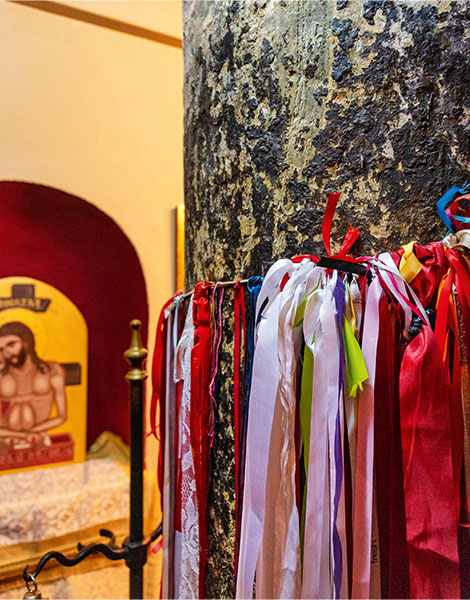
The Church of St John of the Column.
© Perikles Merakos
One of the most impressive churches in downtown Athens is one that usually goes unnoticed. The Church of St John of the Column, in Psyrri, which was constructed during Ottoman times, took its name from the ancient column with a Corinthian chapiter that stands in the sanctuary and protrudes from the roof.
The old Athenians believed that John the Baptist could cure anyone from sickness. According to the Greek historian and academic Dimitrios Kampouroglou, Saint John “in his last days erected a column, and at its foundation he tied all the illnesses with silks of various colors, and he buried them deep there and on top of them he placed a column and said: ‘When I am about to die, whoever falls ill should come and tie three knots of silk on the column, in whatever color his illness is, and say three times: “My Saint John, I bind my illness and may your grace untie it,” and they will immediately be cured.’ This is connected to beliefs that probably developed in the Middle Ages, which attributed to columns some supernatural powers, Pallis explains.
A hidden gem in Pangrati where...
From Michelin-starred tasting menus to sushi...

Discoveries along Amalias Avenue, from the...
Tourists share the highs and lows...