Why Vargiani Is the Perfect Destination for Nature...
Vargiani on Mount Parnassos offers stunning...
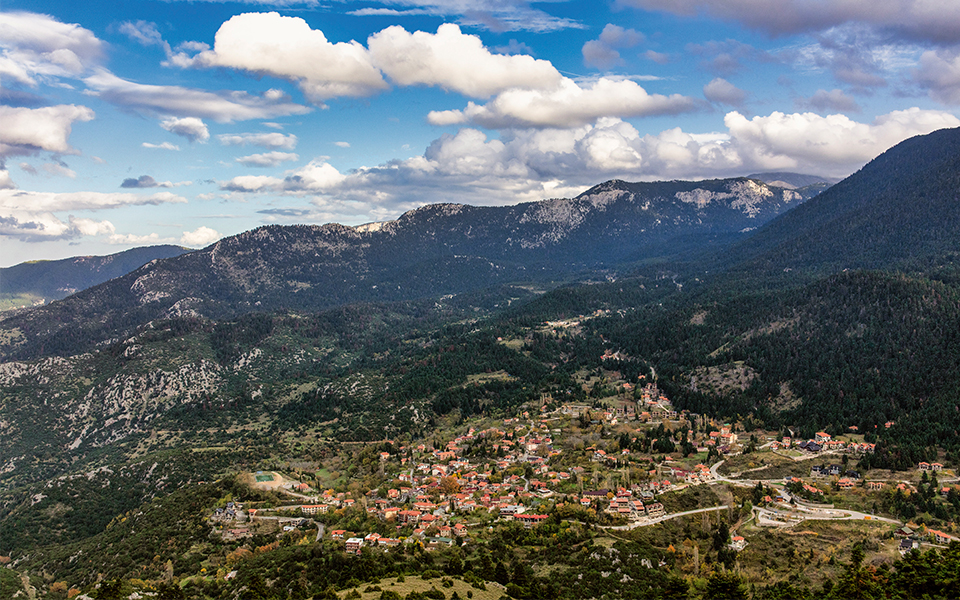
Panoramic view of Eptalofos (or Agoriani).
© Perikles Merakos
Walking among the fir trees of majestic Mt Parnassos, I am reminded once again why this mountain has inspired awe, myths and a sense of the magical since antiquity. Mushrooms in curious shapes and unexpected colors emerge from cracks in tree trunks and from the damp forest floor. With wicker baskets in hand and pocketknives at the ready, we set off on a hunt with the team from MyCooperativa.
For the 12th consecutive year, this five-friend group – all scientists – have been running autumn mushroom identification workshops in various corners of Greece. We join them on the northwestern foothills of Parnassos, in the village of Lilaia (known to locals as Kato Agoriani), just a two-hour drive from Athens.
“The secret is to look at the base of trees, in rotting wood, and under fallen, rain-soaked leaves,” says Elias Polemis, a founding member of the team and a postdoctoral researcher in agronomy and mycology at the Agricultural University of Athens. While we celebrate every tiny discovery, the more experienced participants express concern at the limited mushroom diversity they observed. Sparse rainfall, combined with human interventions such as deforestation, have increased the number of species entering the Red List of Threatened Species, says Vasilis Daskalopoulos, agronomist-mycologist and PhD candidate at the Agricultural University of Athens.
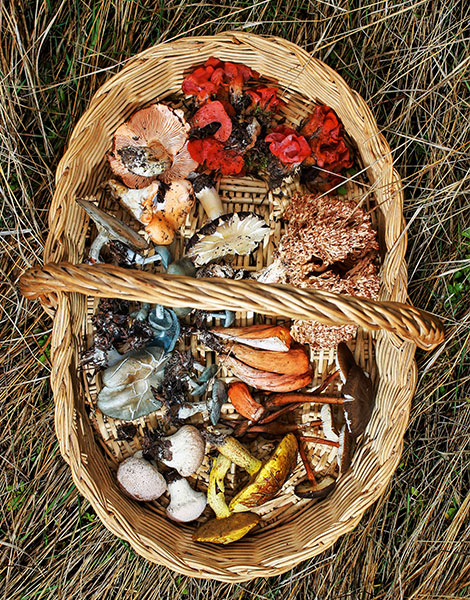
Jelly babies and breadsticks among the mushrooms from our collection.
© Perikles Merakos
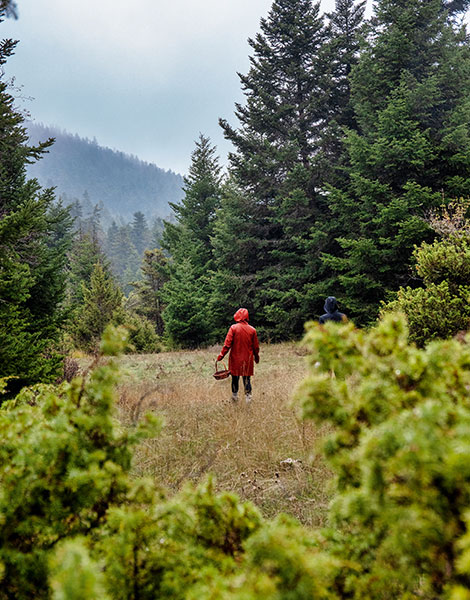
‘Hunting’ mushrooms in a fir forest near the Eptastomo Cave, above Agoriani.
© Perikles Merakos
“Mushrooms are the foundation of life as we know it today,” Polemis says. “Even now, their role remains crucial to the balance of ecosystems.” As we walk through the forest and gently lift the soil, a white, sticky mesh appears – like an underground spiderweb. This is the mycelium, the fungus’ primary body. Beyond its role as a decomposer, it also acts as the forest’s own “social network,” allowing trees to exchange information and nutrients through it.
As inexperienced foragers, we struggle at first to distinguish the different species. But once we spot the first mushroom and then the second, suddenly – like Christmas lights – small and large round caps start appearing with every step we take. In a bright clearing, I spot a perfectly circular arrangement of mushrooms, as if someone had placed them ritualistically, one beside the other.
“The old folks called it a ‘witches’ ring’,” Daskalopoulos says. Later, during the educational session that follows the hunt, he explains further. “This shape forms when the mycelium develops its reproductive organs – the mushrooms that we see – simultaneously in all directions. That’s how this perfect circle emerges.” It’s hard not to see a kind of magic in such perfect symmetry.
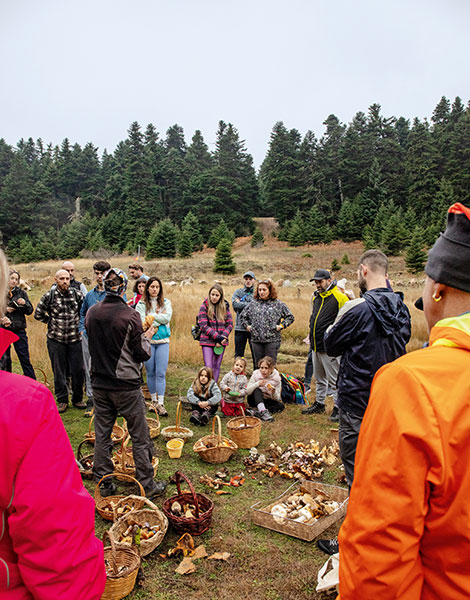
The scientific team MyCooperativa, active since 2013, organizes educational seminars on mushroom identification.
© Perikles Merakos
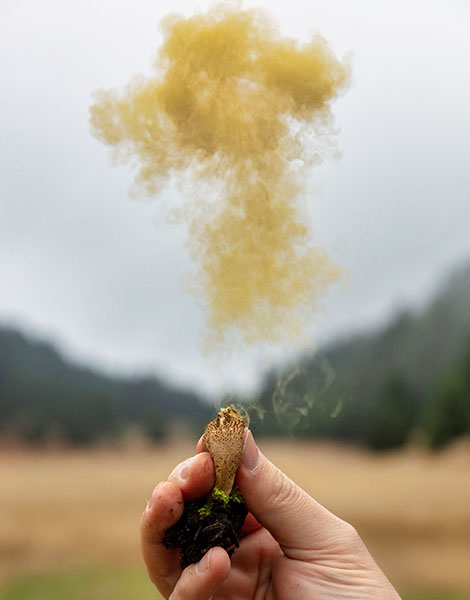
The mushroom Lycoperdon perlatum, also known as the common puffball, releases its spores as a foul-smelling greenish-yellow powder.
© Perikles Merakos
Mushrooms form a parallel world – scientifically fascinating and gastronomically compelling. “Of course, many edible species aren’t eaten at all, for the simple reasons that they’re spicy, bitter or tasteless,” Polemis says, placing a small piece of mushroom on his tongue. Curious, I try the tip of one myself; within a minute, I feel a faint tingling. “Ikaria is the only place in Greece where I’ve seen people recognize and eat every type of russula,” he adds. “But since they’re not exactly the most delicious, locals call them sachlites, meaning ‘bland mushrooms’.”
People such as Elias Polemis and Vasilis Daskalopoulos have devoted their lives to the scientific study of fungi. Still, Polemis is quick to acknowledge the essential role of hundreds of amateur enthusiasts, particularly the Mushroom Lovers of Greece Association. “Their contribution to species identification in Greece is almost on par with that of professional researchers,” he says.
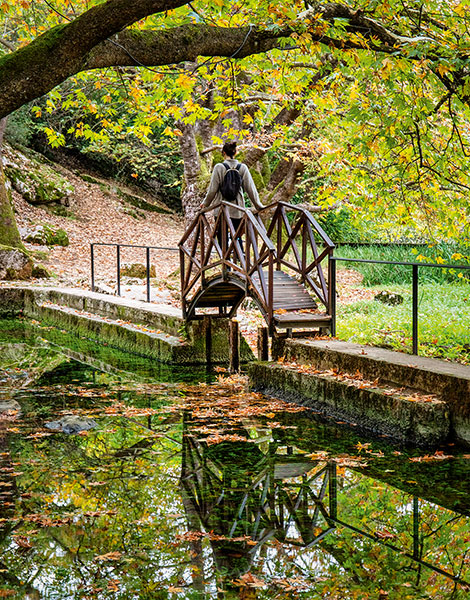
“The wooden bridge at the springs of the Boeotian Cephissus, in Polydroso, looks as if it came straight out of a fairy tale.
© Perikles Merakos
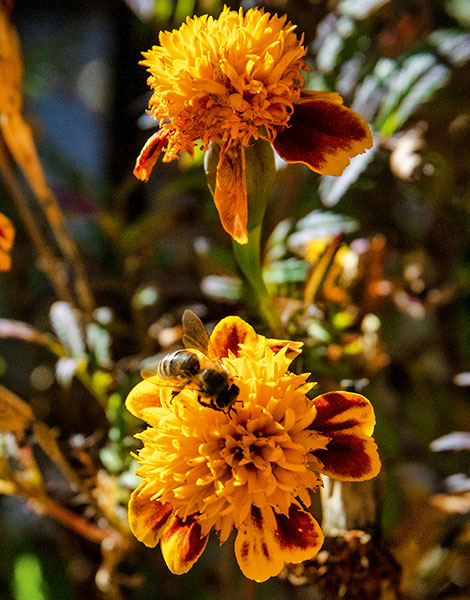
Mr. Nikos’s bees collect nectar from the marigold flower.
© Perikles Merakos
On Parnassos, we meet several of these passionate foragers – and the mushrooms we saw in the forest soon reappear on our plates. In Eptalofos, at the taverna Griza Arkouda (“Grey Bear”), mushrooms take center stage both in the décor and the dishes that arrive at the table. We sample grilled xerakomanites (oyster mushrooms), shiitakes, a homemade pie and a nourishing mushroom soup.
“We come from a livestock family. Back then, mushrooms were the biggest headache in September and October. The sheep would eat them while grazing and go wild—disappear for a week or ten days,” says Giorgos Panagou, owner of the taverna. Then one autumn day, while gathering firewood, he came across a hollow beyond a meadow filled with hundreds of mushrooms – each a different color and shape. “It felt like seeing them for the first time. I was astounded.” From that moment on, he began collecting mycology books from all over the world.
“In the village, we used to eat two kinds: lagomanites and macrolepiotas. When we first started picking lactarius or morels in the spring, nobody wanted them. But gradually people tried them – and now everyone looks for them.” In fact, for the past three years, late October in Eptalofos has brought its own Mushroom Festival, complete with a forest mushroom hunt and an open-air cooking session in the main square of the village.
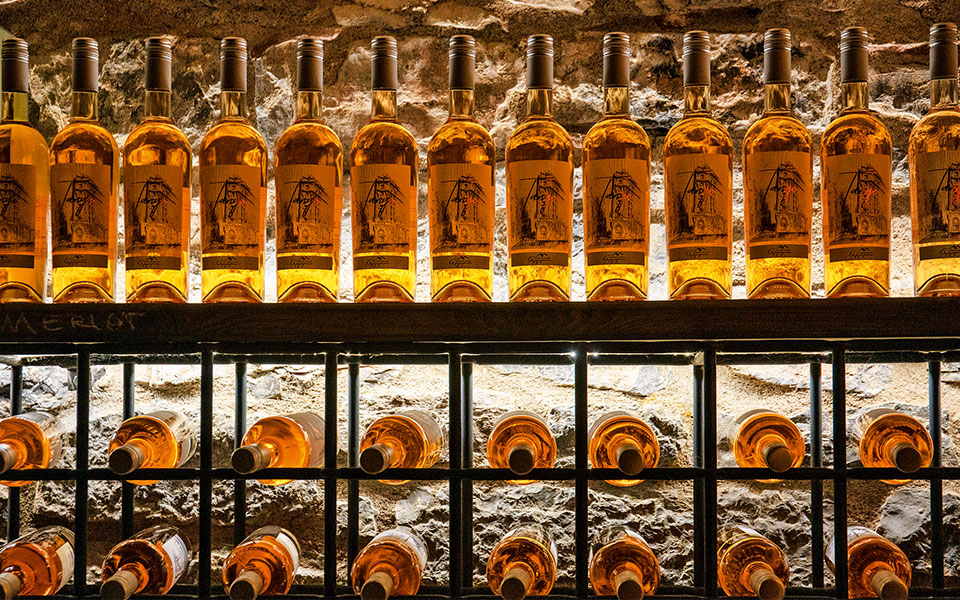
Argyriou Winery.
© Perikles Merakos
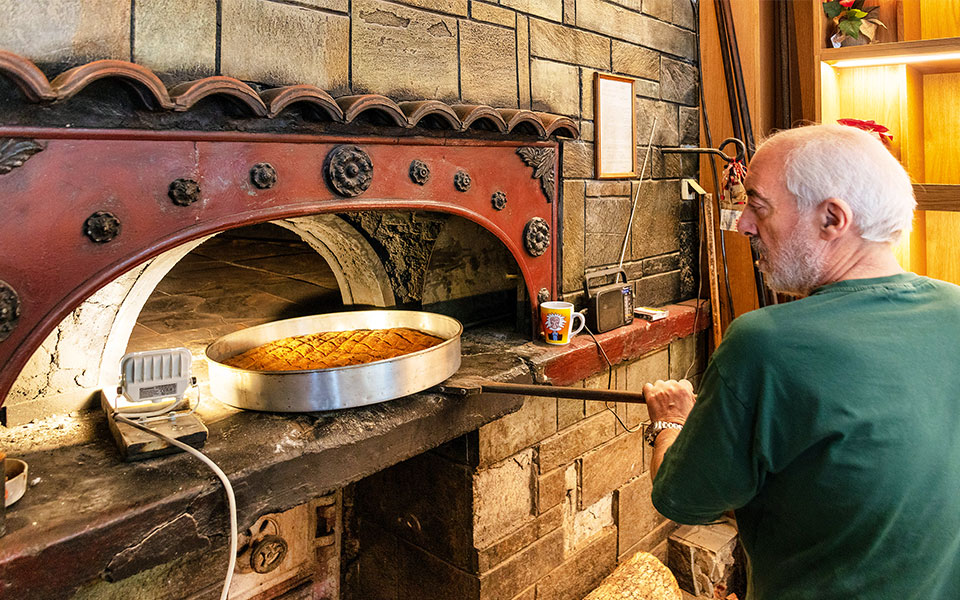
Each morning of our stay, Dimitris Arvanitis, owner of the traditional bakery on Eptalofos’ main square, welcomes us with coffee and freshly baked cheese breads (tyropsoma) and bougatsa (custard pastries) straight from the wood-fired oven. The shop is a popular meeting point for locals – it’s the only coffee spot that stays open year-round – and it’s been the family business for three generations. “On weekends we bake even more,” he says, noting that the highest demand is for the house specialty, a traditional wild-greens pie with cheese.
Two young men at the next table convince us to join them on an outdoor adventure: an ATV ride toward Aghia Triada. Our first mountain outing on a four-wheel, all-terrain vehicle turns out to be exhilarating. Helmets on, we follow 22-year-old Plamen from Polydrosos and his friend. Initial hesitation quickly gives way to excitement. The route is manageable, though it’s clear our guides have tackled far rougher slopes. The panoramic view of the Kifissos Valley is the trip’s highlight – “See, over there, that’s my village,” Plamen says, pointing toward Souvala, also known as Polydrosos.
Dimitris Arvanitis takes the freshly baked wild greens pie out of the bakery’s wood-fired oven.
© Perikles Merakos
In Souvala, just twenty minutes from Eptalofos, another distinct experience awaits: the sheep’s-milk ice cream made by Martha Tyrovoli. Since 1968, her family dairy has stood across from the village hair salon. All of her products are made and packaged on-site and are strictly seasonal – the fresh feta and graviera only appear after December, when local livestock farmers bring in the first milk of the new season.
A little higher up the slope, across from the monument with the warplane, we taste Tyrovoli graviera again – this time paired with a range of local wines produced by the Argyriou family. At the winery entrance, we are greeted by Despina Argyriou, who leads us to the cozy tasting room above the cellar, complete with a fireplace. Outside, beneath an evergreen bay tree that has stood there since the 1800s – when the winery was still her grandfather’s house – two more groups sit around a wooden table enjoying their glasses.
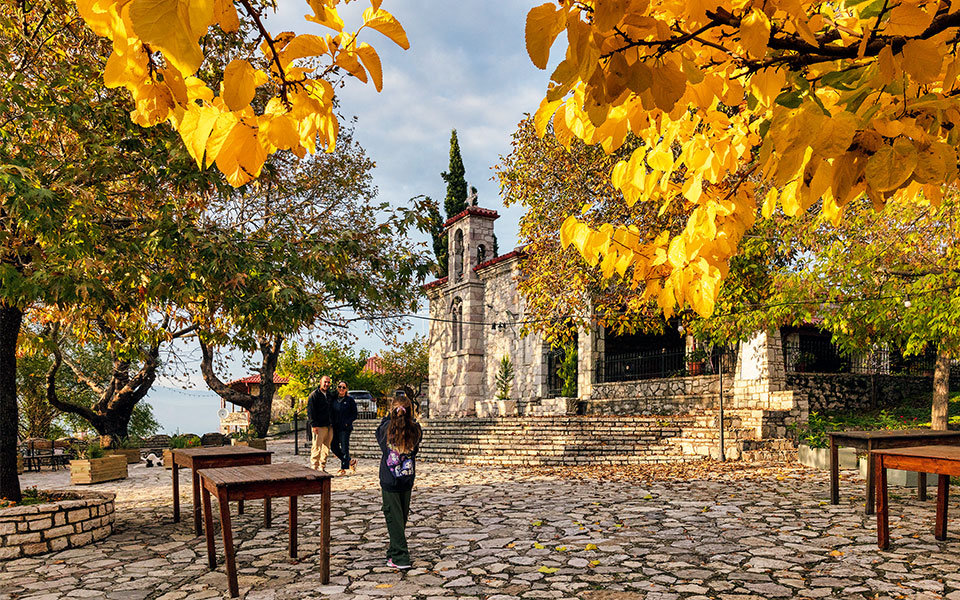
The Church of Aghia Paraskevi dominates the main square of Vargiani.
© Perikles Merakos
Later, back in the village of Eptalofos, as we look out across the Kifissos Valley from the balcony of a beekeeper named Nikos, his friend Dimitris Papadimitriou describes the region’s peculiar geography. “The village is enclosed – it sits in the embrace of Mt Parnassos, so it gets heavy snowfall. If you head back toward Arachova or Livadi, you’ll often find no snow at all, while here everything is white.” This is one reason the village draws so many visitors in winter; it is a hive of activity every day of the week during the holidays. “Eptalofos is a full-on spectacle at Christmas!” a local had told us earlier.
As we sip our afternoon coffee by the fireplace at Le Grand Chalet – part café, part bar, part restaurant – we start to feel the festive spirit creep in. Outside the huge triangular window, the autumn colors of Parnassos stretch out before us once more, illuminated by the last golden light of sunset.
Where to Eat
Griza Arkouda (Eptalofos, Τel. (+30) 22340.612.77) Come for the mushrooms – but not only. The menu includes wild game, while their complimentary walnut pie is a highlight.
Tsafas (Lilaia, Τel. (+30) 22340.512.93) The specialty here is local goat. It’s best to call ahead if visiting on a weekend, as the menu is planned “per head” from early in the morning. Take your seat, enjoy the salads and dips, and let owner Nikos handle the rest.
Le Grand Chalet (Eptalofos, Τel. (+30) 22340.613.01) In a warm, stylish setting, Thessaloniki-born chef Alexandros Theologou serves everything from bougatsa cream-filled croissants for brunch to slow-cooked pork shank with sweet potato purée. During the holiday season, the venue hosts DJ nights and festive dinners with live music.
Tyrovoli Dairy (Polydrosos, Τel. (+30) 22340.512.61) Martha Tyrovoli produces sheep’s-milk yogurt, saganotiri, opsimotiri, rice pudding, feta, graviera, and her signature sheep’s-milk ice cream in flavors that include kaimaki, custard and chocolate.
Arvanitis Traditional Bakery (Eptalofos, Τel. (+30) 22340.612.43) Everything is baked in a wood-fired oven. There’s also a cozy indoor space with a fireplace, plus guest rooms for overnight stays.
Nikolaos Karatzas – Honey (Eptalofos, Τel. (+30) 22340.613.59, 693.751.1997)
For Karatzas’ excellent fir honey, call him directly or stop in at the delicatessen Dora Gis in the village square.
Parnassos Mountain Adventures (parnassosadventures.gr) The company offers ATV excursions and snowmobile tours through the fir forest.
Nearby Excursions
Driving down from Eptalofos to Lilaia, you can turn left for Vargiani or right for Amfikleia.
Vargiani, one of Parnassos’ prettiest villages, is lined with stately stone houses and cobbled lanes. With no permanent residents, it comes alive mainly on weekends. Wandering its alleys feels like stepping back in time, with green signposts pointing to numerous local trails. Stop at Taverna Zervas (Tel. (+30) 693.699.9380) for excellent ribeye steaks, savory pies and hearty stews. A little further down, Mpormpoula (Tel. (+30) 693.651.2103), by the village springs, is known for its spit-roasted meats.
As you head back towards Athens, make time for a visit to Amfikleia, a lively small town where the Folklore Association hosts the Festival of Hondros on December 6, offering steaming pots of cracked wheat with sugar and cinnamon in the Upper Square. During Carnival, locals cook up their famous 130-meter-long kontosouvli. After strolling through the well-preserved traditional settlement, stop for a meal at Mi se Mellei (Tel. (+30) 698.564.2587). In the Lower Square, try an affogato or ravani at Gefsipoleion Oikogeneia Thanou (Tel. (+30) 22340.290.19), made with milk from the family’s own sheep.

Vargiani on Mount Parnassos offers stunning...