Stories Told by the Stones of Crete
A forgotten world comes to life...

© Shutterstock
Anastasis Parasiris welcomes us to the Sfendoni Cave, at the foot of Psiloritis Mountain, in central Crete. In this impressive natural wonder that during its history served as a refuge for local revolutionaries, the young Cretan tour guide with his characteristic accent and stentorian voice guides visitors throughout the year, telling the story of the cave as if it were the first time.
“I used to come here when I was little to play with my friends. Holding flashlights and candles, we would enter through a small entrance that was just big enough for us, and that’s where the adventure would begin. The cave wasn’t open to the public at the time. When it was opened up years later, I decided to return to my hometown and work as a tour guide,” he tells us.
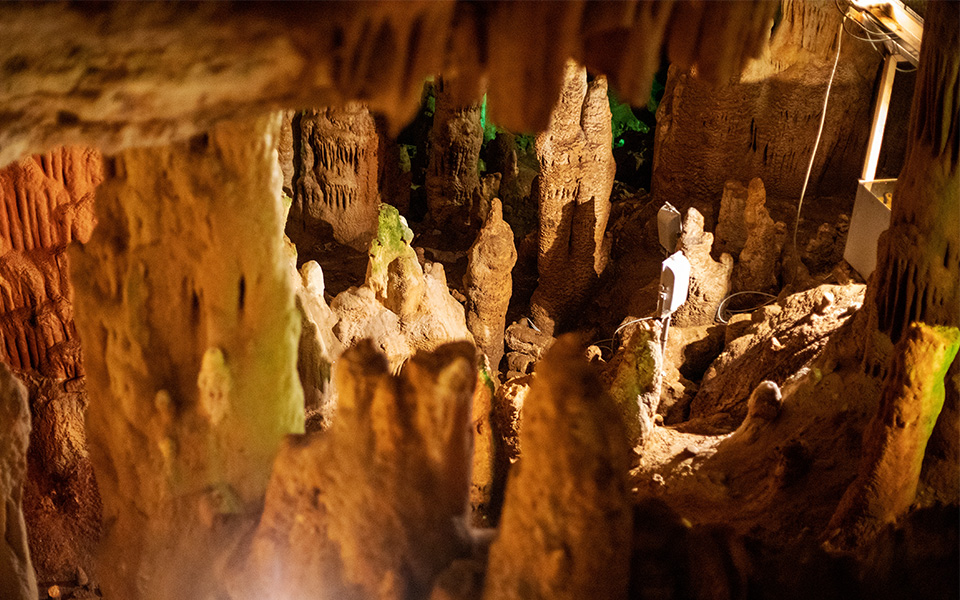
The temperature inside the cave remains stable at 16-17 degrees all year round.
© Shutterstock
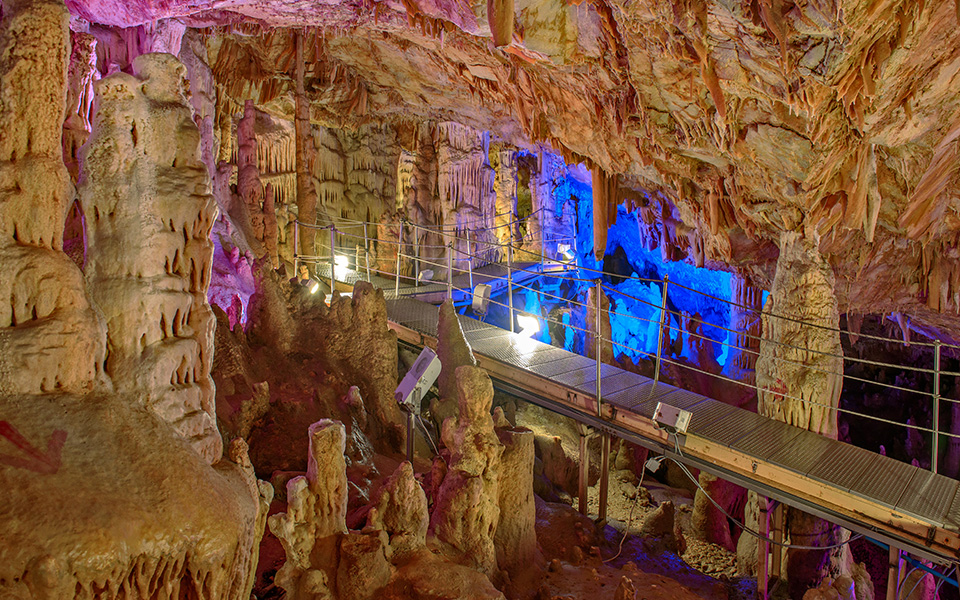
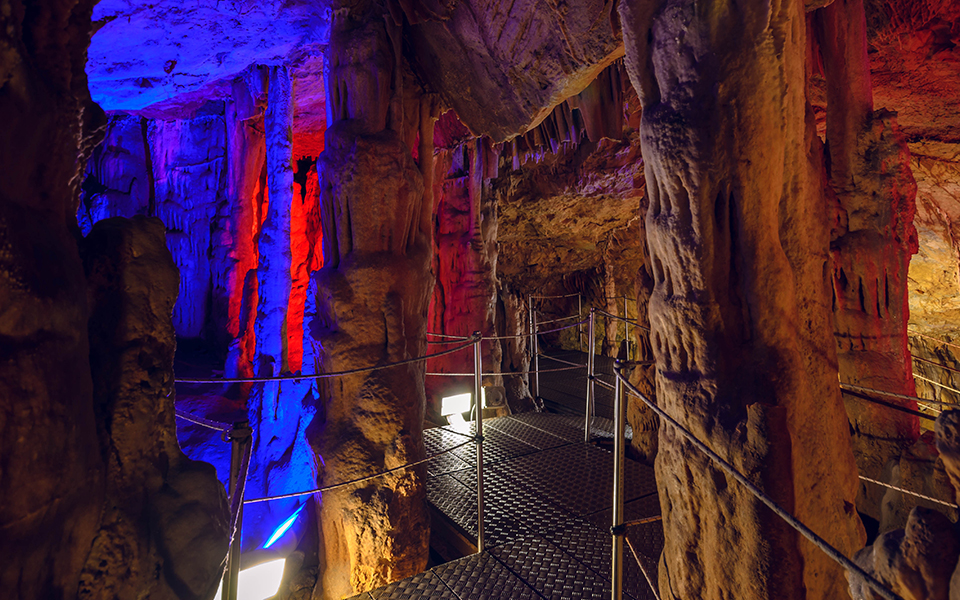
It’s the end of summer and visitors are still arriving from all over the world. Sfendoni, the largest accessible cave on Crete and one of the oldest in Greece, is located about a kilometer northeast of the mountainous village of Zoniana, in central Crete, and 43 kilometers from the town of Iraklio, at an altitude of 650 meters. It is part of the Psiloritis Natural Park and is protected by UNESCO. It is teeming with stalactites and stalagmites, petrified wave formations, and impressive colors that alternate from room to room.
“No one knows when or by whom it was discovered. What we do know is that it dates back 5 to 8 million years, and in the excavations carried out in 1987 by [archaeologist] Gavrilakis, we found not only that there was life in 3500 BC during the Early Minoan Period, but also that important findings emerged from the Neolithic Age and the Late Roman Period,” Parasiris tells Kathimerini newspaper. “Among the animal skeletons that were discovered, there were bones of red deer and roe deer – and these were the most important, because this is how we learned that animals that no longer exist in Crete existed then.”
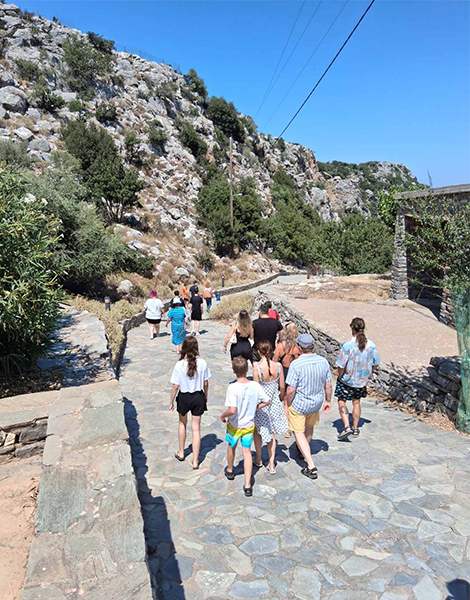
Even at the end of summer, numerous visitors arrive to see the rich decoration and water basins of the largest accessible cave on Crete.
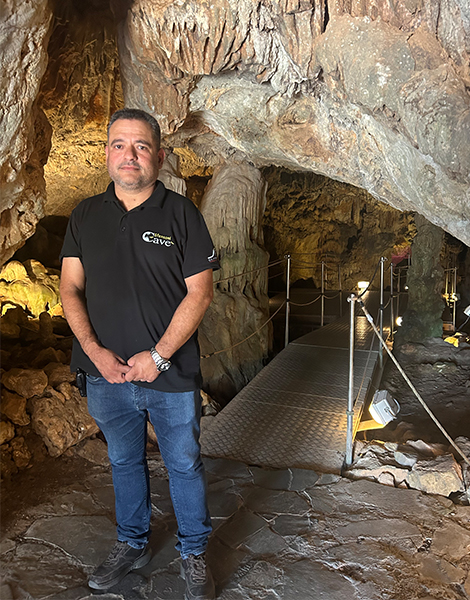
Tour guide Anastasis Parasiris welcomes visitors to the Sfendoni Cave, at the foot of Mount Psiloritis, in central Crete.
The cave took its name from the nickname of a Sfakian guerrilla fighter, known locally as Sfentonis, who lived in the area during Ottoman rule. When a few decades ago, a small human skeleton was discovered in the last chamber of the cave, embalmed in limestone material, evidence that it had been there for several centuries, rumors about what happened to the unfortunate boy began to spread: Some said that it belonged to a young man whom Sfentonis killed out of fear of betraying him, while others believed that it belonged to a child who was lost in the cave and never managed to find his way back.
The unsolved death is one of the stories told by the tour guide that visitors listen to with interest in the “chamber of the lost child.” With the same attention, they listen to another legend that has haunted the village to this day.
“The first chamber of the cave is called ‘the fairy’s sanctuary.’ It took its name from the fairy who is believed to have lived there long ago. Legend has it that a shepherd who had seen her wanted to kiss her, but she eluded him every time. When at one point he set up a trap and caught her, she said to him, ‘If you don’t kiss me, I will wish that your family will always produce silk, but if you kiss me I will curse you all to have trembling hands forever.’ As he couldn’t resist, he kissed her and fear has haunted the village ever since. I remember that descendants of that shepherd, even two decades ago, continued to believe in the curse and said that their hands trembled because of it,” Parasiris tells us.
© Shutterstock
The cave today is a source of pride for the main village of Rethymno. Before it opened to the public, local residents used it to store their cheese – known as “cheese of the hole” and let it mature as the temperature inside the cave remains stable at 16-17 degrees all year round. However, free access, which was possible until the beginning of 2000, also took a heavy toll on the cave. Parasiris does not fail to mention it every time in his tour.
“You have seen some stalactites that are cut. These did not break by themselves. Until 25 years ago, whoever wanted could go in and out and take a ‘souvenir.’ Fortunately, at some point the cave was officially utilized because otherwise there would have been nothing left. Whatever miracles nature creates, we destroy them,” he said.
This power of nature to create sculpture in the dark is what our guide tries to convey to Greek and foreign visitors during his half-hour tour. The cave, he says, is beautiful all year round, but there are some who prefer it in the winter when it sometimes rains and drips. Among the rooms, the “Palace” stands out, which resembles a waterfall, as well as the “Parthenon” room – at the end of the route – which took its name from the distinct columns that resemble the ancient temple in Athens, but also from the absolute symmetry of the chamber.
“Every year, more than 70,000-80,000 people visit us from every corner of the planet, and many of them come back again. I remember visitors who first came alone, after a few years they brought their children, then their friends. It is a cave that most people can’t get enough of seeing, and not unfairly,” Parasiris adds as he bids us farewell, ready to welcome the next group of visitors.
Covering an area of 3,500 square meters, the cave includes a 270-meter-long steel walkway with ropes that allows visitors to see around two thirds of the cave and makes it accessible to people with mobility impairments.
A forgotten world comes to life...
Discover Greece’s islands in September with...

A Polish-born artist who lives on...
Experience Crete’s slow food philosophy where...