Olive Oil from Lesvos, Greece: Economy, Cuisine and...
More than a culinary staple, olive...

© Elias Marcou
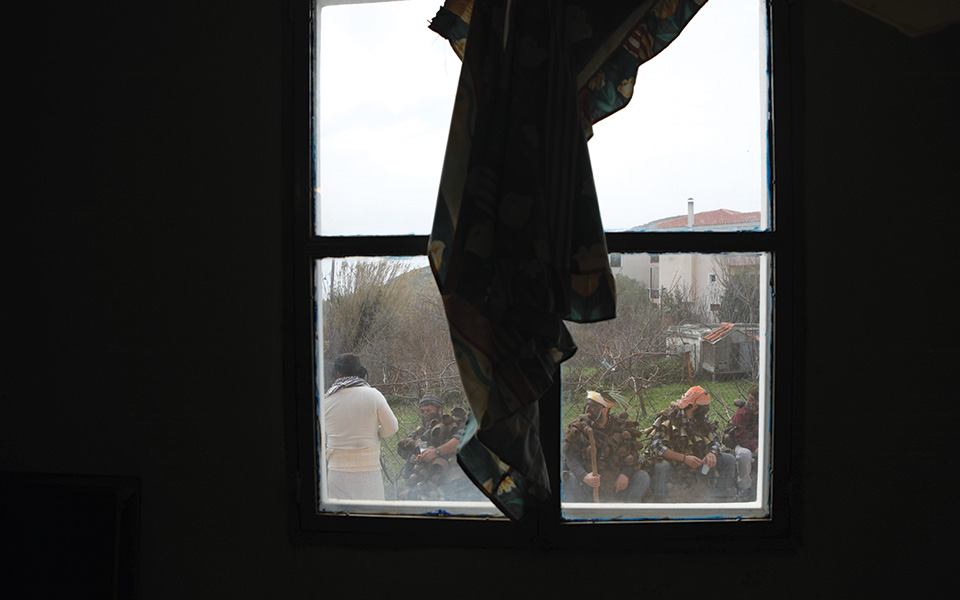
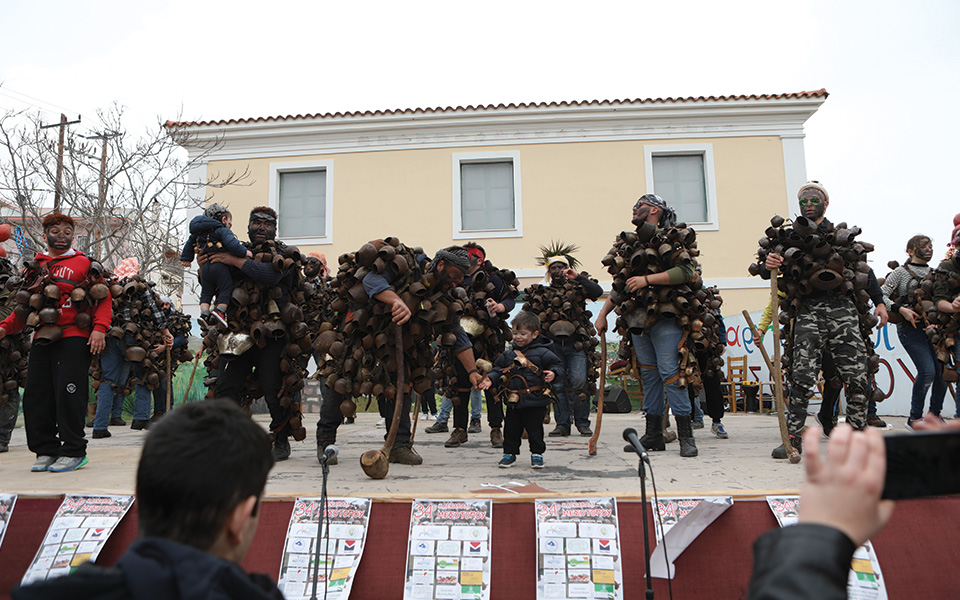
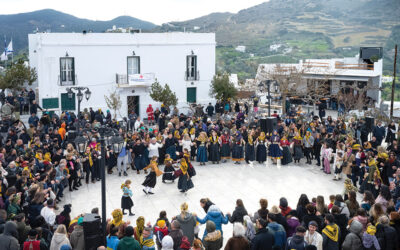
With confident strides and in a formation that begins in the upper village and descends into the cobbled lanes, the Koudounatoi, or “bell men,” of Mesotopos on Lesvos appear every Carnival in what seems a truly primordial procession. Men of all ages – from the moment they can stand on their own feet and for as long as their legs will carry them – strapped with dozens of shepherds’ bells, wrapped in heavy sheepskins and with blackened faces, brandish their koutskoudes, or phallic staffs, and let the sound of the bells shake the village. This great din accompanies a ritual march through the streets and alleys.
In the hillside village of about 600 residents, in the “Wild West” of Lesvos, the custom of the Koudounatoi forms the core of the Mesotopos Carnival. Strings of bells, some weighing more than 20 kilos, are fastened with leather straps across the chest, waist, and hips of the participating males. Until the 1970s, faces were blackened with soot from ovens; today, makeup and paint have replaced the old practice. Nonetheless, dressing up remains an initiation passed down from generation to generation.

© Elias Marcou
“The custom has its origins in Dionysian rites,” Panagiota Plomaritou, president of the Mesotopos Cultural Association Anagennisi, tells Kathimerini. “We cannot explain why we find it only in Mesotopos and not in the rest of Lesvos, but similar practices appear in certain parts of Asia Minor, too.” She recalls that, as a child, she was afraid of the Koudounatoi: “As they violently clanged the bells, they inspired awe.”

© Elias Marcou
The roots of the ritual stretch far back in time. The ritual Carnival performances – with mimetic dances, songs both seemly and bawdy, and representations of the mtsounelia, or spirits, who roamed the crossroads at night – are key to the function of the rite. The Koudounatoi, with winged gourds on their heads and phallic symbols on their shoulders, evoke fertility worship; the noise drives away evil spirits, awakens the earth and calls out for abundance. They descend into the village on the last two Sundays of Carnival, when the revelry reaches its peak. On the central stage, they dance the arap’kos, an erotic mimetic dance full of playful gestures and teasing, recalling the orgiastic atmosphere of the ancient Dionysia.
© Elias Marcou
Leading them is the broustnelas – usually the eldest – dressed more lightly, in a white undershirt with a large bell hanging in front so that he stands out “like a fly in milk.” Behind him, 30 to 40 men and boys keep the rhythm, shake their bodies and strike the ground forcefully with their koutskoudes.
In the past, explains Efthymis Vasiloglou, a driving force behind the Mesotopos Carnival, “The custom took place spontaneously among the men of the village. I remember them from the time I first became aware of the world.” By the late 1970s, the tradition had faded. “The bells fell silent.” In 1986, on the initiative of Loukas Vakalis, Vasiloglou stepped forward, and, since then, the Mesotopos Carnival has come back to life, with the Koudounatoi at its center.

© Elias Marcou
The village’s social geography also left its mark. “In the Upper Village, where livestock breeders predominated, the Koudounatoi appeared,” says Plomaritou. “In the Lower Village, home to farmers, the Evzones came out, wearing foustanellas made from tablecloths.” It seems this dual aspect of the local carnival celebrations reflects an older social balance.
“As children, we would climb onto the roof to watch the entire procession,” Athina Pipini, president of the Mesotopos Association, says. The spectacle still stirs excitement and amazes onlookers. In recent years, the Mesotopites’ Association Anagennisi has brought the custom to Athens as well, introducing the raucous Koudounatoi to a wider audience.
More than a culinary staple, olive...

A photographic journey through Lesvos.

From Lesvos and Chios to Ikaria...
Carnival on the island of Skyros...