An Athenian Gem Among the World’s 100 Best...
The Dolli at Acropolis Scores a...

© Illustrations: Christina Tsevis
Recently, there are fewer birds crossing Athens to head north for the summer. Conservationists point to a decline in their populations across Greece and Europe, and Athenians have noticed the change. The swallows and swifts that made their nests in building cavities and childhood memories are disappearing from the city center. It turns out the birds liked the Athenians as builders and gardeners, especially the way they accumulated things over time on their balconies. They wanted the city and its different kind of efficiency, all in order and slightly strained, the way it left things to be finished by future generations. But they didn’t want the heat.
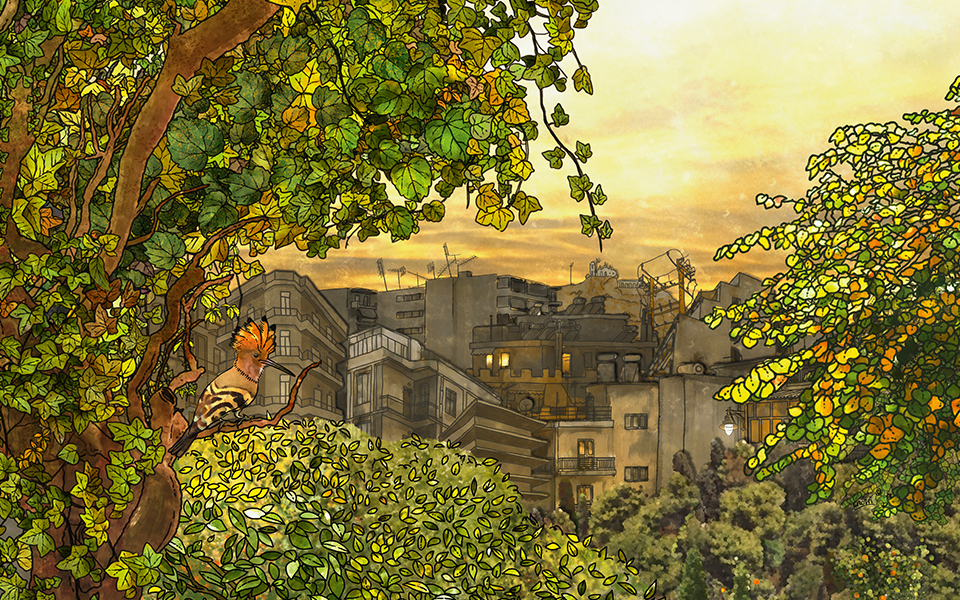
Among the birds that still come through Athens, a few Eurasian hoopoes arrive in the spring to spend a few days under the trees on Ardittos Hill. The hoopoes are kings and queens in full regalia and zebra coats. But even in this high-value real estate they seem positively out of place, a more intense order of reality than the warblers that you can barely distinguish in the gnarly branches of Aleppo pines and flowering Judas trees.
The trees create ground cover and filter the light in a way the hoopoe seems to like. And what does the hoopoe provide in return? Perhaps nothing the trees really need, but we don’t actually know. They don’t do business with the pine cones. They show up dressed for the opera stage. Some days, there’s so much singing and “hoopoopooing,”you might worry they’ve forgotten to eat.
There would be no safe place for the birds, except maybe the scavengers, if not for the idea to create hilltop forests in Athens sometime in the late nineteenth century. There’d be no soil on the slope for the hoopoe to march and drill with its rapier bill, if the trees and shrubs didn’t hold it there in place.
The forest on Ardittos and the nearby Pangrati Alsos were bald hills until first planted around 1908, and replanted after the trees were felled for fuel during World War II. Today the roots regularly fall out of the thin layer of soil sitting on solid rock that refuses to let them anchor. Trees must be continuously replaced by hand, and the soil actively protected from erosion.
There were certainly no trees on the hill in the 19th century. We know this from photographs. And there might be only one tree remaining a century from now if the planting doesn’t continue, or if there isn’t enough water to stop the trees from drying out in the desertifying heat.
It’s possible that, inside the city of Athens, there were never more than a handful of large trees visible at any one time over the previous 2,500 years. But trees were never absent from Athenian life: they belonged to sanctuaries, courtyards, water points, orchards, groves and the agricultural landscape surrounding the city. Plato mentions one plane tree nearby, just outside the city walls at the foot of Ardittos Hill, where Socrates warned his companion not to fall under the spell of the cicada song that was as dangerous as the Sirens’ call.
Elsewhere in his writings, Plato tells us that the mountains surrounding Athens were forested in the time of Atlantis. Which is to say, by the 5th century BC, there were few still living who could remember timber harvesting in the region. Instead, the Athenians established colonies near to forests in northern Greece to gain steady access to wood for the triremes of the imperial fleet. But we know that Athens always had trees of commercial value. And in the last 40 years we’ve learned a great deal about them from pioneering scholars such as Dimitris Karidis who have done painstaking work searching Ottoman tax documents and French shipping ledgers to trace the commodities exported from Athens between the 16th and 19th centuries. Some products were harvested from trees growing in the wild. For instance, we know that acorns from the majestic Valonia oak were used for tanning leather. They were gathered in abundance by Arvanite families from small stands scattered across the Attica countryside, and they left the Port of Piraeus in great quantities.
The olive tree was even more economically significant and it fueled international trade. Athens couldn’t grow enough grain to feed itself, so its olive oil exports paid for imported wheat. In 1671, the English traveler Bernard Randolph recorded some 50,000 olive trees in the Athens district of Elaionas. By 1827, Karidis estimates there were 250,000 olive trees meeting demand from traders in Marseille.
It’s easy to imagine the hoopoe loving the vast, low canopy of the olive grove. And Athenians also cared for it deeply. Legal documents suggest the grove was a chessboard of small holdings divided like the contents of a house. Marriage contracts, for instance, often stipulated the allocation of and care for olive groves, revealing social and economic relationships, as well as strategies for increasing harvest yields.
Athens was an ecosystem already adapted to drought conditions. It might not exist otherwise. But looking at 19th-century panoramas of Athens from a bird’s eye view, we mostly see ancient monuments emerging triumphantly but tragically from a barren landscape. There is beauty in these images, but they aren’t quite right. A real bird following these orientation points is likely to bake or starve to death.
Architect and urban historian Dimitris Philippides has spent decades exploring these ecosystems and creating a language to describe the efficient collaboration that sustained the city. Where he sees a poplar rising above the roofline, it marks a water source. A plane tree at an intersection in Plaka marks the neighborhood commons, while lemon, mulberry, and cherry trees peek over private courtyard walls.
“Everyday life testified to a different type of intimacy in which greenery emphatically participated,” Philippides writes, describing a social life organized around what Greeks call the avli: the courtyard, the church square or the neighborhood commons, where a tree might become part of daily existence and survival.
The hills around Athens were home to forests of evergreen brushwood, wild olive, carob and the occasional pine. But by the mid-19th century they were being stripped to fire lime kilns, removing the root system that traps rainwater on the limestone slope long enough to seep through the fissures to recharge the groundwater.
As the aquifers emptied, the natural springs that had long wet the roots of drought-adapted trees and provided the city with potable water were running dry. And without the roots to slow them, stormwater rushed down naked hillsides, overflowing the network of seasonal torrents that stretch across the plain, threatening everything in its path until the water wasted into the sea.
People began to see trees as infrastructure to capture water. By the 1870s, local politicians had realized that forestry should be practiced as a science and gardening should be taught as a technique. The Philodassiki Etaireia, a reforesting association created in 1899, established what would become the Pangrati Alsos as an experimental forest. In the following decades planted trees on Ardittos, Filopappou, Ymittos and elsewhere.
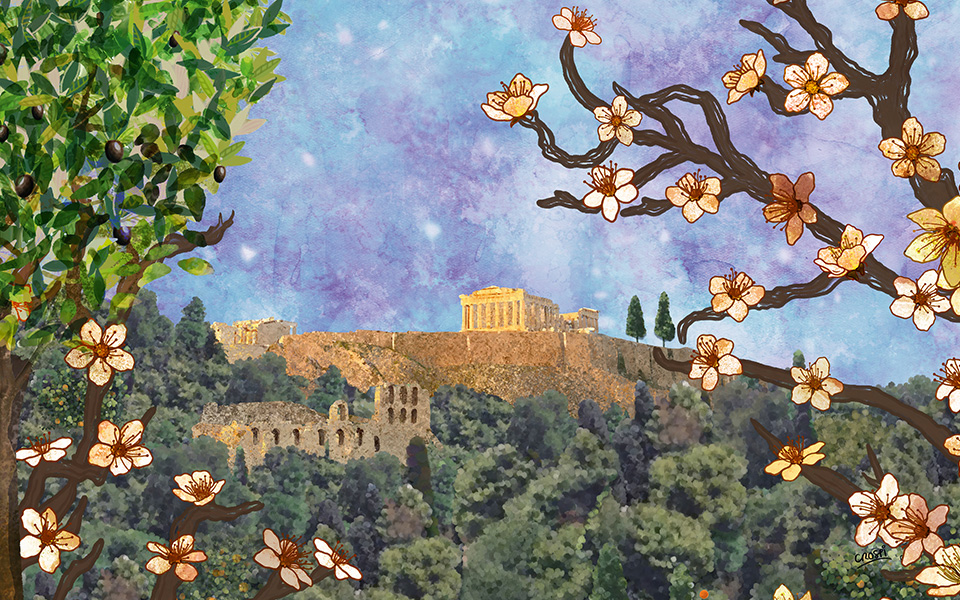
While reforestation was becoming an issue of public concern, the survival of trees was becoming a new ethos, a moral way of living rooted in metaphors of domestic intimacy. This was captured beautifully in an 1882 poem by Georgios Drosinis that, in 2026, remains part of the core curriculum for children in Greek primary schools. The poem is often read as a lesson in morality, but Drosinis also wants his readers to think as amateur gardeners. He is sure they know that the almond tree is the first to flower each year, sometimes as early as January. The flowers appear on naked branches, giving a brief illusion of life rising from death. But it is right after the blossoms fall and tiny green fruits begin to swell that the tree is most vulnerable. If a rainstorm hits right at this moment, the droplets will knock the young fruit off the branches. Excess moisture might cause the fresh fruit to split, yellow, and drop, ruining the tree’s reproductive cycle for the entire year.
In his poem, Drosinis looks from his bedroom window onto the courtyard as his young cousin “shook the flowering almond tree with her tender hands,” filling her hair and arms with blossoms. In her actions, he sees a youthful rush toward private pleasure, an act of impatience disguised as play. The tree showers her with blossoms and the poet can smell the violation in the air. He warns her tenderly about the danger of young fruit falling from the branches too soon. The poem was turned into a song popular with soldiers in the Balkan Wars, and the almond tree emerged as a symbol of springtime hope and lost youth. It was supercharged as a national hymn, and Drosinis complained that he had lost control of its meaning. In his memoirs, he recalled a flowering almond tree cut down to build his boyhood home on Pesmazoglou Street. When they started construction, the blossoms were mixed into the mortar and placed between the stones. But what felt like a magical ceremony did nothing to stop his brother dying in the house within a year, “as if he were dragged to the earth by the avenging sacrificed almond trees.”
Meanwhile, the Athens olive grove disappeared, tree by tree, until the number within the municipal borders had shrunk in 1967 to 15,000, according to historical data of the City of Athens. One final ancient specimen was said to be the tree where Plato convened his academy. It survived more than 2400 years until 1976, when it was mowed down by a careening bus. Its body, preserved for posterity in the museum of the Agricultural University, revealed what it always was, and that it was never merely wood. A visitor who stands in front of the broken tree thinking they are closer to Plato is actually standing in front of the proof that they are not. The tree memorializes a rupture in time that increases the distance and can no longer be repaired. To borrow cautiously from Orthodox theology, the tree seems to hold something of an uncreated force: not a fire that destroys, but one that passes through it. Like the burning bush, the tree becomes an image of matter touched by flame yet not consumed.

The survival of trees increasingly depends on their ability to compete with buildings and roads. The pugnacious cultural critic Kostas Varnalis turned to writing about nature during the Axis Occupation and Civil War, when the destruction of the food supply brought mass starvation and trees across the city were burned to survive the harsh winter. This became his language of resistance, a fight for survival conducted in code. Varnalis described a world in which the survival of trees would become a question of heritage, scaling up the old sense of domestic duty to the size of municipal parks and national forests. He imagined trees as a shared form of life, and forestry as a traditional craft rooted in the common sense of the gardener. This was a civic ethos that might resist the total collapse of society and outlast any political arrangement. And it required the state to act as the steward for trees, transforming them, at a larger scale, into what we would now call public infrastructure alongside roads and buses.
Approaching the end of the millennium, the tree canopy expanded at a faster pace. By 1986 the total number of trees counted by the City of Athens had surpassed 200,000 in urbans parks, squares, and flanking streets. The hills surrounding the Athens basin were planted again with pine trees that grew taller than ever in history. Childhood memories today are filled with the scent of flowering trees and bird song as if they had always been there. Forestry specialists identified the ecosystem services provided by trees, adding another substantial line for their defense: trees provide cooling shade and humidity, prevent soil erosion, and add carbon storage.
The difficult question is whether the combination of memories and services will be strong enough to defend them when buildings are seen as a more valuable use of real estate. Citizens and environmental groups cannot sue as companions of trees on their behalf, they have to sue on the grounds of procedural violations, urban planning laws, or constitutional protections of the environment.
One response is to rebuild this relationship through Adopt-a-Tree programs. Iosif Botetzagias, Professor of Environmental Politics & Policy at the University of the Aegean, has spent years reconstructing the history of Greek forestry, including the century-long campaign to cast shrub-eating goats as the enemies of reforestation. Today, he is watching another strategy designed to formalize the human-tree bond. While adoption programs are usually pitched as ways to improve tree survival and offset municipal overhead, Botetzagias also sees a deeper value in “establishing a personalized human-tree connection” that “may enhance the citizens’ concern for the trees and the forests, in general; very much in the way that individuals’ perceptions about animals change considerably after adopting a pet.” He notes that, according to Herodotus, Xerxes stopped his invasion of Greece to honor a spectacular plane tree he encountered on the way, offering it golden ornaments and assigning it a permanent guardian. Whether this was honorable or hubris, Herodotus doesn’t say.
Yet re-establishing trees as companion species may require more than goodwill. The City of Athens has appointed city officers focused on climate resilience and heat preparation to develop a technical response. There is also an effort to promote street-level awareness through several interactive maps. One shows the existing tree cover and helps users chart a walking route protected by tree shade. Another shows the Heat Risk Index compiled using satellite and sensor data for every neighborhood. A third maps the location of more than 12,000 trees planted by the city since 2024.
Layering these maps over each other, we see that trees are being planted everywhere in the city, although the rate remains higher where tree canopy is already dense and heat risk the lowest. This suggests that many plantings are replacements for dead trees or plantings in tree-dense parks. It also indicates the difficulty Athens faces in changing land use so that it can plant new trees in spots where none have stood before.
Leonidas Economou, Professor of Urban Anthropology and Popular Culture at Panteion University, has spent years studying the evolution of the civic ethos in Athens. Pointing to the forest fires that have grown more intense over the last ten years, he says that the publicity around saving particular trees can obscure a process of destruction that is unfolding more quickly and on a much larger scale. He believes Athenians have developed “this concentration camp indifference that is characteristic of people living in environmentally hazardous environments.” In other words, it’s not that Athenians don’t know what’s happening, it’s that they have stopped perceiving forest deterioration as exceptional. Knowing what is going on, and what is at stake, may no longer be enough.
Athens has trees throughout the city available to anyone who lives here or pays a visit. It is also a crowded place that needs more trees, and where every square meter is already being used for something else. If the risk of planting a tree is that it occupies space that could otherwise be generating revenue or rent, the tree will never win.
And so, the lemon tree migrates to the balcony in a pot. The olive tree becomes a national symbol. The almond tree becomes a poem that people remember. The hoopoe arrives for a few days and leaves. And the orange blossoms in the streets remain democratic in a way that only smells and the flowers that bring them can be. They ignore property lines. They smell the way they smell regardless of whether anyone is paying to receive it, or understands it, or writes an essay about it.
The Dolli at Acropolis Scores a...

Old and new haunts, stories from...
From Christmas markets to New Year’s...
Working across art, craft and design,...