Discovering Archaeology in the Athens Metro
Beneath the busy streets of modern...

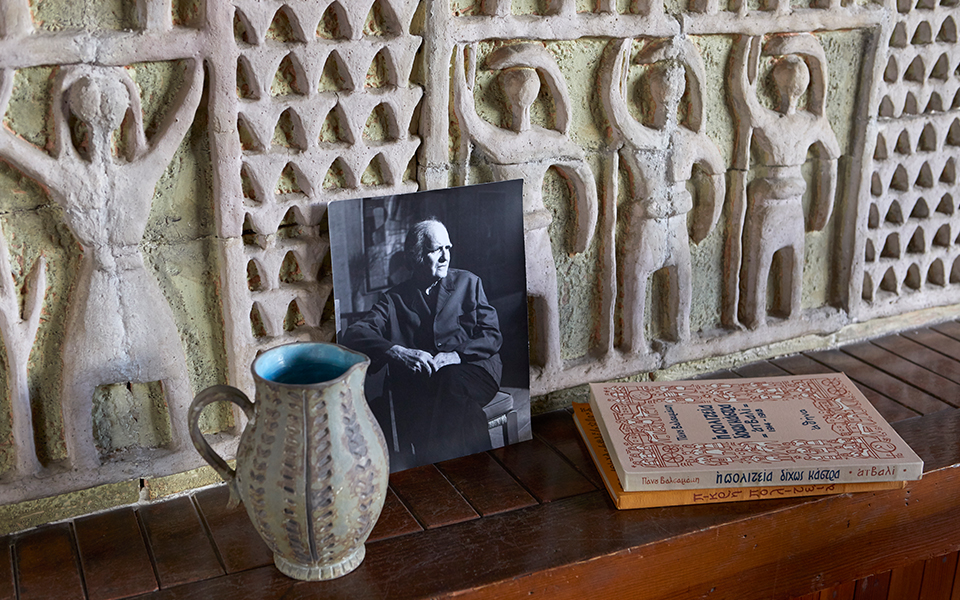
A photograph of ceramic artist Panos Valsamakis, next to a book of poetry he wrote and one of his memoirs.
© Giorgos Vitsaropoulos
Scattered around Athens, more than 100 building entrances are adorned with precisely hand-painted tile tapestries made by the godfather of Greek modern ceramic art, Panos Valsamakis.
Commissioned by discerning patrons in the 1960s and ’70s, the pieces tell stories of ancient warriors and refugees, or feature family portraits and scenes from rural Greece and village life.
Many of the tiles, including one covering a door in Plaka, pay tribute to the people and environment from Valsamakis’ long lost home in Aivali, Turkey – now Ayvalık – where he was born in 1900. His family was driven out in the early 1920s during the Asia Minor Catastrophe, when hundreds of thousands of Greeks were forced to leave the country.
While the number of those Valsamakis tiles on Athens’ streets has dwindled over the years amid the city’s rapid transformation, the innovative artist’s spirit continues to be present in the scores of pieces that Valsamakis Ceramics designs, produces and sells.
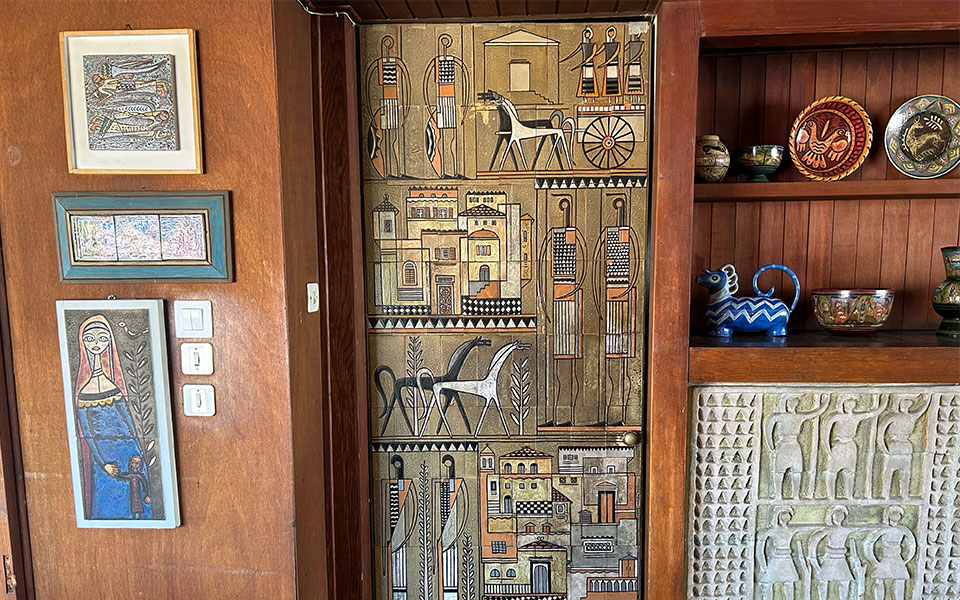
A ceramic tile art door by Panos Valsamakis, in the Marousi home.
© Alexi Friedman
The business that Valsamakis started – and later handed to his son, Alekos and daughter-in-law Afrodite – is now run by his grandchildren, Panos, 53, named after his grandfather, and Sofia, 57. Since taking over the workshop seven years ago, they have expanded and modernized it while respecting Valsamakis’ exacting methods and distinctive style; buyers can now help design their own ceramic tile tables, fire mantles, mirrors and large wall installations.
To coincide with the 40th anniversary of Valsamakis’ death in 1986, Panos has discussed with museums about a retrospective exhibition of his grandfather’s work. Meanwhile, Sofia is creating an archive, cataloging hundreds of Valsamakis design drawings, along with articles, speeches, photographs, videos and other material their grandfather amassed during his life.
In many of Valsamakis’ most intimate works, the viewer is drawn to his subjects’ almond-shaped, compassionate eyes. His pieces were always about the past.
“The [Asia Minor] Catastrophe was a big blow for him; he lost two brothers there,” Panos explains. After the family fled Turkey, Valsamakis studied art in France before settling in Athens in 1930 to specialize in ceramics. His sharp-lined tiles represent the “memories of how my grandfather’s life was before the catastrophe and all the danger they faced during that time,” Panos adds.
Today, Valsamakis Ceramics continues to operate from the same Marousi home that architect Michalis Orros designed in the early 1960s, with showroom and workshop on street level, and residence above. Even though the shop now employs five artisans, Afrodite, 83, continues to design and create tiles. Her husband Alekos died in 2010.
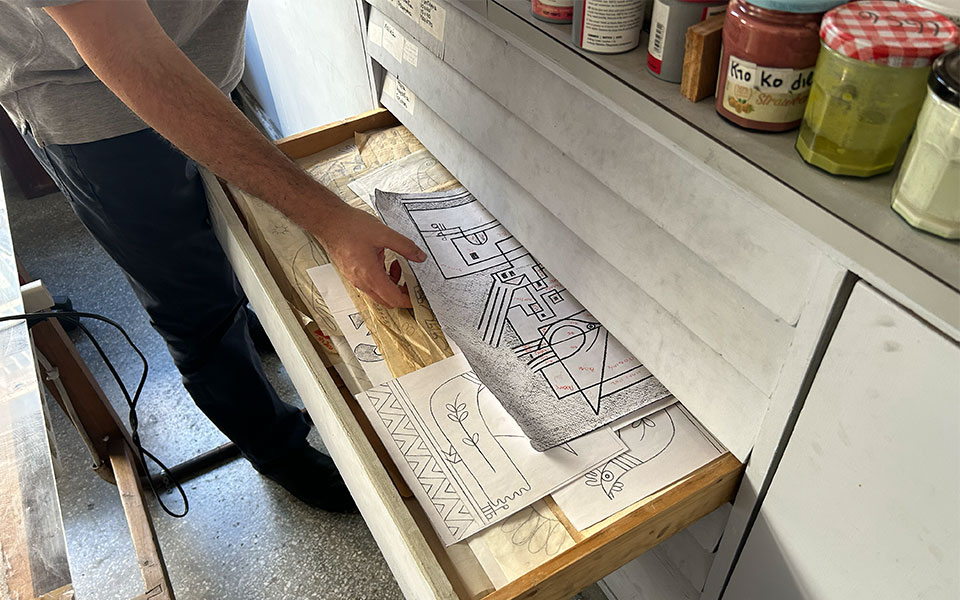
One of the drawers full of Valsamakis' sketches, in the workshop.
© Alexi Friedman
Sitting in his Marousi living room on a recent afternoon, surrounded by ceramic tiles, bowls, plates, sculptures, vases and paintings his grandfather created, Panos speaks with quiet reverence for the man who, he says, combined modern art with folk art and had a passion for architecture. “I think that’s the reason why many of his designs are geometric,” Panos explains.
The house, which also serves as a museum of sorts, includes a ceramic tile door upstairs that depicts village life, another Valsamakis original. The home has been featured in the annual “Open House Athens” showcase as a preserved heritage residence and workspace.
Seeking to spark further interest in their grandfather’s work, Panos and Sofia introduced a weekly ceramic art experience for beginners, where participants tour the upstairs then design, decorate and take home their own 10×20-centimeter kiln-fired tile, using the same methods the Valsamakis workshop employs. The company has also experimented with new colors for its tiles and replaced its old kiln; the new one fires at a higher temperature, locking in brighter, longer-lasting glazes.
“The tours and classes help inform people about our history – that our ceramics are a part of the culture of Athens,” Panos said. “ Many visitors tell us they grew up in homes filled with our ceramics. Some who come to the house get very emotional, they can’t even speak.”
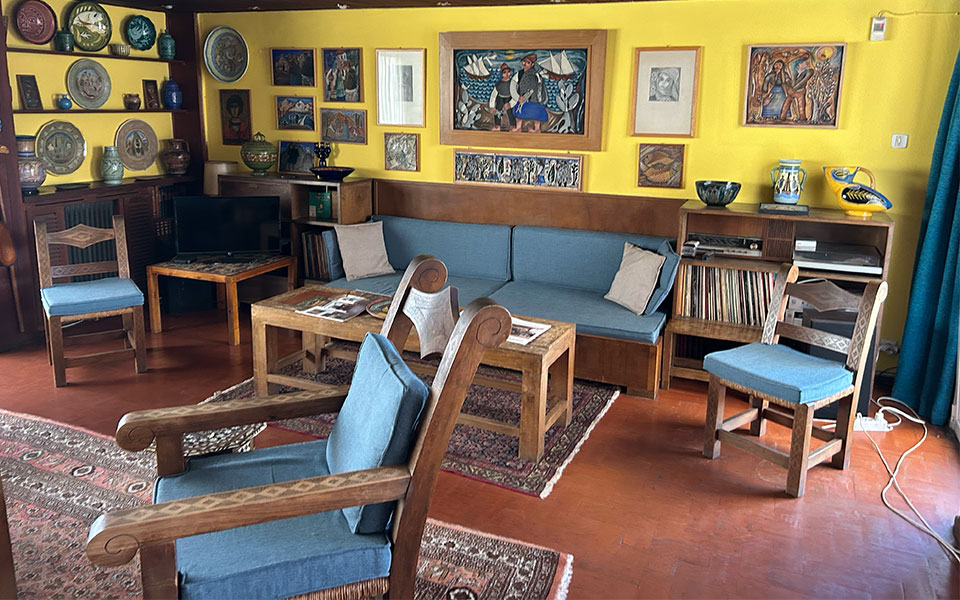
Valsamakis' creations decorate the upstairs living room in the Marousi home and workshop.
© Alexi Friedman
There are legions of Valsamakis fans from outside Greece who visit the store or order pieces online as cultural souvenirs, but the workshop also has its local admirers. Among them is Tina Daskalantonaki, curator of the gift shop at the Museum of Cycladic Art in Athens, which sells Valsamakis pieces.
“What I found in Valsamakis’ story – because it is a story, a part of Greek heritage – is its authenticity. There is respect for history, and so the grandson continues his grandfather’s and father’s work.” When Daskalantonaki looks at a Valsamakis tile portrait, she sees echoes of Greek embroidery. “It’s what women in the villages used to wear every day. He somehow translated that into tiles, alongside influences from many artists like [folk art painter] Theofilos and [artist] Yiannis Moralis. And when you look at his doors in Plaka, you can tell he introduced us to something new there. He is one of the most important ceramic artists in Greece,” she said.
Daskalantonaki, who owns several Valsamakis pieces, including sunset and sunrise tiles, hopes to convince Panos to recreate some of his grandfather’s tile work and plate designs that haven’t been made in years.
In addition to its website, Valsamakis Ceramics also sells pieces on Etsy. Older examples of his work are also auctioned and sold in galleries, indicating interest among higher-end art buyers.
Valsamakis pieces bear simple titles – “Girl with Turquoise Headscarf,” “Greek Family Village,” “Mother and Child Portrait” – and are adorned with thin wood frames.
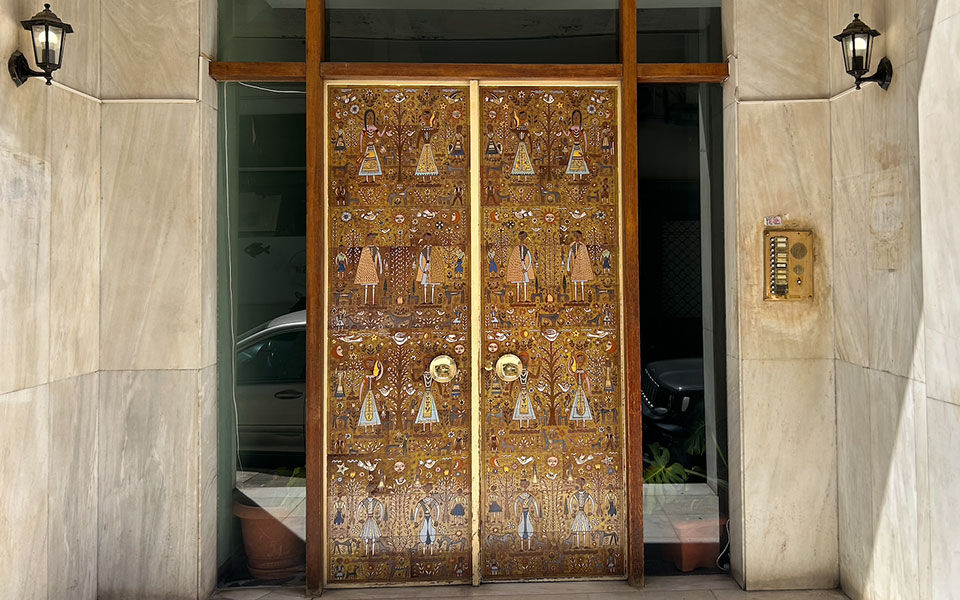
A Valsamakis ceramic tile door at a Plaka apartment building entrance.
© Alexi-Friedman
Recently, Valsamakis Ceramics collaborated with Athens-based home decor and fashion shop Anthologist on a custom project. Owner and creative director Andria Mitsakos commissioned the workshop to create a version of the store’s logo, a chimera, the mythological figure that is part lion, part goat and part serpent.
Mitsakos saw similarities between Valsamakis’ work and the renowned painted pottery tradition of Vallauris in the south of France. She also noted resonances with artistic aesthetics from the Jazz Age through the Midcentury period. “That’s what resonates with me,” she says. Mitsakos spent time at the Valsamakis workshop, looking through some of his old sketches that haven’t been produced; to date, about 2,000 original designs have been made into tiles. She also listened to stories about Valsamakis’ life, including the time in 1957 when he sat on an art competition jury alongside Picasso – one of his influences – who was working with ceramics at the time and praised Valsamakis’ style.
Being recognized by such a luminary was significant, Mitsakos says, “because in Greece, ceramic artists were not as lauded as artists who painted on canvas. It was interesting because obviously in other parts of the world they were so celebrated. But the Greek mentality often waits for outside recognition before appreciating something as cool.”
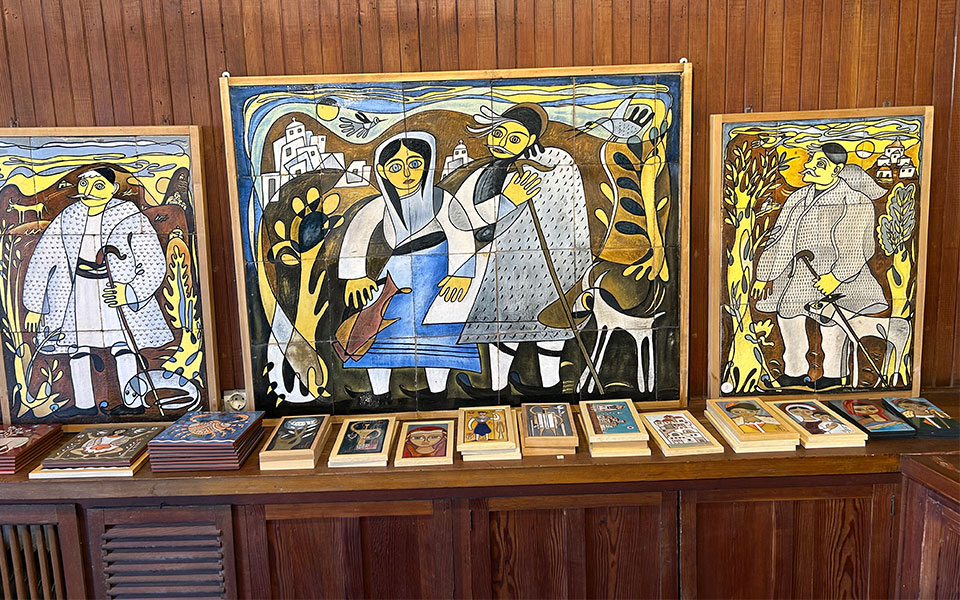
A running theme for Panos Valsamakis in his ceramics was looking back on the place of his childhood.
© Alexi-Friedman
Valsamakis’ stature rose through the years as he grew more experienced. He spent 12 years working in a ceramics factory in Kerameikos – the historic Athenian district once home to potters and artisans – until 1942 when the German occupiers took over the space. He relocated to Lavrio, a coastal town about 50 kilometers south of Athens, where he became director of a ceramics factory, focusing on every-day and special-occasion pieces – including dinnerware and sets for weddings. He also created his own pieces at his small home studio, and sent those to local galleries. Soon, Valsamakis struck out on his own, introducing to Greece some of the techniques he learned from France, along with modern production methods and creative ways to market his pieces, just as Greece was entering a housing boom – an ideal time for promoting ceramics as home décor. And the image of home was never far from his mind.
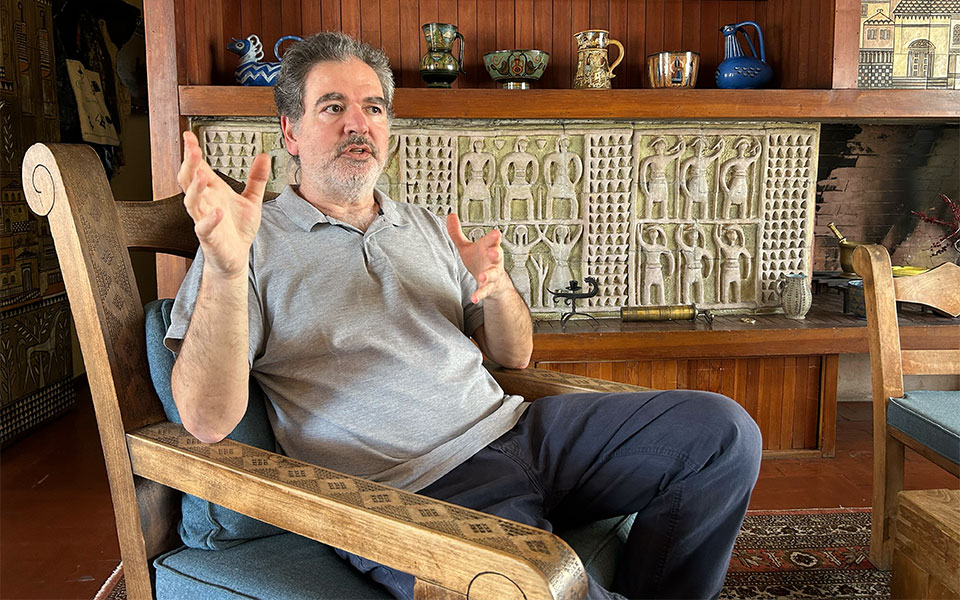
Panos Valsamakis in the family living room, with some of his grandfather's work in background.
© Alexi Friedman
Besides honoring his birthplace through his artwork, Valsamakis wrote two memoirs and a book of poetry, recounting his years in Aivali. Panos recalls his wife Konstantina reading one of the memoirs and pointing out a vivid passage: a description of a painting of the Virgin Mary in a church, where her eyes were described as large and sympathetic. “I think he was influenced by these paintings because the eyes he created were so expressive,” Panos says. A religious man, Valsamakis often created portraits of saints; his rendering of Saint George is one of Daskalantonaki’s favorites.
The distinctive eyes in Valsamakis’ subjects communicate a longing and sadness for a place left behind, Panos adds.
Among the objects in the Marousi living room is an iron key from the home in Aivali. “When my grandfather and his family left, they locked the door because they thought they would return some time in the future,” Panos says. “He never went back. Some of his friends went in the 1970s or 80s, but he wasn’t interested. The place wasn’t the same.” The home, which was next to a beach, was later demolished to make way for an office building.
Beneath the busy streets of modern...
Discover five of Athens’ latest openings,...
Here are some of our favorite...

The Kerameikos archaeological site provides a...