5 Greek Villages Compete for the “Best Tourism...
These are Greece's nominees for this...


Roger Moore with French actress Carole Bouquet during the filming of For Your Eyes Only, the James Bond 007 movie, in February 1981.
© Keith Hamshere/Getty Images/Ideal Image
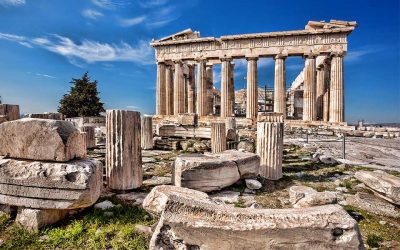
Matt Damon as Odysseus in Messinia, Lily Collins in Mykonos for Emily in Paris, Brad Pitt on Hydra for the filming of The Riders: in recent months, major international productions have once again turned Greece into an open-air movie set. Yet the relationship between Greece and the screen stretches back decades. Audiences have watched Lara Croft (Angelina Jolie) roam Milos and Santorini, seen John le Carré’s The Little Drummer Girl come to life at the Acropolis, and followed the adventures of The Durrells in Corfu.
Further back, films such as Shirley Valentine (1989; shot in Mykonos), Summer Lovers (1982; shot in Crete and Santorini), and The Guns of Navarone (1961; shot on Rhodes) helped introduce Greek destinations to international audiences. In some cases, however, Greece was more than a backdrop. The locations themselves became stars. The films went on to inspire generations of travelers eager to experience for themselves Sophia Loren’s Hydra, Melina Mercouri’s Piraeus, Anthony Quinn’s Crete, Luc Besson’s Amorgos, Roger Moore’s Corfu, Penélope Cruz’s Kefalonia, Meryl Streep’s Skopelos, and Ethan Hawke’s Messinia.
In the summer of 1955, the Greek public learned for the first time that Hollywood giant 20th Century Fox was planning to film Boy on a Dolphin on the island of Hydra. According to producer Samuel G. Engel, the film would introduce Greece to American audiences. As archaeologist Dimitris Plantzos notes in “Hollywood, Greek Antiquities and the Kindness of Strangers,” published in the collective volume The 20th Century of Greek Cinema, the film contained “most of the characteristic elements that were used to redefine Greece’s image for the global tourism market during the 1960s and 1970s, as an exotic landscape of eternal summer.”
The Greece presented on screen was one of whitewashed chapels and ancient ruins scattered across the arid landscape and beneath the sea. Local women were portrayed as sensual and warm-hearted, while men appeared short, dark-haired and somewhat uncivilized, approaching life with uncomplicated simplicity. “This distinctly American way of viewing Greece,” writes Plantzos, “was consciously crafted for a broader middle-class audience eager to consume culture as a commodity and to embrace international travel as a new form of leisure.” The film unfolds as a dazzling montage of Greek landmarks, from Rhodes and Mykonos to Epidaurus, Meteora and, of course, the Acropolis of Athens. Ancient treasures, endless shades of blue, newly opened restaurants, and cosmopolitan seaside resorts all feature prominently. At the center of it all stands Sophia Loren as Phaedra, a young woman from Hydra who dives into the sea in search of sponges and instead discovers the mysterious “boy on a dolphin.”

Never on Sunday
© AFP/Visualhellas.gr
In Never on Sunday, the Greece of the early 1960s – in which Homer (Jules Dassin), an American intellectual, falls in love with Ilya (Melina Mercouri), a carefree prostitute from Piraeus – is a country full of movement, music, and life in harbor tavernas. Yet it is also a land of ancient monuments and everyday pleasures, where the Acropolis coexists with an unpretentious popular culture; a place where ancient grandeur coexists with modern-day freedom and escape.
The film was an enormous success. Melina Mercouri won the Best Actress Award at the Cannes Film Festival and received an Academy Award nomination, while The Children of Piraeus, the title song composed by Manos Hadjidakis, won the Oscar for Best Original Song, helping bring international attention to Piraeus. “With Never on Sunday, you made Piraeus known throughout the world,” Andreas Papandreou would later tell Mercouri while encouraging her to run for office there. The film is also widely believed to have contributed to a significant rise in tourism to Athens. According to data from the Hellenic Statistical Service, visitor arrivals reached 164,287 in 1960. They increased by 21% in 1961, by a further 21.5% in 1962, and by another 28.5% in 1963.
Anthony Quinn dancing the syrtaki on the beach of Stavros produced what remains the definitive image of the Greek summer. Michael Cacoyannis’s film, which won three Academy Awards, gave birth to an archetype of Greek identity that continues to endure in the international imagination: the authentic, larger-than-life character who embraces life with unrestrained passion. At the same time, the film helped establish Crete as an international tourism destination. “Thousands of Northern and Western Europeans, in search of sunshine, flocked to the island seeking Zorba, its golden beaches, and Crete’s fascinating history,” write professors Dimitris Koutoulas and Rodanthi Tzanelli in an article published in Tourism Critiques: Practice and Theory.
The figures they cite demonstrate the film’s remarkable impact on the island’s tourism industry. In 1964, Crete accounted for just 1.9% of Greece’s total hotel capacity. By 1990, the island’s hotels represented 17.7% of the country’s accommodation capacity, with 77,678 rooms, far surpassing both mainland Greece and Rhodes. As this tourism infrastructure expanded, visitor numbers soared, aided by the introduction of direct charter flights from European cities.
In 1970, Crete recorded 732,646 hotel overnight stays, and by 1982 it had overtaken Rhodes to become Greece’s most popular tourist destination. “Crete’s high international visibility and the desire of so many people to follow in Zorba’s footsteps made the film a catalyst for the island’s success,” the two scholars conclude. They also note that the most dramatic increase occurred in 1965, at the height of the global “Zorbamania” phenomenon. International arrivals to Greece rose from 757,495 in 1964 to nearly 29% more in 1965, according to data from the Hellenic Statistical Service.
Millions of viewers watched in suspense as Roger Moore climbed a towering rock face while his enemies attempted to send him plunging to the ground below. The setting was Meteora and the film was For Your Eyes Only, the twelfth installment in the James Bond franchise. The story began much earlier. Following the futuristic Moonraker, Bond producers opted for a more grounded adventure and selected Greece as the principal setting for the legendary spy’s next mission. Director John Glen and screenwriter Michael G. Wilson were particularly captivated by Corfu, believing the island could “play” a variety of roles throughout the film, according to the Bond fan site On the Tracks of 007.
Filming began in September 1980 at the Villa Sylva estate in Kanoni. Additional scenes were shot at Achilleion, the Old Fortress of Corfu, and the village of Kalami. The real challenges emerged in October when the production moved to Meteora. Despite having obtained official filming permits, the filmmakers faced opposition from local monks, forcing them to construct replica sets for some scenes. Nevertheless, the effort paid off. Spectacular images of Meteora’s soaring rock formations and Corfu’s lush landscapes reached audiences around the globe, helping turn the film into a major commercial success, grossing $195.3 million worldwide. In the process, For Your Eyes Only offered millions of moviegoers a dramatic introduction to two of Greece’s most distinctive destinations, further strengthening the country’s image as a place where breathtaking scenery and cinematic adventure go hand in hand.

Dance scene from the movie Mamma Mia!
© AFP/Visualhellas.gr
Greece was going through a turbulent period when a feel-good musical packed with Hollywood stars created one of the most defining postcards of the modern Greek summer. While the country grappled with political and social tensions, audiences abroad were watching Meryl Streep, Pierce Brosnan, and Colin Firth wander through a sun-drenched Greek island paradise to the music of ABBA. For many, it was enough to place Greece at the top of their holiday wish list.
Mamma Mia! transformed Skopelos into the setting of a cinematic dream wedding, while reinforcing an image of Greece built around whitewashed chapels, turquoise waters and carefree island life. Following the film’s release, bookings on the islands featured in the movie increased by approximately 10% in 2009, although the positive impact had already begun to be felt during the summer of 2008. Skopelos’ mayor at the time, Christos Vasiloudis, reported that tourist arrivals in August 2008 were already 5% higher than during the same period the previous year. An article in The Guardian even referred to the phenomenon as the “Mamma Mia! Effect.” “People keep calling and asking how they can come to our own ‘Mamma Mia! paradise,’” the mayor added.
The film also sparked a boom in destination weddings. A local travel agent described receiving inquiries from prospective visitors in England, Hungary, and Australia who wanted to know whether they could marry on the island, host champagne parties, or even purchase property there. Some went so far as to ask whether they could privately rent the beach or the tiny hilltop church of Agios Ioannis Chapel, where the movie’s wedding scene was filmed.
The effect became even more pronounced after the DVD release. According to a report in The Times, one travel specialist said that she and her husband helped organize around 100 weddings on Greek islands the following summer. “After the DVD came out just before Christmas, our bookings jumped by 60%,” she explained. “It was extraordinary because it happened at exactly the same time the financial crisis was beginning.” More than a box-office success, Mamma Mia! reshaped the international image of the Greek islands for a new generation of travelers. For many visitors, Skopelos was no longer simply another destination in the Aegean—it had become the real-life setting of a cinematic dream.
At the dawn of the new millennium, an Italian soldier, played by Nicolas Cage, falls in love with a young Greek woman, portrayed by Penélope Cruz, on the island of Kefalonia. The result was Captain Corelli’s Mandolin, a film that would leave a lasting imprint on the island’s tourism industry. Three years after its release, traces of the film’s influence remained visible throughout Argostoli, Kefalonia’s capital, as documented in an academic article by K. O’Neill published in Anatolia: An International Journal of Tourism and Hospitality Research. Jewelry inspired by the film, wines bearing Captain Corelli’s name, and photo albums celebrating the production could still be found in local businesses and restaurants.
The film’s impact, however, extended far beyond souvenirs. According to the study Using Films as a Tourism Promotional Tool: The Case of Greece by P. Moira, D. Mylonopoulos, and Aikaterini Kontoudaki, the movie contributed to a 14-16% increase in tourist arrivals to Kefalonia. The following year, the island became the eighth most popular European destination among British travelers. The surge in British visitors also stimulated the local real-estate market, reinforcing Kefalonia’s transformation from a relatively quiet Ionian island into an internationally recognized holiday destination. More than two decades later, the film remains closely associated with the island’s image abroad, demonstrating the lasting power of cinema to shape travel dreams and influence tourism patterns.
In 1988, the French fell in love with Amorgos, and a stroll around the island today is enough to confirm that the romance is still very much alive. That was the year when Luc Besson introduced the easternmost island of the Cyclades to the world through The Big Blue, the story of two childhood friends united by their passion for free diving. As Leda Gianouklidi notes in her study The Effect on National Tourism from Filming in Greece, the success of the film led to a significant increase in visitor numbers to Amorgos, particularly from France. Tourist arrivals began rising even in May, traditionally considered the start of the shoulder season, and a number of French visitors went on to purchase homes on the island.
The film’s legacy has endured for decades. In 2016, actor Jean-Marc Barr met Gregory Forstner, who had portrayed the young Enzo, for the first time at Amorgos’ first free-diving tournament. The event later evolved into the internationally renowned Authentic Big Blue, one of the world’s leading freediving competitions. Twenty-five years after the film’s release, Besson himself returned to dive in the waters below the iconic Monastery of Hozoviotissa, which features prominently in the film, describing Amorgos as a magical island. More recently, the 2023 French comedy-drama Two Tickets to Greece once again turned the spotlight on Amorgos, following two friends who had first fallen in love with the island as teenagers after watching The Big Blue. So if you hear French being spoken on Amorgos today, you probably know why.
In 2013, it was the turn of Messinia to step into the spotlight. In the third and final installment of Richard Linklater’s acclaimed Before trilogy, Ethan Hawke and Julie Delpy reunite nearly two decades after their characters first met, this time against the backdrop of the Peloponnese coast, beneath fiery sunsets and star-filled skies. Following the film’s release, passenger traffic at Kalamata International Airport increased significantly, although this growth should also be viewed in the context of the broader expansion of tourism infrastructure and investment that was transforming the region at the time. Nevertheless, the film’s portrayal of Messinia functioned almost like a feature-length advertisement for what had until then remained a relatively undiscovered Mediterranean paradise.
The international media quickly picked up on the phenomenon. In an article published in The Guardian, a travel writer noted: “You, too, can now stay in the Before Midnight Suite at the luxury resort where the couple stay in the film,” referring to Costa Navarino. The movie’s idyllic depiction of the region extended beyond tourism and into the real-estate market. In July 2013, The Times published an article highlighting potential investment opportunities in the area, observing: “As a hit film shines a spotlight on this unspoiled region, rock-bottom property prices could soar. Is now the time to take a gamble and invest in Greece?”
These are Greece's nominees for this...

A practical “all-terrain” guide to getting...

Christopher Nolan's The Odyssey is already...

For nine days, during the 15th...