8 Hidden Greek Museums Just Steps from the...
From olive presses and traditional costumes...

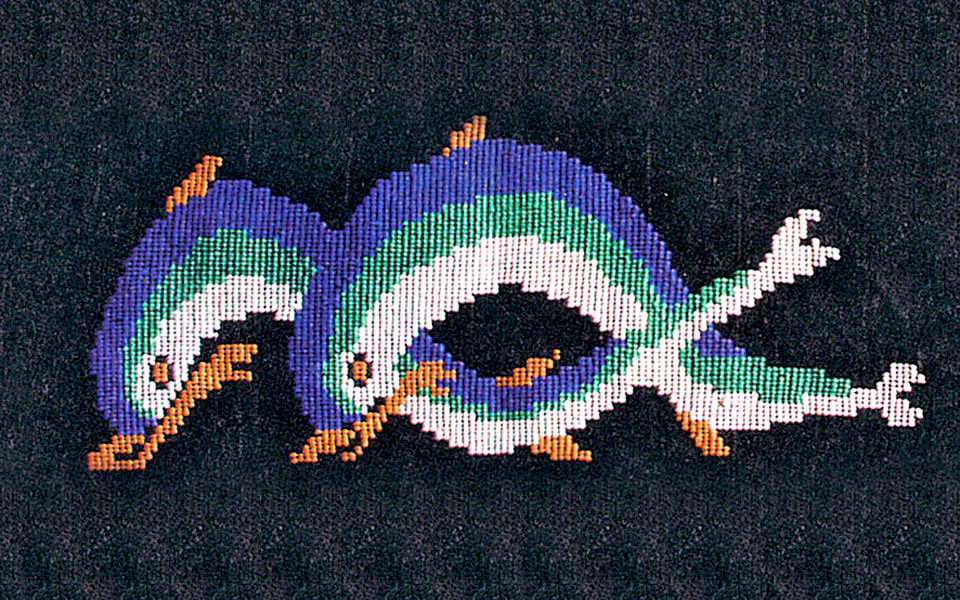
Hem detail from woven skirt, decorated with Delian dolphin motif, from the collection of Frasko Monogiou-Syrianou.
© Panagiotis Chatzidakis
In 1962, German philosopher Martin Heidegger offered the following description from his trip to Delos – the “island of islands” – in his Sojourns: The Journey to Greece: “In the morning the boat glided slowly on the calm water toward Delos… We were just disembarking when we met with some women forming a line along a barely seen path. They had spread out colorful textiles and embroideries for sale – a joyful spectacle, witness to a poor but assiduous life.”
What Heidegger saw that day was, in fact, part of a very long tradition. Archaeological finds from Mykonos and the neighboring islands of Delos and Rhenea tell us that, even in ancient times, textile weaving here was extremely sophisticated, as indeed it was in other parts of Greece. As the centuries went by, the custom remained strong here. The women of Mykonos would spend hours at their looms every day, creating their family’s wardrobe, household linens and other necessities, and enriching their daughters’ dowry chests – in addition to all their other household chores. It was not an easy life.
“Archaeological finds from Mykonos and the neighboring islands of Delos and Rhenea tell us that, even in ancient times, textile weaving here was extremely sophisticated.”
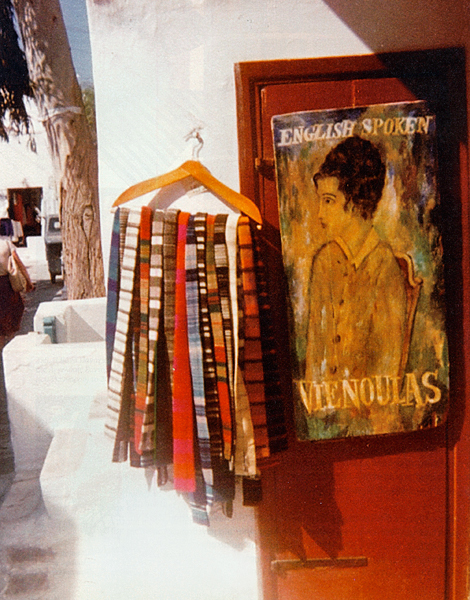
The shop of Vgenoula, a famous weaver. Seen hanging beside her colorful ties, that once took fashionistas by storm, is a portrait of her daughter Amalia, painted by Luis Orozco.
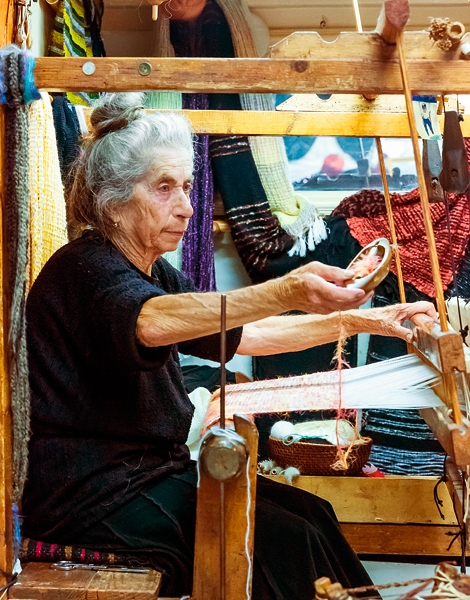
73 year-old Niki Xidaki in Little Venice is one of the last weavers active on the island.
© Dionysis Kouris
The advent of tourism, however, changed not just the island, but the lives of these women as well. Early excavations of Delos in the late 19th c. and organized cruises in the 1920s brought thousands of visitors seeking authentic experiences and products to the Aegean archipelago. As outside interest in Mykonian textiles grew, Mario Zouganeli (1885-1965) played a critical role in getting her fellow island women to see the products of their looms in a newer, more commercial light. One of the women she influenced was Vgenoula Kousathana (1907-1984), a skilled and forward-thinking craftswoman who decided to experiment with new items that she could sell. She began by making trousers and silk throws, and tourists bought them. Her work even earned her a story on the front page of the newspaper Mykonos in 1934: “She is doing brisk business with her textiles. Aside from common cloth, she has now started weaving shoes for the promenade that her husband then soles with rope.”
The other women soon followed suit and all together they managed not only to improve their family’s lot in life, but also to contribute to the island’s fortunes. The first sign of international recognition came in 1937, when the textiles of two Mykonian merchants – Theodoros Harakoulos and Taro Kodizas – won awards at the famed Exposition Internationale des Arts et des Techniques in Paris.
“As outside interest in Mykonian textiles grew, Mario Zouganeli (1885-1965) played a critical role in getting her fellow island women to see the products of their looms in a newer, more commercial light.”
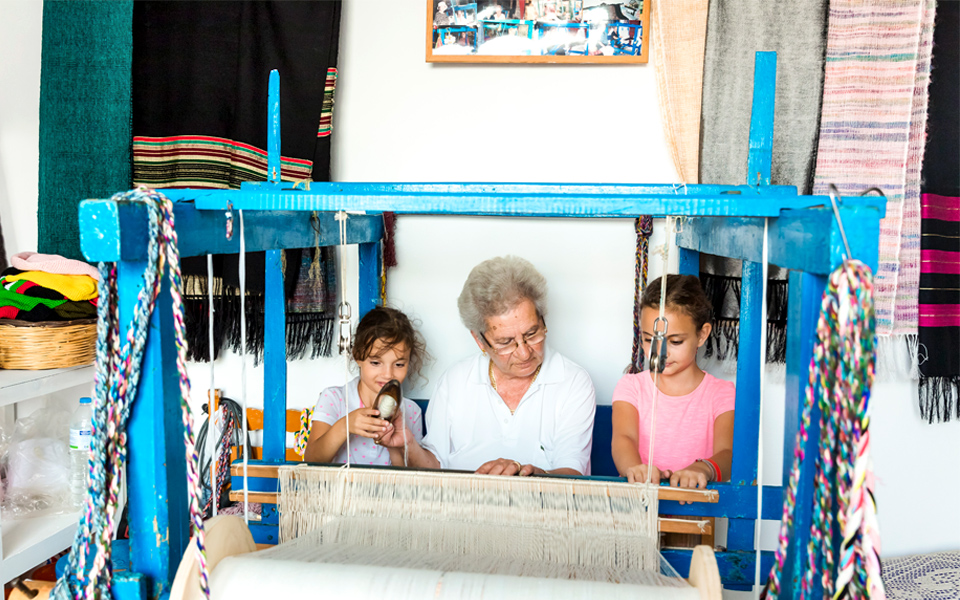
67 year-old Ioanna Zouganeli on Gialos is passing on the island's rich tradition of weaving to her grand daughters
© Dionysis Kouris
After the temporary halt in all commercial and tourist activity imposed by World War II, Mykonian textiles made a comeback in 1954 and for the next 25 years or so experienced something of a heyday both within and beyond Greece’s border. The exotic adventurers and aficionados of all things traditional who visited the island at the time thirsted for anything authentically ethnic – and the ladies of Mykonos were not about to let them down. Working day and night, they turned Chora into one giant mill, with their 500 looms falling silent only on the eve of major holidays. Living rooms were transformed into working spaces and, thanks to their entrepreneurial spirit, the ladies were able to generate plenty of custom.
Magazine and newspaper articles from that period show models, actors and celebrities walking around the streets of Chora in both simple and glamorous clothing procured from these homegrown “ateliers.” It’s said that Christian Dior, a renowned fan of Mykonos, used its textiles in his creations and even dedicated an entire line to them. Givenchy came to the island to dress his models, in cooperation with Joseph Salachas, a local tailor who built a stellar reputation. Greek designers like Jean Desses and Nikos&Takis drew inspiration from these crafts, too, and local creative spirit Yannis Galatis pioneered a new loose-weave technique.
“It’s said that Christian Dior, a renowned fan of Mykonos, used its textiles in his creations and even dedicated an entire line to them.”
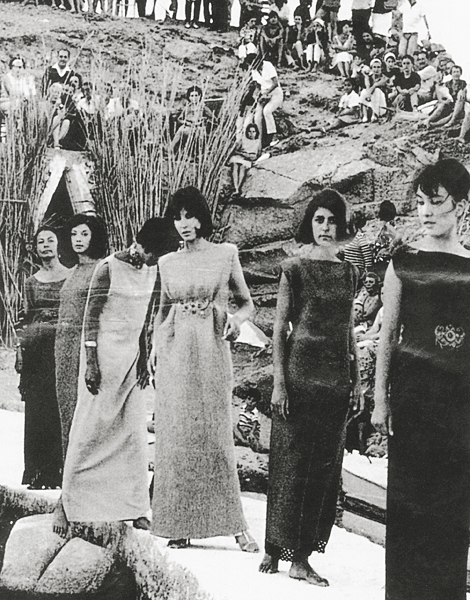
A 1967 outdoor fashion show by Mykonian designer Yiannis Galatis, presenting woven dresses to his international guests.
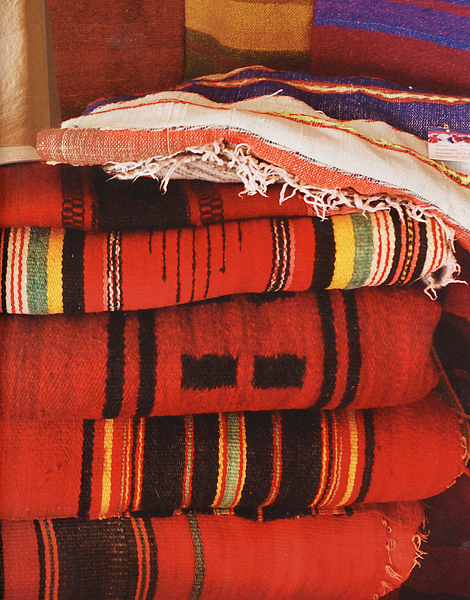
A stack of woven Mykonian blankets; heavy wool for winter, light cotton for summer.
Mykonian weaving also influenced art. Painters, folk artists and craftsmen used pieces of textile to compose impressive tableaux or to construct dolls. The island’s fabrics were made into clothing, paintings, bed and sofa covers, curtains and tablecloths that graced not only trendy Athenian homes but even the royal palace itself. Cloth items became so ubiquitous on Mykonos that shirts, skirts and woven bags could be seen displayed alongside buckets, brooms and braids of garlic in convenience stores across the island.
The craze for Mykonian textiles endured until industrialization finally caught up with the island. Cheap imports pushed down prices to the point where only a handful of weavers were able to make a living. The once-bustling ateliers were gradually transformed into brand stores and rooms-to-let, as the art of the loom perished.
Today, the Mykonos Folklore Museum is the foremost treasurer of this tradition, showcasing 620 samples of the craft. The tradition also lives on thanks to 73-year-old Niki Xydaki in Little Venice and 67-year-old Ioanna Zouganeli in Gialos who maintain the only two working looms on the island, attracting visitors not just with their beautiful wraps, but also with the ambience of a bygone era that can be found in their workshops. Now we can only hope that Zouganeli’s 7-year-old granddaughters – who often bicker over who gets the next turn at the spinning wheel – will carry on this tradition and, who knows, possibly bring it back to glory.
“Today, the Mykonos Folklore Museum is the foremost treasurer of this tradition, showcasing 620 samples of the craft.”
From olive presses and traditional costumes...

On Mykonos, this simple yet vibrant...
Discover Greece’s islands in September with...
A traditional honey-and-cheese pie from Mykonos,...