The Polykatoikia: What Makes the Athenian Apartment Building...
The Goethe Institute's exhibition explores Athens'...

© Stelios Papardelas
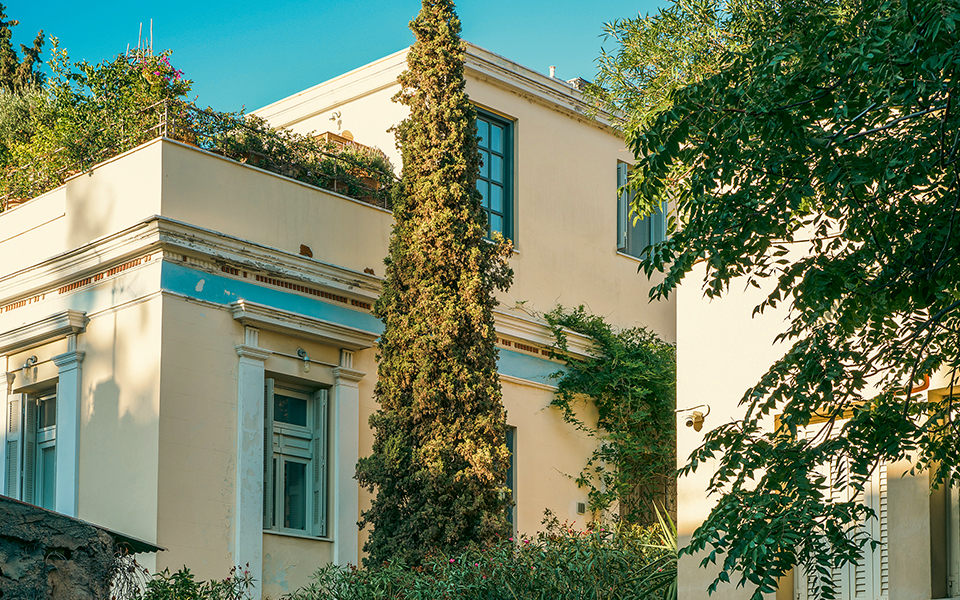
Dawn has not yet broken. On the tree-lined Markou Mousourou Street, not a leaf stirs. From the back alleys, appears the tall figure of Giorgos Grigoriadis, owner of the traditional grocery store. With practiced movements, he raises the shutters and sets out the stands. The sun begins to emerge, illuminating the preserved 18th- and 19th-century mansions, the stone stairways, and the beautiful Nikiforou Theotoki pedestrian street, all of which form what may be the last true oasis in the heart of the city.
Mets has carried a touch of France since its earliest days. The neighborhood, nestled along the bed of the Ilissos River, was chosen by Karl Fix at the end of the 19th century as the site of Greece’s first brewery. It is to him that the area owes its name, “Mets,” after the city of Metz, lost by France following its defeat in the Franco-Prussian War. Yet for many Athenians, the area was long known by the more romantic name Pantremenádika (“the place of the married couples”), as it provided a discreet refuge for lovers among its verdant hills.
© Stelios Papardelas
Since then, Mets has continued to attract artists, both famous and unknown, aesthetes, foreigners, hip travelers, and digital nomads. Among its residents are composer Eleni Karaindrou, musician Foivos Delivorias, and writer Sotiris Dimitriou; in the past, it was home to director Nikos Koundouros, scientist Giorgos Grammatikakis, and former mayor of Athens Antonis Tritsis.
Residents claim that the area combines the convenience of a downtown location and the peace of mind of a suburb: just ten minutes on foot from Syntagma Square, next to Pangrati and only a few blocks above the buzz of Anapafseos Street, Mets still offers a unique sense of safety and familiarity with one’s neighbors. This is largely due to the high rate of home ownership: most residents have inherited their houses from their families and either remained or returned as adults to live here again. Active community associations also play a vital role, voicing concerns about housing, parking, or neglected sidewalks and even campaigning for an organic farmers’ market.
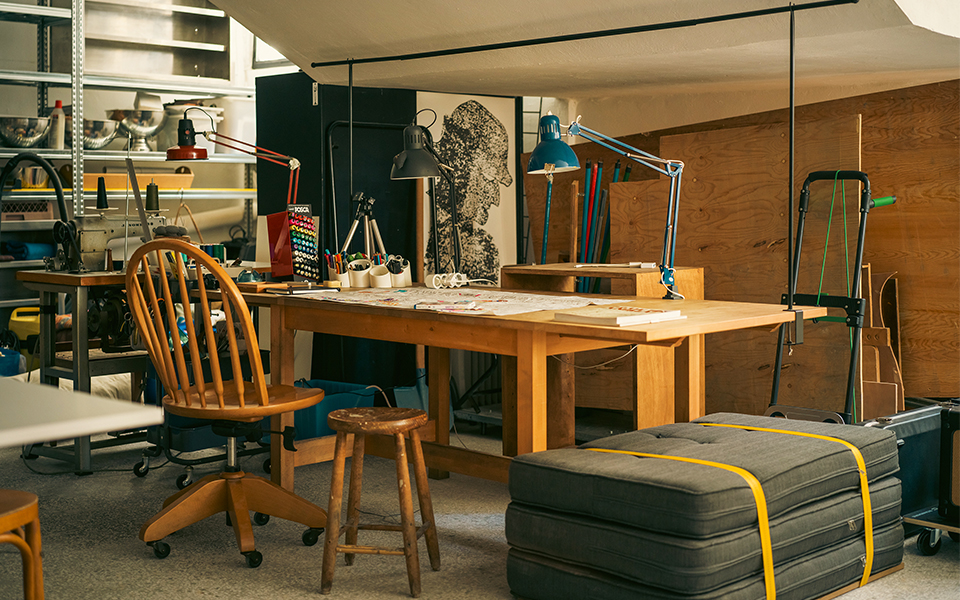
M. Polyxa’s workshop at P.O.E.M.
© Stelios Papardelas
“My grandfather moved from Plaka to Mets in 1977, and since then we’ve all lived here,” says 47-year-old Giorgos Grigoriadis. “When I was young, we used to call the area ‘First Cemetery.’ You can imagine how much fun taxi drivers had with that! They would ask, ‘Do you want me to drop you off inside or outside?’” He remembers, however, that during the 1990s his schoolmates’ families were moving en masse to the northern suburbs. When his brother and business partner Pantelis – now 32 – attended the local middle school, he was the only student from Mets. “Everyone else lived in Pangrati,” he says.
Up until the late 1990s and early 2000s, small businesses thrived in the area: four greengrocers, a tailor, a photo studio, and more. “The new century found us lacking,” he adds. The shop where we meet him had housed a grocery store for decades. When the previous owner sold it, Grigoriadis took it over and, for the past twenty years, has devoted himself to serving the residents of Mets, the enclave framed by Ardittou, Longinou, Nikiforou Theotoki, and Anapafseos Streets. “I want people to come to me for the quality of my products, my service, and the personal connection,” he explains. “For example, if I know a customer has mobility issues, I’ll take their groceries home myself – I’ll even put food in their fridge,” he says as he arranges fruit on the shelves. “Whatever they ask for, I’ll find it: wild Alaskan salmon, Sicilian orzo, rose petal jam, and French breakfast radishes.” The neighborhood’s culinary “whims,” as he calls them, reflect its aristocratic identity.
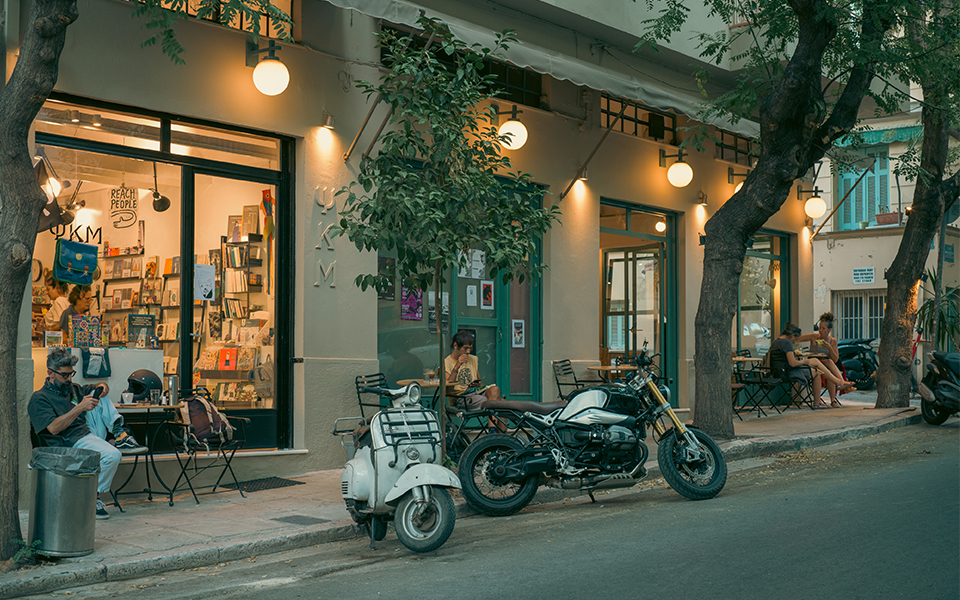
ΨKM is a retro-style convenience store where locals can find anything they might need within their little ‘village.’
© Stelios Papardelas
Across the street from Giorgos Grigoriadis’s grocery store, on Markou Mousourou, stands ΨKM – the neighborhood’s most charming modern convenience store. Its owner, Maria Polyxa, exchanges a dozen cheerful “good mornings” before she even reaches the door of her shop. “My family has been here since the 1950s,” Maria points out. “Until the ’90s there were more open spaces, and we spent the whole day outside.”
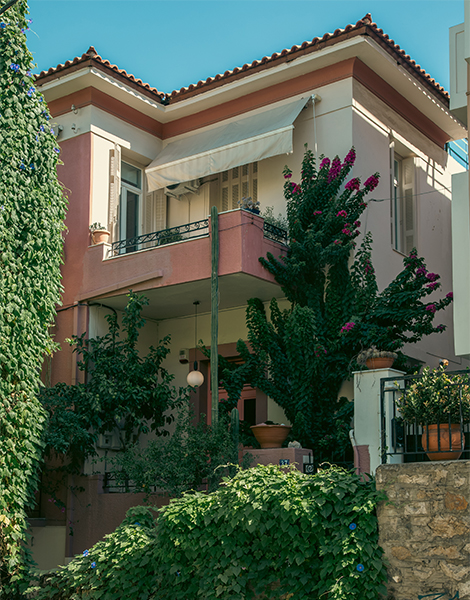
Today, the area’s children play at the playground on Longinos Hill, recently renovated by the Onassis Foundation. Still, even there, adult supervision is always required. The typical Mets home used to be a two-story house: ground floor, two upper levels, and a garden. Before the 1950s, single-story dwellings were more common. Some are neoclassical and now officially listed. “During the dictatorship, a few building permits were issued for apartment blocks – we call them ‘cakes’ around here,” she says with a smile.
© Stelios Papardelas
© Stelios Papardelas
I glance around her shop. Nothing reminds you of a typical Athenian corner store. “I wanted to recreate the corner store of my childhood,” she says. The result is a space where you can find cigarettes, chips, toys, stationery, books from small publishers, and magazines. “Not necessarily in that order!” she adds. The neighborhood embraced it wholeheartedly, given that shops in the wider area are few and far between. You have to go all the way to Anapafseos Street to find a pharmacy, while fishmongers, butchers, and ATMs are found only in Pangrati. Cigarettes are tucked away in an antique chest of drawers, and a table invites passersby to play backgammon or sit and read.
Beyond its playful name – a tongue-in-cheek nod to the military canteen (ΚΨM in Greek) – the shop stands out for its refined aesthetic. Maria’s background as a designer (she studied interior architecture at Vakalo School and holds a master’s in Public Art and Environmental Design from a UK university) is evident in every detail, such as the handmade fabric dolls and the whimsical greeting cards. Long before ΨKM opened, locals already knew Maria for her artistic flair.
Through P.O.E.M. – the Cultural Visual Arts Group of Mets – she has led countless neighborhood children in art workshops and creative projects. Many have written for Metsaki, the annual magazine produced entirely by her young students, while both children and adults take part each year in the beloved Mets Carnival. The Ardittos Beautification and Cultural Association first launched the carnival back in 1927. After decades of dormancy, it was revived in 2008.
“Our first parade was ten years ago,” Maria recalls as she leads us to the new P.O.E.M. space. This is where the afternoon workshops take place and where the carnival costumes are prepared. There, among spools of fabric and paints, John Lennon gazes at us from a shelf; one of Maria’s handmade dolls, crafted with gentle humor and infinite patience.
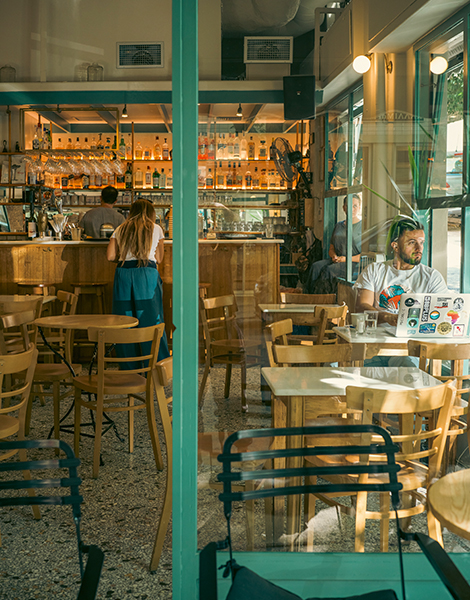
At the historic Odeon café.
© Stelios Papardelas
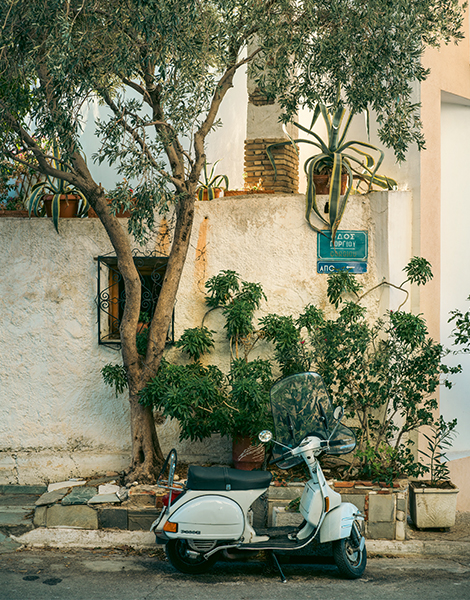
Time seems to have stood still on many corners of Mets.
© Stelios Papardelas
Right next door to ΨKM stands one of Mets’ most enduring landmarks, the Odeon. Open from morning till night, under the steady hum of a ceiling fan that, as Dimitris Fandis – Maria Polyxa’s husband – tells us, has been in the place for over 65 years. The Odeon welcomes people of all ages and backgrounds, offering warmth, privacy, and good music. “We’re like two different places in one,” Dimitris explains as a Jacques Brel song plays softly in the background. “In the morning, we’re a café with both regulars and passersby; at night, we turn into a bar.”
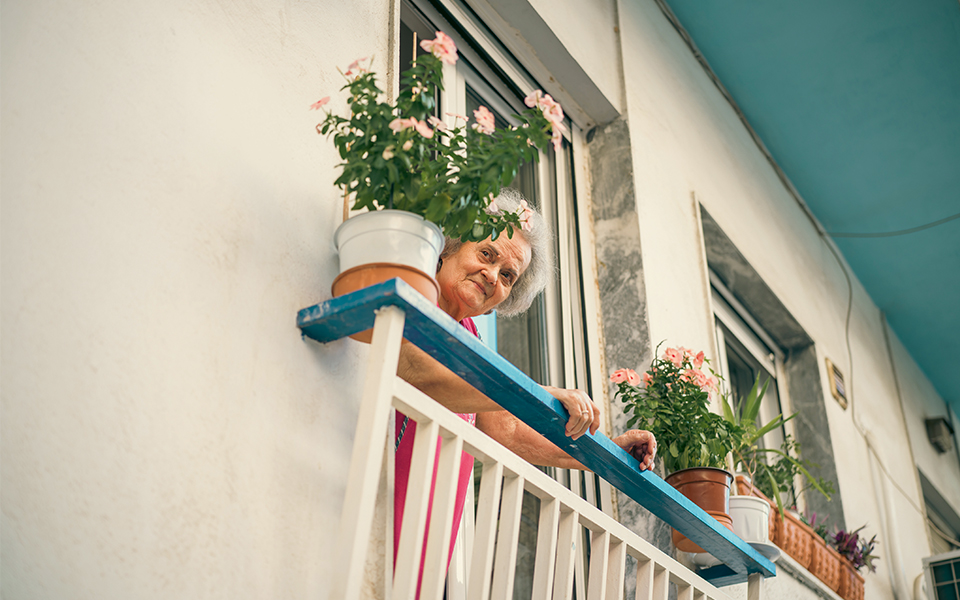
A local resident shares insights about the neighborhood.
© Stelios Papardelas
Before 1988, this space housed the neighborhood’s traditional dairy shop, with just two tables, where old men gathered to play cards, while the owner, Mr. Argyris, served small plates of meze alongside their drinks. Dimitris’s parents met in Paris. “My father was a musician in the psychedelic rock and jazz band Axis. He travelled there for concerts, and that’s how he met my French mother. When I came into the equation, they began looking for a way to return to Greece. Friends from Mets told them that this place was for sale.”
His parents transformed the shop completely, turning it into Odeon, a name chosen as a nod to the neighborhood’s proximity to the Panathenaic Stadium (Kallimarmaro) and their beloved 6th arrondissement of Paris, home to the historic Théâtre de l’Odéon and the iconic Café de Flore. Dimitris himself began working there as a young boy on weekends and took over the business in 1997. The rest, for those of us who live in Athens, is history.
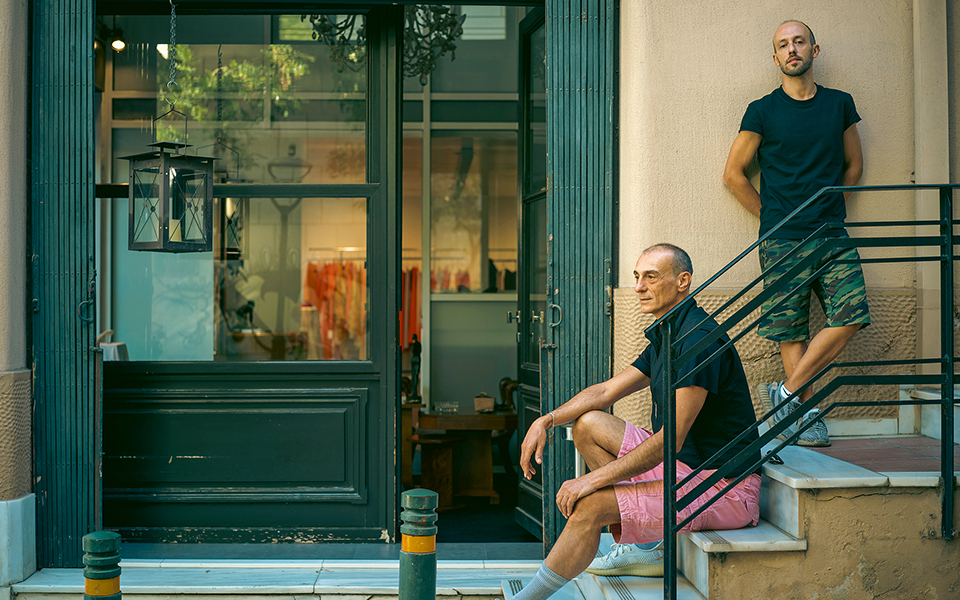
Venediktos Antypas and Christos Petridis outside their studio.
© Stelios Papardelas
When fashion designer Venediktos Adipas came to Athens from Patras in 2000 to study, he first settled to Pangrati. “I used to walk around the city, and on one of those walks I discovered Mets and fell in love with it,” he recalls from the Maison Faliakos atelier on Markou Mousourou Street. “One day, an elderly lady struck up a conversation with me, pointed to a house, and told me the owner was looking for a quiet young tenant, someone who wouldn’t throw many parties or make noise. I assured her I was exactly that person,” he laughs.
Since then, Venediktos has been one of the neighborhood’s “metoikoi” or settlers, as the locals call them. “I remember when people slept with their windows open.” The area wasn’t exactly ideal for a student – “no nightlife, not even cafés” – but he was happy there. Today, everyone treats him as a true local.
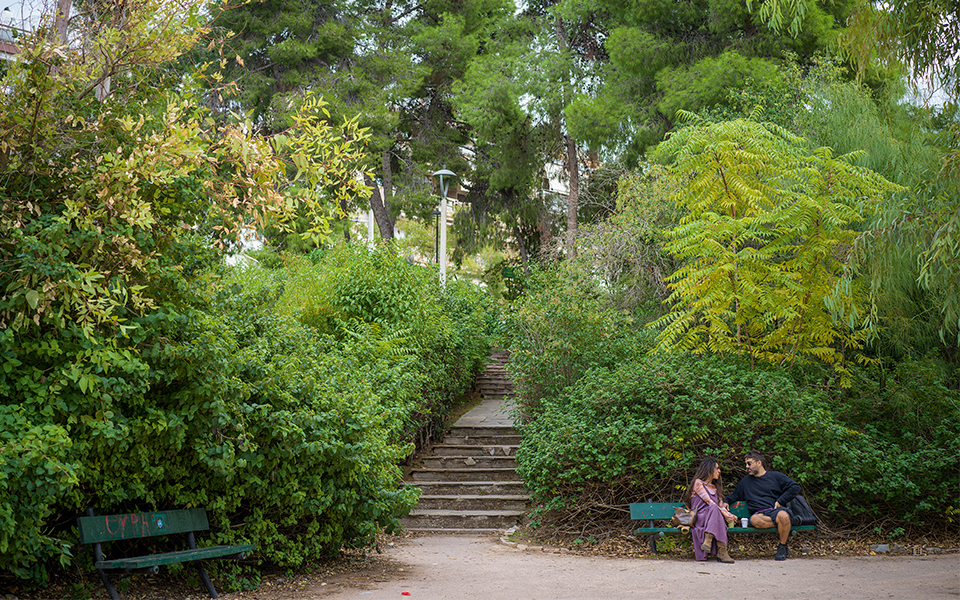
© Stelios Papardelas
An artist at heart, Venediktos has left his mark on Mets with two striking murals at key spots, one of which even features in the neighborhood’s annual treasure hunt. Since 2015, the fashion house where he works alongside Christos Petridis – who succeeded the founder, Kostis Faliakos – moved from Kolonaki to Markou Mousourou.
A fashion house window display in the quiet, family area initially surprised the locals. “Those first days, people literally bumped their heads against the glass, trying to peek inside,” Christos recalls, smiling. “But soon, many became our clients – and even more, our friends.” Sitting on the pedestrian steps outside, he adds, “We left Kolonaki just as it was changing, and here, we found exactly what we were looking for.”
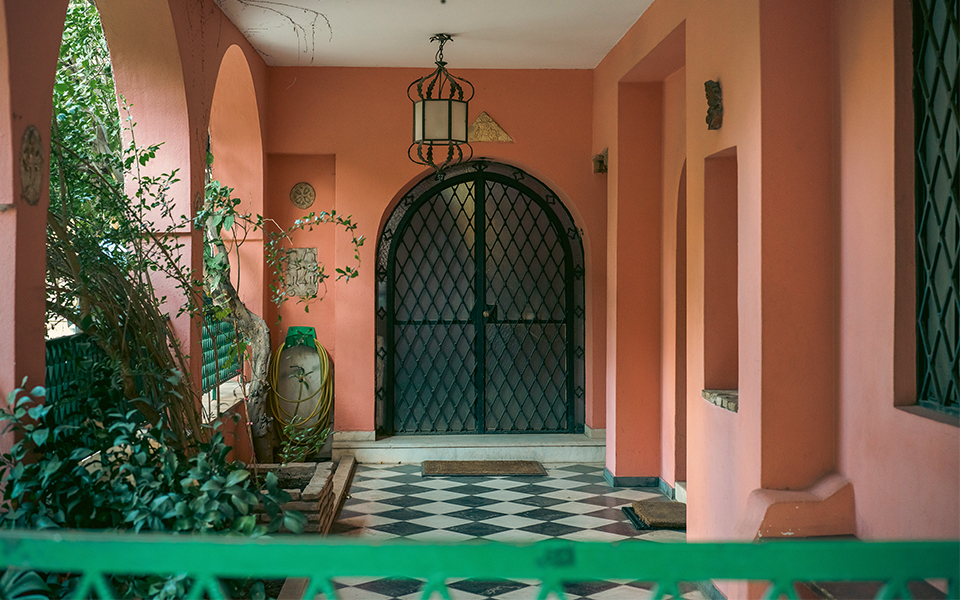
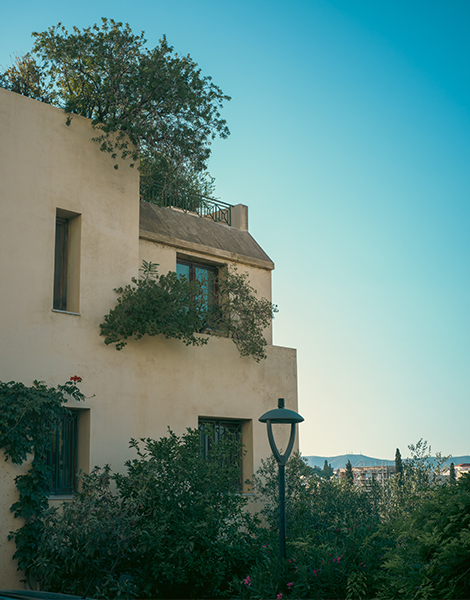
A house on Markou Mousourou Street.
© Stelios Papardelas
A similar story unfolded with Nitra Gallery, located in a small alley between Markou Mousourou and Anapafseos Streets. “We came to Athens from Thessaloniki in 2017, inspired by Documenta,” recounts Aliki Tsirliagkou, the gallery’s second-generation owner. “We opened a project space in Kolonaki, which, due to COVID and lockdowns, functioned solely as an exhibition venue until 2020. Later, I turned my focus to curating art collections for hotels, and that’s how ArtSpark began – as an initiative to enrich the travel experience while supporting the art community.” But Kolonaki – and Nitra’s tiny space – had stopped serving their purpose. “In Mets, we found a 200-square-meter space in a neighborhood with a different kind of energy,” she notes, as she guides us through an exhibition of Panos Famelis’s works.
“Here, visitors don’t just see an exhibition – they experience it. Mets itself is full of landmarks that connect past and present, even an open-air sculpture gallery of sorts: the First Cemetery of Athens,” she says. “It’s not the same audience that drops by a Kolonaki gallery between errands or shopping.”
Nitra now aims to attract thoughtful art lovers who might combine a painting exhibition with a walk through Longinos Grove or along Mets’ quiet pedestrian streets. Still, Aliki is convinced that the future of galleries lies beyond simply hosting exhibitions: “They can serve as cultural spaces.” Her venue on Aristonikou Street, once a publishing house warehouse, has been warmly embraced by the neighborhood. “When we were renovating, everyone who passed by asked what we were opening.
They hoped for a shop to meet their everyday needs but when they learned it was an art gallery, they welcomed us just the same,” she smiles. “As a Thessalonikian, I feel perfectly at ease in Mets,” Aliki adds, laughing as she gets ready to take her dog, Mili, for a walk. “The rhythm here is just a little slower than in downtown Athens, and I love that.”
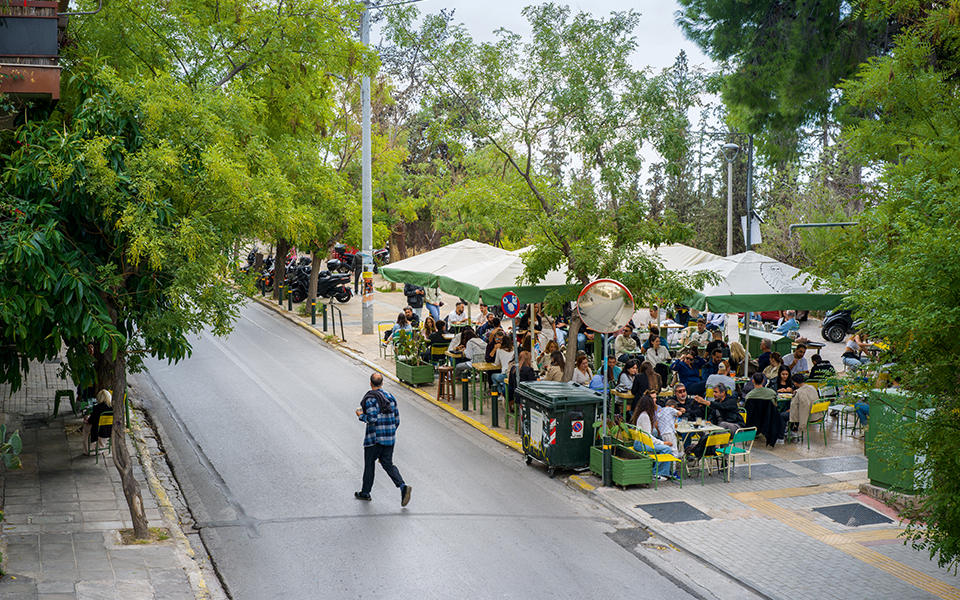
Mets is becoming the go-to spot for Athenians, with new venues opening all around the neighborhood.
© Stelios Papardelas
Mets, says Maria Pertselaki, is a place made for animal lovers. She found herself in the neighborhood after the 1999 Athens earthquakes. “I moved to Athens to study classical singing, and I ended up here thanks to a relative,” she recalls. Since then, she has lived in Mets almost continuously. “Those of us who live here enjoy real quality of life. We’re lucky to be surrounded by two hills, Ardittos and Longinos,” she explains.
Every day, dozens of “dog parents,” as she calls them, meet at Ardittos Hill. “Up there, you can see magpies, hoopoes, cyclamens, even the remains of the Temple of Tyche (Fortune), and now there’s even a dedicated space for dogs.” Yet this idyllic rhythm is now disrupted by the housing crisis. “Our neighborhood is becoming increasingly touristy – we constantly hear the sound of suitcase wheels rolling on the cobblestones,” Maria notes with concern.
“Rents have always been high, but now they’re simply outrageous.” A quick glance at online listings confirms her words: a 40-square-meter apartment rents for €940, a 65-square-meter ground-floor flat for €800, while larger apartments suitable for couples or families generally exceed €1,000. Those who have gone through the ordeal of finding a home in Mets add that the problem isn’t just the price – it’s also availability. One evening, a customer bursts triumphantly into Giorgos Grigoriadis’s grocery store: “You won’t believe it – I found a place!” he announces to Pantelis and Giorgos. The conversation soon drifts to Panathinaikos and the weather.
As the sun sets, people drop by to pick something fresh for dinner. “Give me the key,” says an elderly woman cryptically, and Giorgos pulls out a large box filled with keys, looking for the right one. “I keep everything here, spare keys, documents, money, and of course parcels from couriers,” he explains with a smile. “We’re just like a village here – everyone knows everyone.”
The Goethe Institute's exhibition explores Athens'...
From historic landmarks to edgy street...
A curated journey through exhibitions, history,...

Discoveries along Amalias Avenue, from the...