The gouri, Greece’s traditional good-luck charm, appears in countless forms ahead of the New Year, with the pomegranate among the most enduring and beloved symbols.
From ornate pomegranates to mythology-inspired jewelry, “gouria” are small objects with a long cultural memory – and a hopeful way to welcome in the New Year.
As the year draws to a close in Greece, you may notice shop windows taking on a particular look. Brightly colored charms sit alongside ornamental pomegranates and blue-glass eyes that seem to wink knowingly at passersby. These are not Christmas decorations in the usual sense, but something more specific: objects intended to bring luck. At the heart of it all is the gouri, Greece’s traditional New Year charm, exchanged between family and friends as a quiet wish for health, prosperity, and a good beginning to the year ahead.
At first glance, a gouri may seem like a simple keepsake – a pendant, bracelet, key ring, or small ornament stamped with the number of the coming year. Yet behind its sparkle lies a much older story. The custom belongs to a long Mediterranean tradition of carrying, wearing, or displaying symbolic objects believed to influence fate – a way of negotiating uncertainty at moments of transition, especially at the symbolic threshold between one year and the next.
Here we’ll explore the curious world of gouria: where ancient belief meets modern design, and where the exchange of a small, humble object continues to carry meaning far beyond its size – particularly at this reflective, hopeful moment of the year.
New Year’s fireworks light up central Athens, with the Acropolis watching over the city as one year gives way to the next.
The word gouri (plural gouria) means both “good luck” and “good-luck charm,” and its linguistic roots hint at the custom’s rich cultural layering. Most scholars agree that the modern Greek term likely derives from the Turkish word “uğur,” meaning “good omen” or “favorable sign,” itself possibly linked to the Latin “augurium.” The overlap is telling. Across the eastern Mediterranean, ideas about luck, fate, and protection have travelled for millennia – crossing borders, languages, and religions.
The ancient Greeks, like many societies before and after them, lived in a world shaped by uncertainty. Disease, travel, childbirth, harvests, and warfare all carried enormous risk, and people sought reassurance wherever they could find it. Long before gouria became New Year gifts, Greeks carried amulets, engraved gemstones, coins, knots, and small talismans, believed to hold protective or beneficial powers. Some invoked specific deities or supernatural beings; others relied on symbolism or sympathetic magic. The goal was simple: to tilt fortune, however slightly, in one’s favor.
These objects were usually worn on the body, placed in homes, or carried during journeys. They might promise protection, healing, fertility, or success in love and trade. Their power lay not just in belief, but in proximity – small, portable expressions of hope in an unpredictable world.
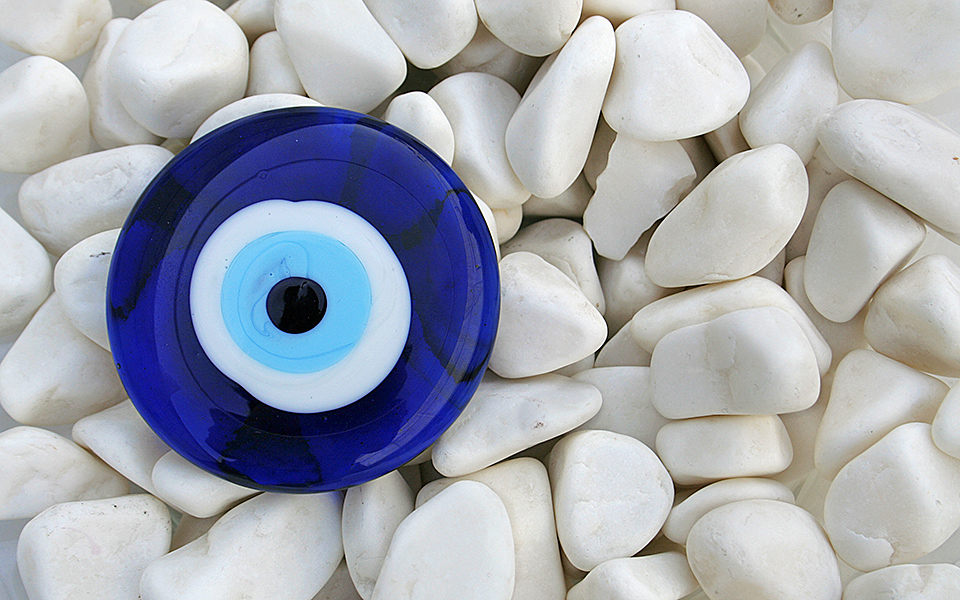
Instantly recognizable, the iconic blue evil eye (mati) is far more than a tourist souvenir, carrying centuries of belief and protection.
Over time, these practices absorbed new layers of meaning. As Christianity spread, older symbols did not disappear so much as adapt. Pagan amulets gave way to crosses, icons, and saints’ medals, while folk beliefs continued alongside official doctrine. Across Europe, everyday charms such as horseshoes – placed above doorways for protection and good fortune – survived well into the modern era. Even today, echoes of these customs remain particularly strong in northern Europe, from Britain to Scandinavia.
In Greece and the wider Mediterranean, however, one charm stands out above all others: the evil eye, or “mati.” The blue eye talisman, believed to protect against envy and the malevolent gaze, is among the region’s most enduring symbols. In Greece, it is especially common to see newborn babies’ cots and prams adorned with an evil eye, safeguarding the young and vulnerable at the very start of life.
The belief itself is ancient. Archaeological evidence suggests that fear of the evil eye dates back at least to the Late Bronze Age (around 1500 BC), with even earlier examples found in Mesopotamia – notably at Tell Brak in modern-day Syria, where eye-shaped amulets have been dated to as early as 3300 BC. From the ancient Near East to modern-day Turkey and Greece, the same symbolic language persists, slightly altered but instantly recognizable.
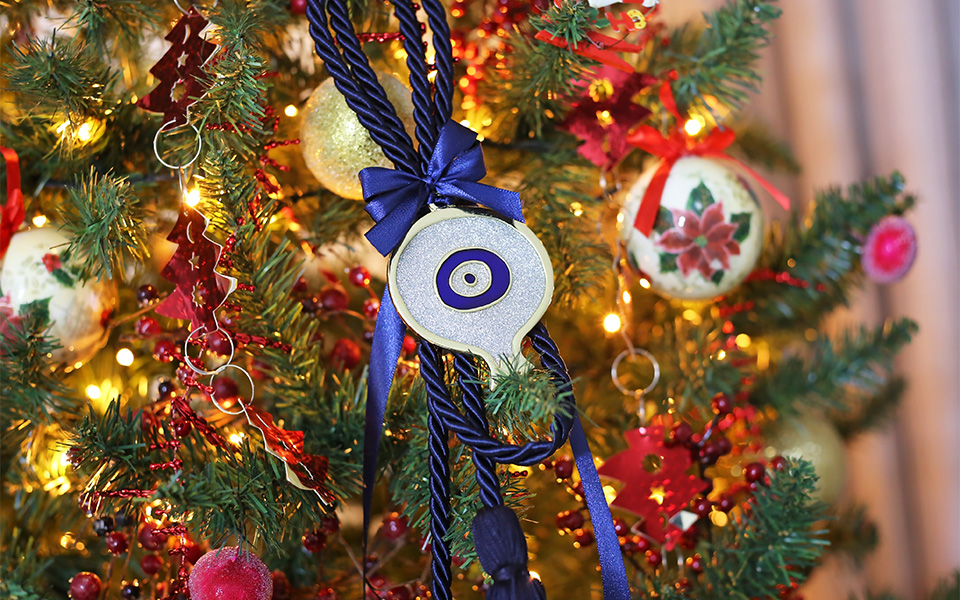
Old meets new: a decorative evil eye charm brings a traditional note of good fortune to a modern Christmas tree.
By the 19th century, these older traditions had coalesced into something more specific. The gouri became firmly associated with the turning of the year – a moment charged with expectation and renewal. Giving or receiving a charm at New Year was no longer just about protection, but about marking time itself.
Despite modern skepticism, belief in the power of lucky objects still runs deep in Greece. From icons worn close to the body to charms hung in homes, cars, and workplaces, many Greeks – including devout Christians, both Catholic and Orthodox – continue to surround themselves with small symbolic safeguards against misfortune.
During the festive season, gouria appear everywhere: in private homes, shop counters, hotel reception desks, and office spaces. Exchanged between family members, friends, and colleagues, they carry a simple but generous message – may the year ahead be kind.
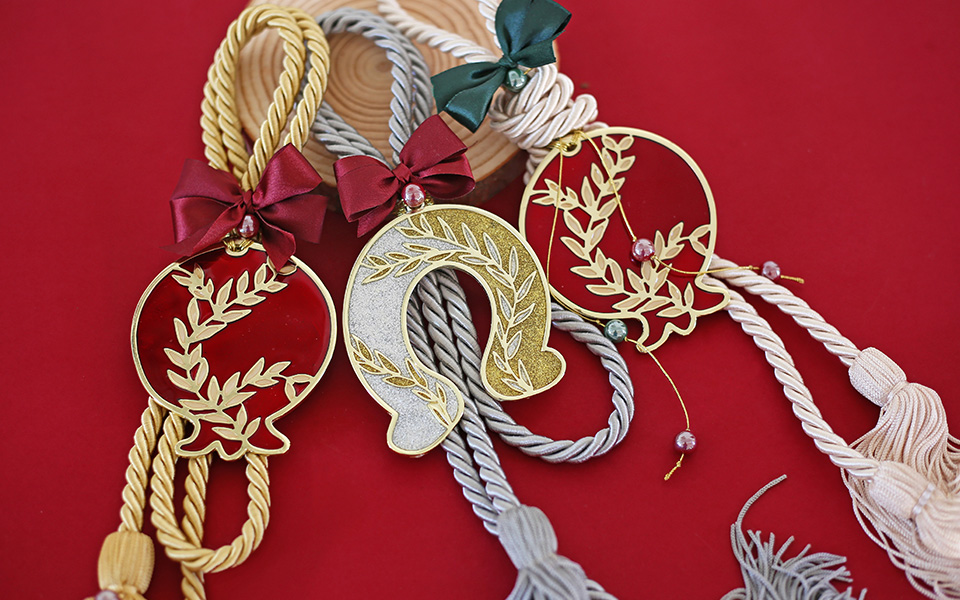
The pomegranate, revered since antiquity, remains a powerful symbol of fertility, abundance, and renewal.
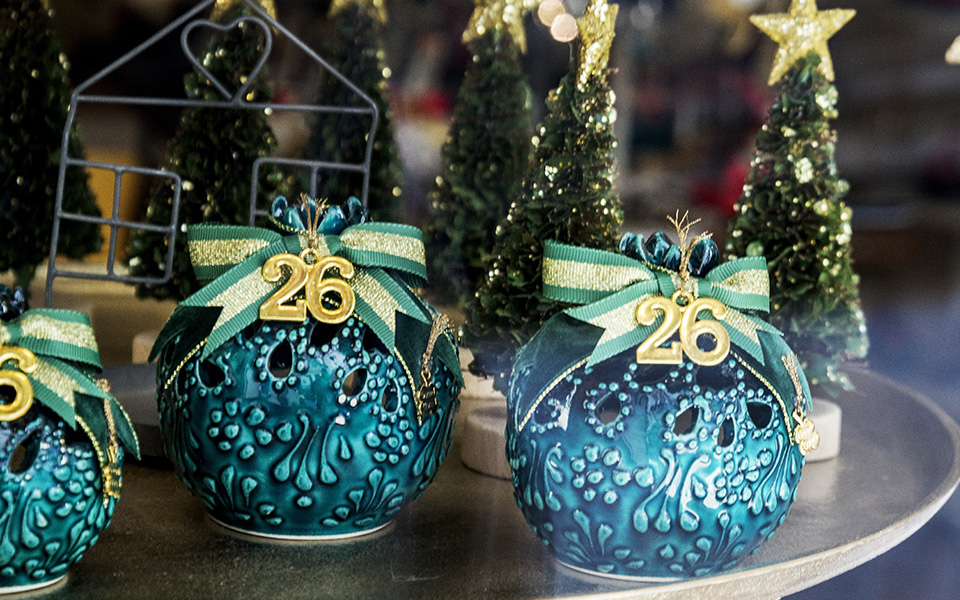
Today’s gouria are anything but uniform. Across Greece, contemporary designers and artisans reinterpret traditional symbols using gold and silver, ribbons, beads, textiles, ceramics, and precious stones, transforming the humble charm into something that sits comfortably between jewelry, decorative object, and cultural keepsake.
Almost always, the year itself is worked into the design – 2026, 2027, or whatever lies ahead – fixing the object to a particular moment in time, even as its symbolism reaches much further back. Prices vary widely, depending on materials and craftsmanship, but the intention remains the same: a thoughtfully made object offered with good wishes. Many makers speak of “meraki” – the care, patience, and personal investment poured into each piece – as something that matters just as much as the finished result.
Increasingly, gouria are also being reimagined through the lens of archaeology and cultural heritage. Museums, galleries, and cultural institutions across Greece treat them not as novelties, but as compact cultural artifacts in their own right. In museum gift shops, visitors will often find beautiful handmade charms inspired by ancient jewelry, coins, architectural details, or familiar motifs drawn from antiquity. These make especially popular souvenirs – small, meaningful objects that connect the past with the present.
Yet craftsmanship alone is not what gives a gouri its resonance. Its power lies in symbolism – and in a shared understanding of what these symbols mean. Certain motifs appear again and again, each carrying centuries of accumulated belief.
Vasilopita, the traditional Greek New Year cake, sliced in anticipation – the hidden coin promising good luck for the year ahead.
The pomegranate is perhaps the most potent of all. Associated since antiquity with fertility, abundance, and renewal, it remains deeply embedded in Greek New Year custom. In many households, a pomegranate is smashed on the threshold of a home at the start of the year, its seeds scattering across the floor as a hopeful sign of prosperity in the months ahead. Rendered in silver, enamel, or ceramic, the pomegranate has become one of the most recognizable forms a gouri can take.
Just as familiar is the evil eye. Whether shaped as a simple blue glass bead or stylized into contemporary jewelry, it is believed to guard against envy and ill intention. Its popularity is no coincidence: the charm serves as a reminder that good fortune, once invited, may still need protecting.
Luck, of course, also has a playful side. That is where the coin comes in – most famously hidden inside the “vasilopita,” the New Year’s cake. Whoever discovers it is said to enjoy good luck for the year ahead, turning an ancient belief into a shared moment of anticipation and celebration around the table. In a country shaped by the sea, it is hardly surprising that the sailing boat also features prominently among New Year charms. A symbol of safe journeys, opportunity, and fresh horizons, it reflects Greece’s maritime heritage and the quiet optimism of setting out into the unknown – a fitting image for the year ahead.
As another New Year begins, the Greek lucky charm remains what it has always been: a small object with a long memory. Whether inspired by ancient artifacts, folk belief, or contemporary design, the gouri continues to offer a distinctly Greek way of marking time – not with grand gestures, but with symbolism, care, and a modest faith in good fortune.