The Averoff Museum: Metsovo’s Cultural Legacy
At 1,160m, Metsovo blends preserved mountain...

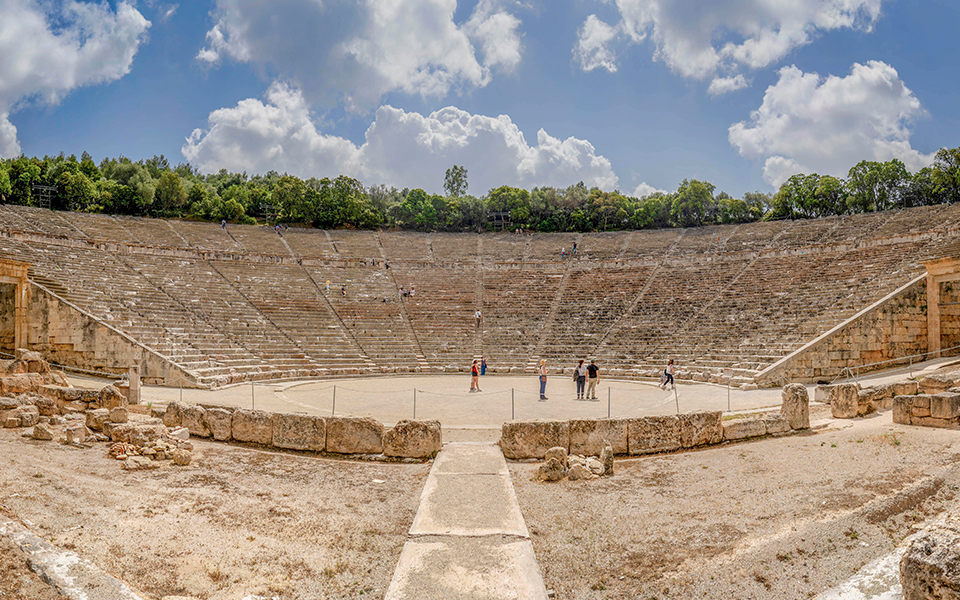
A view of the stage at the stunning Ancient Theater of Epidaurus.
© Perikles Merakos
Tucked into the foothills of Mt Arachnaion in the Argolid region, the traditional village of Lygourio has served as a quiet backdrop to one of Greece’s most revered cultural legacies: the Ancient Theater of Epidaurus. For over 70 years, this humble settlement has hosted the actors, the theater crews and the audiences of the Athens and Epidaurus Festival, becoming an unlikely but enduring home for Greek drama.
“Electricity came to the village overnight in ’61,” says Kakia Liakopoulou, the warm and eloquent owner of the famed Taverna Leonidas. “Maria Callas was due to perform at Epidaurus, and suddenly, we had power. Before that, there were barely any roads and certainly no hotels. Actors stayed in our homes and washed outside with water we boiled in cauldrons. We became like family. They became a little bit rural, and we worked hard to modernize – somehow we met in the middle.”
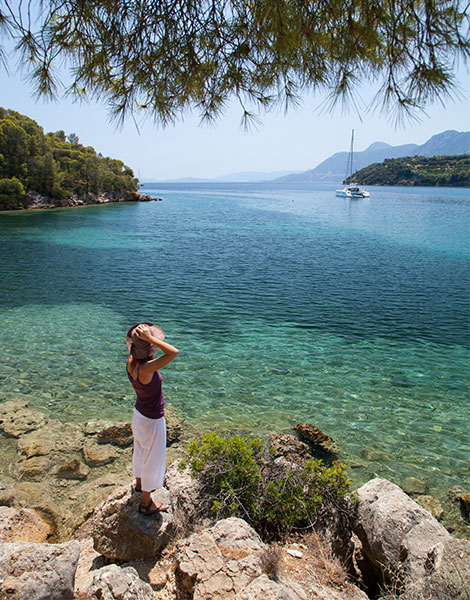
The crystal clear waters of Kalamaki Beach, a five-minute hike from Palaia Epidavros.
© Perikles Merakos
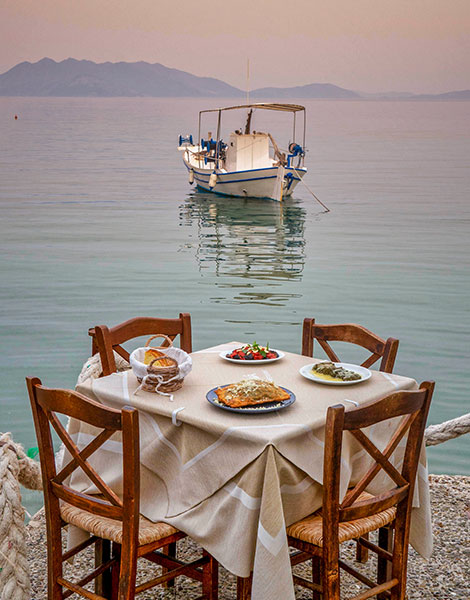
The area boasts exceptional seaside eateries.
© Perikles Merakos
In those early years, the entire village would attend rehearsals, learning the tragedies by heart. Framed photographs still hang on the taverna’s stone walls, with dedications to Kakia and her late husband Leonidas signed by cultural icons such as Maria Callas, Melina Mercouri and Alexis Minotis. What began as a simple village café became one of the most beloved tavernas in the Peloponnese; it has been feeding theater troupes since the 1950s, and preserving, with quiet pride, the soul of Epidaurus.
Actors, too, helped shape the bond between village and stage. It was largely Katina Paxinou, the legendary Greek actress, who taught Kakia how to cook, a gesture of intimacy that speaks volumes. To this day, the cast and crew of every Epidaurus production (along with anyone lucky enough to secure a reservation) return to Taverna Leonidas after each performance, honoring a tradition born of shared meals and deep respect. But similar stories echo throughout the region. Everyone in Lygourio, it seems, grew up in the shadow of the theater, located just five kilometers from the village. This monumental structure, often compared to a seashell or a giant ear for its excellent acoustics, has shaped the fate of the area.
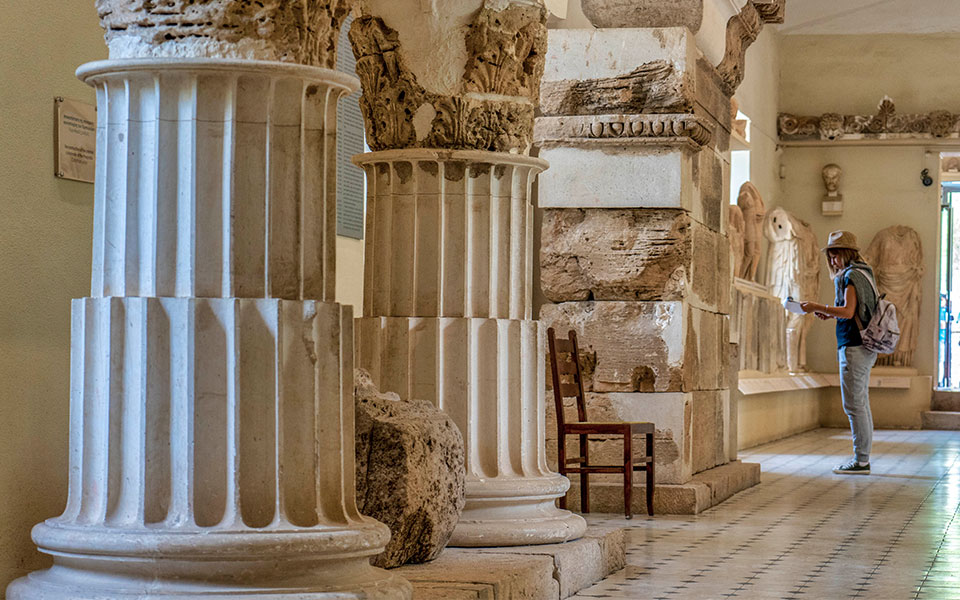
Visitors to the Archaeological Museum of the Asclepieion of Epidaurus will find parts of the ancient sanctuary and replicas of ancient statues unearthed at the site.
© Perikles Merakos
Unearthed in 1881, the Ancient Theater of Epidaurus first hosted a revival of classical drama in 1938 with Sophocles’ Electra, starring Paxinou herself. The official founding of the Epidaurus Festival came in 1955, with Euripides’ Hecuba, directed by Alexis Minotis. Since then, the festival has become a cornerstone of Greek cultural life. Built in the 4th century BC and expanded in the 2nd century BC to seat 14,000 spectators, the theater was originally used for musical and dramatic competitions held during celebrations in honor of Asclepius, the god of healing. What many visitors don’t realize is that the theatre is just one part of the vast Sanctuary of Asclepius at Epidaurus, one of the most renowned healing centers of the ancient world, and today a UNESCO World Heritage Site.
The best way to experience Epidaurus is to arrive a few hours before curtain call and explore the vast archaeological site that stretches beyond the theater itself. Wander through the Tholos, the mysterious Abaton colonnade, the Katagogion guesthouse, the sacred Building E, the Ritual Dining Hall, and the ancient stadium, all remnants of a once-thriving spiritual and healing center. Don’t forget to drop by the small archaeological museum near the entrance. Though modest in scale and somewhat dated by modern museological standards, it offers invaluable insights into what was the greatest healing sanctuary of antiquity. (Remarkably, the sanctuary remained active until the 6th century AD, long after the official ban on ancient worship.)
Of particular interest are the medical instruments and inscribed tablets which, according to archaeologists, trace the cultural shift from divine healing to early scientific medicine. Unfortunately, many of the more mystical healing practices remain undocumented mysteries, leaving the curious visitor to imagine what once took place here.

The small harbor at Palaia Epidavros, ringed by restaurants, is a popular meeting spot for festival-goers.
© Perikles Merakos
Most visitors gravitate toward Palaia Epidavros, a charming coastal village where life revolves quietly around a small harbor, a marina and a string of humble tavernas and family-run hotels. The aesthetics and the amenities may feel frozen in time, evoking earlier decades, but that, locals will tell you, is exactly the point. Here, change is slow, and every summer feels like a familiar return. Simple hotels offer traditional hospitality, and tavernas such as Klimata prepare dozens of home-cooked dishes daily. Vagionia and Kalamaki beaches, just five minutes on foot from the port, are framed by trees that overhang the sea.
You can walk out to the Nisi peninsula, or venture slightly further to discover the Small Theater of Epidaurus – a cultural gem. While it’s not open as an archaeological site, the theater has hosted intimate music and theater performances since 1995. Built for the local population of the ancient city, it seats just 2,000 and offers a rare sense of proximity between the audience and the performers. In the shallow waters of the bay, the submerged foundations of the ancient port are still visible; simply bring a mask and snorkel to Gliati Beach. Nearby, Taverna Athina offers not only fine seafood but also tastings of olive oil and herbal products from Athina Ecofarm. Specializing in wild-foraged herbs and estate-grown olives, the farm welcomes visitors to sample the essence of this land at the source.

At Yialasi Beach, you can rent a kayak to explore the shoreline and the impressive sunken city just below the water’s surface at Gliati Beach.
© Perikles Merakos
One of the area’s most popular stretches of coast is Yialasi Beach, just a short distance from Palaia Epidavros. It boasts campsites, laid-back beach bars (operated by the Apollon and Hellas hotels) and, close by, a surprisingly sophisticated culinary discovery: Kalogerikon, a charming garden restaurant. After the curtain falls, tradition calls for a cold beer at the legendary open-air disco Kapaki, where post-theater nights turn into joyful summer rituals.
For something quieter, head a bit farther out to Panagia Beach, named after the small chapel that crowns the cove. Alternatively, set off on a kayaking expedition with Tribal Kayak (Tel. (+30) 697.458.0898), a company based at Yialasi Beach. Their guided tours reveal secluded coves, sea caves and even a submerged ancient city just a few meters below the water’s surface.
Once a well-kept secret, Polemarcha Beach just north of Palaia Epidavros is now beloved by boaters and campers alike. A dirt road leads you to its pine-fringed shore, where trees stretch right down to the water. The crystal waters are among the clearest in the region, but watch out for sea urchins, and don’t expect to have it all to yourself.
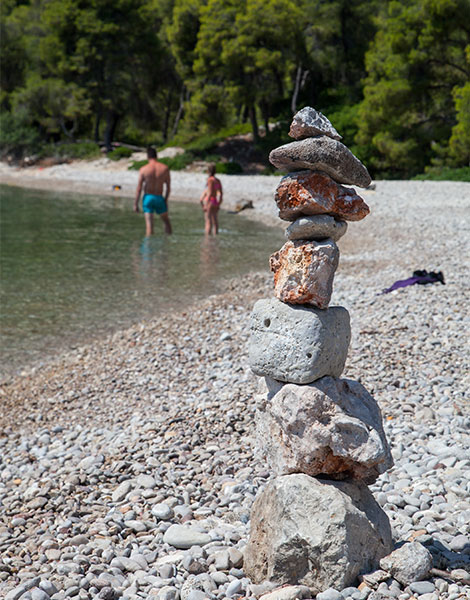
Polemarcha Beach, one of the most beautiful in the area, with pine trees at the shoreline.
© Perikles Merakos
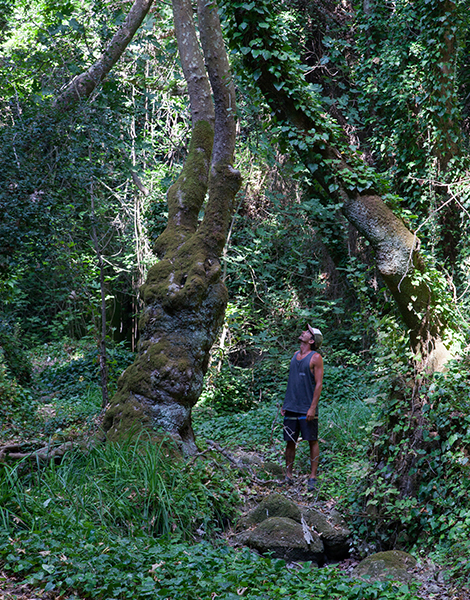
The Giannoulaika Waterfalls.
© Perikles Merakos
There’s more to the area than swimming and ancient drama. The lush countryside, dotted with citrus groves, olive trees and pine-covered hills, is ideal for walks and easy explorations. While the region does hold traces of Mycenaean settlements, most are no longer well preserved. One exception is a remarkable Mycenaean bridge near the village of Arkadiko, still intact and just off the main road. For nature lovers, the Giannoulaika Waterfalls, a 15-minute hike from Arkadiko, are worth seeking out, though the flow depends on the season (at the time of writing, they’ve run dry). In Lygourio, locals will direct you to where you can buy their beloved “Epidaurus ice cream,” made (with local milk) in over 35 flavors by brothers Giannis and Argyris Opsimoulis.
For something truly unique, visit the Kotsiomitis Natural History Museum (museum-kotsiomitis.gr, open 10:00-15:00), founded and lovingly curated by Vasilis and Anastasia Kotsiomitis. Their collection includes fossils and minerals from around Greece – ammonites from Epidaurus as well as fossilized tree trunks, corals, fish and insects – some dating back over 530 million years. If you’re in the mood for a brush with more recent history, head to Nea Epidavros, where Greece’s first National Assembly was held and the Greek Declaration of Independence was signed. It was here, too, that the blue-and-white flag was officially adopted as a national symbol. You can visit the commemorative monument or, if you’re feeling energetic, hike up to the hilltop ruins of a Byzantine castle, with sweeping views and a small chapel dedicated to Saint John the Theologian.
If, on the other hand, you’re not in the mood for a climb or any musings on the evolution of the Greek state, simply head to the harbor of Nea Epidavros, where a quiet beach and a welcoming ouzeri await. After all, everything here really began in the name of health and wellbeing.
At 1,160m, Metsovo blends preserved mountain...

This recipe comes from Germanos Christianopoulos,...

Anyone who has visited Tsintzina, the...

The Kerameikos archaeological site provides a...