Kalamata Off-Season: The Most Beautiful Time to Discover...
Just two and a half hours...


© Shutterstock
“On the first journey of my life, what matters most is not the distance, but the dangers – and the odds are not exactly in my favor: roughly one in a thousand. If I manage to hatch, and if my siblings and I are not eaten by some wild animal before we even get started, I will be just five centimeters long and weigh about 20 grams. Outside the nest, a world far tougher than a creature as tiny as me can handle will be waiting: sand that looks like mountains to my eyes, footprints that seem like ravines, birds and crabs lying in wait, artificial lights that can send me in the wrong direction. I don’t know where I will end up. I only know that I must move toward the sea. But even there, predators, speedboats and fishing gear are waiting. I also know, before I have had time to learn anything else, that I have no other choice.”
This imagined voice of a loggerhead hatchling reflects the extreme vulnerability of one of the Mediterranean’s most iconic marine species, which returns each year to nest on Greek beaches. The nesting season is now underway in Messinia, where conservationists are once again monitoring the arrival of female loggerhead sea turtles (Caretta caretta) onshore at night to lay their eggs in the sand. At Costa Navarino’s Navarino Dunes beach in Romanos, part of a 2.7-kilometre natural coastline, a long-running collaboration with ARCHELON, the Sea Turtle Protection Society of Greece, has recorded 586 nests and 30,508 hatchlings reaching the sea between 2010 and 2025. The figures point to a steady upward trend: from just 13 nests recorded in 2010, the first year of operation, to an annual average of 73 nests over the past three years. Just days ago, researchers identified the first nest of the 2026 season, marking the turtles’ return on schedule to their reproductive cycle.

To trace the loggerhead sea turtle back to its origins is to return to a world before human history. Sea turtles have existed since the age of the dinosaurs, outlasting them by millions of years. Of the seven species found today, three inhabit the Mediterranean, but only the loggerhead nests on Greek shores, from Zakynthos and Kyparissia Bay to the southern Peloponnese and Crete. In Greece, the loggerhead has come to symbolize more than a protected species. From the mid-1980s and throughout the 1990s, it became one of the country’s first widely recognized icons of environmental awareness – a living reminder of the fragile relationship between tourism development and coastal ecosystems. For many, it was also the first time a wild species entered public consciousness under its scientific name: Caretta caretta.
Paradoxically, the loggerhead became known to the wider public almost simultaneously as a protected species and as part of the tourist experience. Public attention began turning places such as Laganas Bay and Sekania on Zakynthos into an early testing ground for environmental awareness. At first, the discussion focused mainly on nesting beaches: construction, lighting, umbrellas, human presence, vehicles on the sand and nighttime disturbance. Later, it expanded to the sea itself: speedboats, organized boat trips, turtle spotting and the observation of turtles at sea, raising questions about how awareness and visitation can themselves become forms of pressure if not properly managed.

At this point, it is worth pausing to get to know the loggerhead a little better: a turtle that, almost despite itself, has become a mirror of our environmental conscience. Among Mediterranean populations, an adult loggerhead weighs around 80 kilos. Like all reptiles, it breathes air and must regularly return to the surface. Its body is protected by a bony, hydrodynamic shell that can reach around 80 to 85 centimeters in length. It feeds mainly on slow-moving or stationary marine life, including shellfish, jellyfish, mollusks, sea urchins, crabs and sponges. Its life unfolds across a range of habitats: the open sea, feeding grounds, coastal areas near nesting beaches and, for females, the beaches themselves.
The reproductive cycle follows a precise rhythm. Mating takes place during migration to the nesting areas or in nearby waters. From late May to mid-August, females come ashore at night, dig nests roughly half a meter deep in the sand, and lay an average of around 100 eggs. A single female may nest two to four times in a season, at intervals of about two weeks. Incubation lasts 50 to 60 days, and the temperature of the sand determines the sex of the hatchlings.
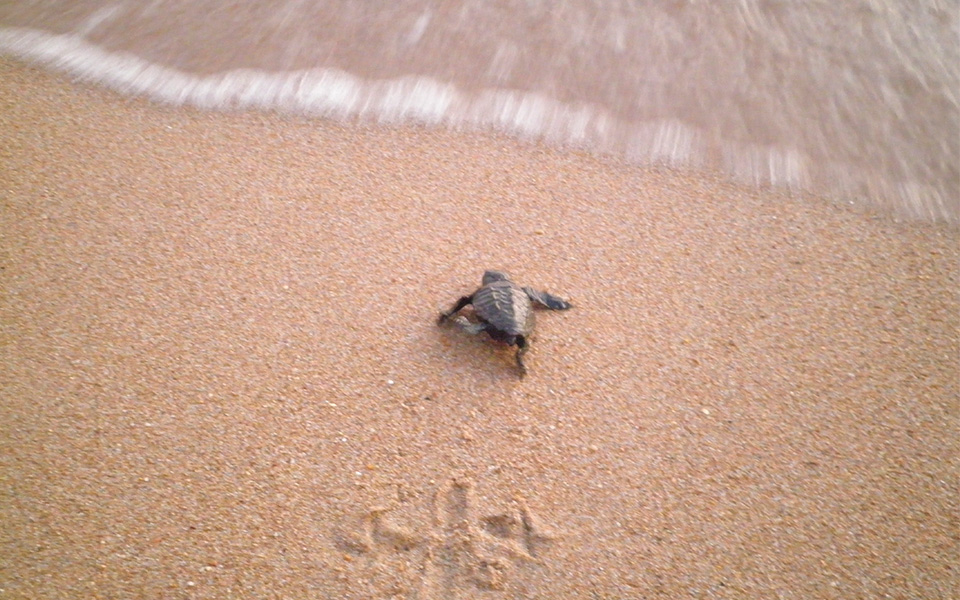
When the time comes, the young begin their slow ascent through the sand — a process that can take up to four days. They emerge together, usually at night or in the early hours of the morning, when temperatures are lower. From that moment, instinct takes over: they must find the sea, guided by the reflection of starlight on the water. It is a brief but decisive passage. Along the way, they face natural predators, strong waves, and human pressures: artificial lighting, noise, vehicles, sunbeds, and any obstacles left on the sand. Once in the sea, further risks await: predators, fishing gear, pollution, and collisions with boats. The very few hatchlings that survive will need around 15 to 25 years to reach reproductive age. Then the females will generally return to the same beaches where they were born to lay their own eggs. That is why protecting a nesting beach is never about a single season. It is about safeguarding a place that may one day be chosen again – decades later – by the same species returning home.

Greece’s experience with such issues has often been a bitter one. When an endangered species is placed on one side of the equation and development pressures on the other, nature has not always prevailed. On Romanos Beach, however, a different approach had already begun to take shape through the collaboration with ARCHELON long before Costa Navarino opened. It was a priority for the resort’s founder, Captain Vassilis Constantakopoulos, that the natural environment should not be an afterthought but part of the design itself. That commitment translated into specific choices. To avoid disturbing nesting turtles or disorienting hatchlings, both the design of the buildings at Navarino Dunes and the resort’s lighting strategy were carefully planned. Low-impact illumination, protective coverings and dense peripheral planting help ensure that light from the resort is not visible from the beach, creating a buffer between built space and nesting habitat.
Since 2010, Costa Navarino and ARCHELON have implemented an ongoing monitoring and protection program for the loggerhead turtle along this stretch of coastline. Each year, researchers survey the population, track nesting activity and protect nests on a daily basis, safeguarding both eggs and hatchlings on their journey to the sea. For visitors, this work often becomes visible in simple ways. Marked and fenced-off sections of sand prompt questions from beachgoers: what lies beneath, and why it matters. At sunrise, ARCHELON researchers and volunteers walk the shoreline, identify turtle tracks, record nests, and – when necessary – relocate them away from areas at risk of flooding or erosion. It is meticulous fieldwork carried out day after day throughout the nesting season.
The program also has a strong educational dimension. Guests learn why the beach needs to remain quiet at night, why sunbeds are placed well back from the waterline, why lighting is kept to a minimum and what a fenced nest in the sand actually means. According to Vassilis Karakousis, Sustainability Director at Costa Navarino, nest excavations at the end of the summer are among the most immediate experiences for the public. Guests can see the eggs up close, hear researchers explain the hatching process and, in some cases, watch the release of hatchlings that have remained trapped in the nest. The guiding idea is simple: protecting the loggerhead cannot be an afterthought once development is complete. It must be integrated from the outset and maintained continuously, as part of the daily life of the beach itself.
“The protection of sea turtles, in most cases, does not require the absence of people from beaches, but the presence of responsibility,” says Daphne Mavrogiorgou, Director of ARCHELON. “The continued successful protection of loggerhead nesting on Romanos Beach in Messinia proves that when the scientific expertise provided by ARCHELON meets a genuine commitment to sustainable tourism development, nature and people can coexist harmoniously. The Costa Navarino model points the way toward the future of responsible tourism in the Mediterranean.” The model has also drawn international attention. Among its high-profile visitors was HSH Prince Albert II of Monaco, known for his environmental advocacy, who described the project as an example of how luxury tourism and conservation can align:
“Costa Navarino is a great example, not only for the sustainable way in which they’re conducting their business, the model that they present here, and the conservation efforts – especially for turtles. But they’re also a great example for other resorts and initiatives like this, that you can do things in a very elegant and modern way – but you can do it in a sustainable way as well.”
In 2025, ARCHELON recorded approximately 10,700 nests along some 97 kilometers of coastline in Zakynthos, the Peloponnese and Crete. An estimated 490,000 hatchlings successfully reached the sea.
Zakynthos
Laganas Bay has six nesting beaches, with a total length of 5.5 kilometers. In the past, these beaches recorded an average of around 1,200 nests per year; in 2025, the number reached 2,155, remaining at a high level for the third consecutive year. Systematic monitoring and protection by ARCHELON began in 1984, while the National Marine Park of Zakynthos was established in 1999. Today, conservation challenges have shifted: the main pressures are no longer ignorance, but intensity: artificial lighting, sunbeds, nighttime beach activity, boat traffic and the growing transformation of turtles into a tourist attraction at sea.
Kyparissia Bay
Kyparissia Bay is considered the largest loggerhead nesting area in the Mediterranean. Systematic nest monitoring began in 1984. According to ARCHELON data, around 6,100 nests were recorded in 2025, a number 74% higher than the average of the previous 12 years. The area is part of the Natura 2000 network and was designated a protected site in 2018. Despite this, it remains a striking example of delayed institutional protection: in 2016, Greece was condemned by the Court of Justice of the European Union for failing to adequately safeguard the loggerhead and its habitat.
Crete
Across Rethymno, Chania and Messara, around 710 nests were protected in 2025. In Rethymno, where the nesting beach stretches for roughly 12 kilometres, the area once averaged around 200 nests per year. Today, pressure is significant, as nesting sites overlap with a densely developed tourism zone, including hotels, roads, water sports and organized beaches. One positive development came in 2025, when eight hotels in Rethymno and Chania were certified as “turtle-friendly” by the TUI Care Foundation, with the scientific support and expertise of ARCHELON.
Messara Bay, with a nesting beach spanning about eight kilometers, is part of the Natura 2000 network. ARCHELON’s work in the area began in 1993. In 2025, 222 nests were recorded and protected. Here, tourism and construction pressure is more limited than in Zakynthos or northern Crete, so the main challenge is preserving the coast’s low-impact character.
Koroni and Lakonikos Bay
Zaga-Memi Beach in Koroni is 2.7 kilometers long. While in previous decades it hosted an average of around 70 nests per year, in 2025, 228 nests were recorded. ARCHELON’s has been active here since 1995, in cooperation with local authorities and businesses.
In Lakonikos Bay, ARCHELON’s work began in 1985 and covers approximately 25 kilometers of coastline around Gythio and the Evrotas River delta. In the past, the area recorded an average of more than 200 nests per year; in 2025, that number reached 1,253. However, higher numbers do not necessarily mean safer conditions: at Mavrovouni, light pollution alone still affects nearly half of all nests, underscoring the ongoing vulnerability of even well-monitored nesting sites.
Just two and a half hours...
Authentic experiences connected to Homeric storytelling...

These sites may not make every...

From alpine forests and dramatic gorges...