Don Dines in Athens: Tzimis, Vyronas
Beyond souvlaki lies a carnivore’s paradise,...

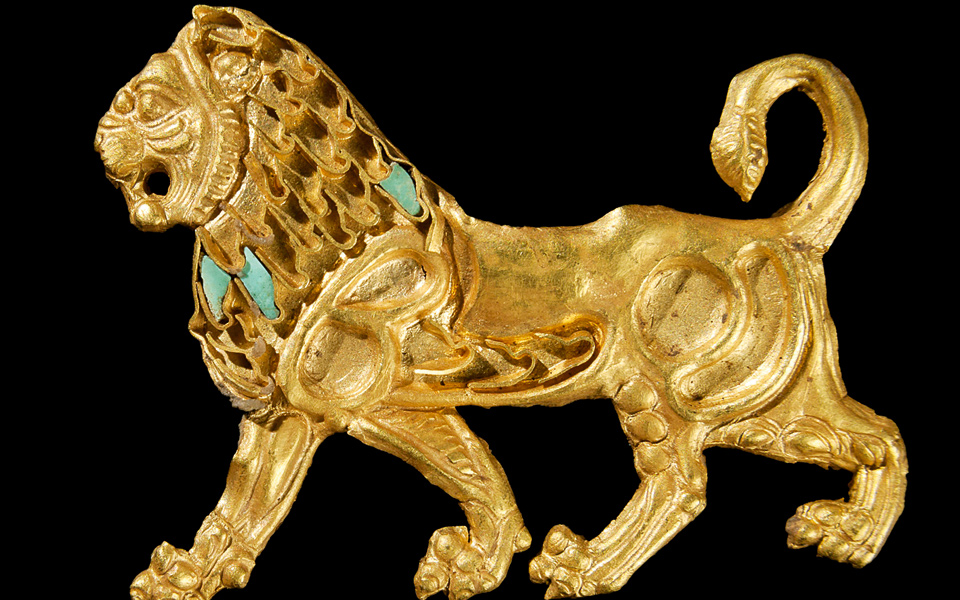
A gold foil ornament with inlaid stones, originally a garment decoration; probably a dedication offered by a soldier returning from Alexander's army (4th cent. BC)
© Vangelis Zavos
Described by Homer as a holy land, Samothrace is awe-inspiring not just for its stunning landscape, but also for its mystical aura. This small island in the northern Aegean has been associated with the little-known Cabeiri, a group of chthonic deities, and the cult of the Samothrace Mysteries, membership in which was believed to protect sailors and other travelers from the perils of the sea. Initiates, including mythical demigods and legendary heroes such as Hercules, Agamemnon and Odysseus, believed that if they ever revealed what went on during the mysteries they would be cursed for life.
The royal family of Troy may have had their roots on the island of Samothrace, while this is also the celebrated spot where King Philip II of Macedonia first met and fell in love with Olympias, daughter of King Neoptolemus I of Epirus, whom he would later marry and give a son that would go on to change the course of world history: Alexander the Great. It was also on Samothrace that Perseus, the last king of Macedonia, sought shelter from Roman persecution in 168 BC.
“ Samothrace has been associated with the cult of the Samothrace Mysteries, membership in which was believed to protect sailors and other travelers from the perils of the sea. ”
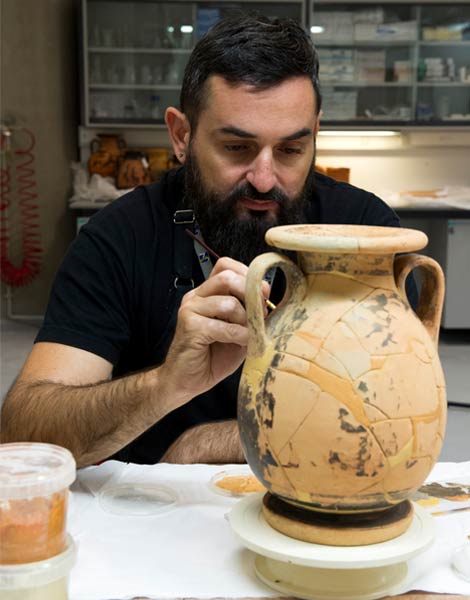
A museum conservator cleaning one of the urns
© Vangelis Zavos
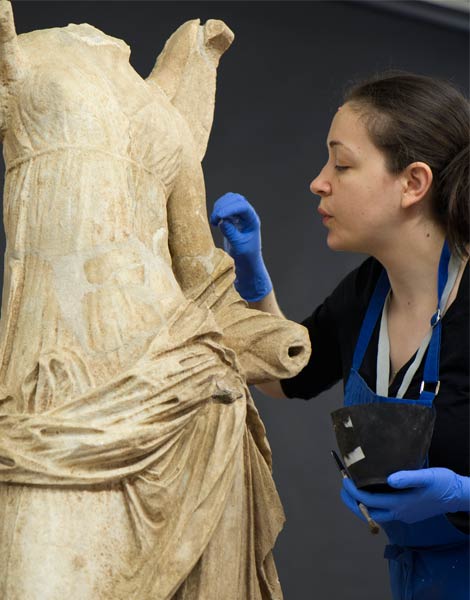
A museum conservator cleaning one of the four female akroteria (125-120 BC) from the roof of the Hieron in the Sanctuary of the Great Gods.
© Vangelis Zavos
These and other chapters of the island’s rich history are the subject of the temporary exhibition “Samothrace: The Mysteries of the Great Gods” now at the Acropolis Museum, which is celebrating its sixth anniversary this year.
Among the 254 objects that constitute the exhibit, highlights include a reproduction of the splendid 2.75 m tall winged statue of Nike (Victory) of Samothrace; a frieze depicting women dancing; a 4th century BC golden lion from Persia; and a marble stele from the entrance of the Anaktoron forbidding entry to the uninitiated.
“ The exhibition will run from 20 June 2015 until 10 January 2016. ”
ACROPOLIS MUSEUM
15 Dionysiou Areopagitou • Tel. (+30) 210.900.0900
Temporary Exhibition Gallery, ground floor
• Opening hours: Monday 8 a.m. – 4 p.m.; Tuesday-Sunday 8 a.m. – 8 p.m.; Friday 8 a.m. – 10 p.m. • Admission to the temporary exhibition is free • Last admission is half an hour before closing.
Beyond souvlaki lies a carnivore’s paradise,...
Discover Greece’s islands in September with...
Discover five of Athens’ latest openings,...
From the salt-sprayed islands to the...