When Gods Were Tourists: Greece’s Sacred Travel Hubs
Before passports and package tours, pilgrims...


Pericles (L), Athens’ great statesman, empowered the people and elevated women's status; Attalus I (center), king of Pergamon, received honors from Athenians for helping to resist the Macedonians; Emperor Hadrian (R) improved Athens’ infrastructure, making city life more pleasant.
Names, names, everywhere! Whether you’re exploring archaeological sites at the heart of ancient Athens or simply making your way through the modern city, you’ll find that Athens is filled with the names of historical figures – some familiar, others less so – many of them associated with ancient monuments still prominent today. Pisistratus, Pericles, Eumenes II, Herodes Atticus, the list goes on…
Who were these people? They were power brokers and moneymen. Ancient Athens was a cosmopolitan city whose leaders and benefactors came from both Attica and abroad. They were members of rich and powerful aristocratic families, generals, kings, emperors and what we might consider nowadays conservative-leaning, anti-democratic oligarchs. Athenian history is filled with colorful, occasionally repudiated characters whose political dealings, public benefactions or personal admiration for Athens’ sophisticated, age-old culture brought them a level of recognition or infamy that went beyond just a name.

Idealized view of the Acropolis and the Areopagus in Athens, by architect/painter Leo von Klenze (1846).
© VISUALHELLAS.GR
Little is said nowadays about Pisistratus, but a century before Pericles arrived to shepherd Athens into its democratic “Golden Age,” this hardline “tyrant” (a term that simply meant “absolute ruler”) from Brauron in eastern Attica held power on and off from 561-527 BC. He consolidated his authority by appealing to the poorer masses (initially the rural citizens of Attica’s hill country), resisting aristocratic leaders, redistributing land and improving the economy. This was early populism, practiced, too, by later politicians including Pericles and Cleon, but the gains for the populace were many.
Pisistratus established the annual Lesser Panathenaic festival and brought its focus onto Athena, asserting her as the city’s central patron deity. He also had Homer’s works documented in more permanent form; encouraged the wine-infused worship of Dionysus through his founding of the Dionysia festivals – and, in turn, fostering the development of drama; improved Athens’ infrastructure, including roads, the water supply and a more organized agora (central marketplace); invigorated the Attic pottery and olive industries; and gave extra-urban citizens greater access to justice through traveling judges.
Furthermore, Pisistratus expanded Athens’ foreign contacts around the Aegean, with one result being the embrace of Ionic-style architecture in the previously Doric-dominant mainland. A recent 2025 study has shown Pisistratid silver coinage was minted from ores originating beyond Attica and Thrace, indicating Pisistratus had direct or indirect trade ties with Asia Minor, Romania and as far away as Spain.
Today, the most visible monument that may evoke Pisistratus is the Temple of Olympian Zeus – although his small original temple was razed by his sons Hippias and Hipparchos and overlaid with a more massive structure, finally completed some six centuries later by the Roman emperor Hadrian. In the end, Pisistratus was largely stricken from Athenian collective memory because he was resented for the immense power he had wielded. His successor, Hippias, was overthrown in 510 BC, fled to Sardis and ultimately advised the Persians to attack Greece at Marathon in 490 BC, even accompanying the enemy onto the battlefield prior to their decisive defeat.

Pericles Admires the Work of Phidias at the Parthenon” (Gaspare Landi, 1811-1813).
© VISUALHELLAS.GR
Another undersung pre-Periclean figure was Cimon (510-450 BC), the son of Miltiades, the Greeks’ foremost commander at Marathon. Cimon was a great general in his own right, one of Athens’ most effective military leaders, who fought valiantly at the Battle of Salamis (479 BC), afterwards going on in the 470s and 460s to win further clashes with the Persians at Eion (beside later Amphipolis) and the Eurymedon River (in central southern Anatolia). He also played a key role in consolidating the Delian League, as Athens became the predominant power in the Aegean. In 461 BC, however, he was exiled for ten years following a diplomatic fiasco with Sparta, and he never regained his former prestige.
Plutarch tells us Cimon was hardly a democrat, instead espousing conservative views and pro-Spartan policies, but was still a good and generous man who opened his gardens and orchards to feed the less advantaged. Having become wealthy from the booty acquired through his military exploits, Cimon contributed to Athens’ improvement, defense and beautification, reportedly constructing athletic facilities, planting trees in the Athenian Agora, installing an entire irrigated olive grove with running tracks and walkways at the Academy, and sponsoring the foundation of the Long Walls that joined Athens to Piraeus. He may have also contributed to the south-side enlargement of the Acropolis and its greater fortification. In the northern Agora, somewhere near the Painted Stoa, Cimon is believed to have restored the shrine of the Athenian hero Theseus and erected three dedicatory herms. According to Plutarch, “When everyone of this era … enriched themselves out of the public money, he still kept his hands clean and untainted, and to his last day never acted or spoke for his own private gain or emolument.”
Cimon’s temperament as a strict military man and admirer of Sparta set him apart from most Athenians. Although a loyal citizen, he likely harbored resentment over the city’s final mistreatment of his father, who had died destitute in an Athenian prison. The marble victory monument erected at Marathon around 470-460 BC – an Ionic column topped with a Nike figure – may have been one of Cimon’s public benefactions, intended, suggests archaeologist George Steinhauer, not only to lend new prestige to the Athenian victory, but also to restore his father’s glory.

An artist’s rendering of the Theater of Dionysus, from an 1891 German encyclopedia.
© AFP/VISUALHELLAS.GR
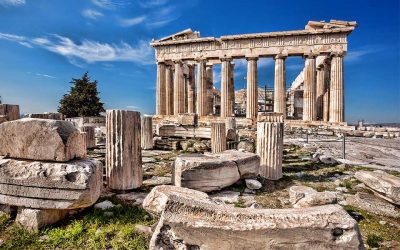
Among 5th-century BC benefactors, Pericles was the gold standard, transforming Athens’ cityscape and empowering the people through his democratic reforms. Although hailing from an aristocratic, well-connected family, Pericles embraced democratic values, in opposition to his political rival Cimon, bringing changes that would elevate the lesser classes and hopefully create a more stable, long-term basis for democracy. Besides monumentalizing the Acropolis with the new Parthenon, Erechtheion, Propylaea and Temple of Athena Nike, he also instituted payment for public service (jurors, councilors and archons), subsidized the Athenian knights, reduced property requirements for holding an archonship, allowed the poor free passes to attend theaters, and decreed citizenship could only be had by those with both an Athenian father and mother. Today, the Parthenon, with its meaningful Ionic frieze highlighting in part the important role of knights and women, represents a timeless work of state-sponsored propagandistic art that celebrates the importance of Athens and Pericles’ own democratic achievements.
An intriguing mystery concerning benefaction comes from the era just after Pericles’ death in 429 BC. The Peloponnesian War had started in 431 BC, followed by a plague in 430 BC that gripped Athens for three or more years. In 420 BC, a small sanctuary dedicated to the healing god Asclepius was established on the Acropolis’ South Slope, sponsored, according to an inscription, by a certain Telemachus, who brought cult statues of Asclepius and his daughter Hygeia across the Saronic Gulf from the main Asclepieion at Epidaurus. After temporarily accommodating these deities at the City Eleusinion on the North Slope, Telemachus brought them around the Acropolis on a wagon to their new sanctuary.
But who was Telemachus? Apparently he was a private benefactor, perhaps Athenian or Epidaurian, who’d somehow gained state permission, and possibly additional funds (per another inscription), to install the new cult just below the Parthenon. Was Telemachus a priest? Why did other priests complain that the sanctuary was encroaching on their sacred space? And was the Asclepieion’s foundation linked to the plague and/or the ongoing Peloponnesian War? We may never know for sure…

Pananthenaic amphora for olive oil awarded to victorious athletes (Metropolitan Museum of Art)
© ROGERS FUND 1914 / THE MET

Pergamon Altar, celebration of the Attalid king Eumenes II’s victory over the Galatians” (engraving by H. Leutemann, 1866).
© VISUALHELLAS.GR
A century after Pericles, Athenians experienced another “golden era” at the hand of Lycurgus from Boutadai, a deme located northwest of the Kerameikos. Once a student at Plato’s Academy, he became a financier so astute and reliable that he was allowed three terms as Athens’ chief treasurer (336-324 BC), during which he tripled the city’s income. Entrusted with vast sums of both public and private funds, Lycurgus executed a remarkable number of public works, including rebuilding the Theater of Dionysus in stone; establishing the Panathenaic Stadium near the Olympieion; constructing 400 new triremes and completing the naval arsenal in Piraeus; and beautifying the area of Aristotle’s Lyceum with trees and athletic facilities. He also commemorated Aeschylus, Sophocles and Euripides with statues, and strictly enforced actors’ adherence to the official versions of their plays. He was known to be so severe in condemning lawbreakers, Plutarch recalls, that he “did not dip his pen in ink, but in blood.” Moreover, a somewhat eccentric character, he wore the same coat every day, summer and winter, but rarely donned shoes.

Athena on an Attalid silver coin from Pergamon (220-190 BC).
© THE TRUSTEES OF THE BRITISH MUSEUM
In the Hellenistic era, as Macedonian imperialism threatened Athens and southern Greece in general, a close bond formed between the city and the kings of Pergamon, particularly Attalus I (ruled 241-197 BC) and his sons Eumenes II (197-159 BC) and Attalus II (159-138 BC). Aiding the Romans against the Macedonians in northern Greece, Attalus I also established the island of Aegina as a Pergamene naval base in 206 BC. After he visited Athens in 200 BC, the city named a new tribe (Attalis) after him, founded a cult in his honor, and publicly recognized the king and his royal house with many statues and honorary decrees. Pausanias reports that Attalus (I) adorned the Acropolis’ southern parapet with several statue groups, one including the now-famous Dying Gaul. He also supported the Academy, providing its scholarch Lacydes with a garden in which to conduct classes, and contributed a stoa (a roofed, colonnaded walkway/shelter) to Delphi – a place of great importance to the Athenians.
Eumenes II continued in his father’s phil-Athenian spirit, gifting the city an arcaded stoa on the Acropolis’ South Slope. His brother Attalus II, who’d battled alongside the Athenians against the Macedonians at Pydna (168 BC) and won several chariot races in the Panathenaic games, likewise erected a magnificent Doric/Ionic stoa on the east side of the Athenian Agora (150s BC). The Agora’s New Metroon (about 140 BC) is said to have resembled in layout the illustrious Library of Pergamon.
In Roman times, Julius Caesar was persuaded by the Athenian statesman Herodes, an ancestor of Herodes Atticus, to provide 50 talents (51/50 BC; equal in value to 1,300 kg of silver) for a new agora in Athens, which was actually built after 27 BC and further subsidized by Emperor Augustus. Its western gateway, sacred to Athena Archegetis and still a prominent monument today, was erected in 11 BC. Augustus also had a temple transferred from the Attic countryside (modern Gerakas) into the Agora and dedicated to Ares soon after his admiral Agrippa had constructed a large odeon in the public square (15-13 BC). According to Plutarch, their contemporary Pompey showed respect for Athens, too, through donations to the city’s philosophers and a 50-talent development fund for urban restoration.
The great philhellene Hadrian, however, surpassed them all, improving and adorning Athens with an aqueduct, a library and a monumental archway leading to the newly completed Olympieion and a new Roman neighborhood. Around the same time, an impressive new odeon south of the Acropolis was founded by Herodes Atticus, a leading citizen from Marathon who may have had an ulterior motive for his largesse, hoping to buy favor with the Athenian people after allegedly murdering his popular wife Regilla.
Before passports and package tours, pilgrims...

The real story of ancient Sparta...

Herodes Atticus was an important local...

Ancient Greece had its own team...