Three Traditional “Kafeneia” You Should Visit in Pilio
Whether you’re in northern, central or...

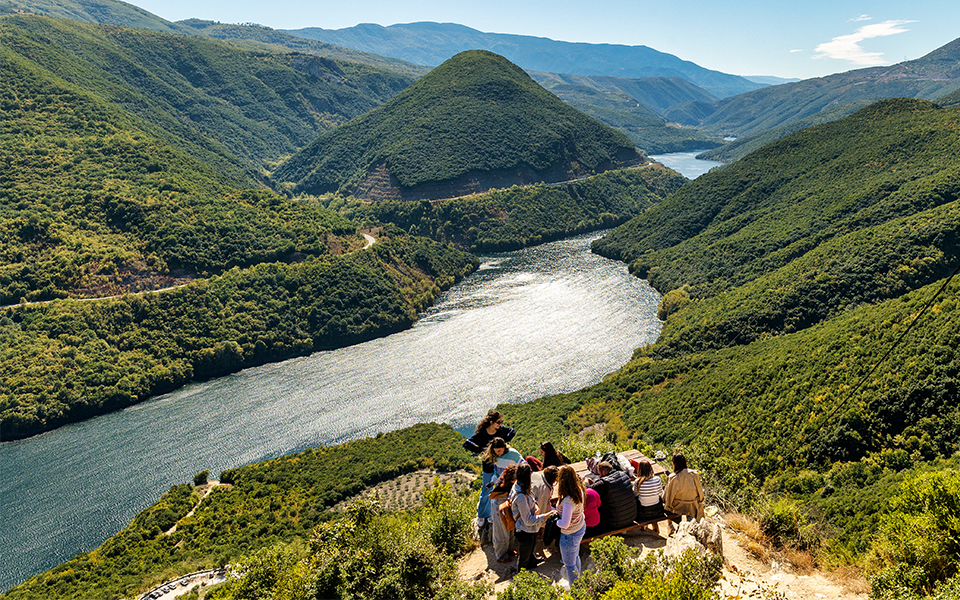
Taking in views of the Aliakmonas and its green banks from the Kallipetra Bench.
© Perikles Merakos
You can spot Veria from a distance, rising sharply above the plains of Imathia. Locals call the dramatic edge of town the “balcony;” in springtime, the famous peach orchards below are a sea of blossoms. On the northern end of town is the Archaeological Museum; Elia Park to the south is a popular promenade site. From here, a few main streets make getting around easy but losing yourself in the alleys of Veria’s historic quarters – Kyriotissa, Barbouta, Makariotissa and Panagia Dexia – is a pleasure. To find your way back out, let the sound of rushing water guide you to the Tripotamos River, its banks thick with trees. In Veria, you’re never far from a historic site, beautiful large-scale street art, something delicious to eat or a cozy place to relax over a coffee.
Veria gracefully weaves together several cultures – Vlachs, Pontians, Asia Minor refugees –against a backdrop of millennia of rich heritage. Located just 10km from Aigai, it was once the heartland of Ancient Macedonia. Later, it became a neokoros – a title of prestige granted to cities with a temple to the imperial cult – during the Roman Empire. Veria flourished as a prosperous Byzantine urban center, served as a strategic hub throughout the Ottoman period and was home to a Jewish community for many centuries. Presiding over an agricultural paradise, Veria’s natural setting is a story in itself: just 5km from town, Greece’s longest river, the Aliakmonas, cuts through a verdant gorge, while Mt Vermio (2,067m), with its forest trails and the Seli ski center, rises just west, and the Piera mountain range lies to the south.
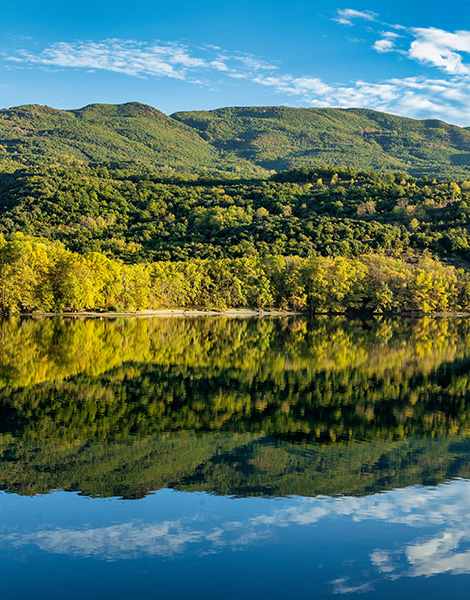
Tranquil splendor at the edge of town.
© Perikles Merakos
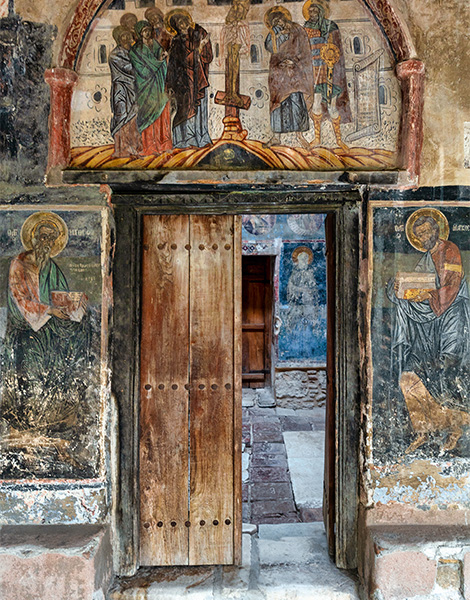
A contemplative moment at the Church of Sotiros Christou.
© Perikles Merakos
The city has a rich religious history. Veria’s Jewish community is described in Acts 17:11 as being “of more noble character than the Jews of Thessalonica” regarding its reception of Saint Paul, who preached from the spot now marked by the Bema of St Paul. Nearby in the historic Jewish quarter of Barbouta is the Synagogue of Veria. Jewish life flourished here until WWII, when most of that community perished in the Holocaust.
Veria is a prime destination for Byzantine art and architecture: “In the Byzantine era, Veria was something of a satellite to Thessaloniki,” says Byzantinologist Tassos Papadopoulos. This explains the wealth of churches. It’s also, he adds, associated with a significant figure: “Saint Gregory Palamas (1296-1359), considered the father of Hesychasm, a spiritual movement that shaped Orthodox monasticism and remains influential today, spent five years here.” Home to several important monasteries, the area around Veria remains a spiritual center.
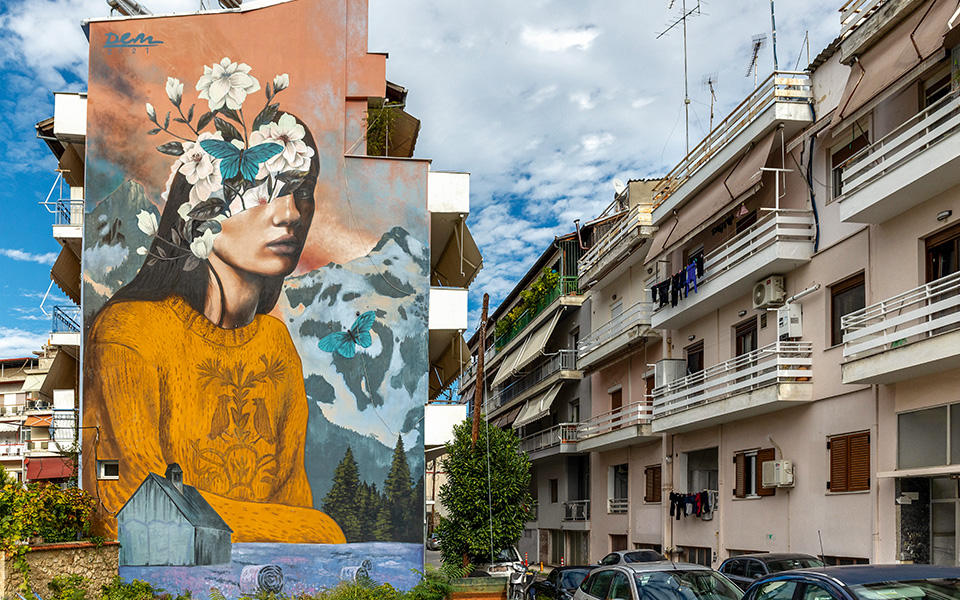
The "Gioconda" of Veria by Themis Konstantinopoulos (signing as 'Dem'), one of his several large-scale pieces bringing a contemporary energy to the cityscape.
© Perikles Merakos
In this snug metropolis, there are nearly 50 extraordinary Byzantine and post-Byzantine churches, most of them in use. The scale of the Old Metropolitan Cathedral, a three-aisled 11th-century splendor, conveys the prestige of Veria in the Byzantine period. White plaster surrounds the surviving portions of wall paintings of the 12th through 14th centuries, framing their beauty and drawing light into the space, bringing the architecture into focus.
The Church of the Resurrection of Christ the Savior (Anastasi Sotiros Christou) is a beauty inside and out, its exterior murals (18th century) protected by a portico. Inside, natural light illuminates scenes and figures painted in the early 14th century (1314/1315), their faces distinctive in their fullness and expression. Georgios Kalliergis reveals himself as the painter in a boastful but generous inscription over the door: “The painter is called Kalliergis, the best painter of Thessaly, together with my good and decent brothers.” Another highlight is the 15th-century Church of Aghios Patapios, built over the ruins of a 5th-century early Christian basilica, its floor mosaics preserved around the site. Follow the walkways to the basement of an adjacent apartment building, where a marvelous surprise awaits: a 4th-century baptistry. A guard can escort you.
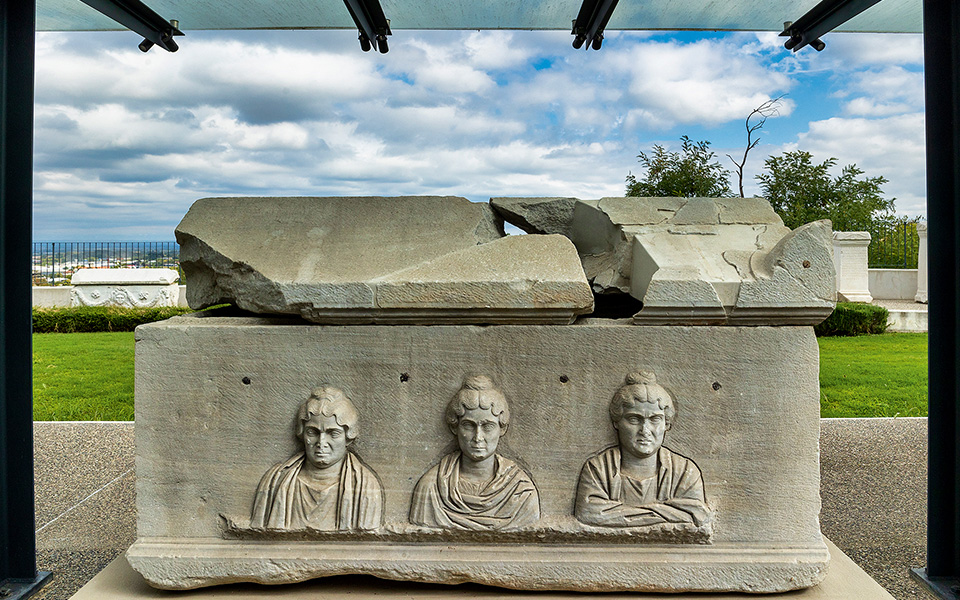
At the Wall of Memory, outside the Archaeological Museum.
© Perikles Merakos
Veria is surrounded by millennia of archaeological wealth. Collections of the Archaeological Museum of Veria span the Neolithic through Roman eras, while the splendid exhibitions of the Polycentric Museum and the Royal Tombs of Aigai are just a 15-minute drive away. The fine collections of Veria’s Byzantine Museum – portable icons, mosaics, coins, manuscripts and more – are displayed over three floors in Markos Mill, in the historic Kyriotissa district.
In the 18th-century Sarafoglou Mansion, the Veria chapter of the Lyceum Club of Greek Women – a women’s organization preserving local heritage all over Greece – has assembled a fine collection. The world of 18th- and 19th-century Veria is seen in the elegant urban dress, household objects, tableware and furnishings, and various ephemera that are displayed in this traditional mansion and its courtyard.
The City Hall is one of Greece’s loveliest. Until 1996, this was the city’s high school, and the stylish restoration itself is worth a look. The building also serves as an informal exhibition space with historic photos – visitors are welcome to drop by.
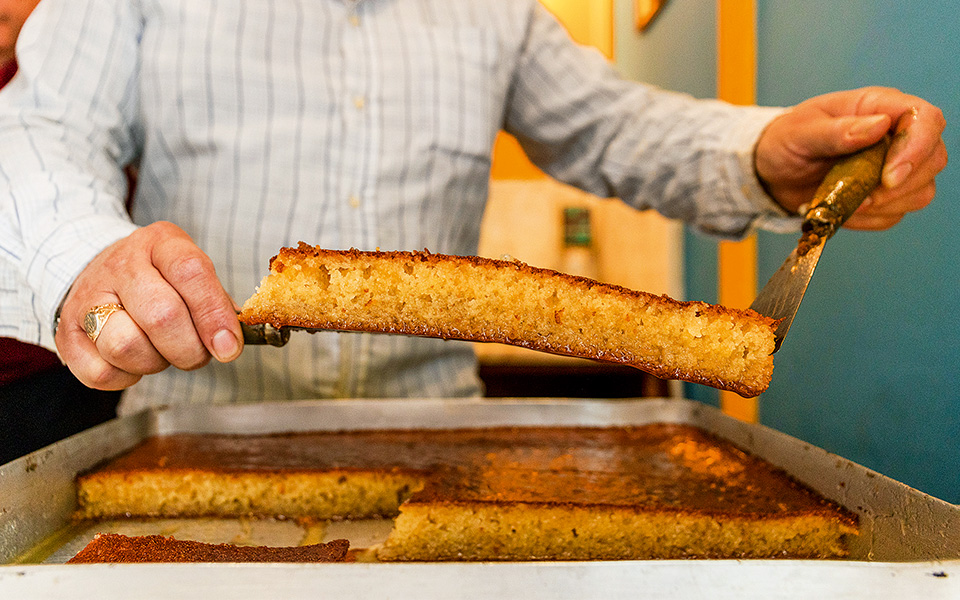
Airy, syrupy revani is a Veria specialty.
© Perikles Merakos
After all this strolling around, a bite on the go from Riza M (113 Κentrikis) is just the thing. “Riza means ‘root’ in Greek. But for Pontians, ‘riza’ means the new generation, the seed that flourishes,” explains Linda, one of the three siblings of the Autzidis family serving up traditional Black Sea bakery goods, such as airy pirozhki, savory pies of flaky perek and delicious otia (“ears” of sweet fried dough).
Veria’s signature treat, revani – a delicate semolina cake moist with syrup – is also a must, and nostalgic Lido (61 Mitropoleos) where happily not a thing has changed for decades, makes a delicious version. Their ice cream, made from local sheep’s milk thickened with salep (the root of a wild orchid, which makes it deliciously stretchy), is also a specialty. For edible souvenirs, visit Farmakis (1 Pindou) where three generations work side by side making traditional cheeses, including smoked braids of kaseri as well as the local batzos, which enjoys protected designation of origin status. For a coffee break in the warmer months, stop by Nea Barbouta on the riverbank, where your order arrives via zipline.
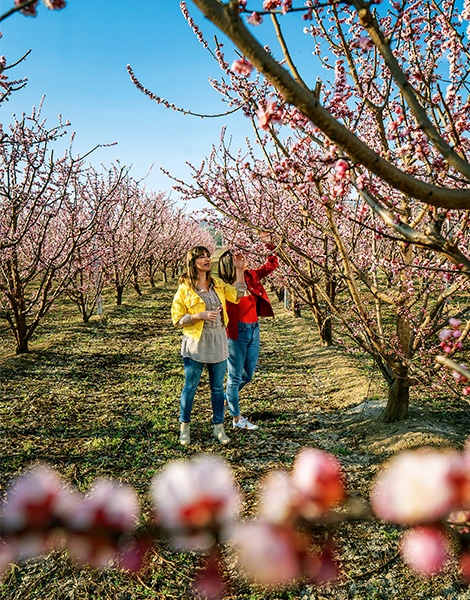
Peach blossom season in March is a wonderful time to visit Veria.
© Perikles Merakos
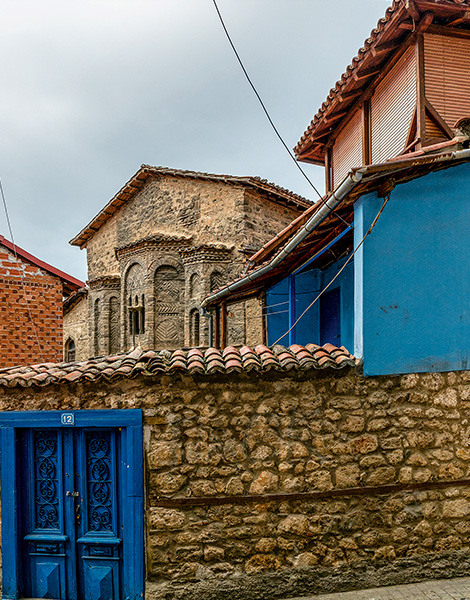
In the Makariotissa district, a glimpse of the Church of Saints Cyricus and Julitta.
© Perikles Merakos
“When Anna cooked, the scent filled the mahala [neighborhood], gathering all the children to eat. That was the custom: whoever had enough to cook, shared. On Sundays, our father had the day off, so he’d put some rebetiko in the cassette player as the house filled with relatives and he made everyone a big lunch.” The Samoukas brothers – chef Giannis, with Thanassis and Manolis front of house – reminisce about the world they grew up in; the Asia Minor refugee community of their forebears lived across the Tripotamos River from 12 Grada (11 Sofou & Dimosthenous), the restaurant they opened as a tribute to their heritage, a love of sharing food through the generations.
It’s all about community here; the brothers grow all their produce or source it from their neighbors. Guided by the season, Giannis enhances his dishes with inspired details; the dolmadakia are wrapped in the leaves of the local xinomavro grape and made fragrant with preserved lemons. The ragout, made with Veria’s famous beef, is a standout. With xinomavro and fruit – prunes or, in winter, quince – the dish is a tender nod to the past, a time when making use of everything available was essential. This is thoughtful fine dining with a Cucina Povera soul. Oenophiles should take special note – some very rare local wines are among the many tempting choices.
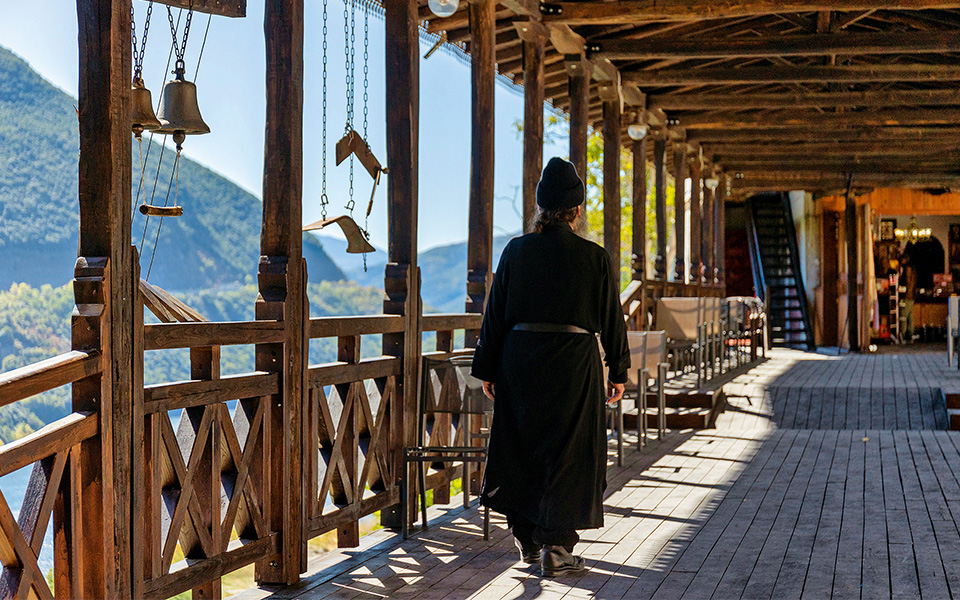
Faith and natural splendor converge at the Kallipetra Monastery.
© Perikles Merakos
If you can find time to enjoy more of the area, the surrounding region is full of discoveries. Aliakmonas Dam and its serene lake are five minutes from town. Reached via the village of Asomata heading south is the Kallipetra Bench. Thrillingly high above the river, it’s actually more of a picnic table; you could bring lunch but be aware that it’s a very popular spot.
The beautifully situated Kallipetra Monastery, with its 17th-century icon of the Virgin Kallipetritissa, is a couple of kilometers down the road. The monastery’s archondariki, where the monks might offer you a coffee and loukoumi, is a fine example of local craftsmanship. Going south along the east bank will bring you to a road ascending to the Holy Monastery of Saint John the Baptist, also called the Monastery of Timios Prodromos, the Holy Skete of Veria. Perched high above the Aliakmonas, the monastery fits the drama of the landscape perfectly. A gate leads to a richly painted chapel and a cave with free-standing figures of saints and Christ rendered in the Byzantine style.
For some, the Aliakmonas itself and its steep gorge are the main draw. Below the monastery, off the main road along the river, there’s a rockface. Look up, and you’ll see groups outfitted with helmets, ropes, harnesses, climbing quickdraws and belaying devices, out for an amazing day as they scale the rock. This is the Nikos Pitoulias crag, a sport climbing destination with bolted and secured routes of different grades to suit every climber, beginner to experienced. Climbs range from 15 meters to an impressive 40 meters. Walking through the gorgeous countryside is a more sedate pursuit. With the Aliakmonas on one side, Mt Vermio on the other, and a host of monasteries and lovely villages throughout the area, exploring by car is a pleasure, too.
Archaeological Museum of Veria
47 Anoixeos, Tel. (+30) 23310.249.72
Winter: Wed-Mon 9:00-17:00. Summer: Wed-Mon 8:00-20:00, Tue 12:00-20:00.
Byzantine Museum of Veria: 26 Thomaidou
Tel. (+30) 23310.761.00
Winter: Wed-Mon 9:00-17:00. Summer: Wed-Mon 8:00-20:00, 12:00-20:00 Tue.
Sarafoglou Mansion
14 Ierarchon, Tel. (+30) 694.594.1596,
Mon & Thu 10:00-12:00, lev.gr, or by appointment.
Veria Synagogue
6 Olganou, by appointment with Mrs Evi Meska, Tel. (+30) 698.388.0329
General information:
Municipality of Veria, Tourism Department,
Tel. (+30) 23313.506.08, discoververia.gr
Many thanks to Ioannis Valachis of the Municipality of Veria and to Nick Ampa for the particulars on sport climbing; for detailed information on routes all across Greece, see thecrag.com.
Whether you’re in northern, central or...

A steep and curvy drive high...
From the salt-sprayed islands to the...

Trace St. Paul the Apostle’s journey...