The Greek Museums That Hide Big Stories in...
From ancient steam engines and living...

© Perikles Merakos
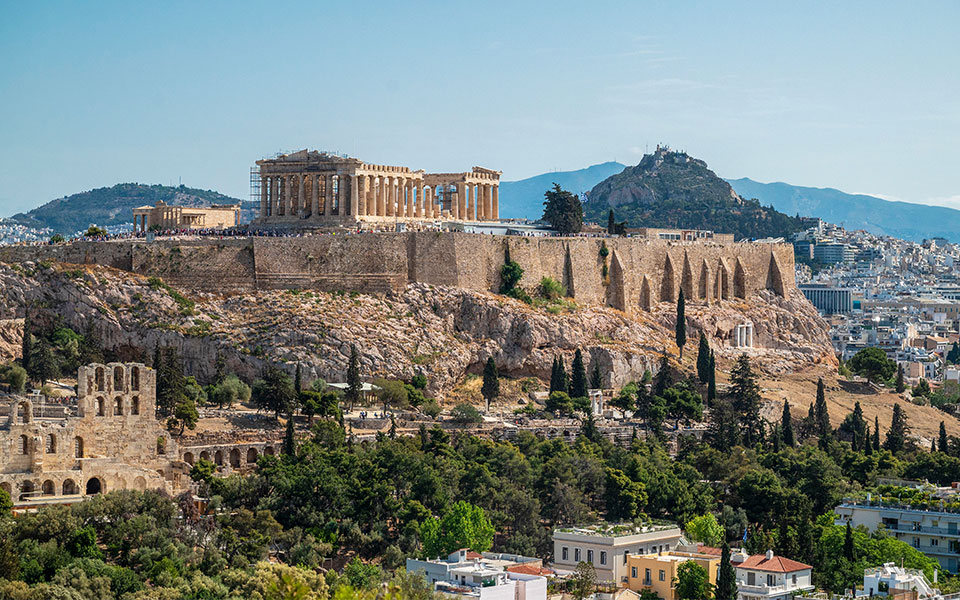
Athens holds countless secrets for culture lovers eager to explore the city on foot. Whether you’re visiting for the first time – in which case we suggest following the guide on the previous pages – or returning for the umpteenth time, there’s a walking itinerary here to inspire you.
We’ve divided the city into three key areas where there’s plenty of cultural sights to see, each waiting to be explored at your own pace. And as a bonus, we’ve included its fabled port of Piraeus. Ready for an artwalking experience that spans everything from Cycladic figurines and Mesopotamian relics to early Jean-Michel Basquiat works, powerful Marlene Dumas canvases and iconic Athenian graffiti?
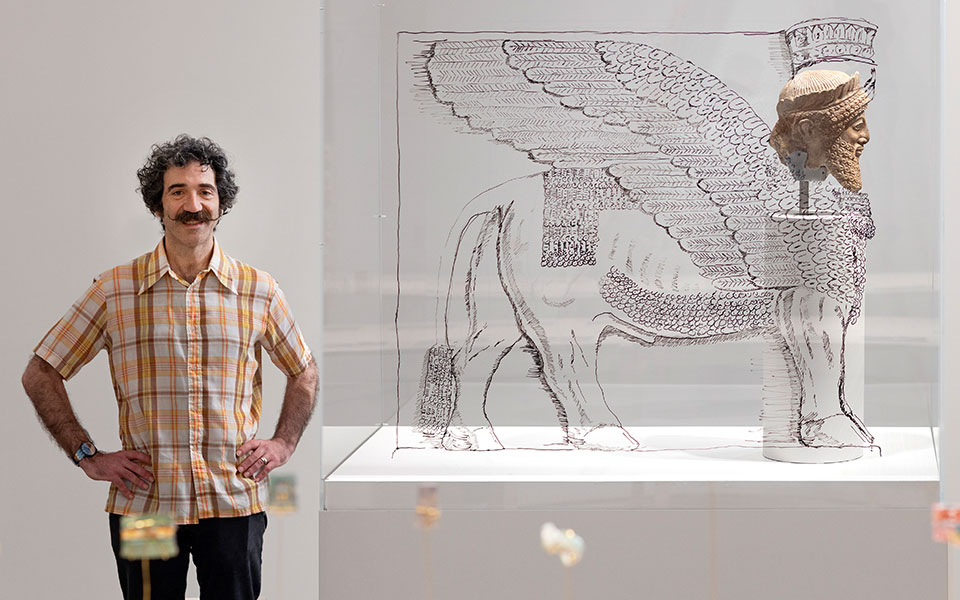
Michael Rakowitz and his work “Study for a Lamassu in Spolia,” in the temporary exhibition hall of the Acropolis Museum.
© Natalia Tsoukala / Courtesy ΝΕΟΝ, the Acropolis Museum and the artist
Why not begin at the very center of the city, in Syntagma Square – a space that feels (without officially being) like a natural extension of the marble-paved forecourt of the Hellenic Parliament? Surrounding the square or just a short stroll away, you’ll find some of the city’s most historic hotels, as well as iconic buildings, embassies, flagship boutiques and cultural landmarks.
Syntagma is also adjacent to the National Gardens – a refreshing green interlude worth exploring, not only for its towering Washingtonia palms and picturesque duck pond but also for the statues that punctuate its shaded paths and the human presence that makes this space so welcoming.
The greater area surrounding the Acropolis, its museum, Plaka and the Ancient and Roman Agora may be a well-trodden tourist hub – but each year, it still manages to come up with new surprises.
Until 31 October, the Acropolis Museum is hosting the temporary exhibition “Allspice: Michael Rakowitz & Ancient Cultures” (free admission with a zero-value ticket). Here, works by the Iranian-American artist Michael Rakowitz enter into dialogue with artifacts from ancient Middle Eastern and southeastern Mediterranean cultures.
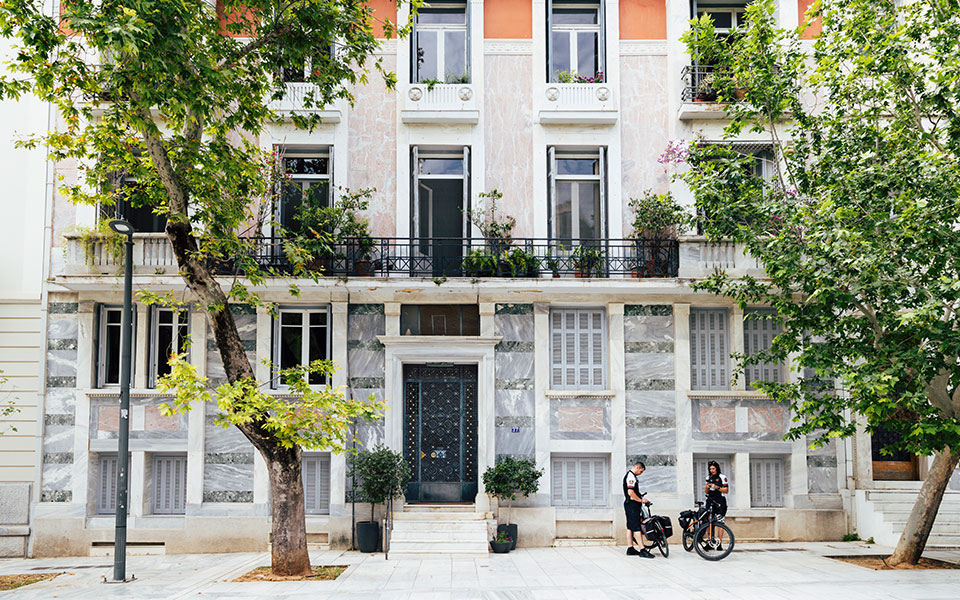
One of the many neoclassical buildings on pedestrianized Dionysiou Areopagitou Street.
© Dimitris Vlaikos
Just 300 metres away, a side street off pedestrianized Dionysiou Areopagitou is home to the Cavafy Archive (16B Frinichou, free admission). Inside, you’ll find personal belongings of the great Alexandrian poet – including his iconic round spectacles.
Only three minutes away on foot from the Cavafy Archive, the Arch gallery (5 Goura) is showing “Exploding Plastic Inevitable,” an exhibition by German sculptor Lena Henke, on view through 6 November.
While in Plaka, it’s worth making a short stop at the Elytis House Museum (4 Dioskouron & Polygnotou, general admission: €7), where the office of the Nobel-winning Greek poet has been carefully reconstructed to reflect the original working environment of this exceptional writer.
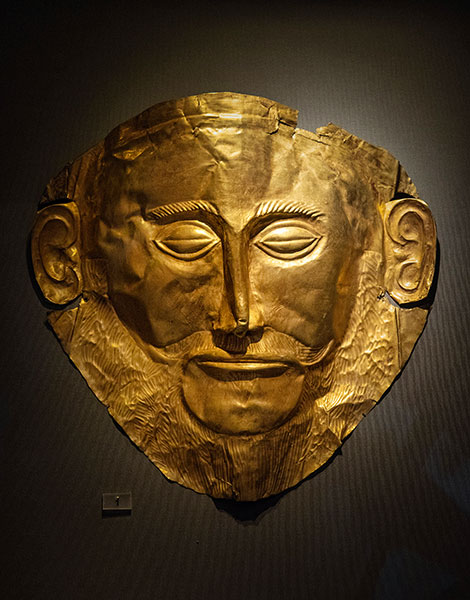
The artifact known as the Golden Mask of Agamemnon, one of the most famous items in the National Archaeological Museum.
© Perikles Merakos
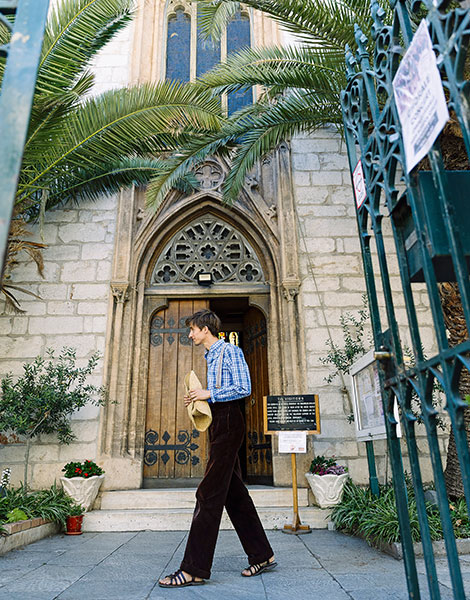
St. Paul’s Anglican Church on Filellinon Street.
© Dimitris Vlaikos
Roughly 300 metres from the Ancient Agora, in the neighbourhood of Thiseio, stands the Alex Mylona Museum (5 Aghion Asomaton Square, general admission: €6). Alongside works by the late Greek sculptress Alex Mylona (1920-2016) and other artists, the museum is hosting “A Cabinet of Curiosities,” an exhibition of intriguing, unconventional artworks on view through 31 August.
Finally, a slight detour on the L-shaped route connecting the Athenian Trilogy to the National Archaeological Museum leads you to Omonia Square, where “Pentakyklo” (“Five Cycles”) – a kinetic steel installation by Greek sculptor George Zongolopoulos – makes a bold statement. Once a popular hub and more recently associated with late-night unease, the square is a safe if lively space in daylight hours and well worth a visit.
At the top of Deligiorgi Street, look for one of the city’s most striking murals, a piece by street artist INO created to raise awareness around hepatitis C. You may spot other examples of his thought-provoking work in other parts of the city as well.
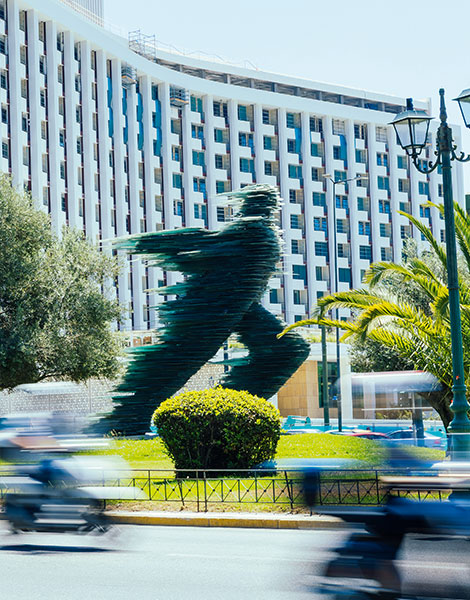
“The Runner" by Kostas Varotsos is one of the city’s most notable public sculptures; it sits on a central traffic island opposite the National Gallery.
© Dimitris Vlaikos
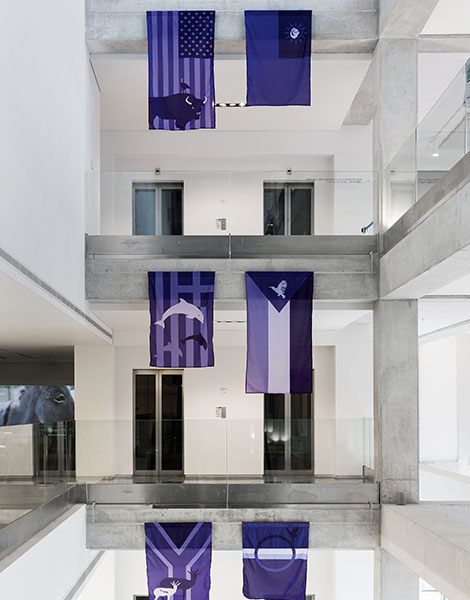
The installation “Embrace your Empathy (2016/2025),” a work by the artistic duo of Gustafsson and Haapoja from Finland, consists of 20 flags and extends over several floors of the EMST.
© Paris Tavitian
These two neighborhoods, which border the city center, are known for their vibrant blend of retail shopping, dining, nightlife and culture.
Kolonaki, the more upscale of the two, is famous for its many art galleries. If you’re going to visit just one, make it Gagosian Athens at 22 Anapirou Polemou, which is currently presenting “A Telegram to My Dear Suki” by Oscar Murillo (through 30 August). On your way, expect to pass elegant boutiques and stylish haunts favored by the city’s elite.
If you’re short on time for leisurely flânerie, head directly to the Museum of Cycladic Art. Its permanent collection is world-renowned for its Cycladic figurines, although it also covers broader areas and periods of antiquity (4 Neofytou Douka, general admission: €12).
Until 2 November, the museum is hosting “Marlene Dumas: Cycladic Blues” – a solo show featuring over thirty slightly unsettling works by the celebrated contemporary artist who recently broke the auction record for a living female painter.
Frozen mid-stride on a patch of greenery between Kolonaki and Pangrati, “The Runner” by sculptor Costas Varotsos is one of the city’s most beloved public artworks. Made of layered glass with a steel skeleton, the sculpture is just a ten-minute walk from the Museum of Cycladic Art.
Before settling into its current home, this piece stood in Omonia Square from 1988 to 1993. Although now cherished by locals and visitors alike, its imposing presence initially sparked heated controversy among Athenians.
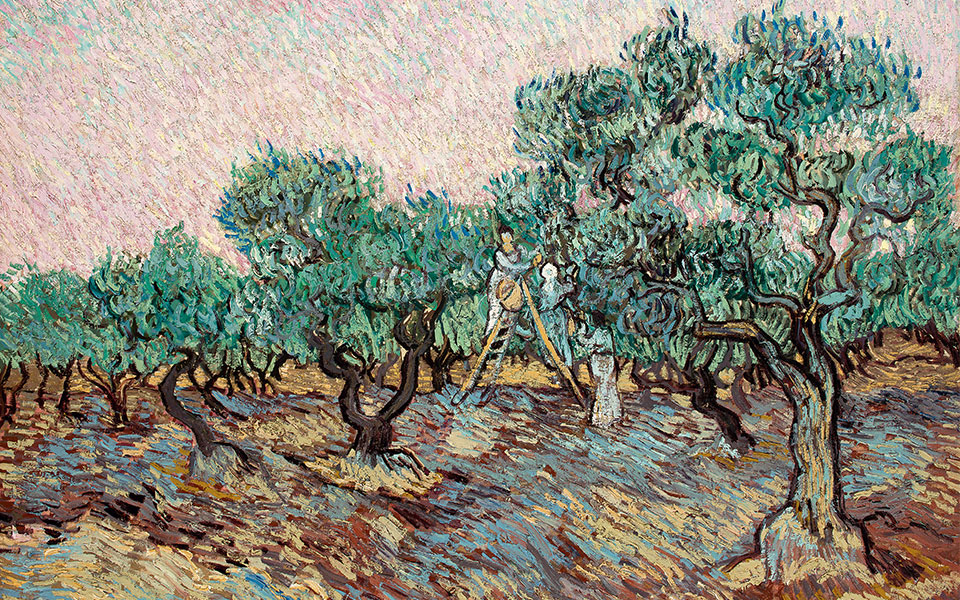
The Olive Harvest, a work by Vincent van Gogh on exhibit at the Basil & Elise Goulandris Foundation.
© PERIKLES MERAKOS, COURTESY OF THE BASIL & ELISE GOULANDRIS FOUNDATION
Directly across from “The Runner” is the National Gallery. (Its permanent collection of modern Greek painting is included in our First-Time Essentials guide.) But if you’re already familiar with those works – or if you’re not particularly interested in such – you might still consider devoting time to either or both of its two remarkable temporary exhibitions: “The Allure of the Uncanny,” presented in the Intermediate Space, and “Los Caprichos,” exhibited in the museum’s basement, work well together as a thought-provoking dialogue between contemporary works characterized by unusual aesthetics and Francisco Goya’s iconic series of eighty etchings. (On view through 30 September.)
As you leave, consider looping towards Pangrati from the rear side of the National Gallery. A 15-minute walk will bring you to the Basil & Elise Goulandris Foundation (13 Eratosthenous, general admission: €12). On the way, you’ll pass through a dense urban grid of apartment buildings that went up in the 1960s and ’70s – the concrete DNA of postwar Athens, and an essential part of the city’s visual identity.
Once a quintessential middle-class neighbourhood – where filmmaker Yorgos Lanthimos and this writer both grew up – Pangrati has, over the past decade, evolved into a hotspot for hipsters and urban creatives.
At the Goulandris Foundation, the permanent collection, assembled from one of the world’s most important private art holdings, features major works by 19th-century and 20th-century masters, including Picasso, Cézanne, Chagall and Lichtenstein. Until 2 November, the museum is hosting an exhibition honoring the centenary of the birth of the pioneering Greek artist Takis.
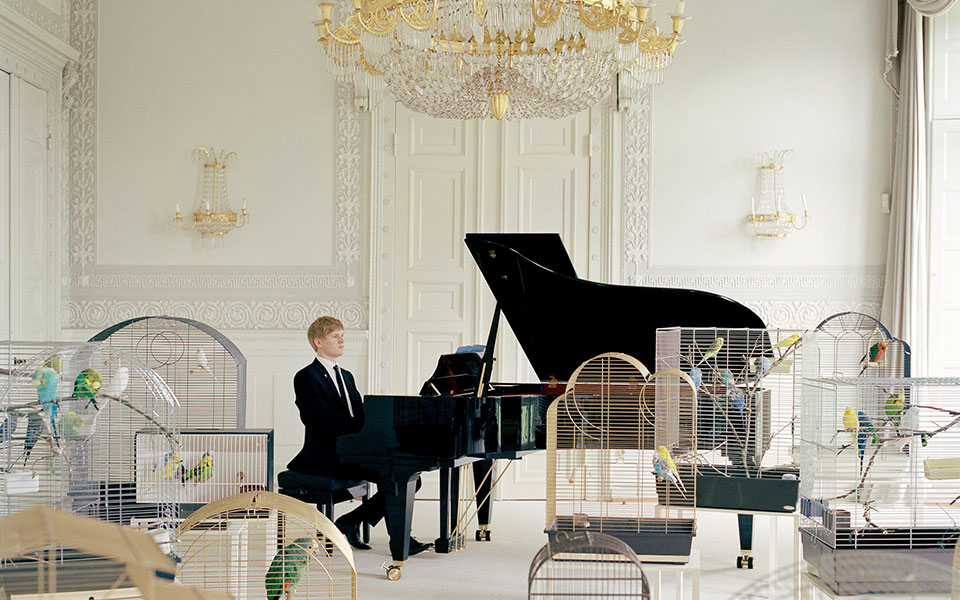
Screenshot from Annika Kahrs' single-channel video “Playing to the Birds,” a 2013 work that’s part of the exhibition “Why Look at Animals?” at EMST.
© Courtesy of Annika Kahrs / Produzentengalerie, HAMBURG
Starting back at Syntagma Square again, an alternative walk down Amalias Avenue, which runs in front of the Parliament, in the direction of Syngrou Avenue will take you past those same charming National Gardens, as well as a number of neoclassical mansions, the ornate St. Paul’s Anglican Church, the equestrian statue of Alexander the Great by sculptor Yannis Pappas (1913-2005), the Temple of Olympian Zeus, and, once you turn onto Syngrou Avenue, a stretch of unapologetically urban scenery, complete with sex shops, before you reach Neos Kosmos.
Some Athenians now call this neighborhood “the new Pangrati” – and they may not be wrong. Once a working-class neighborhood with little in the way of shopping or nightlife, it has recently acquired a different tone, thanks largely to the presence of key cultural institutions.
Your first stop here should be the National Museum of Contemporary Art, or EMST, housed in the former FIX brewery (Kallirrois & Amvrosiou Frantzi, general admission: €10). While you can reach it by metro (two stops from the Syntagma station, one from the Acropolis station), we suggest taking the 20-minute walk from Syntagma Square instead.
Currently on view at EMST is a series of exhibitions under the umbrella title “Why Look at Animals? A Case for the Rights of Non-Human Lives,” running through 2 February of next year.
On the museum’s ground floor is its inviting shop, where you’ll find everything from fans inspired by the work of South African artist Penny Siopis to baseball caps decorated with images from the visual universe of pioneering Greek performance artist Leda Papaconstantinou.
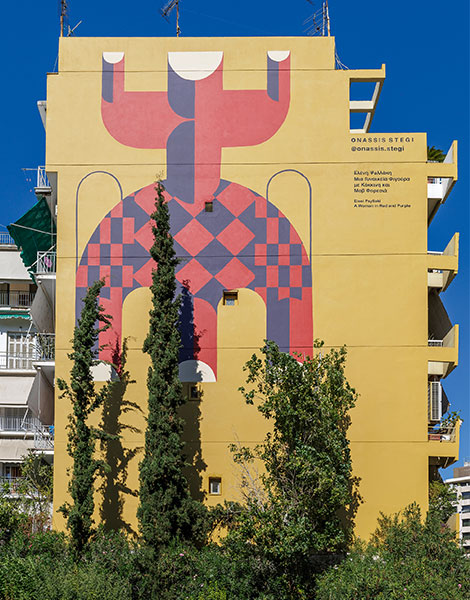
The street art piece “A Female Figure in Red and Purple Costume” by Eleni Psyllaki is a local landmark in Neos Kosmos.
© Stelios Tzetzias / ONASSIS FOUNDATION
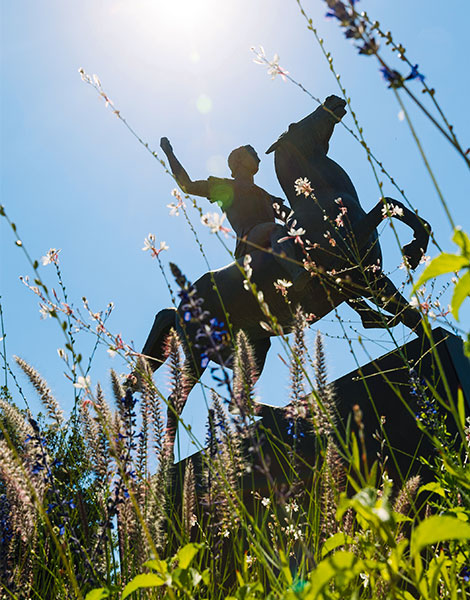
An equestrian statue of Alexander the Great by noted sculptor Yannis Pappas.
© Dimitris Vlaikos
A “micro-neighborhood” within Neos Kosmos worth exploring is Dourgouti. To reach it from EMST, allow for a ten-minute walk past modest apartment blocks and inelegant car repair shops. Dourgouti is architecturally distinctive for its near-identical ochre-coloured refugee housing units, built in the 1930s to accommodate displaced Greeks from Asia Minor and Armenian refugees. Today, these buildings are home to migrant families from the Global South.
Not far from Dourgouti stands the Onassis Stegi, a major cultural institution usually closed during the summer months. However, one of its off-site commissions has become a neighbourhood landmark: a large-scale mural by artist Eleni Psyllaki, depicting a woman in a flowing red and purple dress. The figure stretches across the entirety of an exterior wall of the apartment building at 42 Lagoumitzi Street, adding an impactful poetic presence to the urban skyline.
Let’s be clear: Piraeus is a different city. The port lies some 10 kilometers southwest of the center of Athens, of which it is technically an extension. If you’re catching a ferry from there to one of the islands, it’s certainly worth taking in some of the area’s cultural life and architecture. If you’re not boarding a ship, a trip to this engaging port is still rewarding in itself.
By public transport, Piraeus is accessible via Metro Line 3 (the Blue Line) from Syntagma Square; get off at the Dimotiko Theatro, the last station on the line. If you’re traveling with luggage, consider storing it at a luggage locker – several operate in the Piraeus area, including those belonging to radicalstorage.com.
As soon as you step out of the station, you’ll find yourself in front of the Municipal Theater of Piraeus – a splendid 19th-century neoclassical landmark. About ten minutes on foot from the theater is the Archaeological Museum of Piraeus (31 Harilaou Trikoupi, general admission: €10). Though smaller than its Athenian counterparts, it is home to four extraordinary bronze statues dating from the 6th to the 4th century BC – including notable depictions of the goddesses Athena and Artemis.
Further afield – about a 25-minute walk, or a quick €5 taxi ride – is The Intermission gallery (37A Polidefkous). It is currently hosting “Untitled,” an exhibition of early works by Jean-Michel Basquiat, in collaboration with Galerie Enrico Navarra. On view until 2 August, the show explores the formative years of Basquiat’s rise within the explosive New York art scene of the early 1980s.
Should you indeed be boarding a vessel here, I wish you bon voyage! If you’re simply looking around, I wish you happy discoveries!
From ancient steam engines and living...
From Alexandria to Hania and on...
How did the Greek National Opera...
Echoes from history meet everyday life...