Patmos: Experiencing One of Greece’s Most Sacred Easters
Holy Week and Easter on the...


Corfu celebrates Easter like nowhere else in Greece.
© Christina Georgiadou
Even if you’ve never experienced Easter on Corfu, you’ve probably heard something about it. We the locals always look forward to these special days, to the spiritual elevation they give us, to the litanies and the processions of the funereal biers, to the music – which evolves over the course of Easter week from mournful marches to triumphant fanfares – and to all the incredible smells, a blend of heady wisteria and lilac with the aromas of baking “fougatsa” and “colombina” pastries.
Our customs are deeply rooted in the Byzantine culture and the Greek Orthodox faith, but they are also profoundly influenced by the four-century presence of the Venetians and, to a smaller degree, by the presence of the British, who ruled the island briefly in the 19th century. The customs vary between the town, its suburbs and the countryside to some extent, but they are centered on the same basic principles: a sense of continuity and community that drives mass participation. Through their parish churches, the bands of some 20 philharmonic orchestras, dozens of choirs, numerous groups like from the Red Cross, the Scouts and the Guides, and many other associations, the island’s residents participate actively in all the big religious events. Thousands of people come together and contribute, each in his or her own way, to this spectacular phenomenon known as the Corfiot Easter.

On Corfu, people usually break the fast after the First Resurrection service and the breaking of the clay pots on the morning of Holy Saturday.
© Unsplash
And across the island, of course, a place of honor is held by Saint Spyridon, Corfu’s patron saint, who is the subject of grand processions on Palm Sunday and on the morning of Holy Saturday. All three of the town’s philharmonic orchestras take part in the Holy Saturday procession, performing different funeral marches, from Franco Faccio’s “Amleto” and Vincenzo de Michelis’ “Calde Lacrime” to Beethoven’s “Eroica.” Once the saint’s sacred relics return to the church, the people of Corfu celebrate the “First Resurrection” with the joyful clamor of the “botides” or colorful clay pots that are thrown out of windows and smashed on the paving stones below – fulfilling the Biblical prophecy. The botides custom is a relatively recent one, though; what most Corfiots do in the privacy of their own homes is smash some old, useless item like a cracked plate, for example.
Another feature of Corfu’s Easter that is unique to this island is that most of the churches hold the Resurrection litany on the morning of Easter Sunday rather than on the night of Holy Saturday. Each parish then takes to the streets in procession with its icon of the Resurrection, accompanied by ensembles from the island’s philharmonic bands. In the days that follow, during Bright Week, similar processions take place in most villages of the Corfiot countryside.

All three of the town’s philharmonic orchestras take part in the Holy Saturday procession, performing different funeral marches, from Franco Faccio’s “Amleto” and Vincenzo de Michelis’ “Calde Lacrime” to Beethoven’s “Eroica.”
© Shutterstock
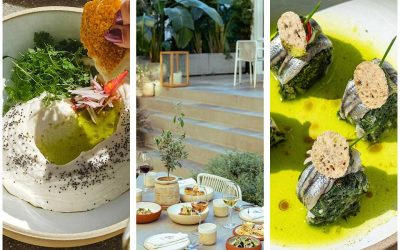
The custom on Palm Sunday is to eat salted cod, which we boil, using the broth in the “skordalia” garlic dip and the fish for battered croquettes. “Savoro” is another typical dish made both on Palm Sunday and on the Annunciation with small fish such as sardines, whitebait, red mullet, bogue or picarel. The preparation begins six to eight days in advance, by flouring the fish and frying it. After removing the fish from the pan, fresh spring onion, garlic, rosemary and black raisins are then added to the oil and lightly sauteed, then deglazed with vinegar or wine. The fish are layered in a glass jar, covered with the aromatic oil and left to marinate for six to eight days – after which they are ready to be eaten.
Among the tastier and easier dishes eaten during the Holy Week fast are “manestra kolopibiri” (a spicy pasta dish with spaghetti and a sauce made with lots of olive oil, grated onion and chili pepper flakes) and “bourou-bourou” (a soup with maccheroncini pasta, grated onion, a tablespoon of tomato puree, chili flakes and olive oil). There are also dishes using vegetables like cauliflower and cabbage mixed with pasta.
One of my favorite salads during Easter is one made with sliced oranges, olive oil, salt and chili pepper.
We dye our red eggs on Holy Thursday: one for each member of the household and one for the house itself, which we keep for the entire year for good luck. We also make our colombinas and fogatsas on the same or the previous day. The dough resembles that of classic Greek “tsoureki” bread, but it is much firmer and includes bergamot as well as mastic flavoring. The colombina is shaped like a dove (hence its name, as colomba means dove in Italian) and is decorated with a red egg and colorful feathers, while the fougatsa is round. I remember my Aunt Mimi serving it instead of bread for several days after Easter.

Red eggs are dyed on Holy Thursday.
© Christina Georgiadou
On Holy Friday, before the church service for Christ’s Descent from the Cross, we refrain from most forms of activity. I remember everyone going to church in mourning when I was a child. We don’t set the table on that day and eat – usually standing up – simple things like a few olives, a bit of lettuce, a slice of halva, a dollop of fish roe paste and a few boiled artichokes.
The typical Holy Week desserts we make at home or purchase from a pasty shop are “kaltsounia” and “kantilia,” both pastries made with fruit and nuts.
We usually break the fast after the First Resurrection and the breaking of the clay pots on the morning of Holy Saturday. Back in the older days, this is when they would slaughter lambs and use their blood to paint a cross on the lintel above every house. This custom has, thankfully, died out, but I can still remember the sound of the lambs crying in the streets of Corfu. Once we’ve broken our fast, we dye more eggs and get to work preparing the “tsilichourda” for dinner. Unlike in other parts of Greece, here in Corfu we don’t make a “mageiritsa” stew out of the lamb or goat offal. Instead, we chop the belly and the intestine finely and boil them in water, throwing out the first batch of water. Then we fry them, adding plenty of holy water, as well as parsley, dill, garlic and onion and then deglazing the mixture with wine, before simmering with a bit of water, salt and pepper. Make sure not to use the spleen, as it will turn everything black. Add the chopped liver 10 minutes before the dish is ready and a generous dose of fresh lemon juice.
On Easter Sunday, we tend to prefer egg-lemon soup with boiled rooster, chicken or beef. This is to spare our stomachs from a heavy meal after the 40-day fast. We save the roasted lamb and potatoes for Easter Monday. Very few families, mainly those hailing from Epirus, spit-roast their lamb or goat. Even out in the villages, they cook it in the oven.
Originally published in Greek at gastronomos.gr.
Katerina Kyriaki is a tour guide and curator of the Corfu Literary Society’s shop. Special thanks to Yiannis Pieris and Dimitris Zymaris, and to the excellent cook Kiki Manesi, for their contributions.
Holy Week and Easter on the...

A classic Corfiot beef dish slow-cooked...

A local favorite inspired by the...

From Lefkada and Anogeia to Paros...