Disability in Ancient Greece: Myths, Facts, and Accessibility...
Professor Debby Sneed explores disability in...


Long before modern tourism, the roads to Panhellenic sanctuaries like Delphi were crowded with pilgrims seeking wisdom from the gods.
© Shutterstock
You’ve been walking for days. The sea is far below now, the air thinner, scented with pine and wild thyme. Ahead, the slopes of Mount Parnassos rise like the steps of a giant altar. The path twists upward toward the place the ancients called the “omphalos” – the navel of the world. You pause at the Castalian Spring, cupping the cold water in your hands and splashing it over your face before climbing the Sacred Way, where offerings from every corner of the Greek world gleam in the sun.
Before “tourism” was even a word, it was a way of life – especially in the form of religious pilgrimage. Each year, in ancient Greece, untold thousands of pilgrims packed their spare pair of sandals, kissed their household gods goodbye, and took to the roads and seas. They weren’t seeking lazy days on the beach or cultural sightseeing, but something deeper: the chance to come face to face with the divine.
The ancient calendar itself was a map of movement. Sacred festivals, processions, and games punctuated the seasons, drawing worshippers to sanctuaries across the islands and mainland. These hardy travelers crossed mountain passes and wine-dark seas, bound for the great Panhellenic sanctuaries – Delphi, Olympia, Dodona, and Delos among them – in search of wisdom and enlightenment. Amid fierce rivalries and shifting alliances, such sites united a divided world through shared faith in the “Dodekatheon,” the twelve gods of Olympus.
Today’s visitors who ascend the slopes of Delphi, wander through the groves of Olympia and Dodona, or explore the windswept ruins on sacred Delos tread paths once worn smooth by countless thousands of ancient feet. The only difference lies in what we take home: modern travelers return with photos and fridge magnets; the ancients carried back favor, healing, and perhaps an answer from the gods.
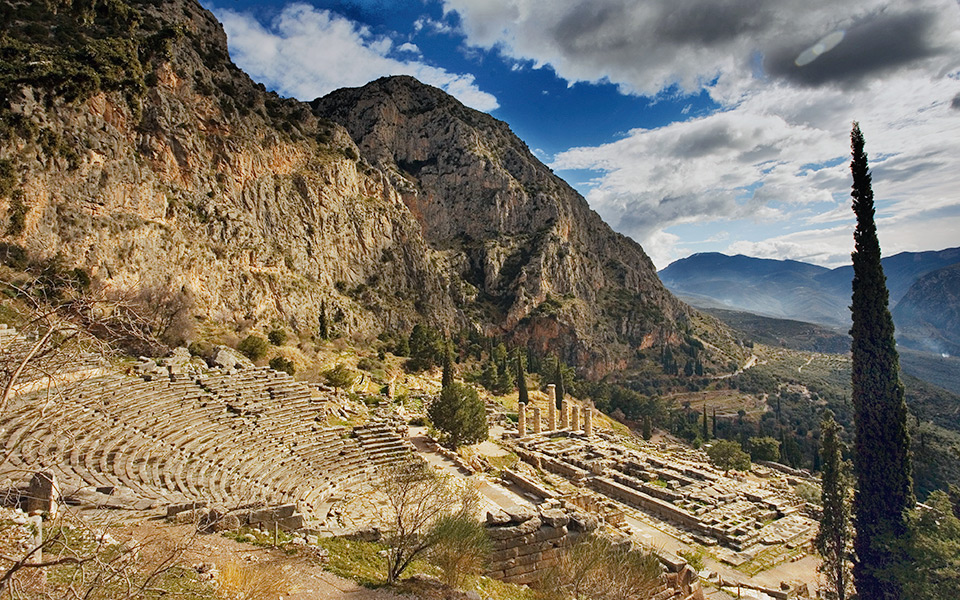
The theater and Temple of Apollo at Delphi.
© Perikles Merakos
Travel in the ancient world was far from glamorous. On land, the wealthy might travel in carriages or on horseback, with porters and pack animals to carry supplies for the lucky few. Everyone else simply walked. The journey could be perilous, with robbers and wild animals lurking on remote routes, and weather that could turn treacherous in a matter of hours.
Despite an extensive road network, Greece’s rugged terrain made overland journeys long and arduous. Often, the sea offered the easier – if not safer and more direct – route. But there were no passenger ferries in antiquity. Instead, would-be travelers bargained with merchant captains for a patch of deck space among amphorae of wine or sacks of grain.
Along the roads, a chain of waystations, inns, and springs supported this hum of human movement. Around major sanctuaries, village-like settlements (“kome” in ancient Greek) would spring up: hostels and bathhouses for visitors, markets filled with stalls selling food, votive figurines, garlands, and souvenirs. The religious economy of pilgrimage fed countless trades – from innkeepers and barbers to potters and prostitutes – all thriving on the flow of pilgrims seeking the favor of the gods.
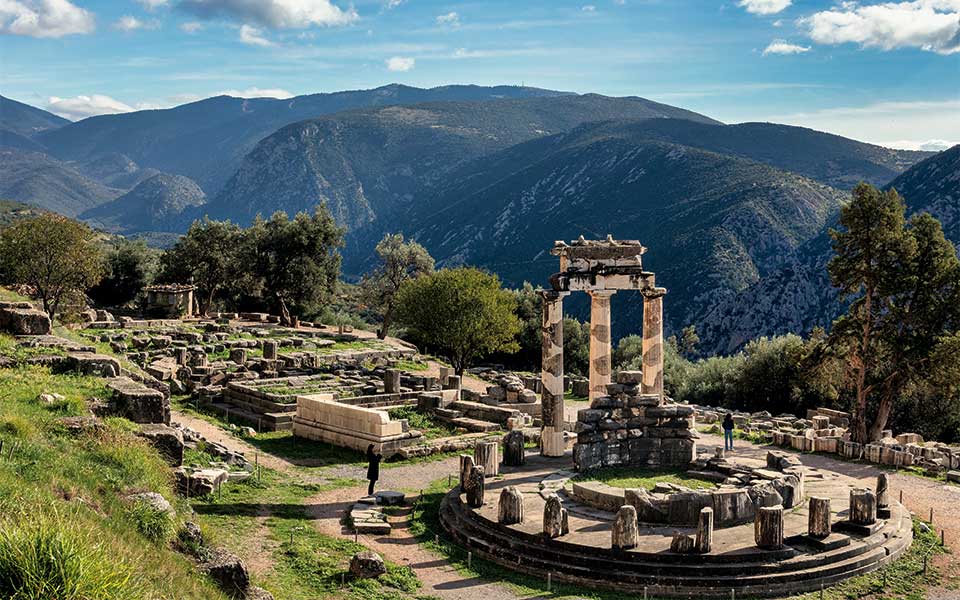
The Tholos (380 BC), at the Temple of Athena Pronaea, is a masterpiece of the Classical period and perhaps the best-known monument at the archaeological site of Delphi.
© Perikles Merakos
In the heart of Phocis, pilgrims arrived at Delphi from across the Greek world, bearing questions for Apollo: Should we go to war? Found a colony? Trust a friend? The god’s answers came through the Pythia, a priestess who sat on a tripod over a cleft in the rock, breathing in sacred vapors and speaking in riddles said to channel the god’s voice.
Before reaching the temple itself, visitors passed a glittering procession of offerings – treasury buildings shaped like miniature temples, filled with statues, gleaming shields, and marble stelae carved with decrees and dedications. Each step up the Sacred Way was a lesson in Greek identity: a living mosaic of dialects, rivalries, and shared belief.
Delphi was more than a religious site; it was a meeting place of worlds. Ambassadors, philosophers, athletes, and merchants mingled on its terraces. In the 5th century BC, an Athenian might hear a Dorian dialect beside him and a Lydian accent behind – a chorus of the Greek world in miniature. Some left their mark in the form of graffiti scratched into the stone, still visible today.
For over a thousand years, Delphi stood at the spiritual heart of the Greek world. When enemies threatened, the Greek tribes set aside their differences to defend it, bound by a shared reverence for Apollo. From that unity emerged the Delphic Amphictyony – a council of city-states that met twice yearly to safeguard the sanctuary and mediate disputes, a kind of ancient prototype of the United Nations.
“Know thyself” and “Nothing in excess” are among the most celebrated maxims, inscribed at the entrance to Apollo’s temple. Routinely discussed in Plato’s dialogues and recorded by Pausanias’ (Description of Greece 10.24.1), these words of wisdom have echoed through the centuries from this sacred mountainside sanctuary.
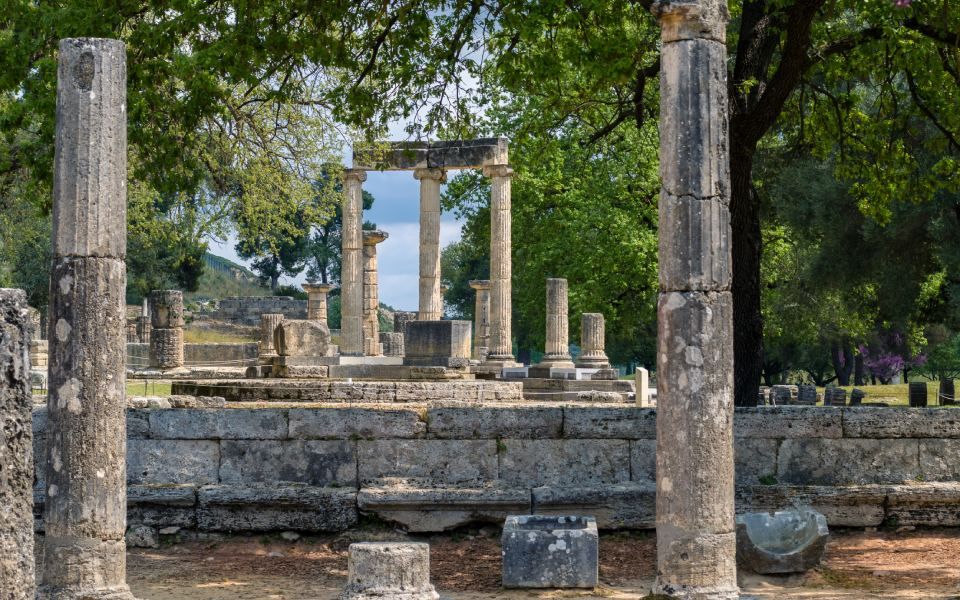
The Philippeion, initially built by Philip II, king of Macedonia, after his victory at Chaeronea (338 BC), and completed by his son Alexander.
© Shutterstock
Nestled in the fertile valley of the Alpheios River, in the western Peloponnese, Olympia was more than a venue for sport; it was a celebration of divine harmony and human excellence. Every four years, a sacred truce (“ekecheiria”) was proclaimed, allowing pilgrims, athletes, and spectators to travel safely from every corner of Greece and beyond. Rivalries were suspended, and the sanctuary of Zeus became a place of peaceful competition and shared devotion – the Olympic Games.
At the heart of the site lay the “Altis,” a walled sacred grove dense with temples, treasuries, and altars. The crowning glory was the great Temple of Zeus (c. 470-457 BC), which once housed Phidias’ colossal gold and ivory statue of the god – one of the Seven Wonders of the ancient world. Nearby stood the Temple of Hera (Heraion), the starting point of the modern Olympic torch relay.
Around the sanctuary sprawled hostels, baths, and training grounds (the Palaestra and Gymnasium) where athletes honed their skills, while merchants and artisans set up stalls to serve the crowds. Inscriptions carved into stone record the names of victors, and the area around the Temple of Zeus was prime real estate for votive offerings – statues, plinths, and captured spoils – from both individuals and city-states celebrating triumphs. Among them, the winged Nike became an iconic symbol, later echoed in the modern Olympic movement and on medals.
For over a millennium, Olympia embodied the ideal of Panhellenism – a sense of shared Greekness that transcended local loyalties.
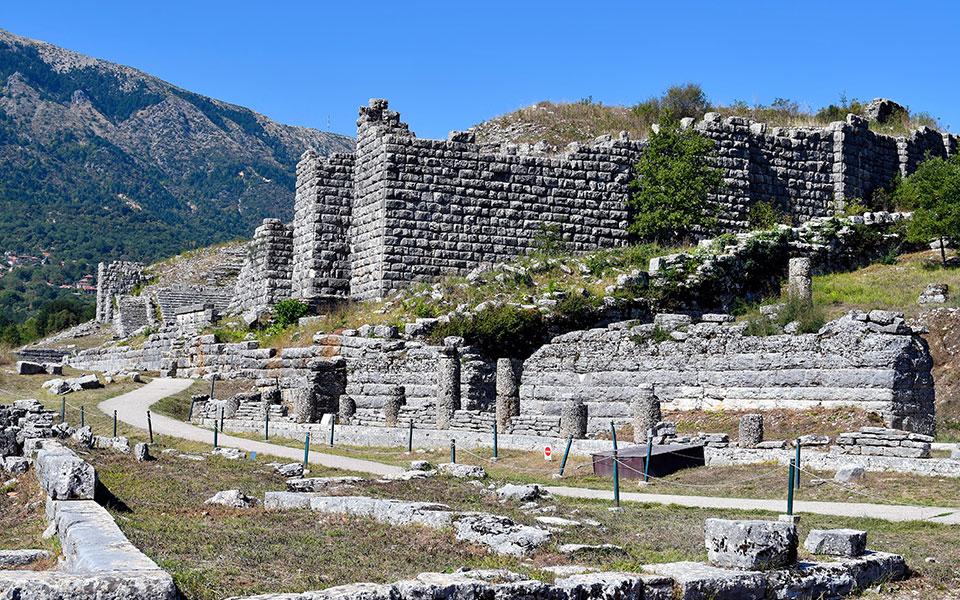
Oracle of Zeus at Dodona.
© Shutterstock
Heading to the far north of Greece, to the green folds of Epirus, the mountains open to reveal a wide, grassy valley – home to the oldest known oracle in Greece, where Zeus Naios (“god of the spring”) and Dione, often linked with the mother goddess Gaia, were believed to dwell in the roots of a sacred oak tree.
Long before Delphi and Olympia’s rose to fame, pilgrims came north to seek Dodona’s voice – not through marble grandeur but through the whisper of leaves and the murmur of the wind. In the 8th century BC, Homer describes its barefoot priests, the “Selloi,” as men “who sleep on the ground and never wash their feet” (Iliad 16.234–235).
Unlike the trance-born prophecies of Delphi, Dodona’s oracle was grounded in the natural world. Petitioners inscribed their questions on thin sheets of lead – over 4,000 survive – concerning everything from health, work, and family matters to public questions about worship and religious ceremonies, and outcomes of conflicts. The attending priestesses (“Peleiades”) listened to the sounds of the oak, the rustling of leaves, the cooing of doves, and the resonant clang of bronze cauldrons (known as “Dodonaean bronze”) that surrounded the tree, their vibrations believed to carry the god’s voice.
In its heyday, Dodona ranked just behind Delphi in prestige, drawing humble pilgrims and powerful rulers alike, including Pyrrhus (319–272 BC), king of Epirus, who inaugurated the Naia festival in honor of Zeus. During the Hellenistic period, the sanctuary expanded, with grand stoas, colonnades, and a vast theater capable of seating 17,000 spectators – one of the largest in Greece.
Today, the original sacred oak is gone – a replacement was planted in the 1950s – yet the valley retains its hush and reverence.
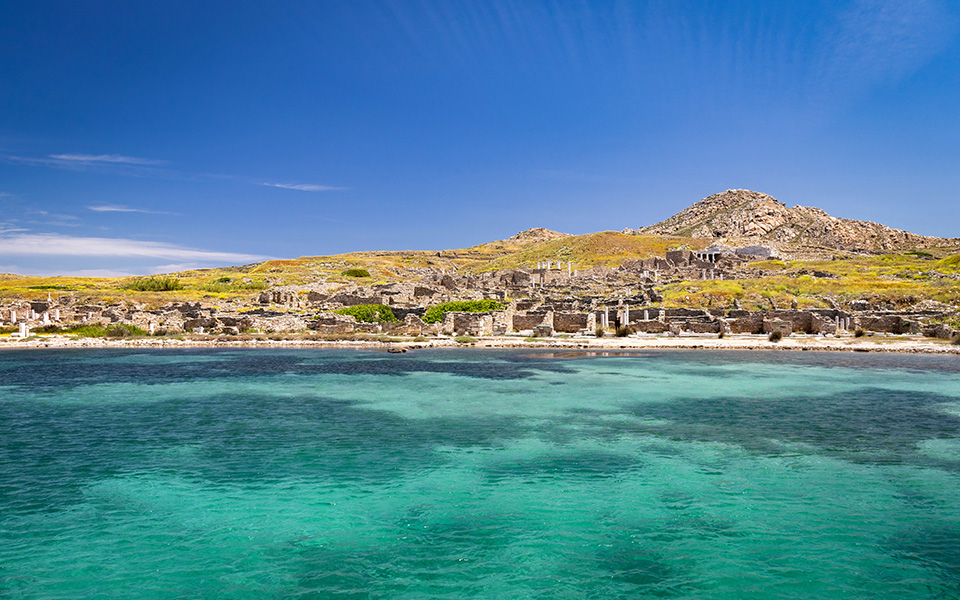
Delos
© Shutterstock
In the heart of the Aegean lies Delos, a tiny island once considered so sacred that no one was permitted to die or give birth there. According to myth, it was here that Leto, pursued by Hera, gave birth to Apollo and Artemis beneath a palm tree after Zeus anchored the floating island to the seabed.
For centuries, Delos was a beacon for travelers, pilgrims, and traders – a natural crossroads for those sailing the Cyclades and a radiant center of Apollo’s worship. Every five years, pilgrims arrived by sea for the Delia festival, joining in processions of song, dance, and athletic contests held in the god’s honor.
By the Hellenistic period, Delos had grown into a cosmopolitan hub of commerce and devotion. Merchants from Egypt, Syria, and Italy mingled beneath its marble colonnades, while sanctuaries to foreign deities rose beside those of Apollo. “Delos lies at the very center of the Cyclades islands,” wrote Strabo (Geography 10.5.2), “and was both the meeting place for sacred envoys, sacrifices, and bands of virgins.”
Today, a 25-minute ferry from Mykonos delivers modern pilgrims to this open-air museum. Walking among the ruins, you pass the Terrace of the Lions, the Sanctuary of Apollo, a theater that once seated 5,000 spectators, and the mosaic-floored mansions of wealthy traders. The silence that hangs over its marble streets contrasts sharply with the clamor that once filled its harbors – a reminder that in ancient Greece, the journey to the gods was as meaningful as the arrival itself.
Professor Debby Sneed explores disability in...

From Crete to Olympus, hike the...

As Greeks gather for their Tsiknopempti...

A monument of memory and music,...