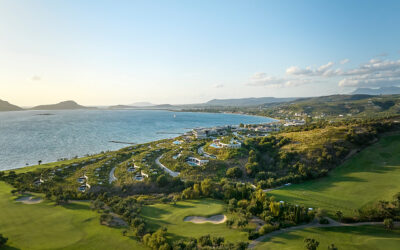
The “Odyssey Season” Begins in Messinia
Authentic experiences connected to Homeric storytelling...


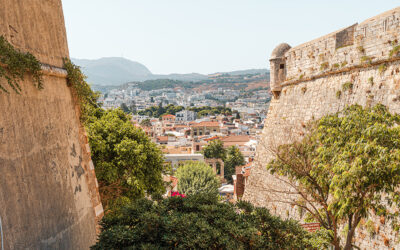
Enchanting view from Malvasia Café.
© Perikles Merakos
Beyond Sparta, as the road narrows and begins to wind through the rugged Laconian landscape, the journey starts to feel almost endless. Even the name “Monemvasia” shifts subtly on roadside signs; sometimes accented on the final syllable, sometimes the penultimate, but most often the antepenultimate, in keeping with local Peloponnesian speech. However it’s pronounced, the question quickly becomes irrelevant the moment the rock comes into view, rising from the sea like a vast “stone ship,” as poet Yiannis Ritsos once wrote , in the Epidaurus Limera bay.
The weather shifts just as dramatically. As the KTEL bus approaches Gefyra, the modern gateway settlement, a sudden shaft of sunlight breaks through heavy clouds, illuminating the limestone mass. By the time visitors cross on foot into the castle town, the only constant is the wind; fierce enough to drown out the sound of rolling suitcases as travelers pass through the western gate and step into their short escape.

The walls of Monemvasia form a “Π” shape, backed by the Myrtoan Sea.
© Perikles Merakos

Panoramic view of the Lower Town at sunrise.
© Perikles Merakos
In the morning, the cafés and small shops along the main cobbled street begin to open. In the central square of the Lower Town, the post-Byzantine Church of Christ Elkomenos is closed due to restoration works, but life carries on around it: children play near the old cannon, while visitors pause for photos with the Myrtoan Sea stretching out behind them.
It is recommended to head to the Upper Town before the weather turns again. “Bring water – you’ll need it,” they advised us at the hotel. They weren’t wrong. The “voltes,” the winding 220-meter cobbled path leading to the upper settlement, proved more demanding than expected, turning what should be a quick climb into a slower, more deliberate ascent. But the frequent pauses offer their own reward, revealing details of the settlement’s layout: houses, churches, and fortifications that earned Monemvasia the title of “famed city” from Emperor Andronikos II Palaiologos. Its walls, shaped like a Π, turn their “back” to the sea.

Relief of the lion, symbol of Venice, carved into the old episcopal palace.
© Perikles Merakos
There is something remarkable about the endurance of this place. Founded by the Lacedaemonians in the 6th century BC, later fortified by the Byzantines, and contested for centuries between Venetians and Ottomans, Monemvasia has preserved its identity through layers of history. Traces of Venetian rule remain visible today, including the carved lion of St. Mark on the former Episcopal Palace. In 1821, the town became the first fortified city in the Peloponnese to pass into Greek hands during the War of Independence.
Today, the Upper Town is uninhabited – if you don’t count the cats, which greet and accompany visitors on their walks. Beyond the gate’s arches lie the remains of Byzantine and post-Byzantine buildings, and further on, the octagonal Church of Aghia Sophia. Among the best preserved on the rock, it is believed to date to the 12th century, built on the site of the earlier Panagia Hodegetria. Though closed during our visit, the sweeping views alone made the climb more than worthwhile.
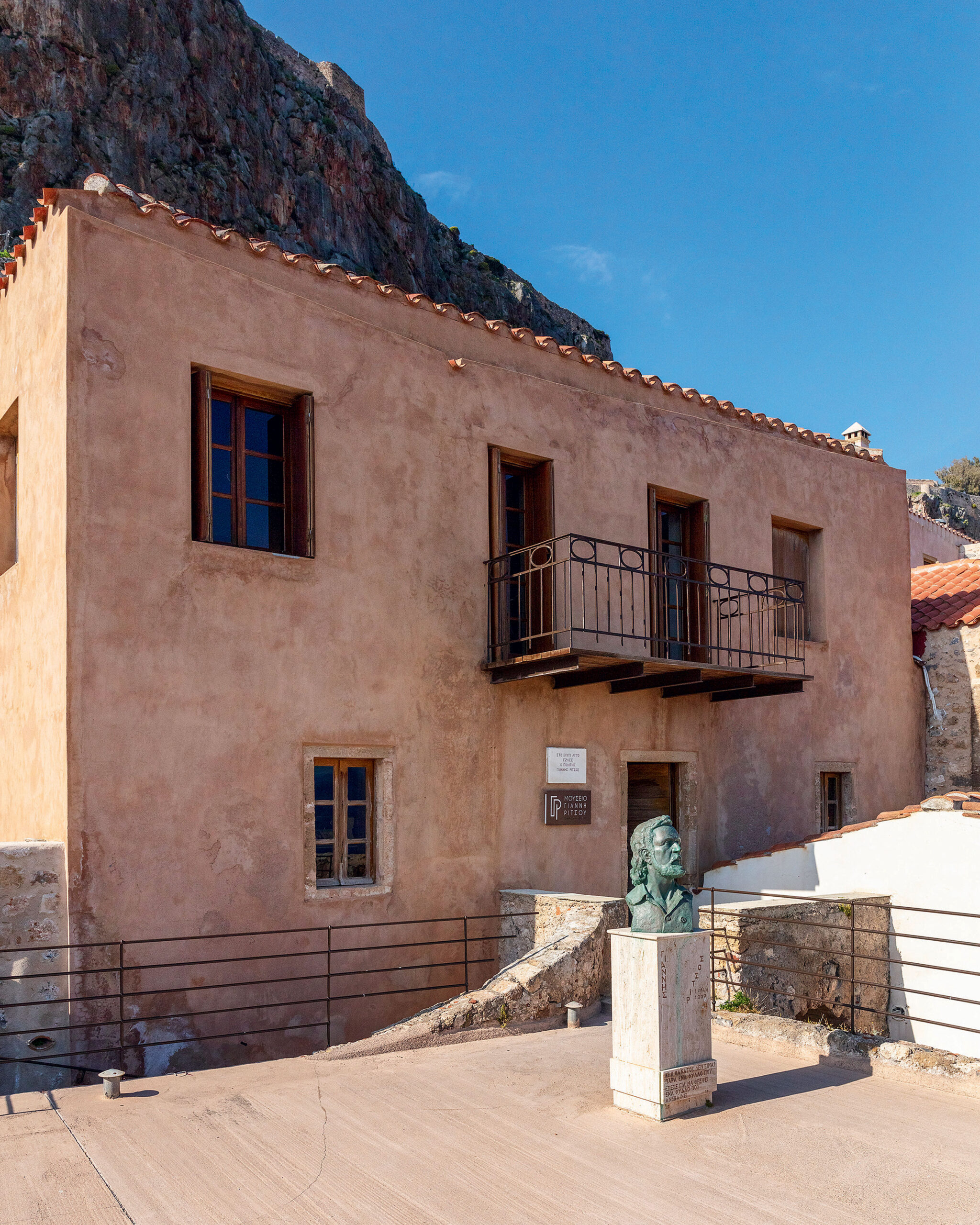
Bust of Yannis Ritsos in front of the house museum.
© Perikles Merakos

The upper floor of his home has been turned into a space dedicated to his work.
© Perikles Merakos
Back in the Lower Town, the main cobbled street grows noticeably livelier as the morning progresses. Yet beneath the everyday bustle, Monemvasia retains a quieter, more introspective dimension that is rooted in memory and intellectual heritage. Walking back toward the castle gate, a vaulted “dromiki” passage opens onto a small terrace overlooking the vast expanse of the Myrtoan Sea. At its center stands a bust of poet Yiannis Ritsos, born in Monemvasia on May 1, 1909. Just behind it is his family home, which, since last July, has been transformed into an interactive museum dedicated to his life and work – an initiative realized through the joint efforts of the municipality and his daughter, Eri Ritsou.
Ritsos was not, strictly speaking, born in this house, but in a cluster of monastic cells near the sea walls and the Church of Panagia Chrysafitissa (today a traditional guesthouse). His family later moved to this residence at the edge of the castle, where he spent his early years. He attended primary school in the nearby Church of Aghios Nikolaos, then used as a classroom, before leaving for Gythio in 1921 to continue his studies. Though he returned frequently, the house remained marked by personal loss and hardship, experiences that would later echo throughout his poetry.

Portrait of Yannis Ritsos with Monemvasia in the background, on display at the new museum.
© Perikles Merakos
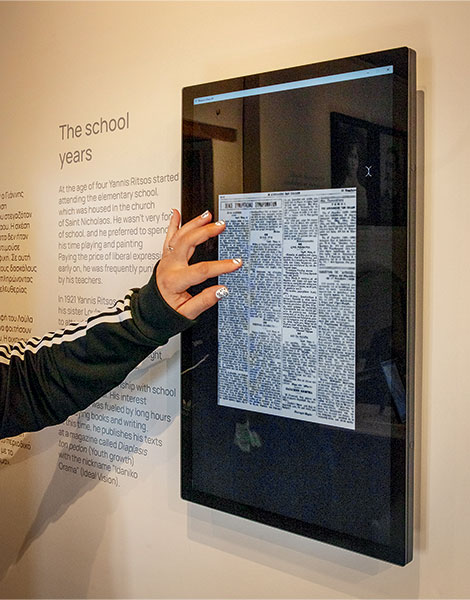
The interactive touchscreens at the Yannis Ritsos Museum make the visit more engaging.
© Perikles Merakos
Inside the museum, his voice still resonates. In archival television footage playing on a loop, Ritsos reflects on his home: “My beloved old house, you have been resurrected through poetry… all those absent are present… and this entire landscape, so often wounded and broken, stands alive again through my art, as a landmark of this universal reality.” The recording, filmed by Giorgos and Iro Sgourakis, offers a deeply personal introduction to the space.
Each room explores a different facet of his life: family, exile, recognition, the musical settings of his poetry, and the figures who shaped his work. Notably, the museum avoids the static, reverential feel of a memorial. Instead, it embraces a contemporary approach, using touchscreens, audio archives, and music to create an immersive experience where poetry and history intertwine. Visitors need no prior familiarity with Ritsos; the exhibition presents him anew, through the fractures and continuities of his life. Even his personal belongings are displayed without sentimentality, serving less as relics and more as traces of a lived-in home.
Through digital installations and carefully curated materials, the museum brings into focus both his family history and the political persecutions he endured. Musical interpretations of his poems guide visitors through the life of a writer who left an indelible mark on modern Greek literature. Objects and exhibits on loan from the Benaki Museum, along with furniture and personal items donated by his daughter, round out the experience, offering a tangible sense of the man behind the words during a visit that lasts around 50 minutes.

The rock of Monemvasia is connected to the rest of Laconia by a narrow strip of land and a bridge.
© Perikles Merakos
By late morning, as checkout time approaches, departing visitors move quietly against the flow of new arrivals. Rolling suitcases in hand, they follow an unspoken code of discretion, making space for those just entering through the gate. “There are many shops along the main street because, as a municipality, we do not allow businesses beyond the castle’s central road. We want to avoid an overconcentration of bars. As for hotels and accommodations, occupancy rates remain high year-round,” explains deputy mayor Stavros Christakos.
Yet behind this steady tourism lies a more complex reality. According to the 2021 census, only 65 permanent residents remain within the castle walls. As Christakos notes, few of those are local. Many longtime residents have relocated either to Athens or to the newer settlement of Gefyra on the mainland. “Most property owners today are high-income individuals from Athens or abroad,” he says. “They come for holidays or to settle here after retirement. Even many shop owners live outside the castle and commute in.”
Signs of this shift are visible throughout the town. Some houses stand in disrepair, while others display “for sale” notices. Property values are among the highest in Greece, reflecting both the area’s prestige and its limited availability.
And yet, despite its popularity, Monemvasia has largely avoided the pressures of overtourism. Its narrow streets, limited space, and controlled development naturally regulate visitor flow. Its relative remoteness also plays a role: reaching Monemvasia from Athens still requires a long journey, preserving a sense of distance that continues to define the experience.

Strolling along the main cobbled street of the Lower Town.
© Perikles Merakos
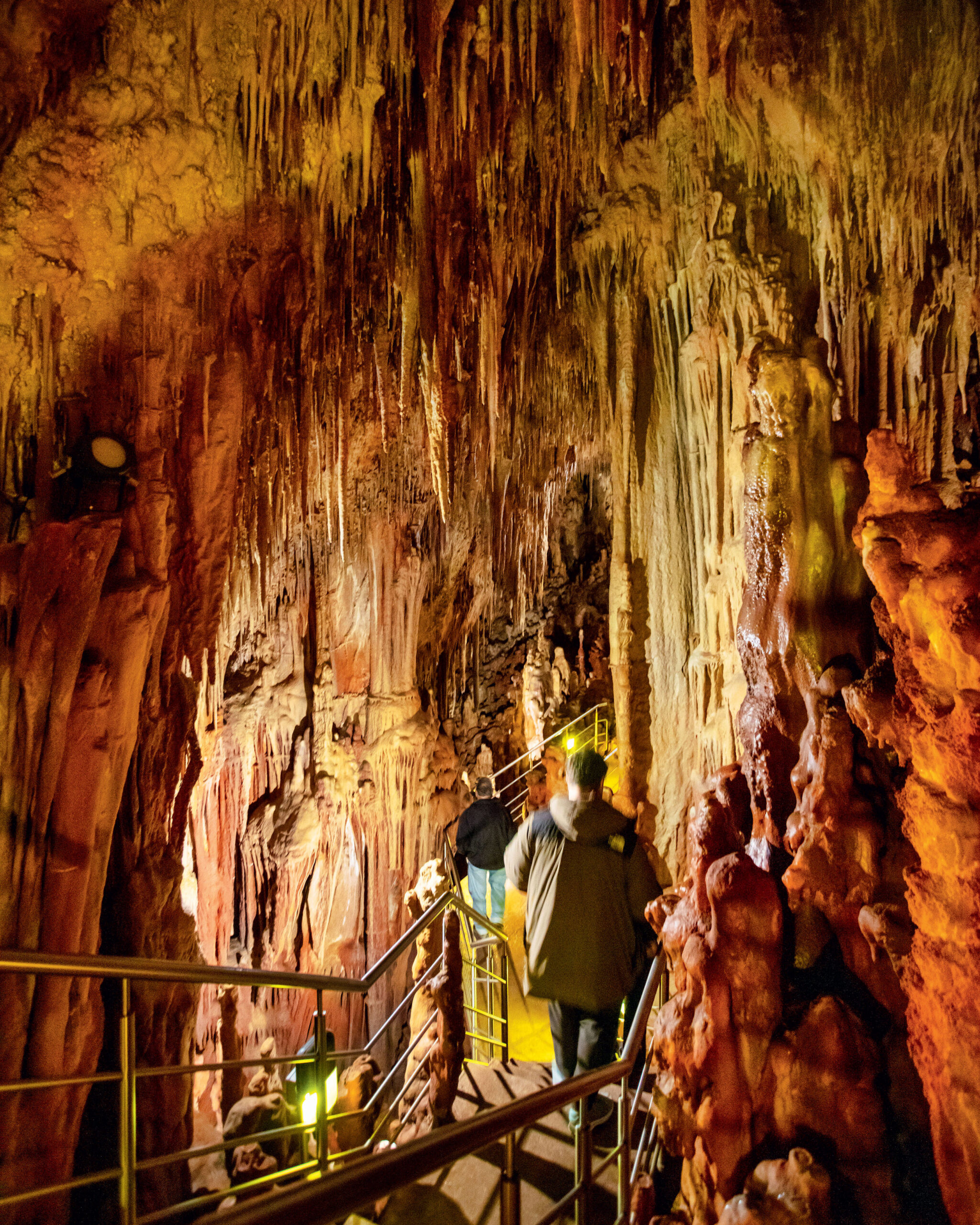
The Remarkable Cave of Kastania.
© Perikles Merakos
As visitors linger over lunch on sea-facing balconies, suppliers move in and out of the castle’s outer gate, restocking local businesses. One delivery is running late due to construction work on a new aerial lift, a cable car designed to carry visitors directly to the Upper Town. With one lane temporarily closed, traffic builds up quickly. “We’ve turned into Omonia Square!” one supplier calls out, only half joking.
The cable car project has sparked debate both locally and beyond. Supporters point to its partially subterranean design and the promise of improved accessibility, making the Upper Town reachable for all visitors. Critics, however, raise concerns about its environmental impact, the potential alteration of the rock’s character, and the risk that easier access could eventually lead to overtourism.

The house where Yannis Ritsos was born.
© Perikles Merakos
At the same time, another long-discussed project is nearing completion: the illumination of the rock itself. First proposed as early as the 1950s, the lighting scheme – designed by acclaimed lighting designer Eleftheria Deko – is now in its final testing phase and is expected to be unveiled soon.
For those visiting during Easter, the experience becomes even more distinctive. Beyond the newly illuminated rock, Monemvasia offers deeply atmospheric Holy Week traditions, notably free of the noise of fireworks. On Good Friday, the route of the Epitaph procession is decided at the last moment, either climbing to the Upper Town or winding through the Lower Town. In both cases, the candlelit procession creates a striking, almost cinematic scene along the cobbled streets. The procession continues toward Gefyra, accompanied by small fishing boats carrying lanterns that follow from the sea, before reaching the Church of Aghios Leontios.
On Easter Sunday afternoon, in Chrysafitissa Square overlooking the water, the ceremonial burning of Judas takes place in a lively, communal celebration. As night falls, the wind whistles through the narrow streets. Bars fill with a mix of locals and visitors, tavernas remain open well past midnight, and the ever-present cats of the Lower Town roam in search of food, watching passersby with quiet curiosity. Even after the crowds depart, even in the strongest winds, this “stone ship” remains vividly alive.
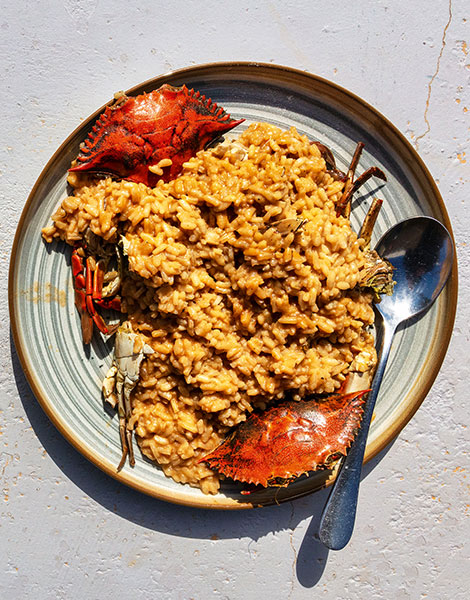
Seafood at Gerakas Harbor.
© Perikles Merakos
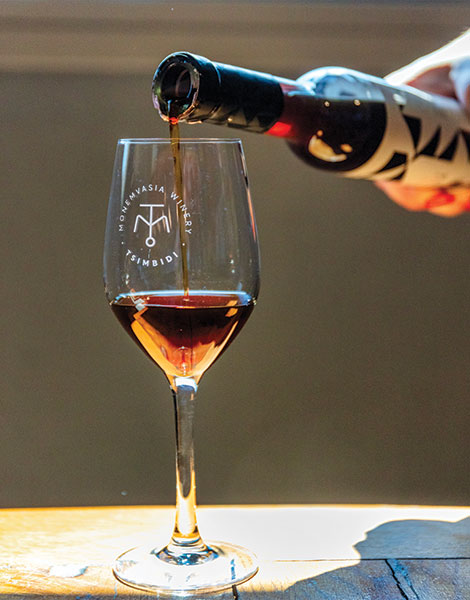
A Glass of Malvasia at Tsimbidi Winery.
© Perikles Merakos
Tucked away on the eastern edge of the Peloponnese, near Cape Malea and behind the mountains above Neapoli Voion, the Cave of Kastania is one of the region’s most striking natural attractions. Formed over some three million years, its interior reveals an extraordinary landscape of stalactites, stalagmites, and towering, multi-shaped columns along a 500-meter route. The drive may be winding, but the cave’s remarkable colors and formations make it well worth the effort. (42 km from Monemvasia; approx. one hour by car)
Founded in 1997 by Giorgos and Elli Tsimbidi, Monemvasia Winery Tsimbidi set out to revive the historic Malvasia grape. This renowned sweet wine is mentioned in 12th-century sources and was once exported widely by the Venetians from Monemvasia’s port, prized for its ability to withstand long journeys.
Thanks to years of research and collaboration with academic institutions, Malvasia wine was successfully reintroduced and, in 2010, received PDO status. Today, the estate’s 75-acre (300 stremma) organic vineyard cultivates seven varieties, with the local Monemvasia and Kidonitsa among the standouts. The winery is open to visitors. (12 km from Monemvasia; approx. 15 minutes by car)
Following the coastal road along the bay of Epidaurus Limera, you will reach Gerakas Harbor. Here, the destination is Diamantis Fish Tavern, known for its fresh, daily catch and consistently good value. It’s a popular spot, especially on weekends, so reservations are recommended. (24 km from Monemvasia; approx. 30 minutes by car)
Monemvasia is 322 kilometers from Athens, and the drive takes about four hours without stops. If you travel with the KTEL Lakonias, the journey takes around six hours. The 10:30 am service arrives in Monemvasia after stops in Tripoli, Sparta and Molaoi. For the return trip, there are three daily services from Monemvasia to Sparta, where you can connect onward to Athens. A one-way ticket costs €35. For more information, please contact KTEL Lakonias (Tel. (+30) 27310.264.41).
Parking is available in the settlement of Gefyra, behind the KTEL station. Due to ongoing cable car construction, it’s best to leave your car there. A local bus connects Gefyra with the castle town (€2.50 per ride), while a taxi typically costs around €5.
Ardamis Guesthouse (Tel. (+30) 27320.618.87; from €143, without breakfast)
Moni Emvasis Luxury Suites (Tel. (+30) 27320.621.22, from €191, with breakfast)
Kelia (Tel. (+30) 27320.615.20, from €75, with breakfast)
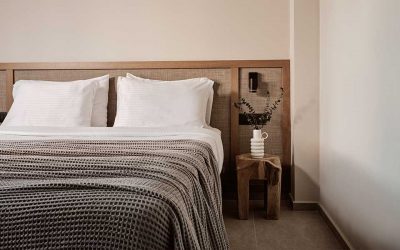
Malvasia (Tel. (+30) 27320.613.23, from €120 with sea view; from €75 for smaller rooms, all with breakfast)
Vyzantino (Tel. (+30) 27320.613.51, from €90, with breakfast)
Likinia (Tel. (+30) 27320.619.39, from €110, with breakfast)
As you enter the castle town, one of the first stops along the main cobbled street is Voltes, known for local specialties such as glina – pork marinated with citrus and herbs, served with pickled carrot – and sautéed liver with sun-dried tomato and balsamic vinegar.
A little further along, Oinomelo serves Monemvasia-style tsaitia, pastries filled with aromatic wild greens.
For fresh seafood, visit T’ Akrogiali in Gefyra, where the rock of Monemvasia provides a striking backdrop.
In Gefyra’s bakeries, look for local sweets such as travichtes (elongated loukoumades), amygdalota, and samousades, a regional take on baklava made with walnuts, almonds, and sesame.
For a more contemporary café experience, Volax in the main square offers micro-bakery-style pastries alongside açaí bowls and specialty coffee.
For drinks, Enetiko, Emvasis, Vathysfairo, and Malvasia Café Bar stay open from morning until late, with extended hours on weekends depending on demand.
Authentic experiences connected to Homeric storytelling...
Stone villages, forest paths and centuries...
Just two and a half hours...
Mild weather and a slower pace...