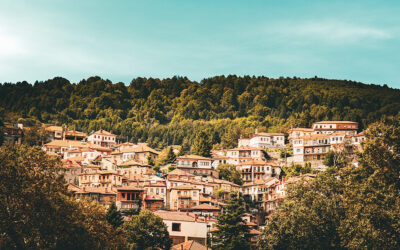
Discovering Metsovo’s Timeless Spirit
At any time of year –...


Rappelling from Kokkoris Bridge with Vasilis Kolios of Active Nature.
© Perikles Merakos
In Zagori, every step stirs a different emotion. We stand in awe before the sheer cliffs of the Vikos Gorge. A sense of tranquility prevails in the alpine meadows that stretch towards the peaks of Mount Tymfi in the distance. The region’s remarkable stone architecture inspires admiration for the generations of craftsmen whose work has endured for centuries.
Far from the bustle of Greece’s island destinations, some of the country’s most beautiful mountain villages provide the perfect setting for a truly restorative summer. Zagori invites us to reconnect with nature, with place, and with ourselves.

Holding a homemade pie, Athanasia Tsoumani shares the story of the nomadic shepherds at the Sarakatsani Settlement of Gyftokambos.
© Perikles Merakos

The Vikos Gorge as seen from the Beloi Viewpoint, just outside Vradeto.
© Perikles Merakos
At 1,340 meters, Vradeto is the highest village in Zagori. Until the 1970s, it could only be reached via its famous stone staircase, making it one of the region’s most isolated settlements. Today, the village attracts hikers from around the world. Some tackle the historic Vradeto Steps from neighboring Kapesovo, while others make the short walk to Beloi, one of the most spectacular viewpoints over the Vikos Gorge, just 650 meters from the village center. “People from 80 to 100 different countries have visited our kafeneio alone,” says Konstantina Anagnostopoulou, who continues to run her grandparents’ traditional kafeneio and is one of the few residents who lives in Vradeto for most of the year.
“Today, if you want to live up here, you need to know six or seven different trades,” adds her father, Lambros Anagnostopoulos, who for many years was the driving force behind the village’s renowned three-day Panagia festival, held every September 8. “You have to know how to repair roofs, cut firewood, butcher livestock, skin animals, even light the church lamps. It isn’t easy.” Mr. Lambros remembers Vradeto when it was still a thriving community with 270 residents, 47 schoolchildren, 11,000 sheep, and around 100 horses. “When I was a child, I rode my horse down the steps twice a day to collect supplies from Kapesovo, where the road ended and the bus to Tsepelovo passed,” he recalls. The Vradeto Steps remain one of Epirus’ finest examples of traditional stone craftsmanship.
The route consists of 1,120 stone steps descending around 450 meters through the mountainside. “Built by master stonemasons from Konitsa for both people and animals, the staircase is incredibly safe and thoughtfully designed,” says Mr. Lambros. “When there’s a meter of snow in Vradeto, there are only about ten centimeters on the staircase.”
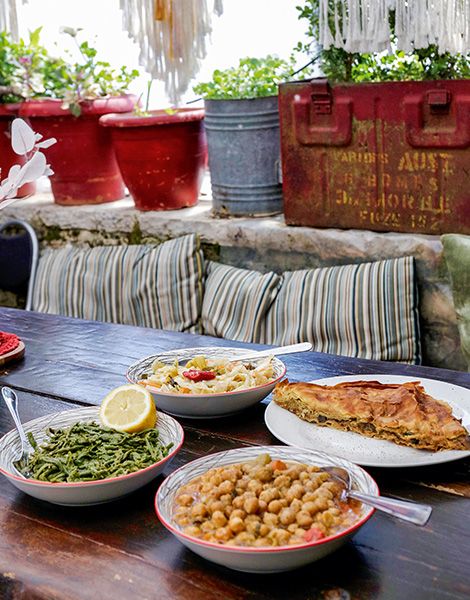
Homemade flavors at Skala Café in Vradeto.
© Perikles Merakos

Traditional Zagori architecture in the preserved village of Dilofo.
© Perikles Merakos
At 1,200 meters, Skamneli is the second-highest village in Zagori. While it lacks the postcard-perfect appearance of some of the region’s better-known settlements, its setting is unforgettable. Nestled among the forests of Mount Tymfi within the Northern Pindus National Park, the village is a gateway to some of Epirus’ most spectacular alpine landscapes. It is also one of the few places where the traditions of the Sarakatsani, Greece’s historic nomadic shepherds, remain vividly alive. Every year, on the first weekend of August, the Gyftokampos area, ten kilometers outside the village, hosts one of Greece’s largest open-air celebrations beneath its pine and fir trees. The Sarakatsani Gathering of Epirus, recognized as part of Greece’s Intangible Cultural Heritage, is a vibrant festival of traditional dancing and the revival of age-old customs that now attracts visitors from across the country.
Just beyond the festival grounds lies the Sarakatsani Settlement, an open-air museum established in 1997. Spread across five acres of woodland, it recreates a traditional nomadic encampment with konakia (traditional huts), a schoolhouse, dairy buildings, sheepfolds and livestock pens, offering visitors a glimpse into a way of life that has almost disappeared. Konakia are considered among the oldest forms of housing in Europe. Traditionally, they were built by the women while the men were away with the flocks.
“Twelve of us lived together in a hut like this,” recalls Athanasia Tsoumani, who spent the first ten years of her life following the nomadic way of life of the Sarakatsani. “In winter we moved down toward Igoumenitsa, and in spring we returned to Skamneli.
“The journey took six overnight stops. We loaded our belongings onto mules, the adults walked, and the babies were carried in sacks. At night we pitched tents made from woven goat hair, which kept out the rain, and slept on reed mats.” “Preserving the open-air museum requires a tremendous amount of work,” says Giorgos Tsoumanis, Athanasia’s son, who runs the museum’s restaurant with his family. “We planted straw in autumn and aim to harvest by hand in spring so we can rebuild the huts exactly as they were made in the past.”
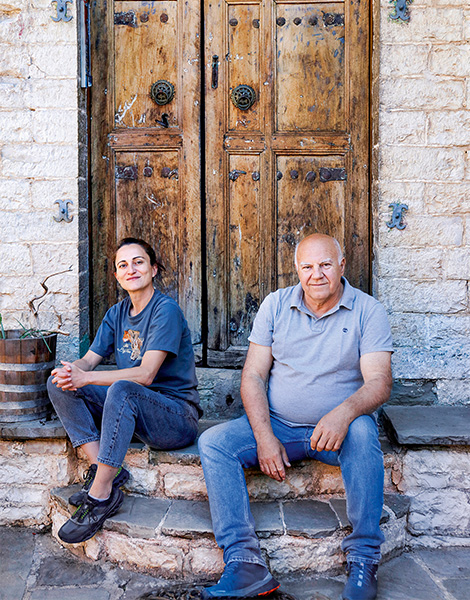
George Kontaxis with his colleague Dimitra Kalyva at the entrance to Arhontiko Dilofo.
© Perikles Merakos
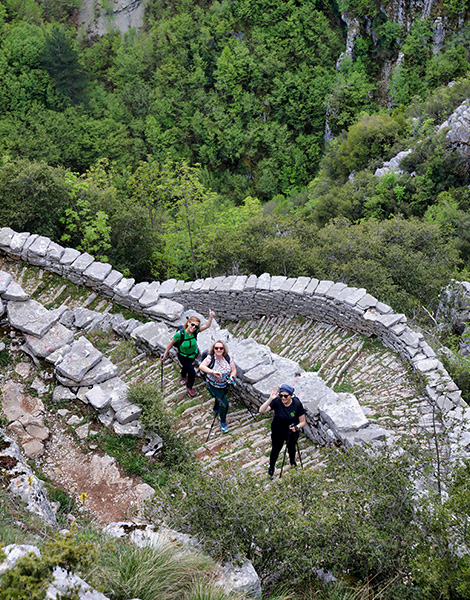
Climbing the Vradeto Steps with the group.
© Perikles Merakos
Just 32 kilometers from Ioannina, Dilofo is among Zagori’s best-preserved villages. Until an asphalt road finally reached it in 1990, the settlement remained largely untouched by modern development, a factor that helped preserve its remarkable architectural character. A car-free village with abundant springs, Dilofo is defined by its cobbled lanes radiating from the central square, shaded by a magnificent plane tree, and by its impressive stone mansions. The most striking, rising 13.5 meters and considered the tallest traditional mansion in all of Zagori, is the Makropoulos Mansion at the entrance to the village. According to local tradition, its owner, a merchant who made his fortune in Odesa, built it high enough for his wife to see her native village of Koukouli from its upper floors.
Another landmark is the Dilofo Mansion, distinguished by its many windows. Construction began in 1633 and was completed in 1865. Today operating as a guesthouse, it was once the home of the Anagnostopoulos family, wealthy merchants who prospered abroad and became major benefactors of the village. Among their many donations was the Anagnostopouleios School, the former boys’ school that still stands on the western side of the village square.
“It once accommodated 84 boys,” says Giorgos Kontaxis, who now manages the mansion. “Another 84 girls attended the girls’ school in the Upper Neighborhood, although that building no longer survives.” In the late nineteenth century, Dilofo had more than 500 residents. Today, only seven live here year-round. Kontaxis also remembers Athinoula, the village’s legendary resident, who welcomed visitors for years and even knew how to repair traditional stone roofs. Through her stories, he says, Dilofo’s past remains alive.
“Most of the villagers were merchants trading spices in Egypt,” he says. “Every autumn the men left, and the women and children stayed behind. Then every summer, when they returned through Piraeus or Preveza and made the final journey to the village on mules, the whole place came alive. They held a great celebration and slaughtered animals to welcome them home. When it was time for the men to leave again, the women climbed to Klapsochorafi – the ‘Field of Tears’ – on the road from the Upper Neighborhood toward Asprangeloi and stood there weeping until the men disappeared from view.”

The Dinalexis Café opened in Elafotopos in 1920 and today remains alive through cultural events.
© Perikles Merakos
Once home to more than 1,300 people, Elafotopos remains one of Zagori’s liveliest communities. Built at 1,100 meters, it is known for its dry mountain climate, beautifully preserved stone streets and welcoming central square, where locals still gather beneath the shade of a centuries-old plane tree.
The birthplace of celebrated clarinet virtuoso Grigoris Kapsalis, who recently passed away, Elafotopos also hosts one of Zagori’s best-known village festivals every September. “When the village was full of people, the festival lasted three days – and even that wasn’t enough,” recalls Evripidis Dinalexis, an engineer, musician, and occasional café owner, who promotes cultural events to keep his grandfather’s and great-grandfather’s traditional kafeneio in the Kato Mahala neighborhood alive.
“It begins with the children, surrounded by their families. Then, after midnight, the women take over with more graceful dances. Later, the younger generation enters the circle, and by dawn the older men dance slower songs filled with emotion,” he explains. “But what truly binds us together is what happens at the end of the night. At dawn, the musicians play mirologia (traditional laments). Everyone sits down and nobody speaks. You usually see the whole village in tears, each person remembering their own loved ones. Then, after the laments, around ten or eleven in the morning, we all dance together once more before going home feeling lighter.”
Hike the Vradeto Steps
Whether you choose to climb or descend, the beautifully crafted dry-stone staircase begins just outside Kapesovo and ends at the Church of Aghios Nikolaos in Vradeto. Along the way, enjoy sweeping views over the Mezaria Gorge and the dramatic landscape of central Zagori, especially at sunset. Allow around one hour for the full route, or opt for the easier 20-minute walk from the village to the Beloi Viewpoint for one of the finest panoramas of the Vikos Gorge. For certified mountain guides, visit vianatura.gr.
Experience Forest Bathing in Skamneli
Switch off your phone, slow down, and immerse yourself in a guided forest experience inspired by the Japanese practice of Shinrin-yoku. Forest therapy guide and certified counselor Filippos Fragoulis combines the natural beauty of Zagori with mindfulness and wellness practices, allowing visitors to experience the restorative benefits of forest bathing. More information: feelforest.gr
Cycle Through Dilofo and Zagori’s Stone Bridges
Explore some of Zagori’s iconic stone arch bridges on a gentle seven-kilometer cycling route linking Dilofo and Kipoi. Along the way you’ll pass Captain Arkoudas Bridge, Kokkoris (or Noutsos) Bridge, Laskaridis Bridge, and the three-arched Kalogeriko Bridge. For an extra adrenaline rush, combine your ride with an 18-meter rappel descent from Kokkoris Bridge. More information: activenature.gr
Visit the Elafotopos Folk Museum
Housed in the village’s former primary school, which closed in the 1980s, the Elafotopos Folk Museum showcases around 3,000 objects representing 52 traditional crafts and nearly two centuries of local history. Created by local educator Michalis Oikonomidis, the museum presents its collection through engaging, hands-on displays that are especially suitable for families and children. Visits are by appointment: Tel. (+30) 693.698.4590
This reporting trip to Zagori was conducted as part of the Greek Ministry of Tourism’s campaign “Mountainous Greece. Elevate Your Journey. All Year Round.”
At any time of year –...

Unexpected discoveries and timeless classics. Everything...
Stone villages, fireplaces and guesthouses that...

From Lesvos and Chios to Ikaria...