The Essential Guide to Greek Christmas Traditions
Explore Greece’s Christmas traditions, from sweet...


The fish trap (“pelada”) of the Anagennisi Fishing Cooperative, with Mount Varasova in the background.
© Dimitris Tosidis
I didn’t expect to be won over by Messolonghi. And yet, despite the absence of striking architectural landmarks, its surrounding landscape – and the weight of its history – quickly leave an impression. The town has a distinctly retro atmosphere, evoking an older, slightly overlooked Greece. Shops feel suspended in time, fishmongers sell both sea and lagoon catch, and bicycles are everywhere, ridden by locals of all ages. Alongside this, there’s a quieter, more contemporary layer, a legacy of the years when the town was home to a large student population.
Messolonghi is currently undergoing a period of renewal. The anniversary of the Exodus has acted as a catalyst for a series of redevelopment projects aimed at reshaping its image. Events are already under way and will continue throughout the year. Among the highlights is the arrival in Greece, for the first time, of Greece on the Ruins of Missolonghi by Eugène Delacroix – but the wider programme offers much more to explore.
Rather than focus solely on major events, we turned to the experience of being here, both within the town and in its surrounding landscapes. History, culture, luminous sunsets, mirrored waters, birdsong, and distinctive local flavours come together to make Messolonghi an ideal destination for a long weekend.

Among the most important exhibits of the Xenokrateio are the marble heads of colossal cult statues of Apollo.
© Dimitris Tosidis
Our only regret is not beginning at the Xenokratio Archaeological Museum. Although archaeological in scope, it features a well-designed digital gallery with multimedia applications that map out cultural routes across the region, offering a clear and engaging introduction from the outset.
Housed in a former Girls’ School building, the museum opened in 2021 and currently hosts, until November, Delacroix’s Greece on the Ruins of Missolonghi. Even without this landmark loan, however, the museum stands out. Its collections span from prehistoric to Roman times, presented across seven rooms that trace the region’s development from the significance of the Achelous River in the Palaeolithic era to the rise and decline of the Aetolian and Acarnanian Leagues.
Particularly striking are the two bronze funerary cauldrons from the cemetery of Stamna. Dating to the Protogeometric period, they contained cremated remains and grave goods. What makes them truly unique are the textiles that once covered the vessels – inside and out –which have survived. Archaeologists have identified six different weaving techniques, along with traces of dye. Clear, engaging, and thoughtfully curated, this is easily one of the finest archaeological museums in Greece.
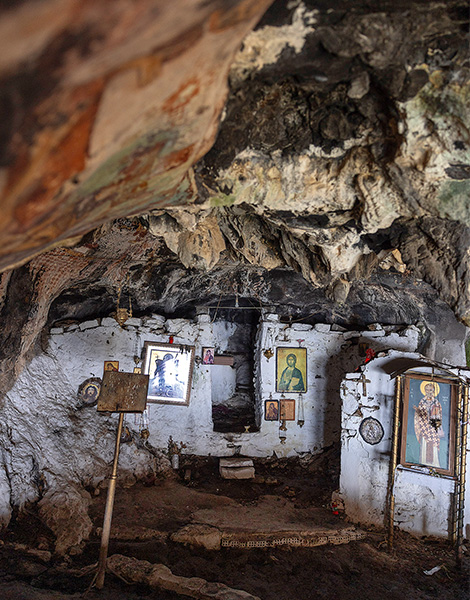
Aghios Nikolaos Kremastos.
© Dimitris Tosidis

A waterfall just beyond Aghios Nikolaos.
© Dimitris Tosidis
A simple Instagram post was enough to prompt a wave of surprised messages from friends in nearby Nafpaktos, Agrinio and Messolonghi, many of whom had not been aware of the quiet beauty of Mount Arakynthos. Several hiking routes trace its slopes, but as it remains largely unexplored, there is no official signage.
A number of hiking routes cross its slopes, though the area remains largely unexplored and without formal signage. We followed the path from Kato Ellinika to Kefalovryso, an old cobbled trail of around 7 km. Along the way, the views open out over the lagoons and Aitoliko, while midway you reach the Byzantine cave chapel of Agios Nikolaos Kremastos, with its rock paintings and stone-built iconostasis. A short distance further on, an unexpectedly dramatic waterfall adds to the sense of discovery.
This is not a route for beginners. The terrain is uneven, with loose stones and sections where the path becomes difficult to follow. Stone cairns provide occasional guidance, and the turn-off to the chapel comes at around the halfway point. Careful footing and steady progress are essential, particularly as you approach the cave.

The tomb of Markos Botsaris, in the Garden of Heroes.
© Dimitris Tosidis
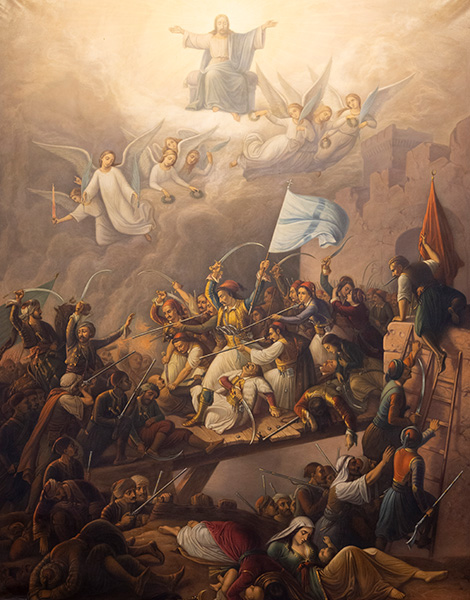
The Municipal Gallery offers a comprehensive overview of artworks inspired by Messolonghi, most of them reproductions.
© Dimitris Tosidis
A visit to Messolonghi feels incomplete without time spent at the Garden of Heroes. Beyond its historical significance, it is also a beatiful open-air sculpture park.
Standing on the ground where the “Free Besieged” fought, the words of Dionysios Solomos take on new resonance: “My eyes have seen no place more glorious than this little threshing floor.” The fortified town was indeed little more than a flat, exposed expanse, dismissed by Ibrahim Pasha of Egypt as a mere “fence”, lacking even the advantage of elevation. Yet the surrounding lagoons, together with its moat and bastions, created a powerful system of natural and man-made defences that played a crucial role during the Exodus of Messolonghi on 10 April 1826. Within the garden, you’ll encounter 69 monuments dedicated to Greek fighters and Philhellenes, as well as the burial mound where the bones of the anonymous defenders are kept.
Nearby, the Municipal Gallery, housed in the neoclassical building of the former Town Hall, offers a comprehensive overview of artworks inspired by Messolonghi, most of them reproductions. Among the most affecting exhibits are the fighters’ weapons, the communion chalice of Bishop Joseph of Rogoi – believed to have been used by those who took part in the Exodus – and a copy of The Exodus of Messolonghi by Theodoros Vryzakis, carried each year in the commemorative procession.
© Dimitris Vlaikos

© Dimitris Vlaikos
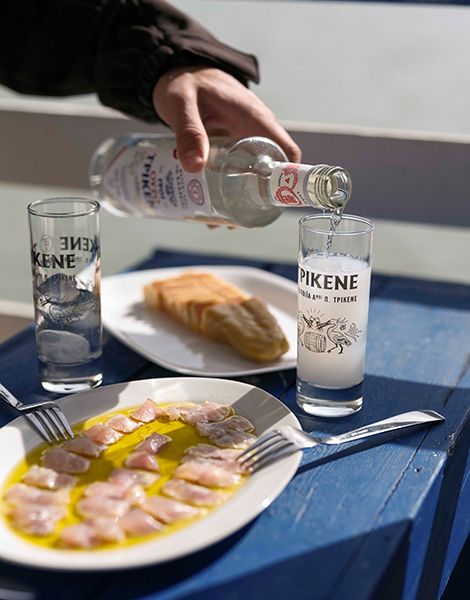
Messolonghi has all the makings of a perfect table in the sun. Start with its two distilleries: the historic Trikene Distillery, operating since 1901 (its shop on Makri Street feels like a small museum), and the more contemporary Pelada Distillery.
Equally integral are the exceptional salt and afrina (sea foam salt) harvested from the Messolonghi Salt Pans, which account for 60-70% of Greece’s salt production. Add to this the abundance of fish from the lagoon’s divaria (traditional fish enclosures) and the open sea, and the culinary identity of the area begins to take shape. Local fishermen prepare a range of cured delicacies, most notably PDO bottarga (avgotaracho), served in cafés and tavernas alongside grilled petali mullet, eel and fried gobies.
A stroll through the Upper Market reveals fishmongers and traditional cafés where locals gather for midday ouzo – we especially loved Koulouvachata. The Lower Market has a more contemporary feel, with pedestrian streets, the charming Malavetas café on Lord Byron Street, and the excellent seafood taverna Dimitroukas on Razikotsika Street.

Lord Byron Museum.
© Dimitris Tosidis
Few places of this scale are so closely associated with such a range of historical figures? In addition to its heroes, Messolonghi is also the birthplace of the families of Kostis Palamas and Harilaos Trikoupis. Their homes stand opposite each other on Mavrokordatou Street. The 18th-century stone house where Palamas grew up and wrote his first works is currently closed for restoration. The Trikoupis residence, originally built in 1730, was destroyed during the Exodus of Messolonghi and rebuilt in 1850; it is open to visitors, albeit with a more traditional museum presentation.
Even though Lord Byron was not from Messolonghi, he was declared an honorary citizen in 1824. A beautifully curated exhibition on his life and work is housed at the Byron Society of the Sacred City of Messolonghi, which founded the museum. At present, it hosts a selection of his personal belongings on loan from the National Historical Museum.
Also worth visiting is the small chapel of Panagia Finikia, on the road to Aitoliko, where the Romantic Philhellene is said to have taken his daily walks.
Trikoupis Museum – Tel. (+30) 26310.262.83, daily 09:00-19:00
Byron Museum – Perimetric Plostaina Road, Tel. (+30) 26310.569.03, 10:30-13:00 (closed on Tue)
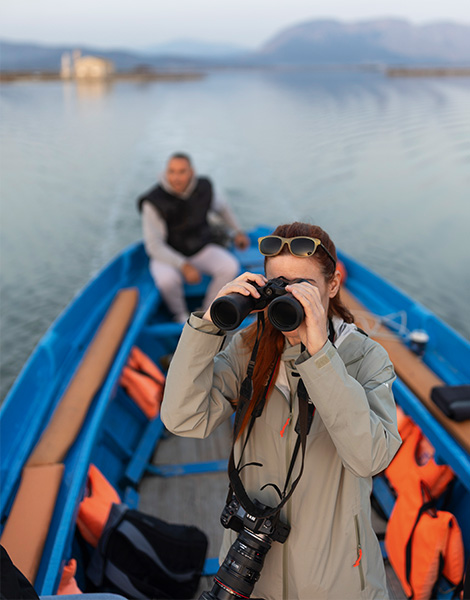
A total of 290 bird species have been recorded here, 100 of them considered rare.
© Dimitris Tosidis

© Dimitris Tosidis
In Messolonghi, you don’t need specialist equipment to appreciate the richness of birdlife. Within the Messolonghi – Aitoliko Lagoon National Park, which encompasses the Messolonghi – Aitoliko lagoon and the lower reaches of the Achelous and Evinos rivers, where they meet the Gulf of Patras and the Ionian Sea, takes shape one of Europe’s most significant wetland ecosystems.
A total of 290 bird species have been recorded here, 100 of them considered rare. According to OFYPEKA (the Natural Environment and Climate Change Agency), particular importance is placed on the populations of key species: around 25,000 ducks and coots, more than 10,000 flamingos, and some 200 Dalmatian pelicans. You can spot them even in winter, while as spring sets in, the arrival of migratory birds creates a truly magical spectacle.
For equipment or guidance, contact the local management OFYPEKA unit, the group Messolonghi by Locals, or visit the Salt Museum of Messolonghi.
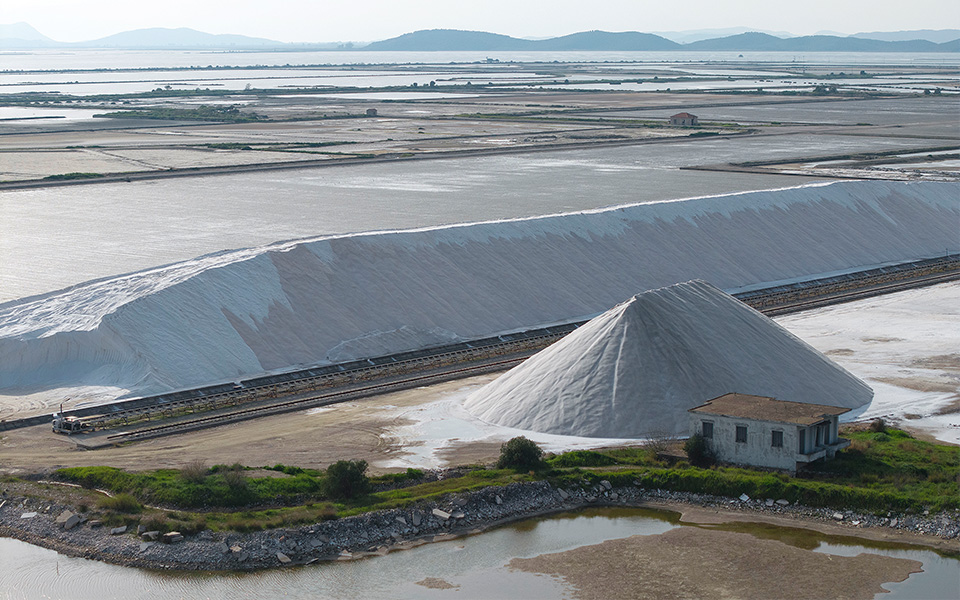
Mountains of salt at the Messolonghi Salt Pans.
© Dimitris Tosidis
I found myself fixated on an 1800s salt shaker, trying to figure out how it worked. Around me, some 1,500 more salt containers from across the world – made of wood, plastic, glass, and every material imaginable – form a truly rare collection. The remarkable Salt Museum of Messolonghi has been operating since 2020 and is housed in the former living quarters of salt workers, dating back to 1946.
Here, you’ll learn about the 14,000 uses of this “white gold” – many of them entirely unexpected – and its lasting impact well beyond the economic sphere into art, ritual and everyday life. Displays include salt crystals from around the world, while outside, traditional harvesting tools are exhibited.
At the right time of year, you can witness the striking salt mounds and the shallow flats where salt collects in the municipal saltworks of Tourlida.
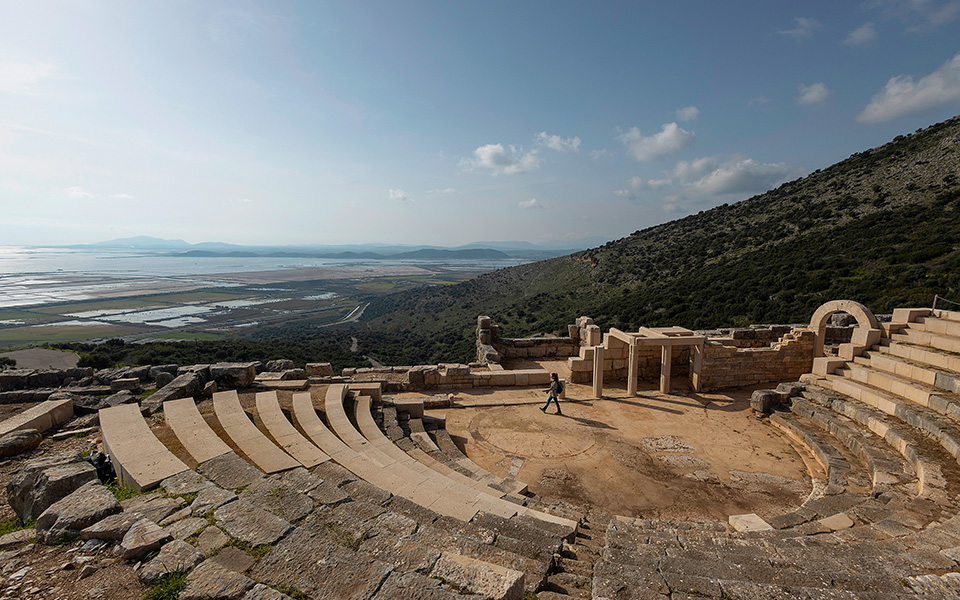
Ancient Plevrona
© Dimitris Tosidis
Settle into the stone seats of the beautiful theater, dating to the late 3rd century BC, and take in the sweeping spectacle of the lagoons stretching out below. Walking among blooming wildflowers, you’re struck by the remarkably well-preserved fortification walls, towers, and gates. The archaeological site of Ancient Plevrona is yet another surprise Messolonghi has in store, just 5 km away.
The first references to the ancient city appear in the Homeric epics. Originally located on the hills of Gyftokastro and Petrovouni, it was destroyed in 234 BC and later rebuilt on its current site, covering an area of 235 hectares. Take your time to explore – and if you visit in summer, don’t miss the chance to attend a performance at the ancient theater.
Open daily except Tuesday, 08:30-15:30

“The Messolonghi locals.”
© Dimitris tosidis
Seven years ago, a group of young people from Messolonghi made a conscious decision to stay in their often-overlooked hometown and highlight its cultural identity. Through persistence and creativity, Messolonghi by Locals has helped bring the town into the spotlight, developing meaningful initiatives that attract an ever-growing number of visitors, while also making everyday life more engaging and sustainable for the locals themselves.
They organize outstanding experiential activities, design cultural route maps, and run both an info point and a local hub. Their work spans events, educational programs, workshops, and even festivals, all centered on culture and the environment.
You can go birdwatching, cycle around the Kleisova Lagoon, visit key cultural sites, and of course take a traditional boat ride on a priari. In collaboration with fishermen from the lagoon, they’ll guide you to the divaria (fish enclosures) and to the islet of Aghia Triada, where one of the most significant yet lesser-known battles of the Greek War of Independence took place – often overshadowed by the Exodus.
The experience concludes at a fishermen’s pelada in Tourlida, where you’ll see how fish is cured and enjoy a meal you won’t forget. Don’t miss a stroll through the wider pelada settlement, either – it’s a place unlike any other.
Shop: 9 Ath. Razikotsika, Tel. (+30) 26313.067.33
Hub: Venizelou & K. Katsi, Tel. (+30) 26313.020.48

The islet of Kleisova, with the Church of the Holy Trinity and the monument commemorating the legendary battle of March 25, 1826.
© Dimitris Tosidis
The loop around the Kleisova Lagoon is a highlight, but another off-road adventure awaits further west, in the wetland system of the Paleopotamos Lagoon. After passing through Aitoliko and Neochori, turn left and follow the canal; you’ll soon reach a dirt road. This rewarding circular route stretches for about 20 km and is best tackled with a 4×4 vehicle.
Driving through the delta system of the Achelous River, you’ll encounter citrus groves, freshwater and saltwater marshes, sand dunes, islets and barrier islands, fish farm installations, and stretches of coastline along the Ionian Sea, including Paleopotamos and the popular Loutros beach, known for its beach bars.
Looking west, you’ll see the Echinades Islands, some of which have gradually turned into low hills due to the river’s sediment deposits. This area, part of the Messolonghi-Aitoliko Lagoon National Park, is home to flamingos, pelicans, and herons, while turtles, frogs, pigs, and cows also make frequent appearances.
Keep an eye on the landscape as you go – you may even spot the wild horses that roam freely across this striking terrain.
Explore Greece’s Christmas traditions, from sweet...
Crackling fireplaces, homemade breakfasts and courtyards...
The charming port city of Volos...
A brave history and uniquely beautiful...