Kypseli: 18 Stops for Food, Coffee and Drinks
Old and new hangouts, cafés, sandwich...

© Konstantinos Tsakalidis
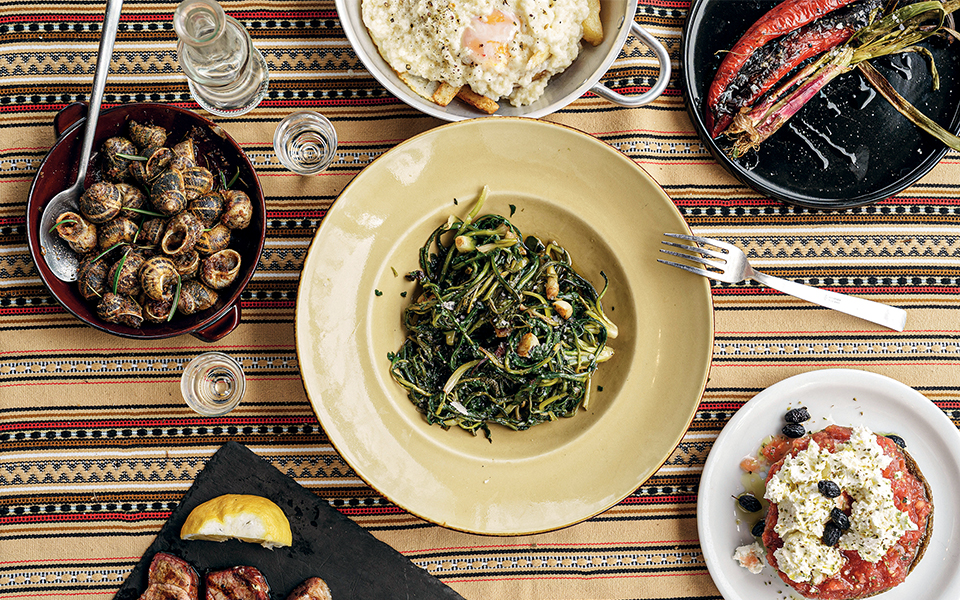
At Ntounias, a rustic taverna nestled in the village of Drakona in the White Mountains, the kitchen garden is planted with heirloom seeds – hardy, native varieties passed down through generations. Wild thyme, oregano, and arismari (local rosemary) grow freely among the rows, and everything is cultivated using organic practices. The beehives produce fragrant mountain honey, the olive grove yields enough oil to last the year, and the land supports a small collection of animals: chickens, turkeys, goats, sheep, and even rare native Cretan cattle, which graze freely beneath the snow-capped peaks. Stelios Trilirakis has run Ntounias (Keramion, Nerokouros, Tel. (+30) 28210.650.83) for over twenty years, producing food that is seasonal, earthy, and deeply flavorful.
During our visit, we run into Manolis Papoutsakis, a Ηania-born chef who owns restaurants in Thessaloniki and Athens. He’s here with fellow chefs – including a three-Michelin-starred chef from New York – as part of a culinary exploration. Every year, they travel to a different region with a strong food identity. This year, they chose Hania.
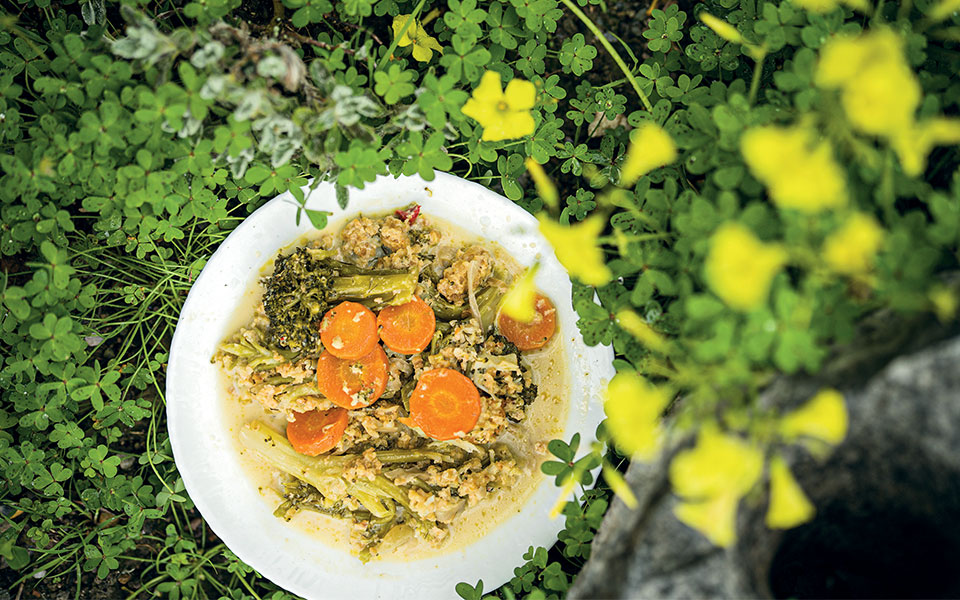
A dish by Ntounias made with whatever the garden yields: sautéed cauliflower and broccoli with cracked wheat, sheep’s milk, and seasonal herbs.
© Konstantinos Tsakalidis
“Why does the food here stand out?” I ask him.
“The region has incredible biodiversity and a vitality that’s hard to match elsewhere on the island,” he tells me. “There are also strong Venetian and Ottoman influences that give the cuisine real character. What’s more, Ηania has an urban culinary tradition, which makes things even more interesting.”
He explains that Cretan cuisine has always adapted to what was available. Boureki, for example, is made with pastry in the city, but not in the mountains. “Flour wasn’t easy to come by in poorer villages,” he says. “Even wealthier homes adapted recipes to what they had. Cooking out of necessity shaped a resourceful mindset. But what turned that into culture was the care and skill behind every dish. You can taste the land.”
And that’s exactly what Stelios Trilirakis is doing at Ntounias – preserving the flavors of Hania and making sure they’re not forgotten.
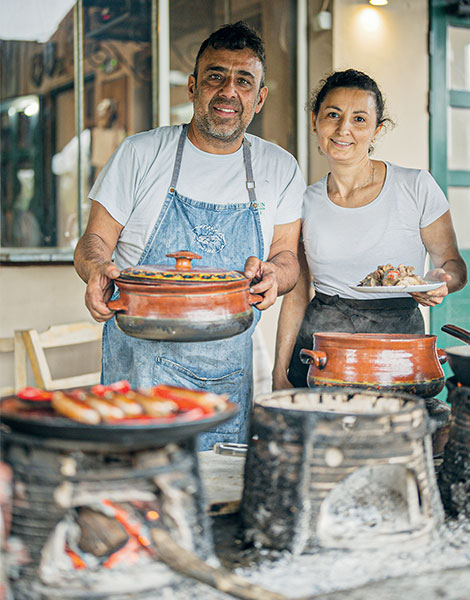
Stelios Trilirakis and his wife Emy Onoufriadis in front of the open hearths.
© Konstantinos Tsakalidis
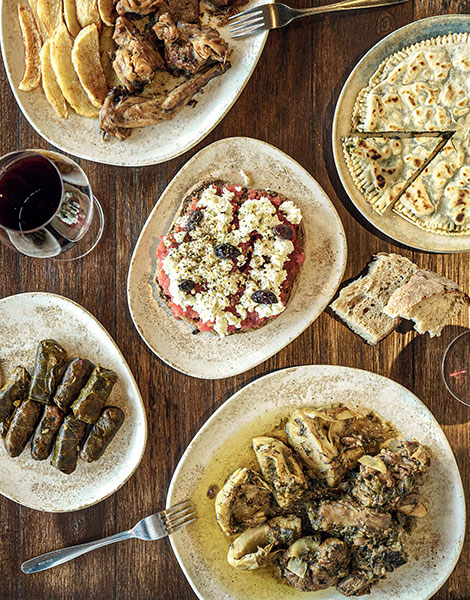
A classic Hania-style table at Chrysostomos.
© Konstantinos Tsakalidis
At Chryssostomos (Defkalionos & Ikarou, Hania, Tel. (+30) 28210.570.35), as at Ntounias, cooking is inextricably connected with the land, the animals, and the passing of time. Chef-owner Chryssostomos Orfanoudakis began cooking professionally in 1994, on the remote Marmara Beach in Sfakia. The ingredients came directly from his family’s mitato, a shepherd’s hut perched 1,800 meters up in the mountains. There was no menu; just a few essentials: fresh salad, omelet, and tsigariasto (slow-cooked meat). He chopped wood, built the fire, cooked, and served. His humble seaside taverna, accessible only by boat, eventually earned international recognition as one of the world’s best beach restaurants.
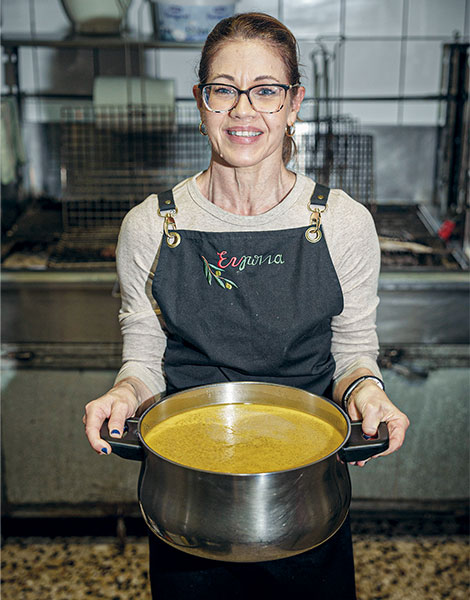
Sophia, owner and cook at Evgonia, holds the "magical" broth in which she prepares the gamopilafo.
© Konstantinos Tsakalidis
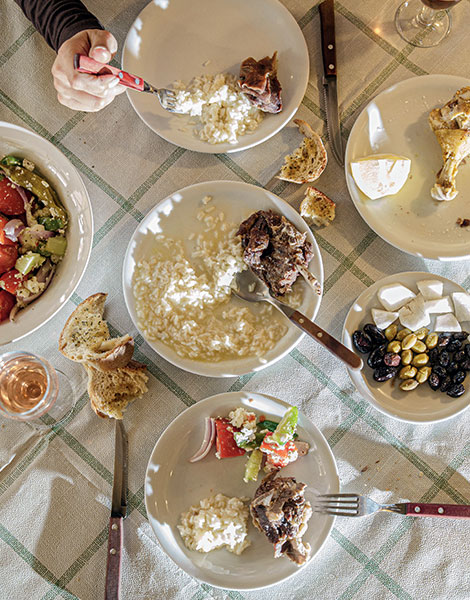
At Evgonia, gamopilafo is the cook’s specialty.
© Konstantinos Tsakalidis
In 2002, Orfanoudakis brought those same mountain-rooted flavors to the Venetian Harbor of Hania. The menu – tsigariasto rabbit, lamb with artichokes, ofto (pit-roasted meat), sfakiani pita, and ntakos – was shaped through years of conversations with friends and regulars.
But success also brought reflection. “Tourism is a double-edged sword,” Orfanoudakis says. “We need the right kind of tourism. If we keep going like this, we’ll lose what we have – the ingredients, the flavors, the animals, even the land.”
He’s committed to a more thoughtful vision of tourism – one grounded in authenticity. That same spirit defines To Limeri (Vasiliou Poulaka, Theriso, Tel. (+30) 28210.778.84), a well-loved tavern known for its antikristo (lamb slow-roasted over the fire) and locally sourced meats. Located in Theriso, a historic village nestled at the foot of the White Mountains, To Limeri is a classic weekend destination for the locals. Just getting there is part of the experience: a winding drive through the dramatic Theriso Gorge, a route loved by both locals and travelers.
“Everyone’s focused on tourism now,” says owner Yiannis Kantounakis. “But very few still work the land or raise animals like we used to.”
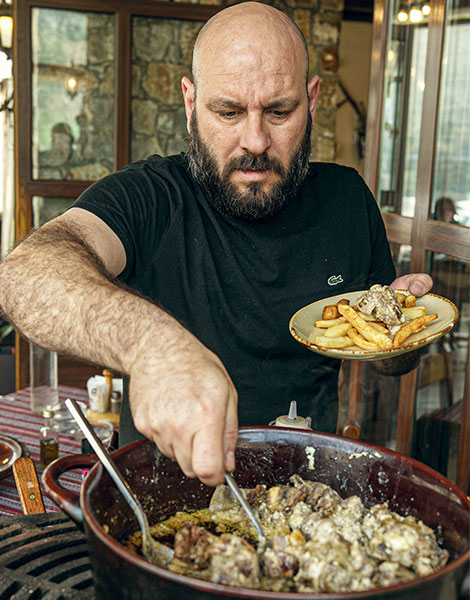
In Theriso, at the taverna To Limeri, Yiannis Kantounakis offers authentic flavors with no compromises on quality.
© Konstantinos Tsakalidis
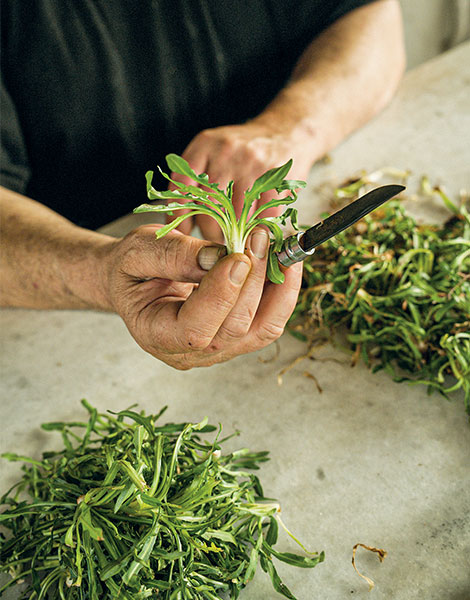
Cleaning wild stamnagathi is hard, laborious work, but its flavor makes it all worthwhile.
© Konstantinos Tsakalidis
Back in town, at Evgonia (Milonogianni 120, Hania, Tel. (+30) 28210.594.20), fish is slow-grilled over coals, while rice simmers gently in lamb broth to become gamopilafo – the signature wedding pilaf of Crete. “If we can’t find good fish at the market, we simply don’t serve it,” says owner Nektarios Chalakatevakis. The menu changes with the seasons. In summer, there are green beans, okra, and stuffed vegetables – whatever the market offers. The cooking is homestyle, but never simplistic. Nektarios’ wife, Sophia, prepares every dish with quiet dedication: maroulides (braised lettuce), chickpeas, snails, lentils, and stuffed peppers. “Fish is fish. Meat is meat. I don’t mess with the flavors. When you eat something, you should know what it is. That’s how I learned, and that’s how I cook,” she says.
The same philosophy guides Bolanis (30 Emmanouil Pimpli, Hania, Tel. (+30) 28210.593.34), a traditional kafeneio in the outskirts of the city. Braised pork, grilled meats, tsigariasto, stifado, dolmadakia, and stuffed zucchini blossoms – every dish has its place on the menu. Manolis Bolanakis took over the family kafeneio thirty years ago and still runs it today with his wife, Stella. “We’ve kept the old rhythm,” he says. “Coffee in the morning, meze in the afternoon.” Stella cooks based on what’s fresh and what inspires her. “I’m not a professional,” she says. “I just love to cook. My mother and my mother-in-law taught me everything I know.” She makes marathopitakia (fennel pies) with the lightest dough, omelets with wild greens like avronies, and deeply seasonal dishes guided by instinct.
This will be the kafeneio’s last summer. Next year, the couple plans to retire, and their children don’t intend to carry it on. “It’s hard work,” Manolis says, “but it’s also part of our tradition. Sadly, kafeneia like ours are disappearing across Crete.”
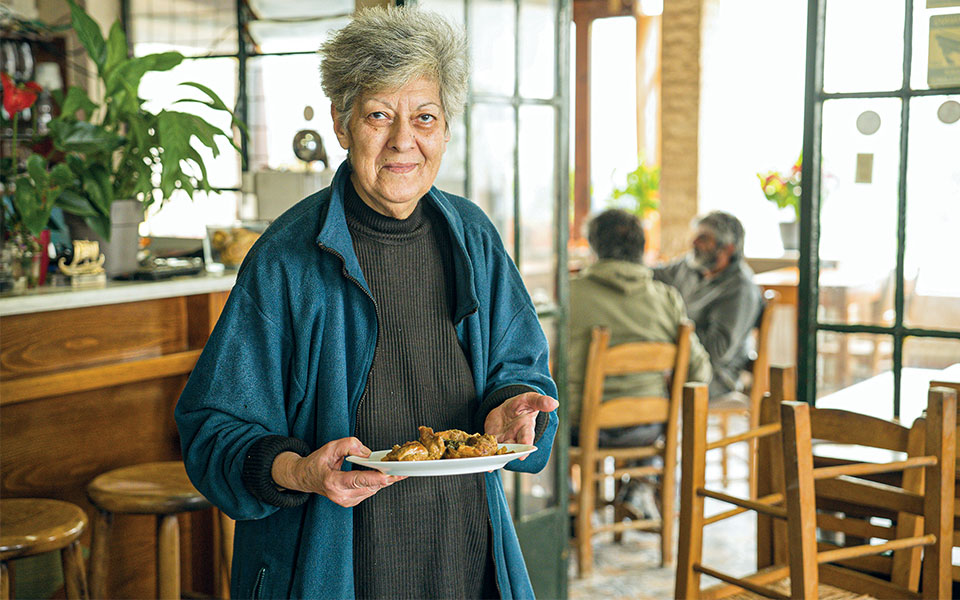
Skilled cook Stella Bolanaki serves her seasonal dishes at her kafeneio.
© Konstantinos Tsakalidis
The tradition of Haniotiki bougatsa lives on thanks to two family-run shops that have become beloved city institutions. With over a century of history and roots in Asia Minor, Iordanis (24 Apokoronou, Hania, Tel. (+30) 28210.888.55) is a local legend. His bougatsa is paper-thin and crisp. The pastry is hand-stretched, and the dough is made with olive oil, which gives it its signature texture. It’s filled with PDO pichtogalo Hanion – also known as Hania’s fresh myzithra – and baked fresh to order.
“Airy pastry requires real skill and fast hands, or it’ll stick and become unworkable,” says Mr. Vasilis, one of the most experienced dough masters at Iordanis’ workshop. Mrs. Ioanna, wife of the late fourth-generation pastry maker Iordanis Akasiadis, knows exactly how to work the dough. “We try not to stray from the traditional method,” she says. “It’s harder, but it’s what keeps everyone coming back for that familiar taste.”
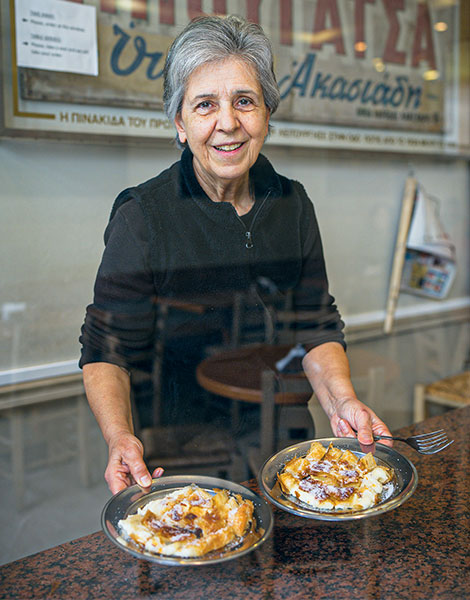
Ioanna Akasiadi, wife of Iordanis, carries on the tradition.
© Konstantinos Tsakalidis
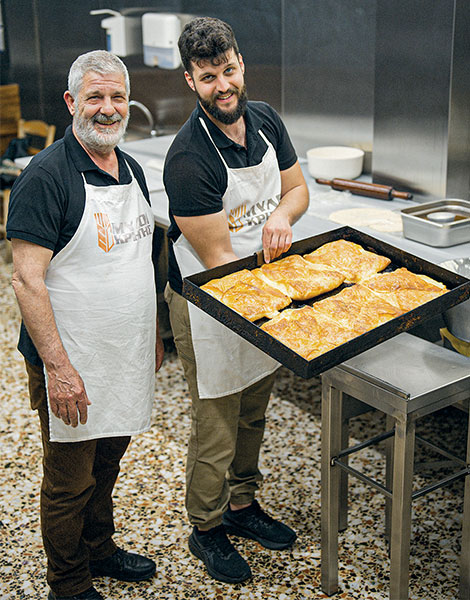
Antonis Tomadakis and his son Manousos at the Bougatsa Hania workshop.
© Konstantinos Tsakalidis
A few streets away, at Bougatsa Hanion (37 Apokoronou, Hania, Tel. (+30) 28210.439.78), the dough is made with a blend of four flours sourced from the Mylos Crete mill in Souda. It rests for 24 hours, then is shaped and cooked entirely by hand. “It takes three of us working together,” says owner Antonis Tomadakis. “People have urged us to use cheaper cheeses instead of fresh myzithra. But we’ve never compromised. That would cost us more than money – it would cost us our name.”
The shop opened in 1986. Tomadakis trained at Iordanis before launching his own business. His children were raised in the bakery and are now learning the craft alongside him. In both of these iconic establishments, what you taste is not convenience, but conviction – a quiet, daily commitment to doing things the right way, not the easy way.
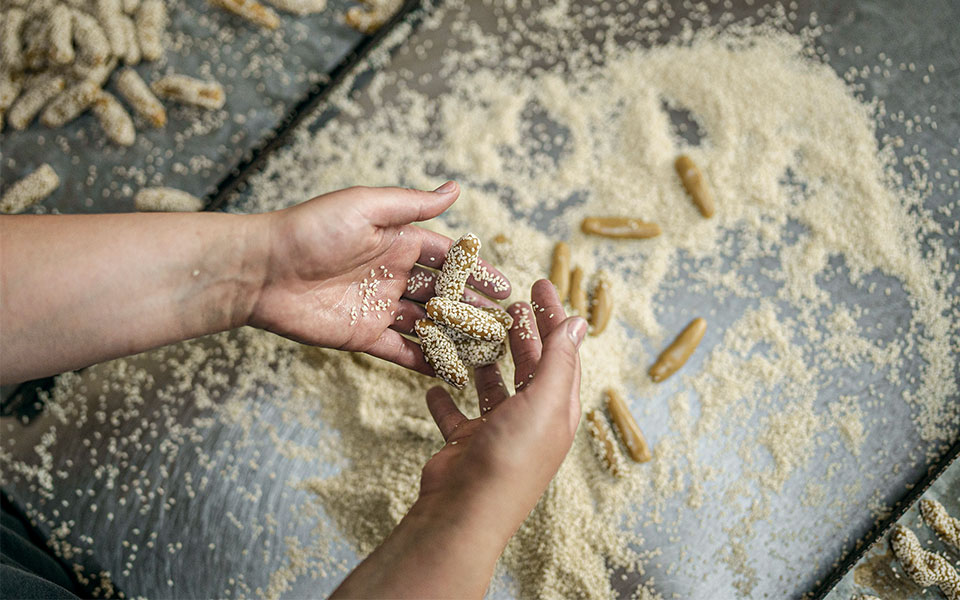
Traditional cookies with orange and sesame.
© Konstantinos Tsakalidis
One of the few remaining wood-fired bakeries in Hania is Drandakis (25 Eleftheriou Venizelou, Hania, Tel. (+30) 28210.551.20), with roots going back to before 1940. “During the Occupation, they took bread from here for the army,” says Maria Drandaki, a third-generation baker. “They made kouramanes [army rations] and large paximadia to make them last.” Every Sunday, the wood oven became the neighborhood’s communal oven. “Each family would bring pans to be put in our oven,” she recalls. “From Sunday roasts to Christmas kourabiedes, everything passed through here.”
Today, the wood-fired oven remains the heart of the bakery. Fueled by logs, it can bake up to 100 kilos of bread at once. The loaves go in first; when the temperature drops, in go the rusks, cookies, and breadsticks. “The wood oven gives everything its signature aroma and character,” says Maria. The bread is made with their own natural sourdough, and the rusks come in barley, spelt, sesame, carob, and multigrain varieties. The selection is wide, but the core principle is quality: village-style loaves made with wheat, wholegrain, rye, barley, spelt, or 100% carob flour. “We don’t use pre-made mixes, and everything is kneaded by hand,” she says. “But the old-school bakeries are closing. People buy bread at the supermarket and keep it in the fridge to make it last. Ours is alive.”
Just a few blocks away, Tzedakis (7 Tsouderon, Ηania) has been serving sweets for over 130 years. Once a dairy shop, it’s best known today for its loukoumades, the honey-soaked fried dough balls that Hania locals learned to love during Ottoman times (in Turkish, they’re known as serai loukoumas).
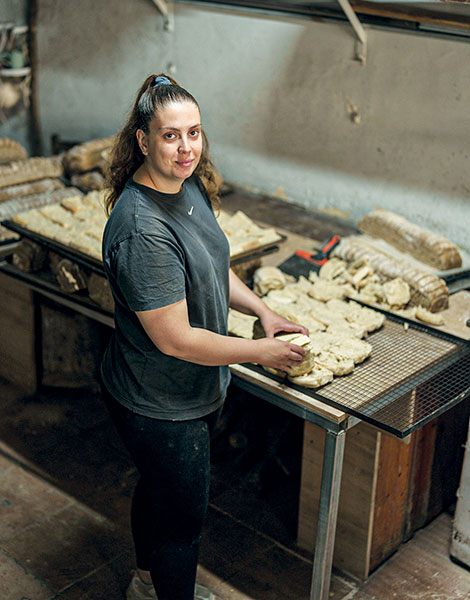
Ritsa Anastasaki, a fourth-generation baker at Drandakis bakery, cuts the rusks before baking them a second time.
© Konstantinos Tsakalidis
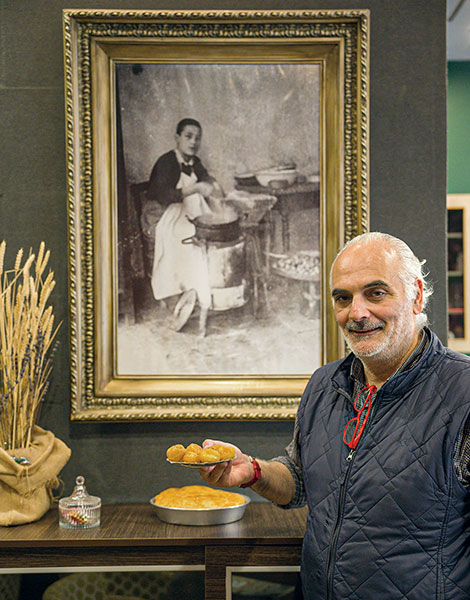
Andreas Tzedakis holds the loukoumades he made for us.
© Konstantinos Tsakalidis
The recipe is simple: water, flour, yeast. Once the dough is ready, the pastry chef must quickly shape it into small balls and drop them into hot oil. Speed is essential; hesitate for even a minute and the dough becomes watery, impossible to fry. At Tzedakis, this step is still done by hand, the traditional way. The moment they come out of the oil, the loukoumades are dipped in syrup. That way, they soak up just enough sweetness, stay crisp on the outside, and burst like golden bubbles in the mouth.
They’re served on small metal plates, dusted with toasted sesame and cinnamon, always with a shot of raki on the side. “Hania-style loukoumades are unique,” says Andreas Tzedakis, the current owner and heir to the family tradition. “You’ll only find them here. Even Ktistakis in Athens–he’s originally from Hania.” The tradition comes alive during the holidays: loukoumades are eaten on Christmas Eve and again at midnight on New Year’s, to ensure a sweet start to the year. In some villages, the bride brings them to her new home after the wedding.
In Hania, flavor is passed down from mouth to mouth, from hand to hand, from one generation to the next. It’s seasonal, local, and deeply personal. It stays alive in homes, cafés, bakeries. As long as there are people who cook with care, who stretch their dough by hand, who knead with their own sourdough starter, the taste of Hania will never become a tourist product. It will remain part of the island’s identity – an edible expression of culture and tradition.
Old and new hangouts, cafés, sandwich...

Explore Corfu’s once-forgotten vineyards and discover...
A hidden gem in Pangrati where...

Athens sizzles with culinary creativity, blending...