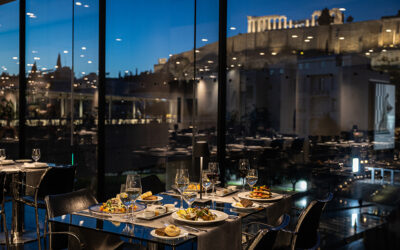
Festive Magic at the Acropolis Museum This Christmas
The Acropolis Museum unveils its festive…


The monumental artwork was originally commissioned for the Mayor of London's Fourth Plinth Program, at Trafalgar Square.
© Apostolos Pasvouris | Courtesy ΝΕΟΝ, the Acropolis Museum and the artist
The Acropolis Museum has unveiled “Lamassu of Nineveh (2018),” a monumental sculpture by Iraqi-American artist Michael Rakowitz, now installed in the Museum’s outdoor garden on its west wing overlooking Mitseon Street. Presented in collaboration with the contemporary art organization NEON, the work forms the second chapter of the ongoing trilogy “Michael Rakowitz & Ancient Cultures” – a joint initiative of the Hellenic Ministry of Culture, the Acropolis Museum, the Ephorate of Antiquities of Athens, and NEON.
Originally commissioned for London’s Trafalgar Square as part of the Fourth Plinth series, Rakowitz’s 4.3-meter-high “Lamassu” recreates the protective Assyrian deity – a colossal winged bull with a human face that once guarded the Nergal Gate of ancient Nineveh, in present-day northern Iraq. The original, dating from around 700 BC, was destroyed in 2015 by ISIS, along with countless other irreplaceable artifacts from the Mosul Cultural Museum.
Rakowitz’s reconstruction, built from more than 10,000 empty cans of Iraqi date syrup, speaks to the survival of memory, culture, and craftsmanship amid devastation.
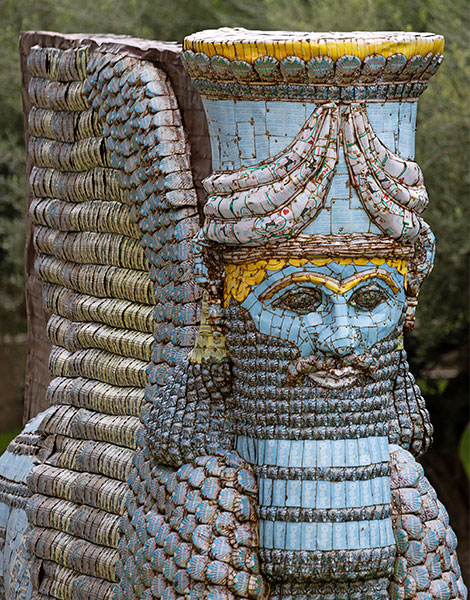
The Lamassu of Nineveh (2018) consists of 10,500 Iraqi date syrup cans and stands 4.3 meters tall.
© Natalia Tsoukala | Courtesy ΝΕΟΝ, the Acropolis Museum and the artist
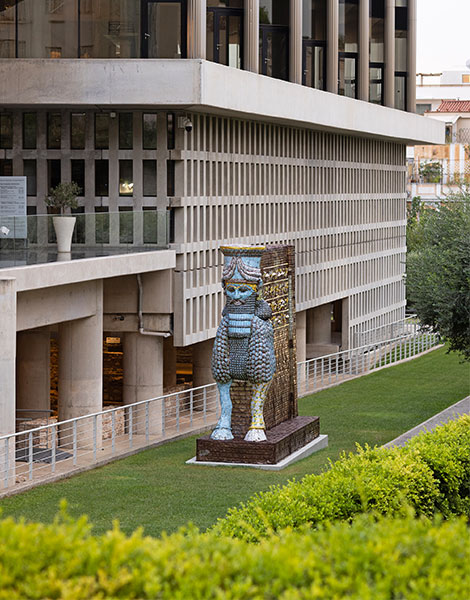
The original sculpture, which guarded the Nergal Gate of ancient Ninevah, was destroyed by ISIS in 2015.
© Natalia Tsoukala | Courtesy ΝΕΟΝ, the Acropolis Museum and the artist
“The Lamassu ‘reappears’ and continues its role as guardian – past, present, and future,” notes Acropolis Museum Director Professor Nikolaos Chr. Stampolidis, who co-curates the installation with NEON Director Elina Kountouri. Standing amid the Makriginanni site – the archaeological excavation underneath the Museum – and within sight of the Parthenon, the sculpture invites visitors to contemplate the continuity of cultural heritage across millennia.
The choice of materials is both symbolic and political. The date syrup cans represent a once-thriving Iraqi industry shattered by war and sanctions, while also embodying resilience through creative reuse. On the sculpture’s reverse, an exposed cuneiform inscription recalls King Sennacherib’s rebuilding of Nineveh, linking imperial ambition to the cycles of destruction and renewal that define human history: “Sennacherib, king of the world, king of Assyria, had the (inner) and outer wall of Nineveh built anew and raised as high as mountain(s).”
The installation follows the trilogy’s opening exhibition, “Allspice | Michael Rakowitz & Ancient Cultures,” currently on view in the Acropolis Museum’s Temporary Exhibition Gallery until October 31, 2025. The series will conclude next year with a third presentation at the Old Acropolis Museum.
To mark the unveiling, the Museum hosted a lecture by historian Dr. Alda Benjamen titled “Heritage, Genocide, and Memory,” exploring how the Lamassu symbolizes both glory and loss – and the enduring connections between objects, people, and place.
Rakowitz, a professor at Northwestern University in Chicago, is internationally recognized for his ongoing series “The Invisible Enemy Should Not Exist” (2006–present), which reconstructs artefacts looted or destroyed in Iraq following the 2003 US-led invasion. His works have been shown at MoMA, Tate Modern, and dOCUMENTA, among others.
The Lamassu of Nineveh will remain on display at the Acropolis Museum through October 31, 2026.
Admission is free.
For more information, visit theacropolismuseum.gr and neon.org.gr.
The Acropolis Museum unveils its festive…
This season, the iconic Athens venue…
Join archaeologists on a journey through…