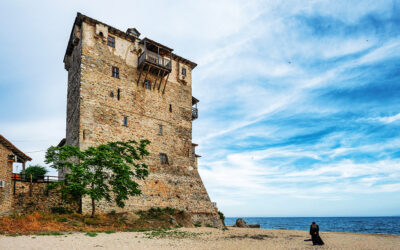
Ouranoupolis: A Place Between Two Worlds
The main gateway to Mount Athos,...

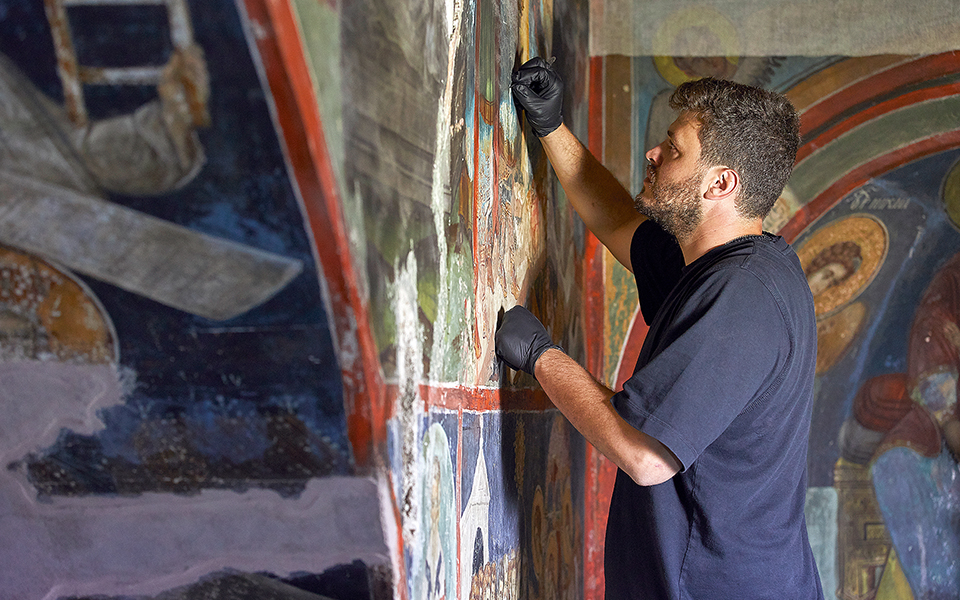
The conservation of frescoes in the Chapel of the Holy Unmercenaries (Agioi Anargyroi), at Vatopedi Monastery.
© Yannis Zindrilis
“Mount Athos is not a museum in the conventional sense, but a living organism. Its sacred treasures are an integral part of worship and daily life,” says Father Theofilos, seated in his office at Pantokrator Monastery. “The Acropolis and the Pyramids may have survived, but they are lifeless monuments. Mount Athos is one of the very few places where the ancient world endures as a living presence. Think of it as a bridge: It connects different people and nations, but above all, it bridges the centuries.”
As he shows us around the monastery, the monk and librarian speaks passionately about its preserved manuscripts and icons, but as we reach the katholikon, the monastery’s main church, his tone changes. “Look closely at these 14th-century frescoes,” he almost whispers. “This is van Gogh, 500 years before van Gogh! The expressive power of Byzantine art here is simply extraordinary,” he exclaims.
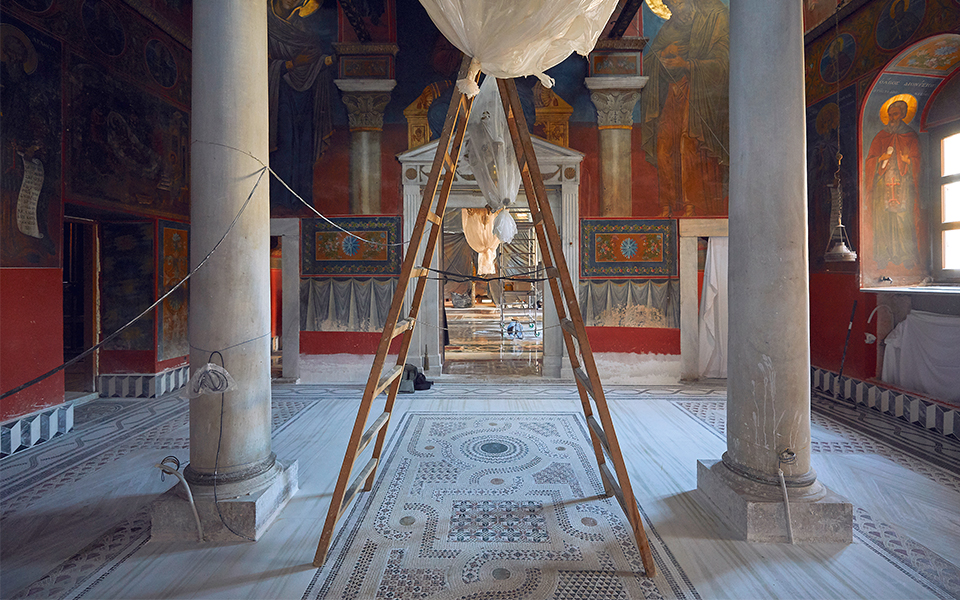
Restoration work at the katholikon (main church) of Pantokrator Monastery.
© Yannis Zindrilis
And yet these remarkable frescoes, along with thousands of other priceless treasures, once came perilously close to being lost forever. During the period when the monasteries operated under the idiorrhythmic system – under which monks lived and managed their affairs more independently – church collection boxes had run dry, and the few monks remaining on Mount Athos were unable to devote sufficient attention to preserving the artifacts entrusted to them by previous generations.
That the monastic community now has state-of-the-art conservation laboratories and is waging a monumental battle against the ravages of time, humidity and earthquakes is remarkable in itself. Working with the Ministry of Culture, the Ephorate of Antiquities of Halkidiki and Mount Athos, and the Center for the Preservation of Athonite Heritage (KEDAK), the monasteries have completed numerous projects involving the cataloging, research, documentation, study and conservation of various treasures. This is not a race against the clock. It is a painstaking effort, quietly carried out day after day.

General view of Vatopedi Monastery’s treasury.
© Yannis Zindrilis
Father Daniel is one of the monks overseeing the preservation of artifacts at Vatopedi Monastery. We meet him on the monastery’s balcony, as he directs a crew carrying out restoration work on the building. He studied civil engineering but never practiced it professionally. “When our brotherhood came here in 1987, the monastery was practically in ruins. Every building needed repairs. To this day, we’ve restored just over half of them,” he says.
There is a fundamental difference between the artifacts unearthed by archaeologists and those preserved in monasteries. According to the monks, the latter require a different approach because of their sacred nature. To illustrate this, Father Daniel shares a story that Elder Ephraim of Vatopedi Monastery used to tell his fellow monks.
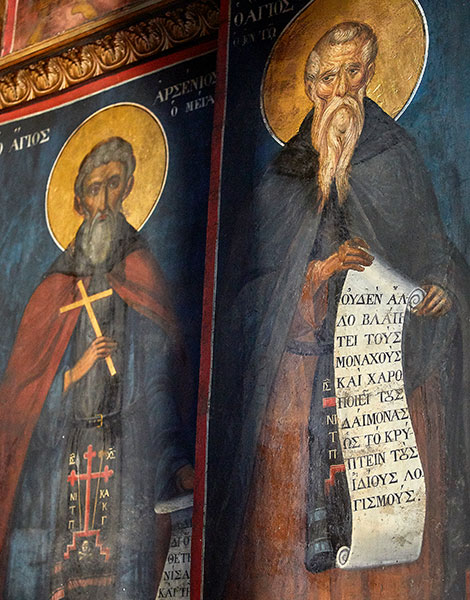
Its frescoes date to the third quarter of the 14th century.
© Yannis Zindrilis

Ottoman-era document, Pantokrator Monastery.
© Yannis Zindrilis
“When he was a young boy, there was a chapel that had fallen into ruins in his village in Cyprus. Almost nothing remained of it but stones. The village boys would go there, pick up the scattered stones and play with them. One day, his grandmother saw him and scolded him: ‘How can you take those stones? They were once part of a church. They have been blessed by incense. They carry the prayers, the tears and the worship services that took place there. They are not ordinary stones to be tossed around.’

Blessing crosses from the treasury of Iviron Monastery.
© Yannis Zindrilis
Standing beside him, listening intently, is 33-year-old conservator Thanos Alexiou. He first visited Mount Athos 12 years ago and was drawn to the monks’ authenticity and kindness. He graduated from the University Ecclesiastical Academy of Thessaloniki and the University of West Attica’s Department of Conservation of Antiquities and Works of Art in Athens.
“The process of becoming a licensed conservator with the Ministry of Culture is rigorous. You have to graduate, complete two years of practical training at a public or private institution, and then submit your credentials to obtain a license to work on objects dating from before 1830. You can’t perform ‘surgery’ without proper training. The responsibility we bear toward these monuments is immense,” he says.

General view of the early 14th-century frescoes in the main church of Vatopedi Monastery.
© Yannis Zindrilis
He holds a specialized chemical gel and a scalpel in his hands. “The gel absorbs soot and softens later layers of overpainting. The scalpel is our most essential tool, literally an extension of our hands. We also use special cleaning agents to remove greasy stains left by worshippers’ hands or incense,” he explains. Conservators may also use various imaging techniques, including X-rays, to determine whether older layers of paint lie beneath the surface and assess their condition.
Alexiou is currently working on the conservation of the Chapel of the Holy Unmercenaries (or Aghioi Anargyroi), an exceptionally demanding project undertaken by the Ephorate of Antiquities of Halkidiki and Mount Athos and included in the Central Macedonia 2021-2027 development program. The small three-aisled basilica was built in the late 12th century and reconstructed in the mid-19th century. Its earliest documented frescoes date to the second half of the 14th century and were commissioned by the Serbian despot John Ugljesa. “During the mid-19th century reconstruction, the frescoes in the nave were entirely overpainted, while the newly raised walls of the side aisles were decorated with new paintings,” says Georgios Skiadaresis, an archaeologist with a PhD and deputy head of the Ephorate of Antiquities of Halkidiki and Mount Athos, explaining that the objective now is to uncover the original Palaiologan-era frescoes beneath the later layers of paint.
“Conservation is a delicate balancing act,” observes Alexiou, commenting on the complexity of the procedure. “For the specialist, you need to make it clear where the damage occurred. For the monk, however, you need to present a harmonious image, without ‘white gaps,’ so that he can pray without distraction.”

A general view of Vatopedi Monastery.
© Yannis Zindrilis
Another project concerns the Vatopedi Monastery treasury and its invaluable collection of Byzantine icons that, around the 1990s, the monks discovered blackened with age, abandoned on rooftops and exposed to rainwater. “The monks of earlier times could not have imagined what lay beneath that oxidized varnish. So, to prevent the icons from being desecrated, they sent them to Constantinople. Entire shiploads of blackened icons would leave here, bound for the Ecumenical Patriarchate, where they were burned in the fires used to prepare the Holy Myron [consecrated chrism]. You can imagine how much has been lost,” says Father Porphyrios, as he shows us around the treasury.
Every monastery on Mount Athos has stories about the rescue and restoration of precious religious artifacts. One striking example is the monumental wooden crucifix at Iviron Monastery, which, according to the Ephorate of Antiquities, stands 4 meters tall and was created in 1525 by the monks Joasaph and Neophytos. One night, the crucifix fell and was dashed to pieces on the floor. The monks swept up and collected the fragments, which remained untouched until a conservator discovered them in the 1990s. He cleaned them, sorted them into boxes and made a rough sketch showing how they might fit together. However, he died before he could reassemble the crucifix.
The years went by, and around 2014, the Ephorate of Antiquities undertook the restoration of the work. Conservator Triantafyllos Stavrakakis found the fragments of the wooden crucifix, which had been stored for years in four wooden drawers in the monastery’s old library. He stabilized them using resins, sawdust, balsa wood and wood glue. “The pieces were put back in place, and the crucifix was restored, bringing this major conservation effort to a successful conclusion,” recalls Elder Christophoros of Iviron.

Ptolemy’s Geography, late 13th to early 14th century, which is held in the treasury of Vatopedi Monastery.
© Yannis Zindrilis
Beyond icons and frescoes, an equally challenging effort is underway to conserve the documents, manuscripts and books housed on Mount Athos. According to the Ephorate of Antiquities, the collection comprises more than 15,000 volumes, along with hundreds of thousands of loose documents dating from the Byzantine and post-Byzantine periods.
“Because of their age and, in many cases, daily use, these materials have suffered various forms of damage. Some is irreversible, such as the loss of part of a book’s pages through trimming, while others can be remedied, including the accumulation of dust, wax and grease; the removal of foreign materials introduced during improper conservation work in more recent times; parchment shrinkage caused by fluctuations in humidity; ink oxidation; fungal growth; and tears and holes caused by wood-boring insects or rodents that require repair and the replacement of missing material,” Skiadaresis explains.
Among the important works conserved in modern restoration laboratories are a 13th- or 14th-century copy of Ptolemy’s Geography, a Four Gospels manuscript dating to around 950, and the 1301 chrysobull (imperial decree) of Andronikos II Palaiologos from Vatopedi Monastery.

A Crucifix from 1525, in the Monastery of Iviron’s Chapel of the Holy Archangels.
© Yannis Zindrilis

The miracle-working icon of the Virgin Portaitissa (Keeper of the Gate) at Iviron Monastery.
© Yannis Zindrilis
The conservation of sculptures, mosaics and marble-inlaid floors is another task that requires specialized expertise and regular monitoring of their condition. Important architectural sculptures have been conserved at Vatopedi Monastery, including the marble panels in the open outer narthex of the main church (katholikon) and at the phiale (holy water fountain). At Iviron Monastery, restoration work has been carried out on the column capitals and the main church’s original iconostasis. Particular attention has also been paid to the marble-inlaid floors adorning the main churches and chapels of Mount Athos’ monasteries, which are rare in Greece.
Such efforts to preserve and showcase this cultural heritage are often hindered by natural forces, however. Following a series of earthquakes in recent years, particularly those in February, June and September 2025, teams from the Ephorate of Antiquities and specialized craftsmen conducted extensive inspections. Priority was given to historic buildings housing frescoes. Since 2025, teams of conservators have been implementing emergency stabilization measures and restoring frescoes damaged by the earthquakes.
As Father Joseph of Vatopedi Monastery puts it: “History is written through sacrifice, through selflessness. We must cherish and document the history of this place if we are to carry it forward. If we are too absorbed in ourselves and unwilling to make the effort, we will not be able to pass on to future generations the history we have inherited.”
The main gateway to Mount Athos,...

A recipe from the monastic kitchens...

Steep cliffs, aerial pulleys and dizzying...