Mavili Square: The Many Lives of an Athenian...
Old and new haunts, stories from...

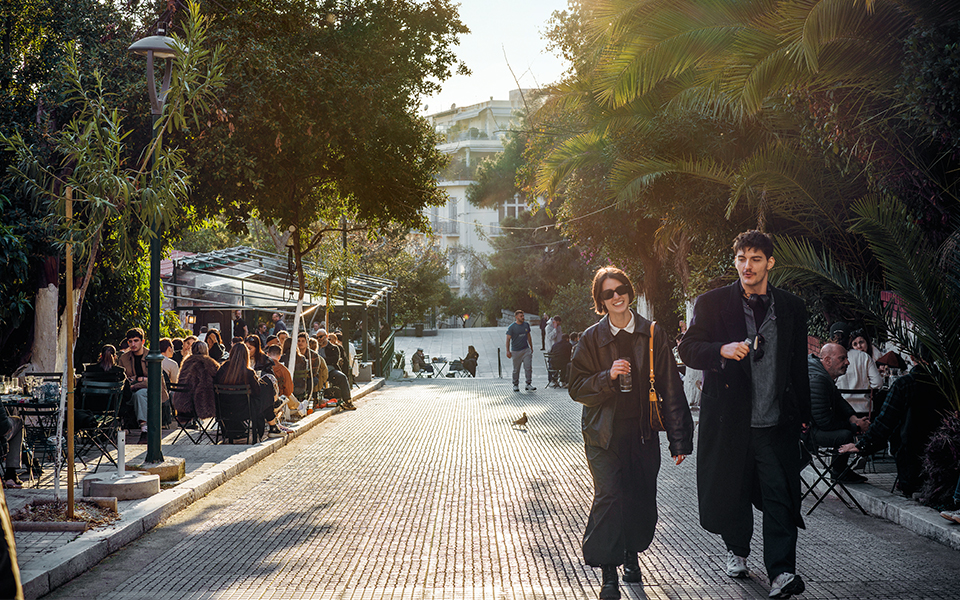
In the foreground, Lambrini and Manos as the afternoon draws to a close and the groups slowly begin to drift apart around the green tables.
© Stelios Papardelas
On Sundays in Dexameni, people read newspapers, hold children’s birthday parties, strike up chance conversations or just take stock of the week – or sometimes of life itself. A few minutes after 10 in the morning, residents, visitors and tourists begin taking their seats on the green metal chairs of the traditional café that shares the square’s name. Shade or sun? That’s just the first of many choices. A line for tables begins to grow, the park benches fill up, the chatter flows on, and the sunlight moves slowly across the small café tables.
From frappé to cappuccino, and from there to fried potatoes and calamari, with the Acropolis in the background serving as the only clock: when its columns lose denifition, the afternoon is drawing to a close; when the marble darkens and the sky behind the Parthenon fades, it must be around seven. An essential souvenir is a sunset photo, taken before the first wave of regulars begins heading home.
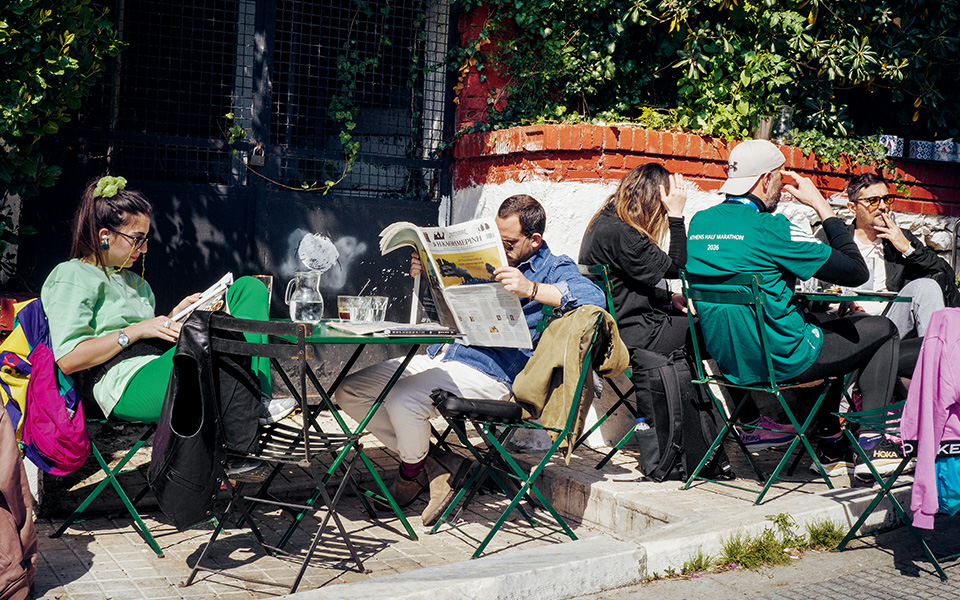
Snapshots of a Sunday ritual. In the foreground, Yiannis and Sofia with Kathimerini, while the group behind them keeps expanding along the pedestrian street.
© Stelios Papardelas
On this Sunday in particular, runners from a race that has just finished arrive on the square’s steps, proudly displaying their medals and race bibs. Around them, dozens of children transform the paved square into an improvised playground. One father performs magic tricks to the delight of the children who have formed a wide circle around him.
A ball from a group of kids hits the sign denoting an archaeological site and, after a bounce, disappears behind the railings that surround the reservoir of a Roman aqueduct. A bust to the left is draped in streamers – a sign that Carnival season was not long ago – while the small space around the statue of Elytis has become an informal bicycle parking area. A small, colorful world is born around a single square.
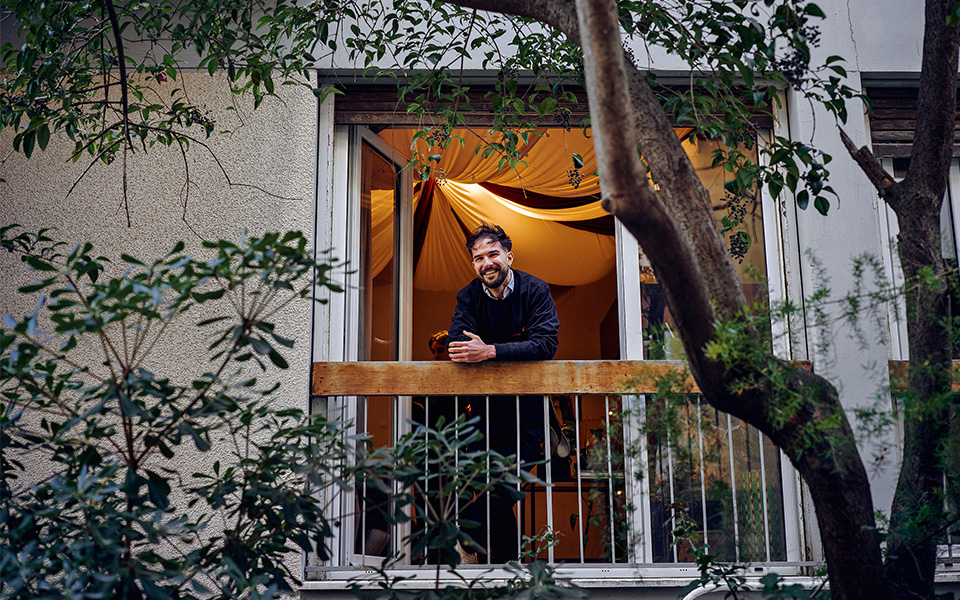
Simos waves to us from his lush green balcony, just a few meters from the square.
© Stelios Papardelas
History – both ancient and modern – forms the backdrop here. Look up and the architecture confirms it: eclectic duplex houses meet Bauhaus lines, while neoclassical buildings stand alongside apartment blocks from the 1970s. At the upper end of the square, the classical gives way to the modern and to the dazzling white façades of newer buildings. No special knowledge of style or architecture is required; simply look at the shutters and you can tell the era each house belongs to. On the ground floors, trees, galleries and public relations offices flourish.
“Not many locals are left in the neighborhood,” says Vasilis, owner of the shop Bitzidis Uomo at number 5 on the square. “I’ve been here for almost twenty years. You should have seen how beautiful it was back then. Every day felt like a celebration. Next door there was Rouga with its lighting fixtures – one of the oldest shops in Athens – Aslanis and Parisis on the corner, and all the little bars that brought life to the area. Today things are very difficult, or at least very different. Most of the buildings have become Airbnbs and many of the old spots for locals are gone. Every week, the faces change. I can’t say whether that’s good or bad, but the sense of community we once knew has certainly disappeared. And then there are the police sirens every five minutes and the constant security presence in the area – things have changed a lot. How do I manage to stay? The owner of this space is very fond of me, and I still have a loyal clientele,” he concludes, greeting residents as they pass by his shop window.

On a stroll through Dexameni, Maria Callas meets the leopard – beauty lies in the details.
© Stelios Papardelas
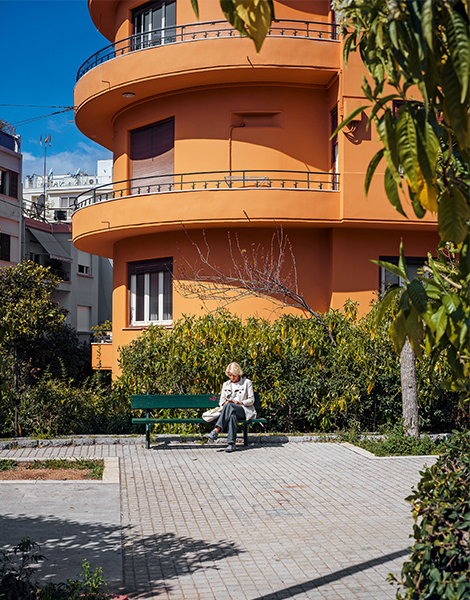
The orange building on Fokylidou Street, an unchanging backdrop to the life of the square.
© Stelios Papardelas
Some two thousand years ago, none of this was part of the vision of the Roman emperor Hadrian. At that time, his goal here was simple: to supply the city of Athens with water – and that purpose remained unchanged for many centuries. Hadrian’s Aqueduct is one of the few Roman aqueducts in Europe that still carries water today. Beginning at the foothills of Mt Parnitha and Mt Penteli and ending in Kolonaki, it stretches for about 25 kilometers. Its historic flow continued uninterrupted from its original construction through to the years of Ottoman rule. In 1847, work began to bring it back into operation. In 1870, the mayor of Athens, Panagiotis Kyriakos, and the project’s engineer, Ioannis Genisarlis, uncovered the nearly buried reservoir beneath the spring in the square, according to research done by Nikos Mamassis and Panagiotis Defteraios, professor and doctoral candidate respectively at the National Technical University of Athens.

An arm-in-arm stroll along Xanthou Street.
© Stelios Papardelas
“We played here as children, and later our own children played here, too,” Christina tells me warmly, adding that she used to live in the neighborhood. “When I was little, the square felt enormous. Do you see that beautiful house over there?” she says, pointing to the three-colored corner building where Spefsippou and Glykonos streets meet. “That used to be Mohnblümchen, a clothing store where all of Athens shopped in the ’80s. I don’t know what else to tell you – this is my village,” she concludes with a laugh.
At the table next to us, a couple has placed a white rose inside their water jug. Behind us, Yiannis and Sofia pause their Sunday ritual and invite us to join them. “We lived here for several years,” Yiannis begins, casting an affectionate glance at the aspiring footballers in the square. “We moved away for practical reasons – mainly parking and getting around—but now we return whenever we can.”
For Sofia, however, the beauty of the place lies neither in the architecture nor in the children playing. “It’s that sunlight that always wins me over, the open-air cinema in the summer, and the guys from the café – we practically know them by name now,” she says, while Yiannis adds that another reason they keep coming back is that, at this café, the waiters – and the quality of what’s served – don’t change every month.
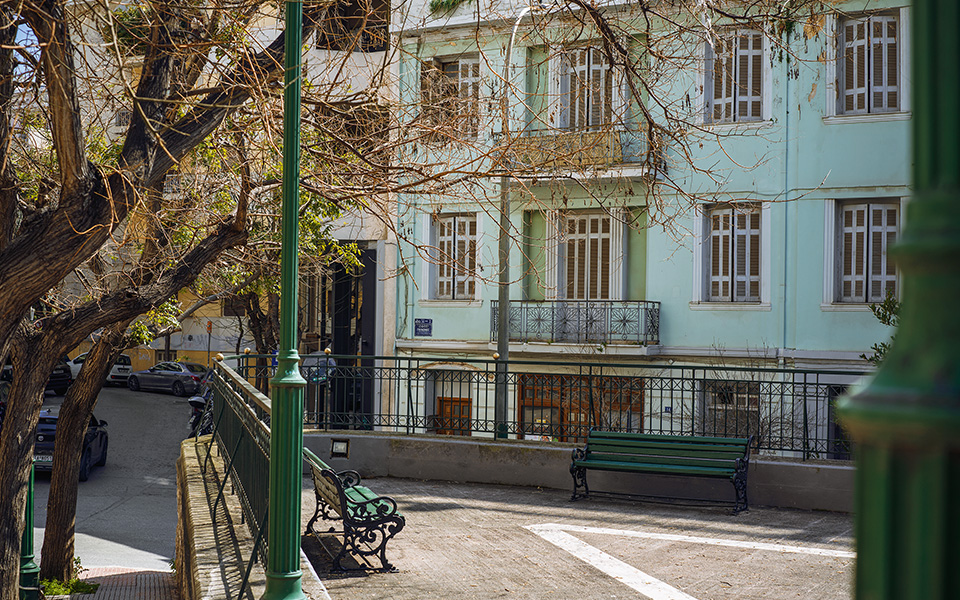
At the corner of Glykonos and Xanthippou, time seems to stand still.
© Stelios Papardelas
“Ernst Ziller,” writes Maria Christaki, a researcher in the Department of Geology and Geoenvironment at the National and Kapodistrian University of Athens, “the architect who left such a strong mark on Athens, also worked on the issue of water supply. He noted that it took eight years of successive repairs to restore the aqueduct. The reservoir of Hadrian had to be covered with a dome and underground pipes installed so that the new water distribution system could operate across the city.”
The literary currents of the time flowed through this small neighborhood at the foot of Lycabettus Hill, too. Writers such as Alexandros Papadiamantis, Odysseas Elytis and Angelos Sikelianos found in its leafy setting and ancient past a romantic landscape for their own explorations.
“Back then Dexameni had all its natural beauty. There were no marble steps, no tight ‘corsets’ of stone walls and iron railings,” wrote Kostas Varnalis in his memoirs – though reality was probably far less idyllic. Until the mid-19th century, the area was known as “Katsikadika,” or “Goatsville,” as goatherds and their flocks occupied most of the land. It was those goats that supplied the then-small city of Athens with fresh milk. Long before its café became a gathering place for intellectuals and poets, Dexameni was simply a patch of land with very few inhabitants.
The discovery of the Roman aqueduct forced the Municipality of Athens to purchase the surrounding plots, paying double their estimated value at the time. The water supply system remained in operation until 1940. The area’s modern landmark – the open-air cinema Cine Dexameni – opened its doors much later, in 1991, as noted on its website, when the Cultural Center of the Athens Water Supply and Sewerage Company (EYDAP) took the initiative to make use of the reservoir’s rooftop. Its metal sign now carries a sense of history of its own, and every summer the projector lights up once again, thrilling audiences young and old until autumn returns.

Jazz, low lighting and classic drinks. A steady favorite for generations, Jazz in Jazz lights up every evening.
© Stelios Papardelas
Friends and acquaintances have gathered around a cluster of tables to talk, and I listen in. “This is my favorite spot in the whole city. Maybe it’s because I’ve lived here for about ten years,” says Simos. “I’ve fought hard to keep my apartment from turning into yet another tourist rental. It’s not easy, but I wouldn’t change neighborhoods for anything. It’s like a small village, with its own culture and its own people. It’s the calm – and that cinematic light that softens everything.”
The sense of this unusual little village comes up again in the conversation, with Magda adding: “I have mixed memories of this place. I’ve come here with friends and with lovers, but I always feel like I’m not in the center of Athens. I don’t know why – maybe it’s the greenery, maybe the metal café tables, maybe the food – but every time it takes me somewhere that feels almost provincial. I certainly don’t feel like I’m in Kolonaki,” she says, as the glasses of tsipouro are filled again.
More chairs appear around the tables, yet no one seems crowded. Someone remarks that “There’s always room for the good ones,” and for the first time I see the phrase actualized. Just before dusk, Manos and Lambrini arrive. Somewhere between the clinking glasses and the laughter, she tells me: “When the sun is out, this is the first – or maybe the only – place that comes to mind. I don’t know why. I feel like there’s always sunshine in Dexameni.” Someone in the group starts to correct her, but although it’s already around six o’clock, the sun is still there. Perhaps Lambrini was right after all, I think just before we leave, watching a few tourists trying to capture the last minutes of Athenian daylight still left to them.
Old and new haunts, stories from...

A personal exploration of Koukaki and...
In which a world-wearied scribe rediscovers...

Athens has always been graced with...