Don Dines in Athens: In/Out Eating
Not all surprises are pleasant, but...


Trio Noon Bar
© Stelios Papardelas
He designed costumes and sets for theatrical works by Sartre and Ionesco, illustrated books by Louis Aragon and Guillaume Apollinaire, and succeeded in placing his mythological figures, his Cyclists and Smokers, in collections the world over. Alekos Fassianos, one of the most distinctive voices in modern Greek art and an important figure in postwar European painting, was born in 1935 in the neighbourhood of Aghios Pavlos in Metaxourgeio, in a neoclassical house with an inner courtyard. Today, on that very site, stands the museum that bears his name, dedicated to a multifaceted art career that began with his studies in 1956 and ran until his death in 2022. Visitors encounter artworks inspired by Byzantine art, ancient Greek history and contemporary Athens, alongside furniture, lighting fixtures, door handles, toys and ceramics, objects he made by hand with the same joy and inventiveness with which he painted. Until October 11, they can also enjoy the temporary exhibition “Malvina Panagiotidi: Bucolic Fever – Dialogue with Alekos Fassianos.” Xenia Georgiadou
Alekos Fassianos Museum
15 Neofytou Metaxa

© Courtesy Alekos Fassianos Estate, © Paris Tavitian

Dying Niobid, 440-430 BC. Parian marble. Rome, from the area of the Gardens of Sallust (Horti Sallustiani), 1906. National Roman Museum, Palazzo Massimo, Rome.
© Museo Nazionale Romano

Krater of the Amazons, 515-500 BC. Attic red-figure pottery. From Arezzo (early 18th century). National Archaeological Museum of Arezzo.
© Direzione Regionale Musei Nazionali Toscana
The Acropolis Museum’s new anniversary exhibition traces the extraordinary story of how Greek art journeyed to Italy and stamped its influence on Western civilization. Rome vanquished Greece but, as the Roman poet Horace observed, “Captive Greece captured her fierce conqueror.” A new exhibition, with free entrance, at the Acropolis Museum explores how that happened.
Presented as part of the Museum’s 17th anniversary celebrations, the exhibition “Inspirations: Ancient Art Living in Italy” brings together 38 exceptional works from some of Italy’s most important museums. Most of these pieces do not travel abroad at all, making this a rare chance to encounter masterpieces usually seen only in Italian collections. The exhibition follows the remarkable journey of Greek art from the first contacts between Greek traders and the peoples of Italy in the 8th century BC to the rise of Rome and beyond. Visitors discover how Greek styles, myths and ideas were embraced by Etruscans and Romans, shaping everything from notions of taste to concepts of education, culture and identity.
Works by modern Italian artists such as Antonio Canova, Alberto Savinio and Giorgio de Chirico reveal how the creative dialogue between Greece and Italy continued into the 20th century. Duncan Howitt-Marshall

Alexander Rodchenko, Clown – Pierrot, 1919, Ink, pencil, varnish and gouache on paper, MOMus–Museum of Modern Art–Costakis Collection.
© MOMus – Museum of Modern Art – Costakis Collection

© © Drawing by Massimo Cantini Parrini for the film Maria by Pablo Larraín (2024), mixed technique on paper , © Archivio Massimo Cantini Parrini - © Benaki Museum / Andreas Schinas - 1961 POSTER Greek National Opera Archive
From Kazimir Malevich’s “Black Quadrilateral” to “Suprematist Cross” by his student Ilya Chashnik and El Lissitzky’s “Study for the Rosa Luxemburg Monument,” the Russian Avant-Garde emerges as a radical break from academic painting, traditional aesthetics and firm boundaries between art and life. Presented at the National Gallery 30 years after the Costakis Collection was first shown in Greece, “The Avant-Garde World: City, Nature, Universe, Human” revisits a movement that sought to reinvent the world from the ground up. Paintings, architectural studies, book covers, posters, theater sets, shop signs and workers’ uniforms reveal an ambition to extend art into every aspect of daily life. At the center of the story is George Costakis, the collector who assembled one of the most important collections of European modern art. Xenia Georgiadou
To 27/09/2026
National Gallery – Alexandros Soutsos Museum
50 Vasileos Konstantinou
The world has never lost its fascination with Maria Callas. La Divina, the Greek-American soprano whose voice, discipline and dramatic power changed opera forever, remains as magnetic for her artistry as for the private mythology that still surrounds her. At Epidaurus, the Greek National Opera revived Luigi Cherubini’s “Medea,” with Italian soprano Anna Pirozzi in the title role that Callas made legendary there in 1961. At the Benaki Museum of Greek Culture, (1 Koubari Street), “Maria La Callas: The Art of Italian Costume Design in the Film” runs through September 13, presenting costumes designed by Massimo Cantini Parrini and worn by Angelina Jolie in Pablo Larraín’s film “Maria.” In the heart of Athens (44 Mitropoleos Street), the Maria Callas Museum offers an immersive, family-friendly encounter with the diva’s world, from artworks, evening gowns and personal objects to stamps bearing her image. Panagiotis Koustas

A gold seal depicting a majestic griffin. Tholos Tomb IV, at Ano Englianos, 15th century BC, Hellenic National Archaeological Museum.
© Hellenic National Archaeological Museum
Presented in collaboration with the Ephorate of Antiquities of Messenia, the J. Paul Getty Museum and the University of Cincinnati, the exhibition “Pylos of Nestor: A Mycenaean Kingdom Revealed” traces the formation of Messinia’s Mycenaean cultural identity from the 17th to the 14th century BC. Through 225 antiquities from 13 archaeological sites, the exhibition follows the transition from a world of powerful local chiefdoms to the emergence of a unified kingdom controlled from the palace at Ano Englianos, traditionally associated with the legendary figure of Nestor. Highlights include the spectacular finds from the undisturbed tomb of the Griffin Warrior, whose discovery in 2015 transformed our understanding of Mycenaean Messinia. Xenia Georgiadou

© Paris Tavitian
Just steps from the bustle of Monastiraki’s flea market, antique shops, and Roman Agora, a light-filled gallery with views of the Acropolis and the Parthenon offers a welcome pause from the noise of the city. Set on the upper floor of a prewar building on Pandrossou Street, above the family-run Martinos Antique Shop – an Athens fixture since 1926 – Melas Martinos is one of the city’s most distinctive contemporary art spaces.
Run by collector and art advisor Andreas Melas, the gallery is worth seeking out not only for its exhibitions, but also for the way it brings together Athenian history, architecture and the international art scene. Through September 12, Melas Martinos presents “Neocolor,” an exhibition of works made by Swiss artist David Weiss in 1977 and 1978, before his internationally celebrated collaboration with Peter Fischli. Using Neocolor wax pastels and the grattage technique, Weiss created vivid images that emerge from dark surfaces, evoking the energy of Zurich’s artistic and musical counterculture in the late 1970s. Georgia Fekou

© Andonis Kappas - Christina Styliara
Even before visitors enter the Vorres Museum in Paiania, the garden wins them over. The small patches of greenery that once lay among the ruins of old houses in the traditional village of Paiania have today become a single, tranquil Mediterranean landscape, with cypress trees, pines, strawberry trees, rose bushes, salvias, ponds with water lilies, bamboo and shaded corners. The sustainable planting, of considerable botanical interest, is resilient and requires little water. Just half an hour from Athens via the Attiki Odos, the museum houses a distinctive collection that straddles the folk traditions of Greece and contemporary Greek art. Currently, the exhibition “Retrospectives: Selections from the Vorres Museum Collection,” curated by Evita Tsokanta featuring works by major Greek artists such as Alexis Akrithakis, Niki Kanagini and Jannis Kounellis, sheds light on lesser-known aspects of the collection. Nena Dimitriou

In the 1950s and ’60s, Fokionos Negri was known as the “Via Veneto of Athens,” a fashionable promenade where the capital’s smart set came to see and be seen. Its old glamour may have faded over time, but in recent years this broad pedestrianized street in densely populated Kypseli has found a new rhythm. Cafés, bars and restaurants now share the scene with dog walkers, strolling families and children at play in a neighborhood abuzz with life.
Begin your walk just before sunset, taking in the striking mix of Art Deco, Bauhaus and modernist apartment buildings before stopping at ¡Topa!. Here, refreshing vermouths, served with an olive in the glass, and a wine list of nearly 100 labels accompany small plates inspired by the cuisines of Crete and northern Spain. A little farther down the street, Lisa serves sourdough pizzas with inventive toppings. End the evening with a screening at Cine Stella, the historic open-air cinema tucked away on Tenedou Street, just off Fokionos Negri. Georgia Papastamou
¡Topa!, 43 Fokionos Negri, Tel. (+30) 210.866.0889
Lisa, 25 Fokionos Negri, Tel. (+30) 211.015.6696
Cine Stella, 34 Tenedou, Tel. (+30) 210.865.7200

Wild Souls
© Angelos Giotopoulos

ERGON House
© Alexandros Antoniadis
Athens is full of flavors worth packing for the journey home. At the intersection of Evripidou and Athinas streets, amid spice shops, traditional grocers and delicatessens, the city’s edible souvenir scene comes into sharp focus. A good first stop is Ta Karamanlidika tou Fani (52 Evripidou), known for its cured meats, including its deeply aromatic pastourma. Bold, savory and coated in a fragrant spice paste, it is best enjoyed with Greek ouzo or tsipouro. A little farther uphill, toward Syntagma, ERGON House (23 Mitropoleos) offers a contemporary take on the Greek pantry inside one of the city’s most food-focused hotels. Its ground-floor marketplace brings together extra-virgin olive oils, tinned fish, fruit preserves and beautifully packaged Greek staples. Keep an eye out, too, for dried figs; prized since antiquity as a source of energy, they were one of the ancient Greek world’s most valuable trade products. Just a few steps away, on Voulis Street, the bright, colorful Wild Souls (36 Voulis) is a smart stop for one of Athens’ most satisfying halvas. Made without palm oil or preservatives, it comes in several flavors; the versions with carob syrup and Aegina pistachio are among the most popular. They make a distinctive gift, and they’re the perfect energy boost during a food walk through central Athens. Alternatively, try the nut butters, made from 100% freshly roasted nuts. Georgia Fekou

September 18
© Angelos Giotopoulos

© Urs Fischer, Courtesy of the artist and Gagosian
In an area once defined by Athens’ traditional trades – doorknob shops, locksmiths, plumbing suppliers, dye works and tailors – a new generation of cafés, wine bars and restaurants has begun to change the rhythm of the neighborhood. At the entrance to historic Stoa Kairi, just steps from the Central Municipal Market, September 18 is a quietly stylish, all-day option in this old commercial pocket of the city.
Part Scandinavian in mood, part Mediterranean in spirit, it serves breakfast dishes such as a tender, buttery French omelets, poached eggs with hummus and za’atar, and yogurt with tahini, thyme honey and poached pear. Later in the day, stop by as much for the interesting crowd as for dinner, or simply settle in with a glass of wine, a cheese plate or one of the raw starters. Georgia Papastamou
September 18
6 Kairi
Tel. (+30) 210.321.9784
Urs Fischer’s new exhibition at Gagosian Athens, “Eugène Atget,” named after the pioneering French photographer, takes the contemporary city as its subject. Inspired by the urban landscape of Los Angeles, the Swiss artist combines silkscreen, painting, stencil and photography to create compositions in which text, portraits and images collide and overlap. Moving between representation and abstraction, the monumental works on display capture both the restless energy of city life and the visual overload of the contemporary world. Xenia Georgiadou

Trio Noon Bar
© Sofia Papastrati
Just beyond the historic center, Neos Kosmos has become one of Athens’ most exciting neighborhoods for those who’d rather follow the locals than the guidebooks. Start early at Amore (1-3 Menechmou), a spritzeria that’s attracting crowds. Spritzes here include those made with Aperol, Campari, Averna or Cynar, while the wonderfully dirty Martini, served with olive, anchovy, pickles and capers, works almost as a drink and a snack in one. Pair it with Greek cheeses, cured meats or bottarga with toasted almonds. Next door, Epta Martyres (3B Menechmou) fills up with a crowd drinking wine at sidewalk tables. The list runs to around 150 labels, mainly from Greece and France, while chef Serafeim Athanasiou suggests daily off-menu dishes based on whatever he finds at the market. End the evening at Trio Noon Bar (18 Sismani), about 30 meters away, with impeccably made classic cocktails, Greek craft beers and the easygoing feel of an Athenian neighborhood that still feels authentic. Marina Petridou

Devotees of collectible design should not leave Athens without discovering Astronauts, the creative studio of Danae Dasyra and Joe Bradford. Having studied three-dimensional design in England together, the duo now work from their Athens studio, experimenting with proportion, form and metal in ways that make the improbable feel possible, rather like astronauts themselves. Their signature technique is hydroforming, an industrial process that gives their pieces the soft, inflated look of colorful balloons. It is like blowing air into a balloon; only here, water is used to “inflate” metal and give it shape. The result is a series of three-dimensional metal objects and fully functional furniture, from tables and lamps to chairs that are unexpectedly comfortable, that seem to dissolve the hardness of the material into something fluid, organic and almost weightless. “What we do is redefine everyday objects by stimulating the imagination,” Dasyra and Bradford say. Although they are based in Athens, their work has appeared in design fairs and exhibitions elsewhere in Europe and in the United States. It has also been featured in Architectural Digest, and pieces of theirs will be displayed at the Walker Art Center in Minneapolis in October 2026. Georgia Fekou
Instagram: @madebyastronauts
Not all surprises are pleasant, but...
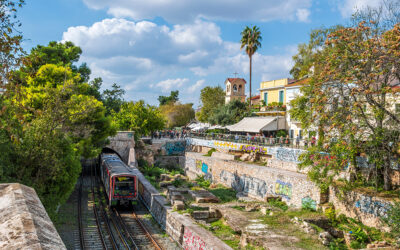
Beneath the busy streets of modern...
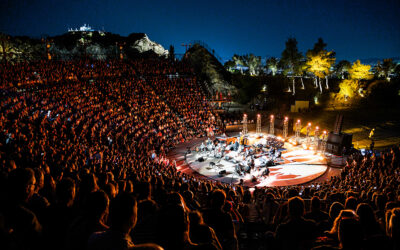
A summer mix of cultural events...
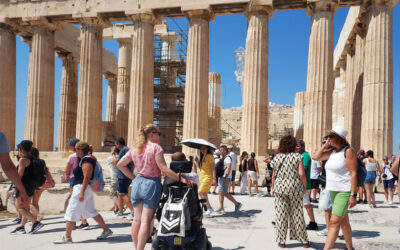
Tourists share the highs and lows...