How Christopher Nolan’s Epic Is Putting Greece Back...
Christopher Nolan's The Odyssey is already...

© Nikos Kokkalias
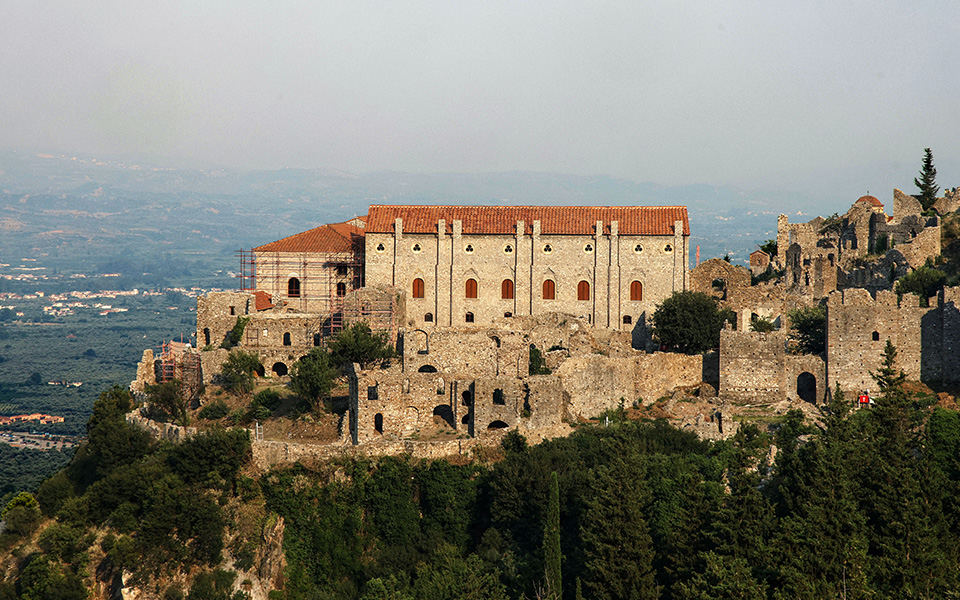
The Pantanassa Monastery, inside the great Byzantine city of Mystras, offers a precious connection to the Byzantine world. As the sisters write:
“The first spontaneous thought that comes to mind when you are living in Mystras is that you are a link in the chain of time… Living at Mystras and in the Monastery, you imperceptibly live, feel, and breathe in the past, the present, and the future as a single line, as a flow…”*
At the Pantanassa Monastery, the rhythms of a life guided by faith are much as they were in the Byzantine world. This 15th-century monastery remained active even after the Ottoman conquest of Mystras until the 1770-1771 Orlov Revolt against the Ottomans, which took place during the Russo-Turkish wars under the command of Russian Admiral Alexey Orlov. It was restored in 1822, only to be burned just two years later during Ibrahim Pasha’s devastating campaign in the Greek War of Independence (he was also commander during the siege of the Sacred City of Missolonghi).
According to local tradition, a shepherdess named Efimia was tending her flock among the monastery’s ruins when a woman dressed in black appeared and commanded, “Rebuild my home.” Efimia dismissed the vision at first, but it returned in her dreams. When the mysterious woman appeared again, Efimia understood that it was the Virgin Mary calling her to restore the monastery. She rebuilt Pantanassa, giving rise to the sisterhood that continues there today.

© Nikos Kokkalias
When the first nuns came to Mystras in 1855, they found a devastated city. They restored Pantanassa and helped with the restoration of all the churches of Mystras. Through careful documentation, they preserved its history before it was lost to time.
This connection between the sisterhood of the Pantanassa Monastery and the preservation of the cultural and spiritual heritage of Mystras would continue through the generations. Today’s sisterhood represents the monastery’s fifth generation of nuns, led by Mother Superior Averkia, who has lived at Pantanassa since 1960. She is joined by Sister Akakia (since 1966), Sister Agnes (since 1989), and Sister Elisabeth (since 1998).
The Katholikon of Pantanassa is one of seven surviving Byzantine churches at Mystras, alongside Aghia Sophia, Aghios Dimitrios (the cathedral), Panagia Hodegetria (“She Who Shows the Way”), Aghioi Theodoroi, Perivleptos, and Evangelistria. Although the Ottomans left the iconography in place, they did gouge out the eyes of many of the saints, to disturbing effect. Over time, soot, dirt, and mineral deposits obscured the frescoes so completely that, by the 1930s, many had virtually disappeared from view.
Sister Kaliniki, who joined the Pantanassa sisterhood in 1920, was a gifted iconographer. She also dedicated herself to the preservation of Mystras’ churches.

© Nikos Kokkalias
While she was cleaning the walls of a church, sister Kaliniki’s spatula slipped; an eye stared out at her. She continued to chip gently, revealing more and more of the image, pioneering a technique to remove the layers of debris without damaging the precious images beneath, “a method still used today,” sister Agnes adds.
It was slow and careful work, and Mystras has many churches.
“Fotis Kontoglou was here to help her for three years before the outbreak of the war and also Tsarouchis came to help them,” the sisters relate. Architect Anastasios Orlandos, who led restoration work at Mystras between 1937 and 1939, likewise became part of the effort. Years later, the architect of the recently restored Palace of the Despots, Stefanos Sinos, would begin his own career under Orlandos’ guidance.
The neo-Byzantine painter Kontoglou was a deeply influential figure for modern Greek artists; Nikos Engonopoulos and Yannis Tsarouchis were his first students. The heritage of Mystras was a profound source of inspiration for Kontoglou. He writes movingly on the unique power and restraint of Byzantine art in his essay “The Melancholy of the Palaiologians,” a reflection on his years working on the restoration of the Perivleptos:
“In all the world there has never been, nor will there ever be, an art equal to that of the East in imparting such passion and such sweet sorrow to its creations. Whoever possesses a warm heart will understand what I mean. No art has ever employed such simple means, and no art has ever achieved such things.”
One of Kontoglou’s own works, a portrait of Constantine Palaiologos, now appears alongside the recreated imperial garments in the Palace of the Despots exhibition.
The connection between the Pantanassa sisterhood and the artists of Greece’s celebrated Generation of the ’30s reveals something deeper: modern Greek art rediscovering its Byzantine roots, not only stylistically but spiritually. Nikos Katzanzakis visited Kontoglou at Mystras during his travels in the Peloponnese, commissioned by the Kathimerini, in 1937. In his “Journey to the Morea,” he sums up this connection beautifully, referring to Mystras as “…the hill on which Modern Greece was born.”

© Nikos Kokkalias
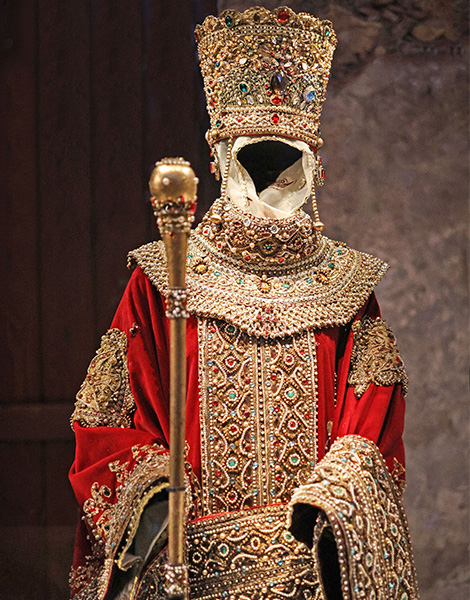
“It’s a weighty legacy we inherit,” said sister Agnes of this strong tradition of service to the culture and history of Mystras. As restoration of the Palace of the Despots entered its final phase after more than four decades of work, the sisters found a new calling. Looking closely at donor portraits and funerary portraits (tafoportraita) in the churches’ frescoes – figures depicted in the fashions of their own time – they wondered whether the lost world of Byzantine dress could be recreated.
They began the project in 2018.
The sisterhood has long been known for weaving, embroidery, and silk production, reflecting Mystras’ historic role as one of the Mediterranean’s great centers of silk manufacture and trade. It seemed natural to assume the sisters already possessed the skills required for such intricate costume making.
“No – we knew nothing, nothing at all!” sister Agnes explains.
“Sister Averkia (their sister superior) was the truly gifted seamstress. Had we started some years earlier, she may have been able to show us, but by the time we began, her hands had given out. She could offer only her encouragement and her advice, but that itself was a precious gift.”
© Nikos Kokkalias

© Nikos Kokkalias
The work demanded far more than craftsmanship, especially since the sisters were teaching themselves many of the techniques as they went. Reconstructing Byzantine dress also required years of scholarly research.
“We had mentors: Dr. Maria Parani and Dr. Melita Emmanouil. We could not have done this without them.”
Dr. Parani, a professor of Byzantine Archaeology and Art at the University of Cyprus, is the foremost expert on Byzantine ceremonial and everyday dress. Dr. Emmanouil, a professor of Art History at the National Technical University of Athens, has written on the frescoes of the Pantanassa Monastery as well as on Byzantine dress. Their guidance helped ground every reconstruction in historical evidence.
Several of the pieces the sister created came directly from frescoes in the churches of Mystras, such as the memorial portrait of Manouil Laskaris Chatzikes in the Katholikon of the Pantanassa Monastery. The clothing is recognizable at once; standing before them in the Palace of the Despots, visitors have the uncanny impression that the figures have stepped out of the frescoes and into the imperial court.
But such images alone don’t always give enough information to bring a garment to life. “‘How would the sleeve have been attached?’ we would ask ourselves. ‘We cannot see the cuff – what might it have looked like?’” the sisters explain. “We researched such questions by consulting all kinds of texts and images. For each of the costumes, we reference the research, giving the historical precedents that guided our interpretations.”

© Nikos Kokkalias
Drawing on 13th- to 15th-century frescoes of Mystras, illustrated manuscripts, miniatures, and figures from portable icons, they would sketch the designs and then create life-size garments using a variety of techniques and mediums, such as painstakingly painting by hand a repeated motif on an expanse of velvet, for example. Velvets and fine silks, gold leaf and special pigments for iconography, acrylics and oil paints, gold embroidery threads, glass jewels and beads were among the many materials used.
“Many of these decorative motifs that we uncovered in our research are projected onto the throne,” the sisters tell me. These changing projections enliven the space, immersing visitors in the visual world of Byzantium.
The reconstructions reveal the cosmopolitan character of late Byzantine Mystras, where Eastern traditions mingled with Western influences. The palace itself tells the same story. The Venetian windows in the east wing, for instance, were built by Emmanouil Kantakouzenos, who travelled often to Italy.
As Sefanos Sinos, who presided over the restoration committee, has observed: “After Kantakouzenos, the efforts of John VIII Palaiologos to unite the Orthodox and Catholic churches are manifested in the architecture of the later wings of the palace, with the Venetian Gothic style influencing the later windows of the palace…”
“We see this project as both a dialogue and a memorial for all those who once lived in Mystras, so that the people who lived in Medieval Mystras might be brought from oblivion to remembrance…” the sisters write in their forward to Under the Light of the Court: Images of Glorious Attire, published by the Hellenic Ministry of Culture. Sister Agnes’ voice is thick with emotion: “We did this for Palaiologos, for the people who lived in Mystras over the centuries, for Byzantium.”
Where did the sisters carry out all this work? I ask, imagining a workshop with large tables and a team of assistants.
“Why, here, of course.”
The sisters gesture around the small sitting room with its window looking over the valley. On the walls around them are photos of earlier generations of the sisterhood. One shows sister Kaliniki, the restorer of the frescoes, painting an icon. A faded photo from the late 19th century holds a place of honor. The image was found by sister Elisabeth at an auction online too late to purchase the original, but the copy is precious: five nuns gaze into the a camera of a traveling photographer. In the middle is sister Efimia.
The sisters also financed the project themselves. Once completed, they donated the entire collection to the Hellenic Ministry of Culture.
“These pieces, and the heritage of Mystras, belong to the people of Greece and to the people of the whole world,” they say.
They express gratitude to the Minister of Culture Lina Mendoni for believing in them and entrusting them with this heritage, to Mrs. Olympia Vikatou, General Director of Antiquities and Cultural Heritage , and Mrs. Evaggelia Pantou, director of the Ephorate of Antiquities of Laconia. Experts of the Costume Department of the Greek National Opera have ensured the preventative conservation of these beautiful pieces.
“These people lived, rejoiced, mourned, heard children cry, fought, suffered, triumphed, were defeated, yet still survived and created. They have left their mark across centuries upon us: upon me and you, the next link in this mysterious chain of this wonderful, magnificent, yet so brief life. They have urged us to lift the veil of Oblivion, if only for a moment…”*
*“Under the Light of the Court: images of Glorious Vestiture,” Hellenic Ministry of Culture, 2026
Archaeological Site of Mystras
Tel. (+30) 27310.833.77, 27310.253.63
April-August: 8:00-20:00 daily
September & October: Closing times gradually become earlier
November-March: 8:30-15:30
The Pantanassa Monastery is located within the archaeological site and is open during the site’s operating hours.
Christopher Nolan's The Odyssey is already...

At the award-winning Archaeological Museum of...
Discover five mountain destinations where crisp...

With world-class routes and a growing...