Beyond the Beach Bars: The Reinvention of Ios
Once famous for its vibrant nightlife,...

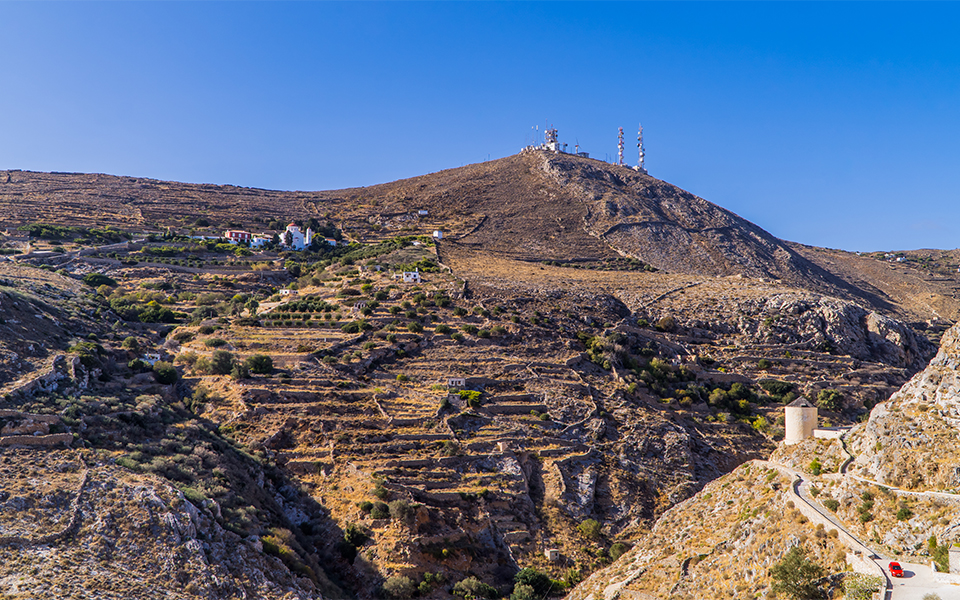
A hillside on the island of Syros, with dry stone walls dominating the landscape.
© Shutterstock
“To me, dry stone walls are works of folk art,” says Giorgos Karris, a biologist and associate professor at the Ionian University Department of Environment. As I browse through photographs from Dry Stone Wall Days – an initiative organized by the Hellenic Society for the Environment and Cultural Heritage (ELLΕΤ), which took place from March 20 to 22 on Amorgos, Andros, Donousa, Kasos, Crete, Kythnos, Milos, Naxos, Santorini, Serifos, Syros, Tilos, Tinos and Folegandros – I try to grasp how something so simple can carry such weight. Stones stacked without mortar may appear unremarkable at first glance, yet they hold deep architectural, environmental, economic, and cultural significance.
“Despite the rain and sleet, participation was remarkable, especially among young people,” says Niki Kefala, president of ELLΕΤ’s local committee on Naxos. “Students from the middle school in Skado and the General High School of Tragaia took part. Many even asked for the event to be repeated.” For visitors, dry stone walls are often seen as picturesque remnants of the past; features of the Cycladic landscape that fade into the background. For locals, however, they are central to island identity. Why is that?

A characteristic technique from the island.
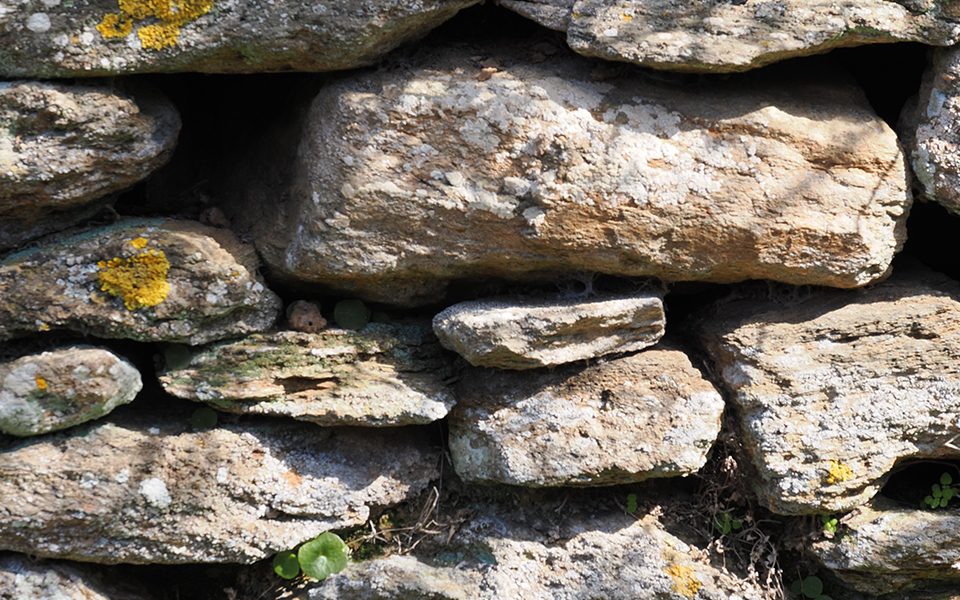
“The stones must be placed ‘patikes’ – flat and stable – and not ‘dromikes,’ with the narrow side facing outward. The ‘matos’ (the length of the stone) should always face inward. If we happen to use a shorter stone because it looks good, then we need to ‘lock’ it from behind with another stone so that it sits firmly,” explains experienced builder Haris Chamilothoris from the village of Moni on Naxos.
In addition to the rich local vernacular associated with it, it becomes clear that dry stone construction is a complex craft; one that stretches back to the Mycenaean era. “We use no cement, lime, or mud. Nothing at all. Every gap has to be filled with small stones – we say the structure must be ‘packed’ from the inside. And the large stone placed on top must ‘sleep,’ as the old masters used to say. In other words, it must be perfectly stable and well-set. I always say that there is a right and a wrong way to place a stone, but there are no right or wrong stones.”
On Naxos, particularly in the mountainous areas of the island, thousands of meters of dry stone walls form terraces and agricultural structures such as “mitatoi,” small rural shelters used by farmers and shepherds. Building them is painstaking work that requires great precision: a master mason with two assistants can complete only three to four square meters of wall a day. That effort makes their gradual collapse all the more painful to witness. “When a dry stone wall is damaged, it’s difficult for a private individual to restore it,” Chamilothoris says. A fifth-generation builder, he chose not to encourage his children to follow the same path, describing the craft as physically demanding. Still, he takes pride in having trained many others. “Dry stone walls have their secrets. The good thing is that I’ve trained quite a few craftsmen in my time, and that makes me happy.”
© Shutterstock
“If it weren’t for dry stone walls, our fathers and grandfathers would not have been able to survive. They used them to create terraces on the hillsides so they could plant vineyards, orchards and crops,” says Haris Chamilothoris. For Eleni Maïstrou, an architect and emeritus professor at the National Technical University of Athens, dry stone walls represent a simple, austere solution that embodies the principle that “form follows function.”
From a biological perspective, their value is equally compelling. “They create microclimates that support wildlife which otherwise could not survive there. They are like ‘arks’ for lizards, snakes, and other invertebrates that struggle in areas without plant cover,” explains Giorgos Karris. “We should also remember that dry stone walls prevent soil erosion. They help avoid surface runoff and prevent the flow of nutrients toward the sea or another final water recipient, creating fertile ground for cultivation. In this way, terraces help preserve both the soil and its fertility.”
As summers grow hotter and drier, wildfires are becoming an increasingly common occurrence. “When major fires occur, we lose trees – and with them, a natural barrier against runoff – leading to further soil and nutrient loss,” adds Karris. “Dry stone walls could act as a brake on this rate of erosion. It’s as close to a perfect environmentally friendly intervention as it gets. Few human interventions are as beneficial.”

Dry Stone Walls in Andros: Young children learn the secrets of the craft at an event organized by the Hellenic Society for the Environment and Cultural Heritage.
“My father saw the first structure I built, didn’t like it, and tore it down right in front of me,” recalls Chamilothoris. “I was a child, and I burst into tears. But one of my uncles was there and called out, ‘Come here, my boy, don’t listen to him. Come, let’s build together.’” For island communities, dry stone walls are much more than an ancient construction technique; they are at once a source of memories and a vital solution to the contemporary problems facing their communities. “Local societies and local authorities can – and should – insist on preserving the unique character of the Cycladic rural landscape, to prevent unchecked development from destroying it and undermining the production of local goods essential to both residents and visitors,” writes Maïstrou. Rather than allowing these structures to fall into ruin, initiatives like those organized by the Hellenic Society for the Environment and Cultural Heritage offer a meaningful path forward, helping dry stone walls reclaim their rightful place in the landscape.
Lydia Carras, founder and president of the Hellenic Society for the Environment and Cultural Heritage
On these islands, stone and sea have created some of the most beautiful landscapes on the planet. That is what two leading European filmmakers – Michelangelo Antonioni and Bernardo Bertolucci – told me some years ago, when they asked us to work together toward having the Aegean islands recognized by UNESCO.
Over time, people created their own masterpieces within these landscapes – settlements built with extraordinary respect for their surroundings. Rather than damaging the land, they constructed dry stone walls that hold the soil in place – soil that yields exceptional local products – while also conserving the precious water of the Aegean and creating habitats where remarkable biodiversity can flourish. Many island residents have come to recognize their value and are taking steps to preserve them. After admiring dry stone walls on Sikinos, Kythnos, Tinos, and other islands, I thought we should dedicate a few days to celebrating them across the Aegean. And because, in Greece, people can do extraordinary things when they work together, the entire celebration was organized in just a few days. Together, we honored these humble yet invaluable structures – the true jewels on the land of the Aegean.
Once famous for its vibrant nightlife,...
Discover hidden beaches, authentic tavernas, ancient...
On its own or paired with...
Experience Spetses in its most enchanting...