The Long Road Home: The Battle for the...
Two centuries of dispute, diplomacy and...


George Osborne has another three years as chairman of the British Museum’s board of trustees and is hopeful of an agreement on the Parthenon Sculptures before his term ends. ‘I enter this discussion in really good faith, and I’d like to reach an agreement. I also think the timing is good,’ he tells Kathimerini.
© Reuters
British Museum Chairman George Osborne is optimistic that an agreement on the Parthenon Sculptures is still possible, proposing an arrangement under which the 5th century BC works would be displayed alternately in Greece and Britain.
In an interview with Kathimerini, Osborne outlined his vision for cooperation between the two sides. “My conception and what the museum’s board would like to see is that these very valuable and historically significant marbles would spend some of their time in Athens and some of their time in London,” he says, adding that he also believes the issue could be resolved within the next three years, before the end of his tenure.
There have been reports recently that talks between the British Museum and the Greek government on the return of the Parthenon Sculptures have collapsed. Could you tell us what is really going on?
I’m still optimistic that we can reach some kind of agreement. It’s obviously a long-standing issue, and if it were easy to solve, it would have been solved at some point in the last 200 years. So you have to approach it with some humility. But I think we should be able to reach some agreement whereby we share these amazing treasures and have a mutual exchange of objects. All the people who come and see the Parthenon and go to the Acropolis Museum will be able to see some of the objects that have been in London, and the many millions of people who come to the British Museum will be able to see amazing treasures from Greece. I think the will is there – but sometimes in life and in politics, getting the actual deal done is difficult.
Why do you think that British politicians change their position so much on this issue? When he was the mayor of Manchester, the current prime minister had tweeted that you should return the marbles to Greece. Now he says it’s up to the British Museum, not the British government. What’s going on? Boris Johnson also changed his mind on the issue.
Τhe easy answer is you have to ask [Prime Minister] Andy Burnham. But I think it’s important to draw a distinction between what is in the power of the trustees of the British Museum and the chairman, and what the law of the land in Britain allows. So, the British Museum can lend objects and it has lent very sensitive objects around the world. For example, at the moment we have a loan of the crown jewels of [the Asante] to Ghana. Ghana was a British colony 100 years ago, so that’s a difficult and sensitive historical relationship. But we’ve come to an agreement that works for the Ghanaians and for us. We can lend objects; what we can’t do is simply return objects. We’re not allowed by the law in Britain. And that means not just the British Museum, but other museums too. If the law were to change, that would require parliament, and that’s not our responsibility; that is the responsibility of members of parliament.
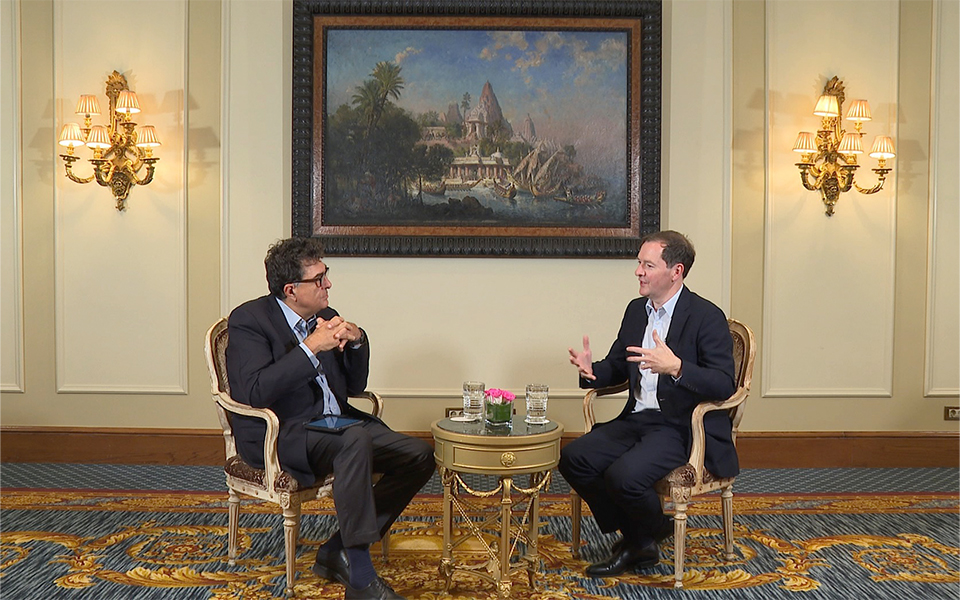
British Museum Chairman George Osborne (right) speaks with Kathimerini Executive Editor Alexis Papahelas.
What does the British Museum’s proposal entail? What do you expect the Greek government to accept so talks can move forward?
I don’t want to get into the details of the discussions, but fundamentally, my conception and what the museum’s board would like to see is that these very valuable and historically significant marbles would spend some of their time in Athens and some of their time in London – essentially on a kind of rotation basis, which would then mean it would be legal for us to do this by British law. It’s not everything that people would want in Greece, but for the first time in 200 years, the first time in the history of the modern Greek state, those objects would be in Athens for part of the time. And, you know, in life you have to decide whether you want to get 100% of everything you want or try and reach an agreement where not everyone gets everything they want, but it’s still a very significant step forward. This would be a major step forward for the British Museum. These objects have never left the British Museum since they arrived at the beginning of the 19th century. But we are willing to think of an arrangement that is sensitive to Greek requirements, but also respects our position – and so that would be a mutual exchange. If what people are expecting is simply for us to say, “Okay, we’re sending them all back to Greece,” that, for starters, is not legal in Britain.
But the law can change, right?
Parliament can change the law. But it’s also not really the conception of the British Museum – I understand that not everyone here in Athens will appreciate or respect this – which is that you can see these objects from all these different civilizations next to each other. We have amazing objects from ancient Egypt, ancient Iraq, Africa, the Americas, East Asia and, of course, Greece. So it’s a museum of lots of civilizations, not a museum of one civilization, and we think that plays a role. And that’s why this year, 7.5 million people, most of whom are not British, will come to the British Museum. It’s one of the most visited places on Earth.
So, to be clear, what you’re asking for is a loan or a “deposit” (like the Fagan fragment) – something like that?
Well, we must respect the language. We don’t want to be insensitive, but ultimately for us – and I’m not the British government anymore; I’m the chairman of the museum – it has to operate within the confines of British law. We have an arrangement that would allow the Parthenon frieze and other elements of the Parthenon complex to come to Greece and, over time, to have an increasing proportion of them in Athens. But I understand it’s difficult; I’m not naive. I understand there are a lot of people in Greece who just say, “Don’t deal with the British Museum. They should all be returned tomorrow.” I know – and they’ve been saying that for many decades.
The big question here is, of course, that every scholar I’ve spoken with, including Turkish scholars who have studied the Ottoman archives, claims the sculptures were stolen, that there is no official order, no firman, giving permission for the sculptures to be removed by Lord Elgin.
No, look. Of course, I am aware of the debate here in the British Museum. They were acquired by the British Museum from the British government at the time, which had acquired them from Lord Elgin. We have many objects in our collection with a sensitive history, and some people believe they shouldn’t be in the British Museum. I understand that, and I have lots of conversations with different governments about that. But at the same time, we are clear that they came here legitimately. Would I like them to also spend some of their time in Athens? Yes, I would – and that’s the first time the British Museum has ever said that.
Have you been to the Acropolis Museum? Have you sensed the amputation, the weight of the absence of the Parthenon Sculptures?
Yes, I have visited it. It’s a great museum. I was there once as a finance minister during the euro crisis, when the prime minister at the time singled me out and said, “George, we want the sculptures home.”
But did you feel the sculptures’ absence?
Well, as I say, there is a different context – and I understand this is not the position of many people in Greece. But I think there is a difference in the Acropolis Museum. There, they tell a story about a particular physical site, the Acropolis. And of course, you can see the Acropolis. And they tell a story about ancient Greece and the Athenian democracy. In the British Museum, they tell a different story. They tell a story of this civilization and where it sits in the world. It’s telling a story about civilizations and about what connects the world, so [the sculptures] perform a different function. And, you know, millions and millions of people see them, so it’s not as if no one sees them in the British Museum. So, I think if you were starting today with none of the history – and I know the history is very complicated, and I respect the history – you would say, surely we can find some arrangement whereby they are enjoyed both in London and in Athens, and that we have some kind of rotation of the objects. And that is, after all, what we do with almost every other country in the world. I mean, we also have issues with some other countries, but generally speaking, we have extremely collaborative arrangements with the Italian government, the Egyptian government – we even lent the Cyrus Cylinder, which is one of the most precious objects in our collection – to Iran. We engage with governments on very sensitive cultural objects. We’ve just done an exhibition of the Silk Road, and of course, at the moment we have one of the most valuable objects in France, the Bayeux Tapestry, in London. So, we have been able to find solutions to the mutual benefit of the people who go not just to our museum, but to museums in other countries, and I would hope that that’s the spirit in which we can have this conversation.
You’re about to renovate the wing where the sculptures are exhibited. Where are you going to move them to? And maybe this is a good opportunity…
Of course it would be a good moment to try and reach an agreement. Partly for that reason, but I think partly in its own right. But there’s no doubt that even absent an agreement, they’ll still be on public display. We will show them somewhere else in the museum while the renovation takes place. And, of course, you know, there’s a big renovation happening of the National Archaeological Museum in Athens as well.
You have another three years as chairman of the British Museum’s board of trustees, correct?
I’ve done five years and I have three more.
Do you expect the issue of the Parthenon Sculptures to be settled by the end of your term?
I hope so. I really do hope so. I enter this discussion in really good faith, and I’d like to reach an agreement. I also think the timing is good.
Originally published in Greek at kathimerini.gr
Two centuries of dispute, diplomacy and...
Victoria Hislop reflects on the stalled...