Aristocratic Syros in 9 Photos
Nine snapshots capture the cosmopolitan charm,...


© Konstantinos Tsakalidis/SOOC
We met her by chance with members of her family on the footpath leading from Alonissos’ Old Village to the small church of Aghioi Anargyroi on the island’s southwest coast. It was mid-June. A brief shower had left the air scented with thyme and oregano, and the midday heat had eased. Julie Taylor wore well-worn leather hiking boots, a wide-brimmed hat, sunglasses, and carried a small backpack containing water and a handful of cherries. At 83, the retired American schoolteacher has walked this trail – and countless others – more times than she can remember. It is no coincidence that the locals have nicknamed her “No Bus Julie.”
Since 1984, apart from the pandemic years, she has returned to Alonissos every summer. We came to know her remarkable story over the course of three meetings. Having long since become something of a local herself, she was eager to show us around the island. The following day, we met again for lunch at Meltemi, the fish taverna on Megalos Mourtias Beach where she has been a regular for more than four decades. There, we began to piece together a family story that could easily have come from the pages of a novel. Sitting beside me was her brother, Colin Campbell, a former journalist and foreign correspondent who worked for international publications such as The New York Times. Soft-spoken and matter-of-fact, he described his evacuation from the Middle East to Athens in 1982.
Together with a reporter from The Washington Post, Campbell had helped uncover plans for the massacre of Palestinian civilians during Israel’s invasion of Lebanon. On the day they were due to leave, an American diplomat urged them to head straight to the airport, warning that people were waiting for them at their hotel. It was an extraordinary story – but only one chapter in the family’s remarkable history.
The conversation then passed to his wife, journalist and author Deborah Scroggins. Her book Emma’s War tells the story of Emma McCune, a young aid worker who arrived in war-torn Sudan determined to make a difference before marrying rebel leader Riek Machar. “When she was five months pregnant, she was struck by a local bus,” Scroggins told us in a way that suggested she believed the incident may not have been an accident. The events took place in 1993.

An old family photograph.
© Konstantinos Tsakalidis/SOOC

The island's small but remarkably vibrant American community.
© Konstantinos Tsakalidis/SOOC
As I listened, I couldn’t help thinking about the unexpected ways people’s lives intersect; or perhaps, more accurately, about Alonissos’ quiet ability to bring them together. Just the previous afternoon, we had been complete strangers. Now we were sharing seafood by the water with an award-winning author, a renowned foreign correspondent, and their daughter Anna, who had married her French husband at Leftos Gialos, the idyllic beach on the island’s eastern coast.
The story of Alonissos’ American community came into even sharper focus when we met Julie again at her home on the evening before our departure. Winding through the winding alleys of the Old Village, we arrived at a beautifully restored two-story house with wooden floors, handwoven rugs, antiques, and postcard-perfect sea views. Julie and one of her sons, 60-year-old Jim, a former executive at an American magazine publishing company, welcomed us inside and began recounting their family’s long relationship with the island.
For the next two hours, I could barely keep up with my notes. Julie’s mother, Betty Campbell, a schoolteacher born in Atlanta in 1919, first came to Alonissos in 1980. “She wanted to track down my brother, who was working as a foreign correspondent in Bangkok. On her way back from Asia, she decided to visit friends from South Africa who had bought a holiday home on the island. The Fishers – a diplomat and a general practitioner with four children – had served with the British Army in Thessaloniki during World War II, and that’s how they had first discovered Alonissos. I hadn’t heard from my mother for more than two months when the phone finally rang. ‘I bought a house!’ she shouted.”

A bowl her mother bought on Skyros.
© Konstantinos Tsakalidis/SOOC

The pendant depicting Athena, which she bought many years ago in Plaka.
© Konstantinos Tsakalidis/SOOC
Following the devastating 6.1-magnitude earthquake that struck Alonissos in 1965, killing two women and destroying nearly 65 percent of the buildings, the Old Village was largely abandoned and property prices collapsed. “She bought an entire house for just $24,000,” Julie recalled, adding that she eventually lent her mother the money. “After my brother escaped the Middle East, he visited her in 1982 and convinced her to buy a larger house – the one we’re sitting in today. Because my mother couldn’t transfer money from the United States to pay the owner, a South African living in Switzerland at the time, I paid for the house myself.” Her daughter Kathy would be the next family member to fall under Alonissos’ spell.
Julie herself first arrived on the island in 1984 with her other son, Mike, and a group of students. From then on, she regularly organized school trips to Alonissos. “I remember walking around Plaka in Athens, and shopkeepers would ask me where I was going. When I said, ‘Alonissos,’ they looked at me in amazement.” She was just as amazed when she arrived at Patitiri, the island’s port. “We had no electricity, so we couldn’t even have a refrigerator. The water supply was unreliable because the tavernas used most of it. We only bought a car about ten years ago, and there was no public transport, so we walked everywhere. We’d hike forty minutes down to Patitiri just to buy the International Herald Tribune. Today, you can’t even buy a newspaper on the island.”

The cupboard has been in the house from the very beginning.
© Konstantinos Tsakalidis/SOOC
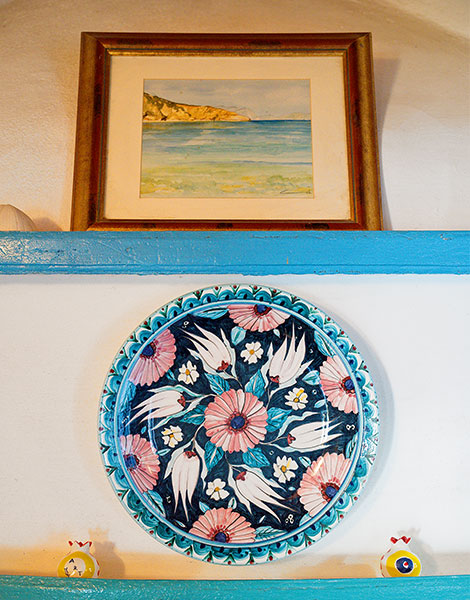
The painting depicts Kokkinokastro Beach, while the plate was bought by Julie on Skopelos.
© Konstantinos Tsakalidis/SOOC
Back in the 1980s, before landlines became commonplace on the island and long before mobile phones, Julie walked everywhere. It was simply part of daily life. “Even if I wanted to arrange when we’d meet with friends in another village, I’d have to walk for an hour or two just to get to their house.” Over time, walking became a habit. So did Alonissos. Although she lives in Cape Cod, Massachusetts, playing golf and cooking for her seven grandchildren, the Greek island has become as much a home as anywhere else. Later that evening, as we headed out for dinner and she greeted nearly every shopkeeper along the way – sometimes in hesitant Greek – I asked whether she ever felt she was simply living out her mother’s dream. After mentioning that she had studied Ancient Greek at school, she smiled and shook her head.
“Not at all. First of all, in Alonissos you can truly be yourself. Your title and your financial status don’t matter; what matters is whether you’re an interesting person. And here I’ve met fascinating people from all over the world. Secondly, life is peaceful and free from stress. You don’t need to book a table for dinner, nobody rushes you to leave after you’ve finished eating, and you don’t have beach bars blasting music all day.”
She paused for a long sip of red wine before continuing. “Coming to Alonissos has undoubtedly made me a better person than I would have been had I never come to Greece. By choosing to settle here, my mother taught us not to be materialistic. She showed us that the most beautiful things in life – the reddish sky at sunset or the blue of the sea – can be enjoyed without spending a penny.” At one point in our conversation, Julie described Alonissos as a “democratic” place, in the sense that rich and poor alike enjoy much the same quality of life and services. That, together with the island’s extraordinary natural beauty, is what she treasures most. It is also the message she carries as Alonissos’ unofficial ambassador, inspiring dozens of friends and relatives to visit the island every year. It is remarkable to think that this small American community has taken root here largely because of Julie.
In winter, whenever she feels homesick for the island, she looks at a photograph hanging on her wall: the view from the very footpath where we first met. Two slender olive trees cling to the edge of a cliff beside a handful of pine trees, beyond them an endless expanse of blue. Her second homeland, captured in a single image.
Nine snapshots capture the cosmopolitan charm,...
Rising like a mountain from the...

As development reshapes the Cycladic island,...

Despite its modest size, Ithaca is...