How to Explore Athens’ Cultural Highlights on a...
From ancient sites to lesser-known museums,...


Scottish painter Jack McConville on the balcony of his studio, on the site where Vrachos, a renowned taverna and meeting place for many writers of prewar Athens, once stood. When McConville first discovered the neighborhood, its image was very different.
© Socrates Baltagiannis
Closed supermarkets that have stood empty for years, old clothing workshops, tavernas, former sailcloth-cleaning businesses, contractors’ offices, detached houses, and apartments in postwar apartment buildings have, in recent years, become the unlikely homes of a large part of Greece’s contemporary art scene in Kypseli. Yet the downtown neighborhood’s connection with literature and the arts is far from a new phenomenon. In previous decades, Kypseli was home to an extraordinary range of cultural figures, from poets Odysseas Elytis and Nikos Gatsos, and painter-poet Nikos Engonopoulos, to theater director Karolos Koun, composer Iannis Xenakis, and art critic Toni Spiteris.
Even the mythology surrounding the pedestrian street of Fokionos Negri, together with the area’s architectural heritage – with its richness and its aesthetic influences, from neoclassicism to postwar modernism – is enough to explain the new “spring” Kypseli is experiencing. Many of the artists we spoke with refer to the neighborhood’s architecture and history; others struggle to define the elusive “something” that keeps them attached to a place that began as a suburban retreat and evolved into one of Athens’ most densely built and multicultural districts. Yet they all return to the same qualities: the calm and sense of familiarity that define this part of Athens – or at least defined it when they first arrived.

Painter Antonakis has lived on Fokionos Negri since 2007. ‘I was born next to the Pedion tou Areos park, and I remember being fascinated by the area from childhood,’ he says. In 2022, he also purchased his studio.
© Socrates Baltagiannis
The painter Antonakis (born Antonakis Christodoulou) was still living in London when he began an insistent search for a home on Fokionos Negri. “I was born next to the Pedion tou Areos park, and I remember being fascinated by the area from childhood. I didn’t want a home on one of the parallel streets; I wanted to live directly on the pedestrian street. When an apartment finally became available, even the notary preparing the paperwork told me I was throwing my money away. In 2007, when I told friends that I lived in Kypseli, they looked at me strangely. I invited them over, and they came with fear, with hesitation.” In 2015, the magazine Flaneur dedicated an issue to his beloved street. “They also had Aiolou Street on their list. It doesn’t matter whether a street is commercially significant for the city – it can be anywhere. They are guided more by instinct. I knew them and suggested that they give me 11 or 12 hours of their time. We visited homes, ate at tavernas, spoke with people; Fokionos became an entire issue. In a way, I feel that I helped promote it.”
In 2022, he also purchased his studio in Kypseli: an old, abandoned taverna on Kleonis Street, near Aghios Athanasios Church. Today, however, he feels that the neighborhood has become noisier and that its character has changed. “People are buying entire buildings and converting them into Airbnbs. Once, you would walk quickly along Agias Zonis Street at night; now you can’t even walk at your own pace because you keep running into outdoor tables and chairs.”
In the same area, visual artist Olga Miliaresi-Foka has also maintained her studio for the past eight years. She has no previous connection to the neighborhood; she did not grow up there, nor did she move there because other artist friends had already settled there. She ended up on Lefkados Street while searching for an affordable rental and a space that suited her needs, eventually finding a ground-floor space that had previously operated as a cafe. “I didn’t come here because I was drawn by the more human side of the neighborhood, but you cannot deny that there is now an artistic community here.”
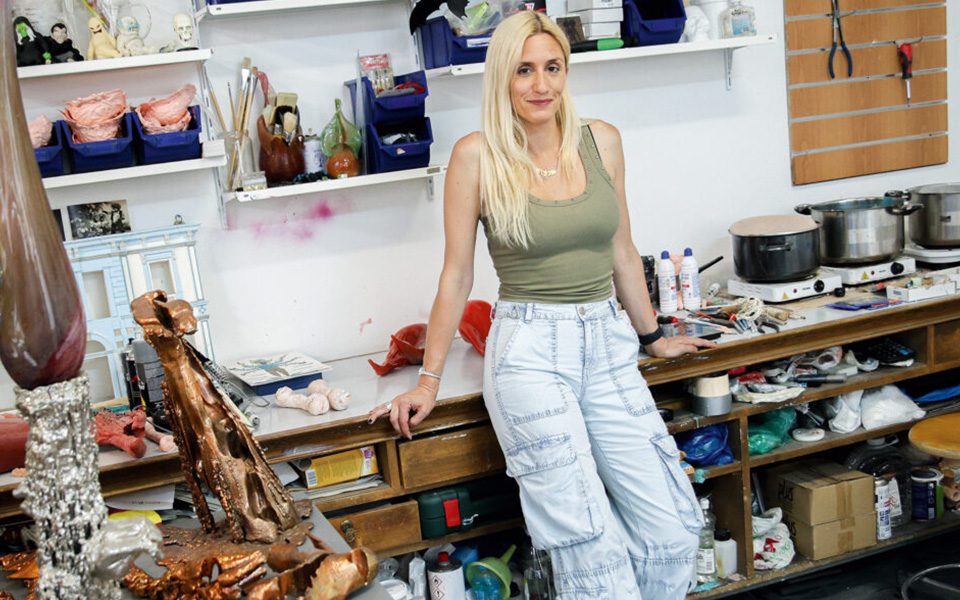
Malvina Panagiotidi, one of the earliest visual artists of her generation to establish a studio in Kypseli.
© Socrates Baltagiannis
Among the earlier arrivals is Malvina Panagiotidi, who rented her studio on Peran Street in 2016. Until 2019, she divided her time between Athens and Berlin, where she was completing her postgraduate studies. “I live in my grandmother’s house – she was a Kypseli resident – and I was looking for a space nearby,” she explains. Because her work also involves wax sculpture, she needed access to the studio at night in order to fill the molds. “I felt safe. Of course, I arrived before the big buzz began; everything was more affordable.”
She points out that Kypseli has always been home to different communities, and now another has been added: the artists’ community. “That is a beautiful thing, as long as it does not bring wider socioeconomic changes that transform the area,” she says. I look up and notice an elaborate pink rosette on the ceiling. I ask whether all the semi-basements in the neighborhood have decorative rosettes like this. “This used to be a plaster workshop. This was a display piece, and it remained from the space’s previous use.” My gaze moves across the works around me: pieces I have encountered in previous exhibitions, models, bronze elements from sculptures she is currently preparing, pots arranged in rows on small gas stoves, a dollhouse perched high on a shelf, and a plastic Batman overseeing the creative process. Is Kypseli present as a point of reference in all these works? “It appears in the production process. Around the studio there are many repair shops and machine workshops; I collaborate with numerous craftsmen for the construction of my sculptures. I feel that I am building a network around my work.” Indeed, the exhaust pipes and mechanical components incorporated into some of the sculptures she is currently exhibiting at the Alekos Fassianos Museum – in dialogue with the painter’s archive and design objects – come from auto repair shops and spare-parts yards.
A little farther up the same street, we meet the painter Panagiotis Loukas. A resident of Kypseli for several years, he searched for a studio within walking distance of his home. “I can’t imagine having to travel across Athens just to go to work. I want to be able to decide on the spot. I even come here on Sundays; I enjoy it.” When he first arrived in Kypseli, there was almost nothing there. “At Agios Georgios Square, there were only Oi Nostimies tis Mairis (a traditional Greek mageireio, serving home-cooked dishes) and a coffeehouse. Now many cafes have opened, but they are not places connected to the neighborhood; they are simply businesses.” He admits that what initially drew him to Kypseli was its peacefulness. “At my home, opposite the courthouse, not even cars passed at night. Here, in the neighborhood where my studio is, someone even had a rooster.”

‘I can’t imagine having to travel across Athens just to go to work. I want to be able to decide on the spot. I even come here on Sundays; I enjoy it,’ says painter Panagiotis Loukas, who searched for a studio within walking distance of his home.
© Socrates Baltagiannis
I head downhill to find the studio of painter and sculptor Evgenia Vereli on Olenou Street. She discovered her workshop – a former bakery – while walking through the area. She had been coming to Kypseli since 2011 to attend preparatory classes for the entrance exams to the School of Fine Arts, and she has lived in the neighborhood since 2018. “Things have changed a lot. In general – and although I probably shouldn’t say this – I have the feeling that wherever artists go, things are eventually destroyed. Kypseli has become fashionable now. Agias Zonis Street has started losing its diversity. Fokionos, of course, is still holding on; there you can see the full spectrum: grandmothers chasing after children on bicycles, artists, groups of students, couples.” She believes that the main reason behind the movement of artists to Kypseli was the rising rents in other areas. Yet the neighborhood continues to attract people because it offers a sense of community. “It also gives you a feeling of self-sufficiency; you don’t need to go far because everything you need is here. A city within a city. I can go for days without leaving its boundaries.”

‘Things have changed a lot. In general – and although I probably shouldn’t say this – I have the feeling that wherever artists go, things are eventually destroyed,’ observes painter and sculptor Evgenia Vereli, with a degree of self-criticism.
© Socrates Baltagiannis
Angelo Plessas is also drawn to particular streets of the neighborhood. Since 2018, he has run PET Projects in a semi-basement space with a courtyard opening onto the building’s interior area, at 87 Kerkyras Street. “During the Covid pandemic, residents would come out onto their balconies and watch the performances. I have relationships with the entire neighborhood. I’ll talk to the man who owns the dry cleaner, I’ll get my haircut here; I used to go to Syntagma Square only for the gym. Now a new one has opened here, so even Syntagma has disappeared from my routine. My entire daily life will take place within a 1,000-meter radius.” Angelo previously lived near the National Archaeological Museum, but he noticed something beginning to emerge in Kypseli, particularly among artists. “It has a beautiful energy; it has soul. It doesn’t have the brutal gentrification of Pangrati; it isn’t Koukaki. You still have to search for where you’re going to eat. And geographically, the fact that it was not so central helped it avoid becoming part of the Airbnb empire. You still encounter ordinary people here, with older habits and ways of life.”
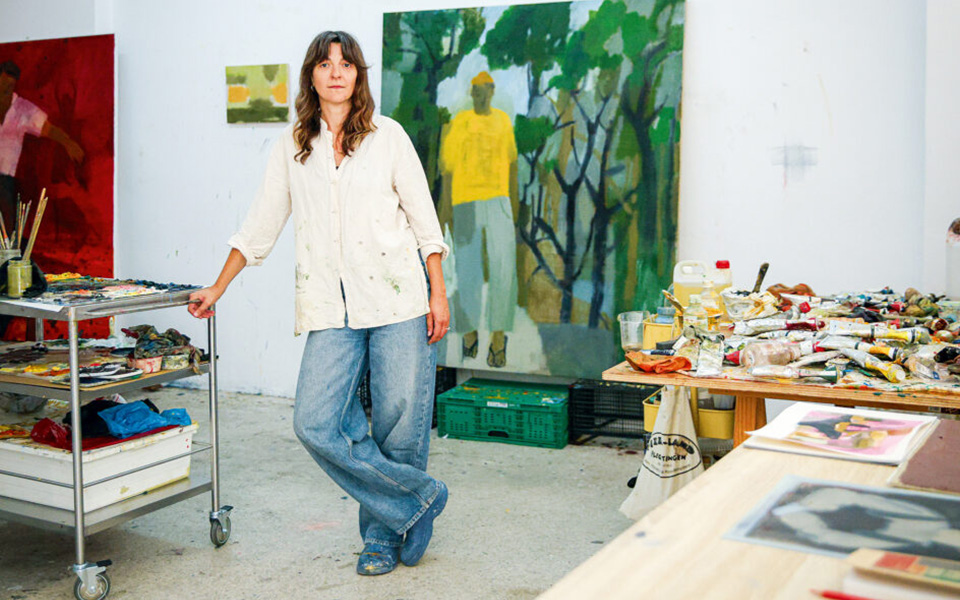
Ioanna Limniou left Exarchia in search of a quieter neighborhood. The space where she now works was once a clothing workshop. ‘A seamstress who worked in the garment subcontracting business that operated here comes by and tells me stories. I tell her about my paintings, too, even though she doesn’t understand them.’
© Socrates Baltagiannis
The importance of preserving Kypseli’s social mosaic is also emphasized by artists Theo Triantafyllidis and Polina Miliou. “Kypseli is home to many different communities and a unique diversity of people. It is important that these communities remain connected and are not displaced from the neighborhood in the name of development,” they say. The couple moved from Los Angeles to Athens during the pandemic. In 2022, they found their space: a former supermarket on Ithakis Street, opposite the building associated with Elytis, which they renovated and transformed into a shared studio. Last summer, they created Espresso Bar, effectively opening their space to the neighborhood and inviting residents to discover their work. As they explain, Kypseli has always had a strong artistic presence, with people from theater, cinema, and the visual arts. “In a way, this tradition continues today, alongside the many other communities that coexist here.”

The economic crisis, which forced many businesses to close, gave artists the opportunity to find large spaces that had remained unused and neglected for years, says painter David Sampethai, whose studio was once home to a sailcloth-cleaning company.
© Socrates Baltagiannis
On Kafkasou Street, I visit the studio of Scottish painter Jack McConville. At the site where a 1960s apartment building now stands, there was once Vrachos, a renowned taverna and meeting place for many writers of prewar Athens. McConville’s connection with Kypseli began almost by accident. “I ended up here because my partner, the visual artist Rallou Panagiotou, was from the neighborhood,” he says. When he first came to know the area, during the years of the refugee crisis, its image was very different. “The park was full of drug users and syringes. Today, these signs are no longer visible, although I suspect they have simply moved elsewhere,” he observes. At the same time, he sees a neighborhood undergoing transformation: new cafes continue to open, people from other parts of Athens are discovering it, and new residents are arriving, while others are being forced to leave. “I’m not surprised that other artists choose it. I understand what makes it attractive: Its location in relation to the city center is ideal, while the park and its streets have a distinctive character.”
The painter David Sampethai is a lifelong Kypseli resident and says he would find it difficult to leave the neighborhood today. His first studio, however, was above Panormou Street. “I had to leave because they wanted to turn it into an Airbnb. This space on Drinou Street became available – an old sailcloth-cleaning company used to operate here – and I returned to my base.” He says with relief that this part of Kypseli will probably never become fashionable, because its streets do not lend themselves to the kind of development that brings cafes and commercial venues. “I like Kypseli. It is a place where people from all over the world live, Greeks and foreigners alike, and over the years a certain degree of integration has been achieved.” He argues that the economic crisis, which forced many businesses to close, gave artists the opportunity to find large spaces that had remained unused, abandoned, and neglected for years. “Then Covid arrived and strengthened this trend even further. Of course, during the pandemic we also discovered that our neighborhood had green spaces. Until then, the only people who went into Pedion tou Areos were dog owners.”
The newest member of the group is Ioanna Limniou. In 2025, she left the space she had been renting with friends – a wonderful neoclassical building on Themistokleous Street – and moved her activities to a semi-basement on Edison Street, between Gyzi and Kypseli. “Exarchia changed; there was too much noise, and we began looking for a new home. This is a neighborhood from another era. It is quiet, it has trees, you can hear birds. It has everything an artist needs in order to create their own space-time.” The space where she now works was once a clothing workshop. “A seamstress who worked in the garment subcontracting business that operated here comes by and tells me stories. I tell her about my paintings, too, even though she doesn’t understand them. Art can seem strange to outsiders; they wonder whether I teach classes or how I make a living. “With my artist friends who live on the surrounding streets, I joke that I have installed cameras in the studio: There are two ladies sitting on the balcony watching everything that passes by. But there is genuine care behind it – they are not doing it out of malice. The people who live here talk to one another, they greet each other. For me, having grown up in Alexandroupoli, this feels familiar and natural.”
From ancient sites to lesser-known museums,...
Mary Zournazi’s documentary, “Acropolis Cats &...
Spend a day exploring one of...
Working across art, craft and design,...