5 Lesser-Known Greek Delicacies
These rare local specialties, rooted in…


Giorgos Karkanis carries on the family business in Vryses.
© Yannis Zindrilis
Even on Sunday morning, the chimneys of Apokoronas’ dairies in northwest Crete are billowing smoke. In villages like Tzitzifes and Fres, farm trucks stop at the roadside and unload milk crates from the sheep and goats of the area’s numerous small-scale farmers. In contrast to the morning coolness of this semi-mountainous area, when you enter the cheese factories, the stifling heat emitted by the huge vat pasteurizers, with a capacity of a thousand liters, prevails.
At the Kostakis cheese factory in Tzitzifes, two young men work with agile and coordinated movements that resemble a choreography. They quickly place various white plastic containers on the metal counter and with the help of a slotted spoon they remove the white cheese that has begun to curdle into small balls and transfer it into the containers. There it will drain for a few hours until it becomes anthotyro (a fresh, white, low fat cheese). But the cheesemakers continue to work. Sifis Kostakis takes the shaker, a large piece of wood, in his hands and bends down to carefully stir the contents of the vat from end to end, while his sons are busy with the milk that is steaming in the remaining four cauldrons and is intended for different types of cheese.
The same process takes place behind the doors of the approximately 25 dairies in the region of Hania, where work usually starts at five in the morning and continues until seven in the afternoon – or even later. The main advantage of these small family units is that the fresh products reach the consumer very quickly. Some even have a shop right next to their workshop.

Sifis Stavrianoudakis and his family raise sheep of a native Chania breed and maintain a deep respect for the traditional principles of animal husbandry.
© Yannis Zindrilis
We drive to Vryses and meet Giorgos Karkanis, whose father started making cheese in a mitato – Cretan name for the rudimentary shepherds’ dwellings to store and age cheese – on the Askifos plateau 50 years ago. One of the white cheeses he produces is tyromalama, a fresh, unsalted, white cheese which is made just like the hard graviera cheese. This soft cheese was traditionally made in the period before Orthodox Easter and is mainly used for Easter kalitsounia, the traditional small cheese or herb snacks.
In Fres, with the snowy peaks of the White Mountains as a backdrop, lies the Giannoulis family’s cheese factory. Nikos Giannoulis, a second-generation cheesemaker, explains that soft white cheeses have a significant advantage for the producer over yellow ones. Because they are consumed fresh, they do not require space for maturation or long-term storage. At the same time, because the demand for milk from large dairies fluctuates greatly, the changes that occur in the price of the raw material often force small cheesemakers to set prices that are too high for the local market to support. Expensive cheeses, such as graviera, can remain unavailable for months, creating difficulties in both storage and revenue. Giannoulis Cheese Factory has been focusing on white cheeses in recent years, while its specialty is the excellent fresh ice cream made from sheep’s milk, with flavors such as carob or homemade kataifi.
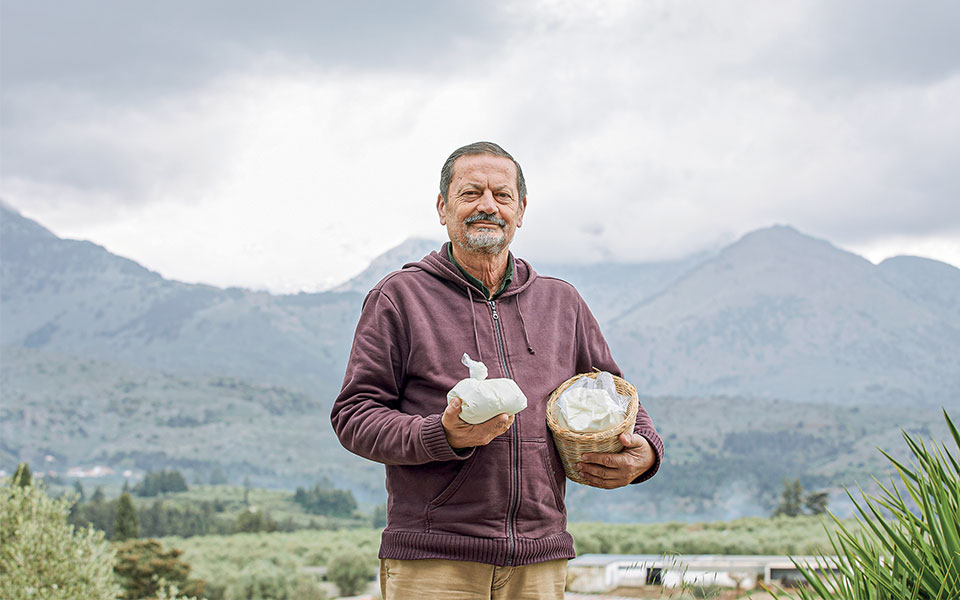
Nikos Giannoulis makes cheese and excellent sheep’s milk ice cream in Fres.
© Yannis Zindrilis
A significant advantage of the cheese dairies of the prefecture of Hania is that the livestock here is not stabled. The sheep and goats graze on the slopes of the mountains and a large part of their food is natural. It is even said that for this very reason the milk produced in May – when the wild grasses and herbs are in bloom – is the best of the year. The Askifos plateau, where Manousos Tsitsiridis’ cheese factory is located, is also lush green in spring. His entire family works feverishly at different posts, while in one of the vats the anthotyro – also a by-product of the making of graviera – has begun to form.
The town and the region are famous for their graviera, ever since a cheesemaker from Switzerland came here at the initiative of early 20th century Greek statesman Eleftherios Venizelos, to teach the Cretan shepherds the art of Swiss gruyere, from which the popular Greek yellow cheese took its name.
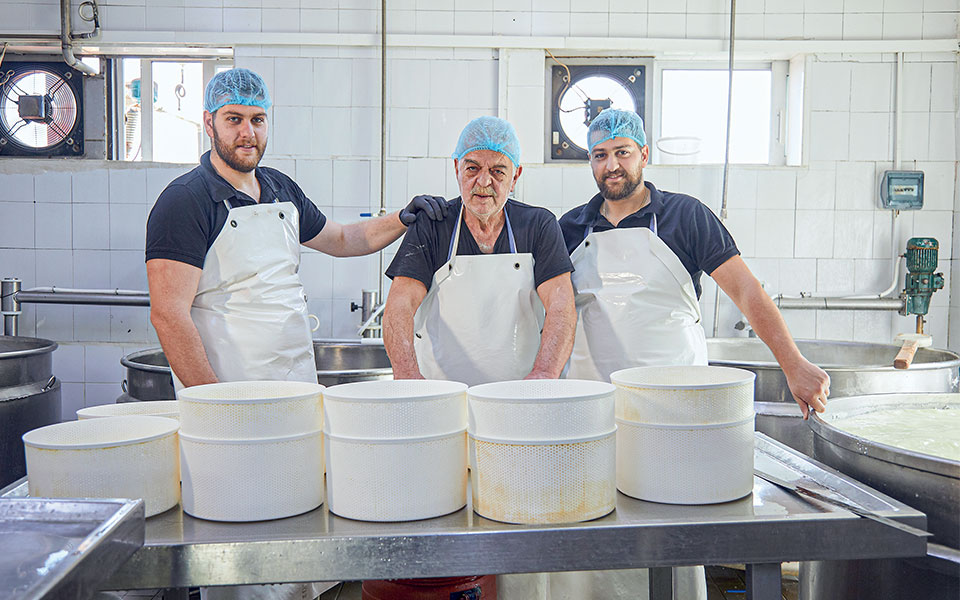
Sifis Kostakis and his sons at their cheese production facility in Tzitzifes.
© Yannis Zindrilis
Another important cheese factory on the plateau is the Madaritiko of the Stavrianoudakis family. Young Sifis Stavrianoudakis explains that one of the reasons why the cheeses of Hania stand out in taste and nutrients is that most of the sheep and goats here are a local breed. He invites us to the winter pasture where his flocks spend the cold months, in Apokoronas. Passing areas where tourist accommodations and villas are springing up like mushrooms, we reach a point outside Xirosterni where the natural landscape remains untouched. Stavrianoudakis shows me the characteristic hump on the nose of the goats and the short hair of the pure white sheep.
These small local breeds are so hearty that they can spend the entire summer on Madara, on the peaks of the White Mountains, and feed exclusively on grass and herbs. This clearly makes a huge difference in the taste and quality of the milk they produce. I ask Stavrianoudakis if he would leave livestock farming for a more comfortable and profitable profession. He answers me with his gaze fixed on his herd: “If you grow up with animals, you don’t know any other way. Imagine that if you take away an old man’s herd, he might die.”
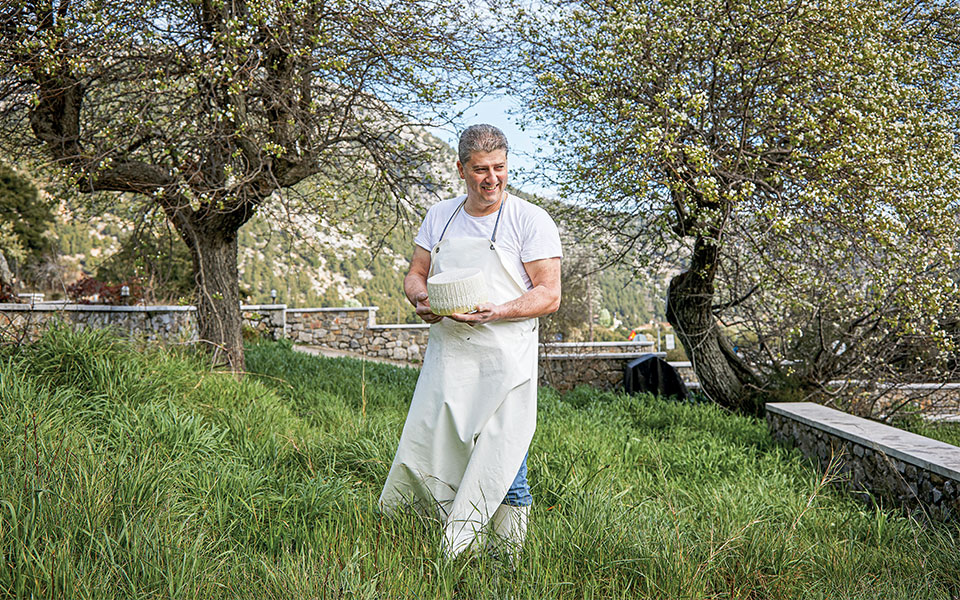
Manousos Tsitsiridis makes cheese together with his entire family on the Askifou Plateau.
© Yannis Zindrilis
The largest cheese factory in Hania is that of the Balantinos family in Varipetro. It is a modern unit that can handle 20 tons of milk per day. Spyros Balantinos, head of production and quality control of the company and president of the Hania Cheesemakers’ Association, gives us a tour of the premises where the pichtogalo is matured, a PDO product produced only in Hania. This rich, creamy cheese with the slightly tangy flavor replaces feta in salads and on dakos, is used as a filling in Sfakian pita, and has also begun to be used in preparations such as cheesecake or even knafeh. “In Hania, we also call pichtogalo mizithra or xinomizithra. The corresponding cheese in Sitia is called xygalo. And what we call anthotyro, the people of Iraklio call mizithra,” explains Balantinos, opening up the big issue of the different names used by residents of different regions of the island to refer to similar cheeses.
In his capacity as the regional adviser for the primary sector and tourism, his main goal is to promote the establishment of common names so that white cheeses can be promoted more systematically in the markets of Greece and abroad. The Cheesemakers’ Association of Crete, in collaboration with the regional authority, is preparing a charter of specifications in order to create a network of visitable cheese dairies. “The product is demanding and many of the businesses survive precisely because they are family-run and their owners dedicate countless hours of work,” Balantinos explains. “Extroversion – both in terms of product distribution and presentation to the public – is important to ensure the sustainability of the sector.” The era when Cretans made cheese in the mitato is certainly over, and the future of the sector seems to be closely linked to the sustainable tourism services being developed on the island.

© Yannis Zindrilis
Kalitsounia, one of the most traditional dishes of the area, are made from tyromalama artfully encased in crispy, thin dough.
The main traditional use of tyromalama is the Hanian kalitsounia. The abundant family dairies of the prefecture and the pastures of the White Mountains (Lefka Ori in Greek) are perhaps the two deepest secrets of this tradition, which we find only here and not in other parts of Crete. With milk production peaking in the spring, tyromalama has become synonymous with the celebration of Orthodox Easter and the end of the Lenten fast.
This fatty cheese is therefore combined with crispy, thin dough and creates a nutritious dish that is usually consumed hot, right out of the oven. There are also more modern versions of the traditional recipe, where the tyromalama is mixed with anthotyro and condensed milk to make it lighter. This taste is closer to today’s taste and nutritional standards, and the queues that form at the workshops in Hania that specialize in kalitsounia, such as that of Vangelis Lambakis, are huge in the weeks before Easter.
These rare local specialties, rooted in…
Parfaits, seasonal sorbets, tray-baked sweets and…

At the Daremas family bakery, a…
Their chestnut honey, harvested from the…