The Best Places to Shop in Athens
A fashion-minded shopping trip embracing classic…

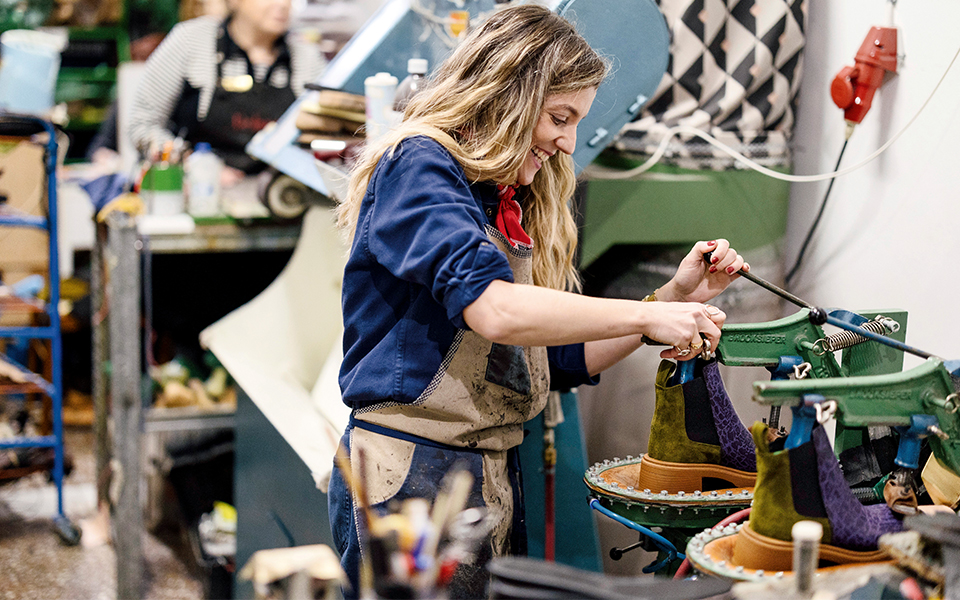
Behind the door of her shop, de.bour, Depi keeps her workshop.
© Angelos Giotopoulos
“Do you know where I can find a cobbler?” a woman in her early thirties asks me one morning outside Panepistimio metro station. Before I can answer, she adds: “I don’t mean someone who does repairs, but someone who actually makes shoes from scratch. What do you call them? A shoemaker?” Her question feels almost out of place today. In a world saturated with endless options, she’s searching for a pair of handmade shoes. Yet she’s not alone. What was once a fading craft is quietly making a comeback, as traditional techniques are revived and passed on to a new generation.
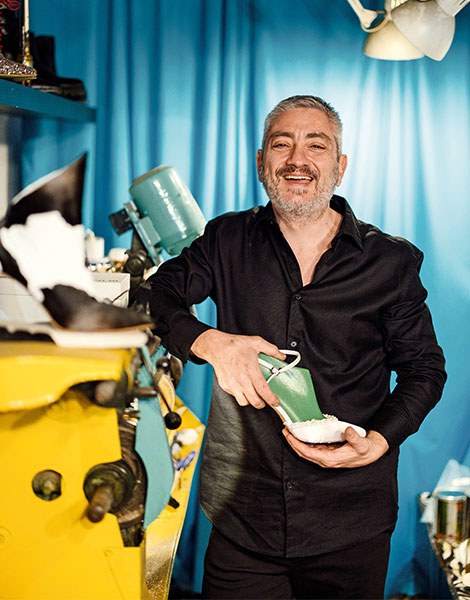
Nikolas Germanos in his workshop.
© Angelos Giotopoulos

Exquisite pumps, like small works of art, by Nikolaos Germanos.
© Angelos Giotopoulos
“The sense of personalization that handmade products offer is extremely important to the buyer,” says Depi Bournazou of de.bour (58 Aghias Fotinis, Nea Ionia), speaking from her workshop. She has spent the past 15 years working in handmade footwear, overseeing every stage of production alongside her team.
“In the beginning, the only people who truly appreciated the value of handmade products were those with orthopedic needs. Finding the right fit is essential. We often forget that shoes are not like T-shirts – quality matters. Shoes support the entire body, so their build quality should be a priority,” she explains. However, as she points out, in Greece handmade craftsmanship has long been associated with folklore; an idea that has shaped, and at times limited, public perception.
“The public remains largely uneducated when it comes to craftsmanship and creativity – many people are surprised to hear that I actually make shoes,” says Nikolaos Germanos from his workshop-store in Exarchia (24 Kallidromiou). A “shoemaker by birth,” he studied Product Design & Management at Central Saint Martins and has been working with footwear for more than two decades.
“Having my workshop and store in the same space creates a very special dynamic – it allows for direct contact with people. I don’t design just for the sake of it. A shoe is an extension of someone’s personality, a form of expression.” His designs reflect that philosophy: imaginative, sculptural, almost like small works of art. But creativity alone isn’t enough. “It’s a challenging time for small businesses. For a craft to survive, it has to be paired with strong business sense,” he adds.

Detail from the Esiot storefront in Exarchia.
© Angelos Giotopoulos
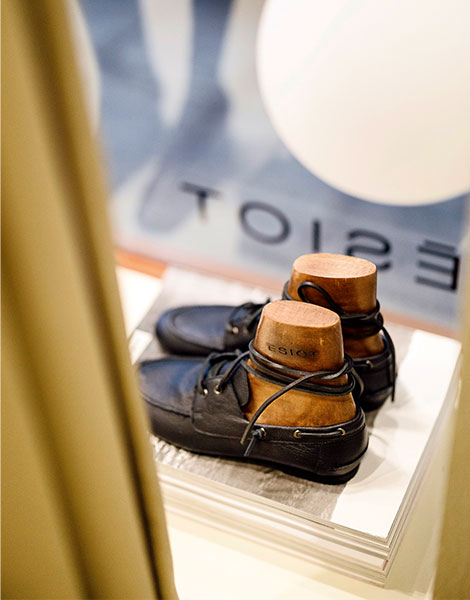
Detail from the Esiot storefront in Exarchia.
© Angelos Giotopoulos
For Eirini and Ioanna Sioti of Esiot (41 Mavromichali, Exarchia / 11 Drosou, Tinos), however, there was no business plan to begin with. “For us, it all started with an idea for a shoe design that did not exist at the time,” says Eirini. “It’s neither common nor easy. We didn’t come from a footwear background, so we had to research everything, from workshops to materials. We’ve been hands-on from day one, and we still are.”
Their first design – a chunky gladiator sandal – made an immediate impact. “We started cautiously, but the response was strong. People are becoming more conscious – they’re choosing one good pair instead of several each season. Even for me, as a consumer, it took years to appreciate the importance of a well-made shoe,” she concludes. Balancing creativity with market demands remains a challenge, especially for small businesses navigating long-term sustainability.
“Things have changed. In addition to making the product, we now have to manage our website and social media,” emphasizes Vikentios Katsalis of Lemisios, a family business now in its fifth generation (6 Lykavittou, Kolonaki). I meet him and his uncle, Marios, in their workshop on Asklipiou Street, where they produce around ten pairs a day. “When I finished school, I didn’t know what I wanted to do. At some point, my father suggested I stop by the workshop to get a sense of the job – no pressure. I saw the creative side of it and got hooked. Vikentios, on the other hand, had been coming here since he was a child,” says Marios, as he glues a sole into place.
“I consider myself very lucky that something clicked for me, because our work is like a puzzle. You can’t just learn one part – you have to understand the whole process, even sales. And today, pricing has to reflect market realities. We try to keep things accessible, but as soon as people hear ‘handmade,’ they assume expensive,” adds Vikentios.
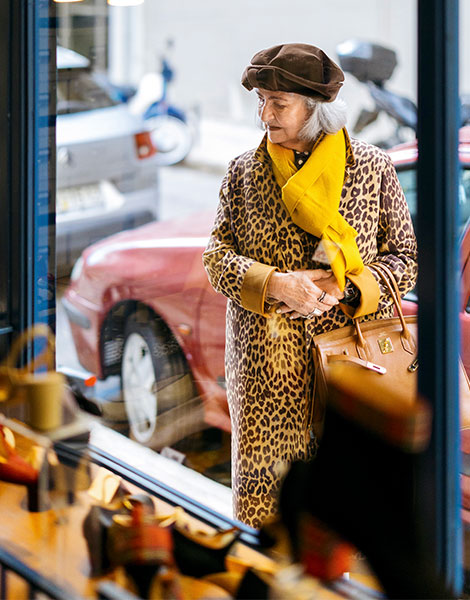
Lemisios.
© Angelos Giotopoulos
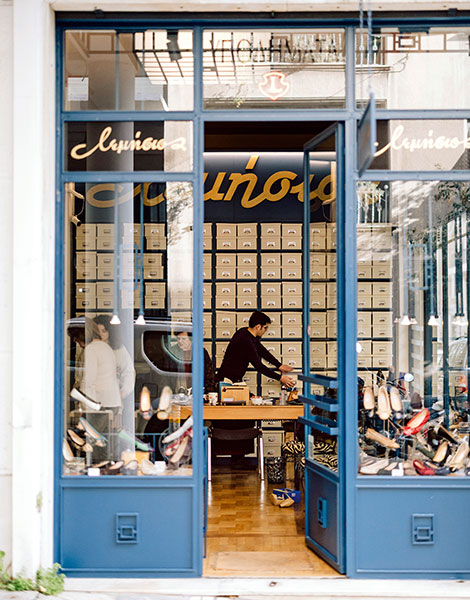
View of the shop Lemisios.
© Angelos Giotopoulos
While the appeal of handmade goods may be romantic, the reality is more complex. The survival of craft depends not only on financial resources, but on people; and those with the necessary skills are becoming increasingly rare. Training schools are scarce, and the desire to learn is often lost in the rush of modern life.
“It’s a very demanding craft, and it’s not widely taught. Technical skills in general are disappearing. What will become of these crafts is uncertain. Most of those who can teach them are older, so that’s a real concern,” says Depi Bournazou. Still, there are those determined to keep the tradition alive. Lemisios is one example. Germanos, too, has hosted workshops for people of all ages, inviting them to experience the process firsthand.
“I wanted to pass something on and show that making a pair of shoes by hand is not impossible. The students’ reactions, especially when they hold the final product in their hands, are incredibly moving,” he adds. The story doesn’t end here. The future of craftsmanship remains uncertain because, ultimately, it rests in our hands. Conscious consumption goes beyond buying less or avoiding fast fashion. It asks us to consider the people behind what we wear. And if you look closely, you might just find them – right around the corner.
A fashion-minded shopping trip embracing classic…

This little-known folk craft has been…

From contemporary tamas and marble furniture…

At the Daremas family bakery, a…