9 Design Objects Inspired by Greece’s Living Heritage
From contemporary tamas and marble furniture…


© Perikles Merakos
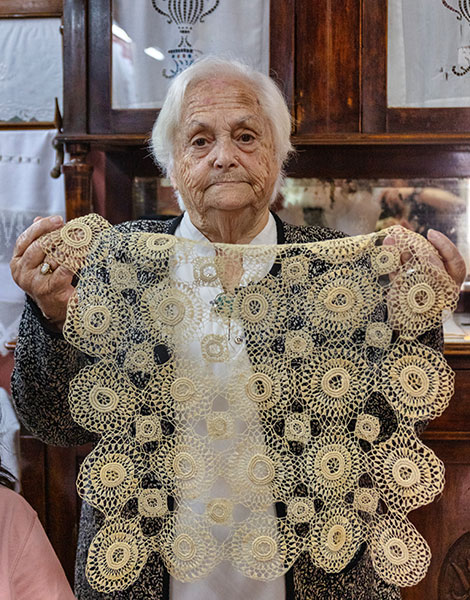
Agave is best known as the plant used to produce tequila or syrup, which in recent years has become a popular substitute for sugar. However, few people realize that the plant, which arrived from South and Central America in the 15th century, is also used to make an impressive range of products, from juices and soaps to threads and ropes. In Kefalonia, local women developed a distinctive lace-making tradition using thread extracted from the plant’s leaves that has continued for more than a hundred years. In May 2026, by decision of the Ministry of Culture, the craft was designated an element of Greece’s Intangible Cultural Heritage.

© Perikles Merakos
Today, only a handful of women in Kefalonia still possess the knowledge required to work with this cactus-like plant, whose towering flower stalk can reach 4.5 meters in height, and which is more commonly known in Greece as “athanatos” (“the immortal”). One of them is Stamo Sklavounaki, who has not only kept the art of agave lace alive through the Harokopio Workshop for Poor Women and Girls of Kefalonia, but has also played a decisive role in securing its official recognition.
Born in Peratata, beneath the Castle of Aghios Georgios, where the craft is believed to have been practiced since at least 1865, Sklavounaki grew up surrounded by needlework and embroidery. Now approaching her 90th birthday, she continues to champion the preservation of the technique and hopes to establish an exhibition space at the Harokopio Workshop, where visitors will be able to follow every stage of the thread-making process.
© Perikles Merakos

© Perikles Merakos
“To make a single ball of thread took many days,” Sklavounaki recalls. The fibers had to be soaked and regularly washed, while care was required when handling the plant, whose sap can irritate the skin. The finished fibers were then cleaned and prepared before being transformed into lace. Research conducted by Sklavounaki during her years at the Historical and Folklore Museum suggests that affluent women in the late 19th and early 20th centuries often commissioned rural women to produce lace on their behalf, supplying them with measured quantities of thread and weighing the finished pieces upon delivery.

© Perikles Merakos
The lace was used to create doilies, collars, dresses and even wedding gowns. Common motifs included flowers, vines and geometric patterns inspired by the island landscape. Because agave thread varies in thickness, no two pieces were ever exactly alike. The material is also remarkably durable, retaining its natural color and requiring no synthetic inputs. For Sklavounaki, the tradition still offers lessons for the present. “With the means available today, why can’t we make better use of agave plants to produce bags from natural fibers instead of nylon?” she asks.
The Harokopio Workshop welcomed the heritage designation as an important milestone. “The inscription of agave lace in Greece’s Intangible Cultural Heritage is not merely a symbolic act,” the organization said in a statement. “It is a meaningful act of protection, preservation and future development for a unique technique.”One can only hope that safeguarding this tradition will no longer rest solely on the shoulders of an institution sustained through the dedication of volunteers, and that more people from Kefalonia will come forward to support and continue the remarkable work that has already been accomplished.
From contemporary tamas and marble furniture…

Meet the artisans, designers and family…

At the Daremas family bakery, a…

A family workshop crafting copper objects…