Kefalonia’s Agave Lace Added to National Heritage List
This little-known folk craft has been…

© Thanasis Vranos
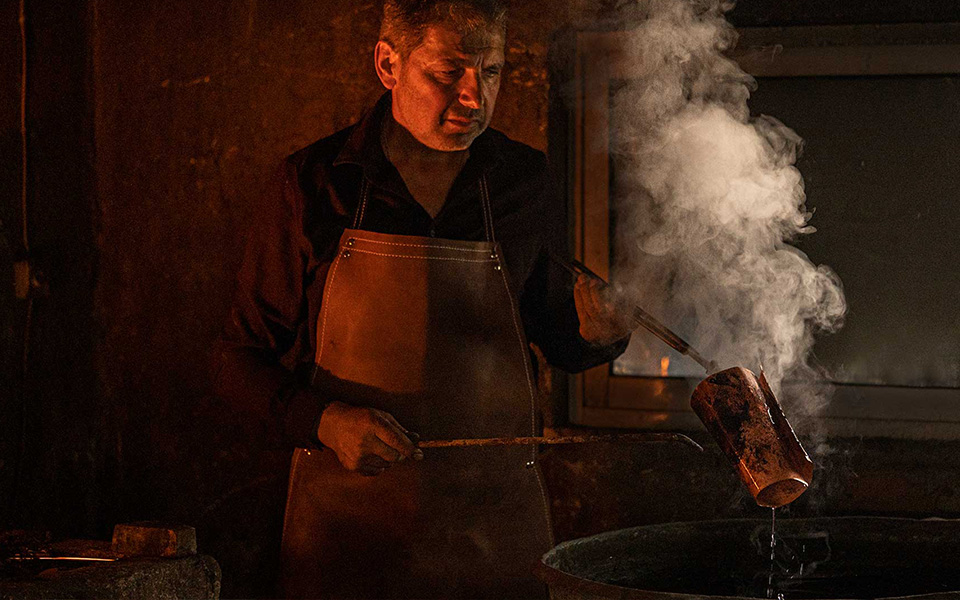
The history of this old family coppersmith workshop had its start back in Ottoman-era Kozani. Around 1850, as the wooden sign at the entrance attests, a man named Kountouras established his workshop in the smoky, noisy neighborhood where the metalworkers’ guild had congregated. Nearly two centuries later, two of his descendants, brothers Dimitris and Michalis Kountouras, are continuing the work he began.
Using coppersmithing skills passed from generation to generation, the current owners inherited their love of the craft from their father and uncle and, in turn, have passed it on to their own children, who already work beside them: Markos, Dimitris’ son, and his cousins Markos and Savvas, sons of Michalis.

© Thanasis Vranos

© Thanasis Vranos
Inside the workshop, copper is everywhere. In what feels like a dark cave, percussive sounds and pulsing colors – iridescent reds, at times brownish, at others flushed with rosy, earthy reflections – fill the air. The fire burns in the forge, the flames rising to Markos’s chest as he tries to tame the metal the way humans have been doing for thousands of years.
The walls are pitch-black, like charcoal. On the floor lie iron hammers and wooden mallets, shears and compasses. The tools of this trade are not acquired in a shop — the brothers must produce them as well. A rhythmic sequence of hammer blows echoes through the space as the two brothers and their sons work the glowing metal. Countless strokes creating hollows and ridges contribute to the methodical, precise crafting of each object.

Michalis and Dimitris Kountouras, along with Dimitris’s son Markos, carry on a craft that has run in their blood for generations. Michalis’s two sons now work in the workshop as well.
© Thanasis Vranos
Around them, arranged on workbenches, on the floor, along the walls and on shelves forming narrow aisles, are hundreds of rows of old smoke-darkened cookware alongside shiny new copper pieces produced there: baking pans, trays, pots, distillers, and baptismal fonts.
Customers drop by to order cooking vessels and tsipouro stills. In the workshop are two impressive distillers that have just been completed. One resembles a copper hourglass, while the other – with layered domes, portholes and thermometers – looks like a cross between an ornate bathhouse and a steam engine.
Here, things bear completely unfamiliar names. The craft uses a language entirely its own, an almost exotic terminology – words that have traveled through the centuries with the coppersmiths, some from ancient Macedonian and Arab metalworkers, others from Ottoman, Venetian and Slavic craftsmen.

© Thanasis Vranos

Old and new utensils, wooden mallets and other tools used by the coppersmiths.
© Thanasis Vranos
At half past two in the afternoon, the hammers fall silent. Fathers and sons gather in the workshop’s small kitchen and set a simple table, and yet they preserve the etiquette of a formal family meal as they eat. Then the fires are lit again, the hammering resumes, and the work continues until late afternoon.
This is one of the last coppersmith workshops in Greece, a bright vein of gleaming copper rising from the depths of history and binding the Kountouras family to the ancient art of the god Hephaestus. For their struggle to keep a fading art alive, their insistence on handmade production and their passion for the metal they work, they received this year’s Gastronomos Traditional Craft Award.
Climbing onto the stage to receive it, the brothers expressed visible surprise at the distinction and offered their thanks. Among other remarks he made, Dimitris Kountouras said: “This award shows that we must continue our work and pass it on to our children, so that all these years will not have been in vain and we will not be the last.”
This article was previously published in Greek at gastronomos.gr.
This little-known folk craft has been…

From contemporary tamas and marble furniture…

At the Gastronomos Great Celebration, the…

The Koumartzis family is transforming a…