Weaving New Stories: Five Greek Artists and Designers
Greek creators are revisiting textile traditions…

© Aspa Koulyra, Studio Kominis
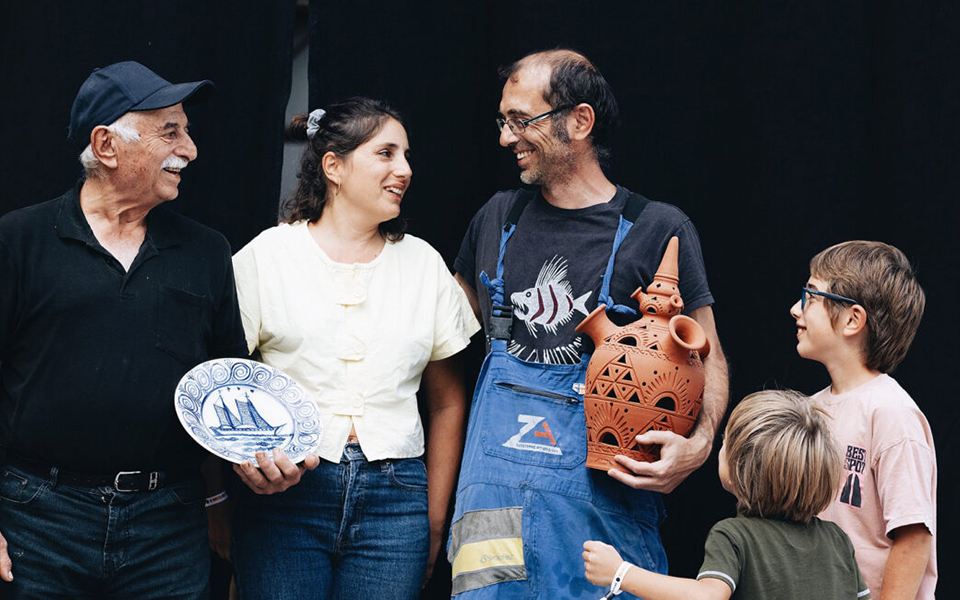
The stage gleamed with polished ceramics in vibrant colors that sparkled under the lights: bowls, plates and serving platters, pitchers, mastelo dishes and clay cooking pots. They were the creations of the Lembesis family from Sifnos, a family of potters who stepped onto Stage E at the Gastronomos Great Celebration to offer the audience a glimpse into their craft.
The 30 minutes allotted to them could hardly contain the full story of their art, yet they were enough to reveal just how rare and demanding this art form has always been – and still is today. The Lembesis family’s connection to ceramics stretches back more than a century, as Gastronomos editor-in-chief Christina Tzialla noted. Today, Nikos Lembesis, the fourth generation of the family, continues the tradition he learned from his father, Giannis.
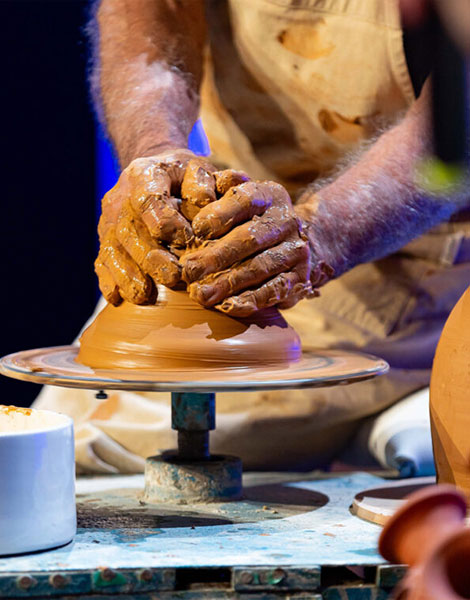
“From a young age, I spent my summers in the workshop and realized I loved the process of creating,” Nikos said simply, while beside him his father – seated at the distinctive slanted Sifnian pottery wheel (kindly provided for the event by the IASON ceramics workshop) – shaped clay effortlessly in his hands.
© Aspa Koulyra, Studio Kominis

© Aspa Koulyra, Studio Kominis
The traditional Sifnian pottery wheel may be harder on the back, “but it is more productive – you can apply greater force and produce more pieces,” explained Giannis Lembesis. “I was born in the mud,” he added, recalling how he learned the craft as a child in his father’s workshop in the seaside village of Heronissos. From there, the family’s ceramics were shipped across Greece and as far as Egypt. Using Sifnos’ characteristic red clay, Giannis learned to make the stamna – the traditional water jug and, the way he describes it, the most difficult of all vessels to master.
“There were the tsikalades (makers of cooking pots) and the stamnades (makers of water jugs),” he explained to the audience. “The stamnades also made cooking pots. But the tsikalades did not make stamnes, because they were difficult. Whoever can make a stamna is a master. But no one is ever truly perfect – you are always learning. I’m 75 years old and I am still learning.” From an early age, he also learned every stage of the process by hand: digging the clay, sifting it, mixing it with water to achieve the right consistency, drying the vessels and finally firing them in the kiln.

© Aspa Koulyra, Studio Kominis
Electricity brought new tools and conveniences, but the essence of the craft – and the urge to create – remained unchanged. Pottery, the family says, runs in the blood. It is also an art that demands openness to new influences, such as those introduced by Diane Katsiaficas, the Greek-American professor at the Minnesota College of Art and Design, whose encounter with the family inspired the vivid decorative motifs that now characterize their ceramics.
It was Giannis Lembesis’ mother, Katerina – the legendary Grandma Kate – who first began painting the family’s pottery. She started with trees and little hens before moving on to real and imaginary creatures in various colors. Experimenting constantly with pigments and techniques, she created the vibrant visual language that would become the signature of the family workshop. The younger generations embraced and expanded that legacy.
On stage, Nikos and his wife, Maria Maiopoulou, bend over large platters, using their brushes to bring fish, caiques and octopuses, flowers, deer and birds to life through designs that are now unmistakably their own. This embrace of modernity did not come easily to Giannis Lembesis, but over time he adapted and introduced his own motifs – especially boats. Still, it is the shaping of clay that his hands know best, from the simplest forms to the most demanding pieces, such as the stamna and the flaroi, the distinctive three-spouted ceramic chimney tops placed on the rooftops of Sifnian houses.
“Nowadays many people on the island are worked with ceramics – there are around 15 workshops,” said Nikos Lembesis. “But very few true craftsmen know how to work the wheel and make stamnes, like we do. We are the oldest.” His father added: “Young people today no longer want to work with the wheel; they prefer molds. We make everything by hand, even the plates.”
Meanwhile, Nikos’ children, Ionas and Chrysanthos – the fifth generation of the family – moved happily around the stage, completely at ease among the tools and the clay, helping and trying things. “Will they continue the family tradition?” Christina Tzialla asked. “I hope so,” Nikos replied.
And so do we. Perhaps one day they too will discover, as their father once did, that they simply love to create.
This article was previously published in Greek at gastronomos.gr.
Greek creators are revisiting textile traditions…

The Koumartzis family is transforming a…

A family workshop crafting copper objects…
Their chestnut honey, harvested from the…