9 Design Objects Inspired by Greece’s Living Heritage
From contemporary tamas and marble furniture…


Sevastiana Konstaki, An Ace Up My Sleeve, cotton thread, 70 × 100 cm. This work was selected for participation in the Noema Craft Prize 2026.
For many years in Greece, thread, weaving and embroidery were primarily associated with traditional crafts. There were, however, notable exceptions. Among them were the tapestries produced by Oikotechnia, a Royal Welfare initiative launched in the 1960s to revive the art of Greek tapestry. As part of the initiative, leading Greek painters created original designs, which were then transformed into striking tapestries by skilled weavers, resulting in works that occupied a space somewhere between painting, textile and decorative art.
Around the same period, visual artist Niki Kanagini was experimenting with weaving as an artistic medium. The 1970s saw the emergence of rugs reproducing works by prominent Greek artists. Nonetheless, the use of thread remained largely tied to craft traditions and the applied arts, rather than it being embraced as amedium of contemporary expression in its own right.
Specific motifs, fixed techniques and natural materials often limited the ability of such works to stand as independent artistic statements within the field of contemporary art. Today, the picture has changed. A new generation of creators, working across different media, is approaching thread with an experimental spirit, using it to explore ideas about the body, identity and nature.

Alexandra Bissa
© Athena LIaskos
© Athena LIaskos
© Athena LIaskos
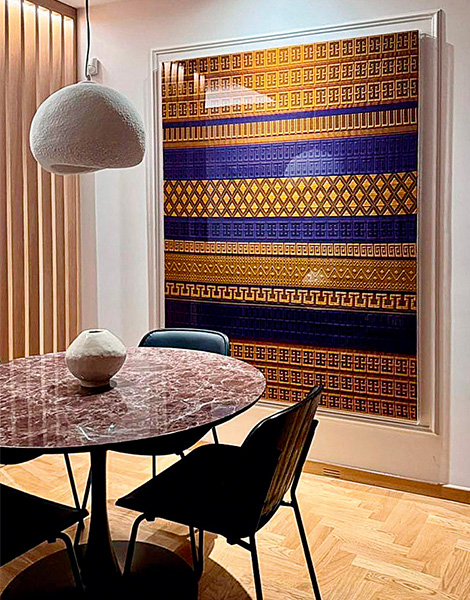
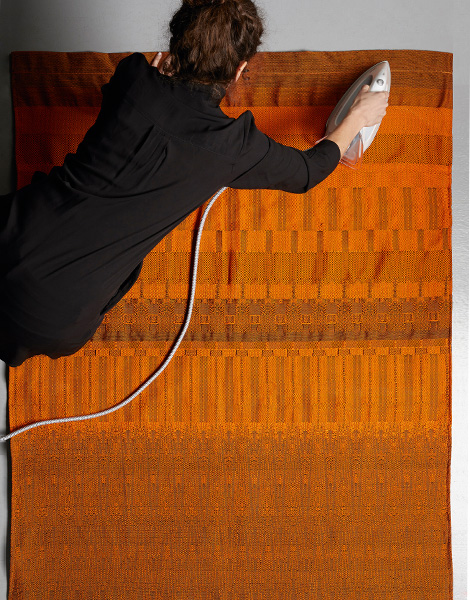
“Fabric is our clothing, our sheets, our quilts and our curtains. It surrounds us at every moment of our lives and yet, in essence, it is created through a remarkably simple process,” says weaver Alexandra Bissa. After studying interior architecture, decoration and object design at the University of West Attica, Bissa moved to Metsovo for a year to learn weaving from her aunt. “The idea was to learn more about fabric before moving into textile design. But once I understood how the loom worked, my plans changed.”
She went on to pursue postgraduate studies at the Chelsea College of Arts before returning to Athens and opening her own studio. Working on a hand-operated loom with a dobby mechanism, which allows for the creation of more complex patterns – particularly geometric motifs, such as diamonds and polka dots – she began by making neck warmers, pocket squares and pillowcases. Today, she collaborates with major design houses such as Zeus+Dione and Yoma Casa, as well as with architecture firms on larger scale commissions.
“At first, traditional weavers were skeptical if I didn’t follow convention. Now there is greater acceptance, because they see that we share the same language and that what connects us is the technique itself.”
Christiana Vardakou
© Stelios Papardelas
© Stelios Papardelas
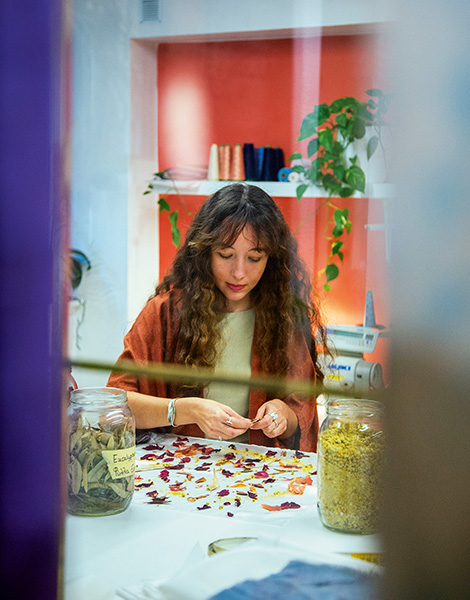
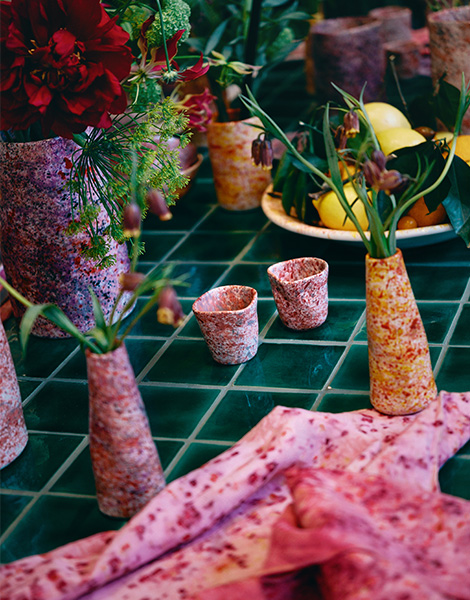
Christiana Vardakou turned to textile design as a way of bringing together her love of interiors, fashion and painting. After graduating in 2018, she left London and set out on an extended journey through Southeast Asia. She visited studios, studied traditional techniques and observed every stage of production. Returning to Athens, she began working with silk from Soufli, cotton and linen from Tripoli, and natural dyes derived from Greek plants.
“In Greece, there isn’t the same wealth of written resources you’d find in England. Knowledge is passed down orally, from one generation to the next,” Vardakou explains. Her research took her to Zagori, Metsovo, Kefalonia, Mani and Crete, and she learned which plants produced the most interesting results. “An acorn cap gives a beautiful grayish mauve; ivy and walnut leaves make a lovely olive green.”
Most of her materials are gathered by hand or sourced from small farms and herb shops. She uses a variety of techniques, including bundle dyeing, in which fabric is wrapped together with leaves, flowers and other plant materials, transferring pigments and impressions directly onto the fabric surface. The results are organic and often abstract. She began by making curtains and cushions, then clothing and accessories; today, she also creates wall pieces. “Dyeing allows you to experiment, to transfer onto the fabric whatever you want to express,” she says. “The process also creates a deeper connection with nature.”

Kleopatra Tsali
© Vangelis Zavos
Kleopatra Tsali is a sculptor who works primarily with clay and fabric. “I can’t introduce myself as either a ceramicist or a textile artist; I choose the material depending on what I want to express,” she explains. She was initially drawn to fabric for practical reasons, but she soon discovered other qualities as well. “It is lightweight and full of movement. You can let it guide the form rather than impose one on it.”
For her organic sculptures, Tsali uses deadstock silk, unused surplus material left over from other productions, such as workshops, fashion houses or textile manufacturers. Wanting to deepen her understanding of the material, she also began raising silkworms. “First of all, it satisfies my curiosity. Just as I am interested in knowing where my clay comes from, I wanted to understand the origins of thread. I enjoy observing the process, all the transformations the silkworm undergoes, that intermediate state before it becomes a moth. It makes me think about the changes we go through in our own lives.”
Four years ago, together with visual artists Irini Gonou and Hanna Norrna, she created Morus, a collective that documents the silk-making process through a digital diary. The group also organizes workshops and exhibitions, with each artist approaching thread and textile practice from a distinct perspective.

Joy Stathopoulou
© Vangelos Zavos
Joy Stathopoulou’s lighting pieces resemble three-dimensional weavings. “Weaving is a unique art form. I could never claim to be a weaver, since I only use my hands to work around the frames. But I do think my pieces have a connection with weaving,” she explains.
Her path to design was anything but conventional. Trained as a lawyer, Stathopoulou practiced law for many years before, picking up a ball of thread in 2018 and deciding to create her first lamp. “What fascinates me is light as an artistic medium,” she says. That inaugural piece still sits in her studio today, serving both as a reminder of the leap she took and as a marker of how far her work has evolved.
In 2021, she presented “Tsolias“ and ”Bouboulina” at the Benaki Museum Shop, two monumental lighting works created to mark the bicentenary of the Greek War of Independence. Three years later came “Making Waves,” an interactive installation for the Posidonia exhibition that rendered the movement of the sea through threads made from recycled plastic bottles.
Most recently, she unveiled the award-winning “Lighting Echoes: From Prehistory to Tradition” in Cyprus and Athens. The work creates a visual dialogue between the prehistoric cruciform figurine of Pomos from Chalcolithic Cyprus and the region’s traditional female costume. “Thread is deeply woven into Greek identity,” she says. “From Ariadne’s thread to traditional textiles, it forms part of our collective visual memory.”

Sevastiana Konstaki
© Vangelis Zavos

© Vangelis Zavos
If there are three coordinates that define Sevastiana Konstaki’s creative universe, they are architecture, fashion and contemporary art.
A graduate of the Department of Architecture at the University of Thessaly, Konstaki first turned to macramé for her diploma project, which focused on Kritika, a village on Rhodes from which her family originates. “As I was trying to understand the landscape and imagine possible interventions, I realized that every proposal altered the character of the place and the way people lived within it. In the end, I chose thread, because it allowed me to speak both about the material world and about human presence.”
Embroidery and sewing were already part of her family history: her grandfather was a tailor and her parents embroidered. Yet she is careful not to define herself through any single technique. She works with macramé, embroidery and frame-loom weaving, but without pursuing technical perfection as an end in itself.
“When people encounter works connected to craft, the first thing they often ask is how long they took to make. That quickly leads to discussions about tradition, heritage and preservation. These are important conversations, but they can also distract from the way a contemporary artwork should be approached. Learning a technique is one thing; how you use that technique artistically is another,”
The human body lies at the center of her practice. Konstaki sees it as a living landscape where desire, memory, fantasy and social identity converge. Knotting, weaving and stitching become tools for mapping these relationships. Through knitted sculptural garments, collages, drawings and spatial works, she explores the ways in which bodies connect to place, time and one another.
From contemporary tamas and marble furniture…

At the Gastronomos Great Celebration, the…

The Koumartzis family is transforming a…

A family workshop crafting copper objects…