Thessaloniki’s Oldest Ottoman Bathhouse Reopens
Once the social heart of Ottoman…


A series of important underwater discoveries off the island of Karpathos is shedding new light on more than 2,600 years of maritime activity in the region.
© S. Apostolopoulos / Hellenic Ministry of Culture
A series of important underwater discoveries off the island of Karpathos is shedding new light on more than 2,600 years of maritime activity in the region. The finds, announced by the Hellenic Ministry of Culture, form part of a long-running research program aimed at mapping the submerged cultural heritage of the southeastern Aegean.
Conducted between October 2025 and early 2026, the survey – led by the Ministry’s Ephorate of Underwater Antiquities in collaboration with the National Hellenic Research Foundation – focused on the waters of northern Karpathos and the nearby islet of Saria.
Over the course of more than 120 dives at depths ranging from 3 to 45 meters, an international team of over 40 scientists – including specialists from Mexico’s National Institute of Anthropology and History and the Norwegian Maritime Museum – documented a remarkable array of underwater remains spanning from the late 7th century BC to the early 19th century.

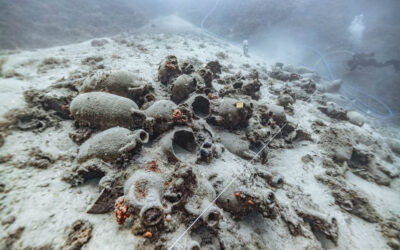
Vrykountos Bay. Shipwreck KX2.
© E. Diamantis / Hellenic Ministry of Culture
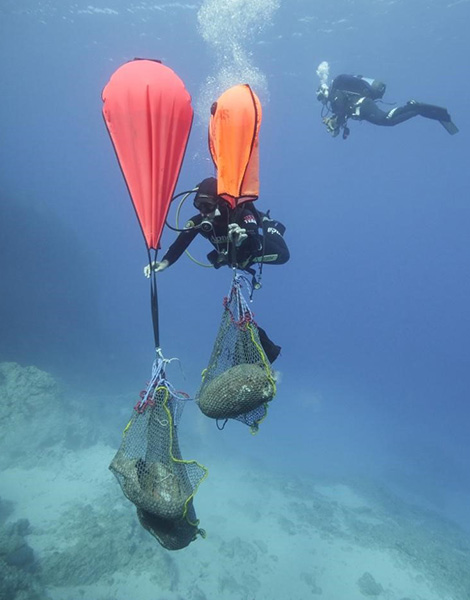
Lifting of objects from the site of the wreck KT3.
© S. Apostolopoulos / Hellenic Ministry of Culture
Among the most significant discoveries are five shipwrecks – four dating to antiquity and the Roman period, and one from the early modern era. Several of the ancient wrecks were found still carrying their cargoes, including amphorae once used to transport goods such as wine and oil. These ceramic vessels, resting undisturbed on the seabed for centuries, offer a vivid snapshot of the trade networks that once crisscrossed the Aegean.
The team also identified remains of ancient harbor installations, pointing to the existence of organized maritime infrastructure along Karpathos’ coastline. Particularly striking is the discovery of more than 20 early Byzantine-era anchors in the sheltered bay of Tristomo. Their concentration suggests that the area was a significant maritime hub during Late Antiquity, likely serving vessels navigating between the Aegean and the eastern Mediterranean.
Research efforts centered on coastal zones where traces of ancient settlements remain visible above water, including the sites of Vrykous and Nisyros – two of the four cities that once formed the so-called “tetrapolis” of Karpathos, referenced by the Strabo (Geography X, 5.17). These connections between land and sea reinforce the island’s long-standing role as a crossroads of cultures and commerce.

A conservator cleans marine encrustations off the broken-off neck of an amphora raised from waters off Karpathos.
© S. Apostolopoulos / Hellenic Ministry of Culture
Beyond its archaeological value, the project also reflects growing concern for the preservation of underwater heritage. A parallel initiative explored innovative methods for protecting submerged antiquities from the impacts of climate change, including in situ conservation techniques tested in nearby Kasos.
Still relatively untouched by mass tourism, Karpathos is celebrated for its rugged landscapes, traditional villages, and crystal-clear waters. Now, these latest discoveries add another dimension to its story – revealing a hidden world beneath the waves that speaks to the island’s enduring relationship with the sea. That relationship continued into modern times: Karpathos was once part of the wider Dodecanese sponge-diving tradition, with generations of islanders making a living from the sea, diving deep in search of natural sponges in waters not unlike those now yielding their archaeological secrets.
As research continues, the seabed around Karpathos promises to reveal further insights into the region’s maritime past – offering both scholars and visitors a deeper appreciation of Greece’s rich and layered history.
Once the social heart of Ottoman…

As travelers look beyond the region’s…
Ten ancient shipwrecks, mapped dive routes,…
Ancient ruins meet modern recipes as…