
For World Alzheimer’s Month, a new program at the Acropolis Museum for visitors with dementia uses ancient portraits to encourage memory, conversation, and connection.
What can a face tell us about the person behind it? At the Acropolis Museum, the answer may be more complicated – and more personal – than it first appears.
This month, portraits of figures from antiquity will provide the starting point for a special museum experience for visitors with dementia, designed to encourage memory, conversation, and personal storytelling. Created in collaboration with the Alzheimer Society of Athens to mark World Alzheimer’s Month, “My Story Has a Face” has been specially developed for participants from the Society’s Pangrati Day Center.
The program draws on portraits of prominent figures that were found on the Acropolis and are now displayed in the Museum. Rather than simply looking at the sculptures as works of ancient art, participants will be invited to consider what a portrait can communicate about a person – and how the way we choose to present our own image can become part of the story we tell about ourselves.
It is an especially intriguing idea when applied to the Museum’s Roman imperial portraits. The likenesses of emperors and members of their families were carefully controlled images, designed to communicate particular identities and values. Once an emperor had established an official portrait type, copies could be reproduced and distributed throughout the Roman Empire, allowing his carefully constructed image to be recognized far beyond the capital.
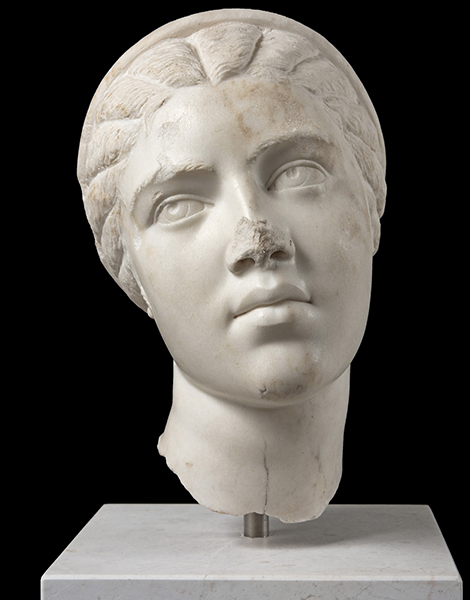
Head of a statue of Fulvia Plautilla, late 2nd–early 3rd century AD.
© Acropolis Museum

Head of a statue of Fulvia Plautilla, late 2nd–early 3rd century AD.
© Acropolis Museum
The portrait of the emperor Caracalla, dating to around AD 215, and that of his wife, Fulvia Plautilla, from the late 2nd or early 3rd century AD, offer striking examples. These were not simply portraits in the modern sense: imperial images conveyed political and moral ideals and could commemorate events ranging from an accession to the throne or an imperial visit to a birthday, marriage, or deification.
Now, centuries later, those ancient faces become prompts for a very different kind of storytelling. Looking closely at a face, discussing what it might express and considering how people want to be remembered can encourage participants to recall their own experiences, thoughts, and emotions.
The initiative also reflects a growing recognition of the role cultural spaces can play in supporting people living with dementia and their families. According to the World Health Organization, 57 million people worldwide were living with dementia in 2021, with nearly 10 million new cases each year. Alzheimer’s disease is the most common form, accounting for an estimated 60–70 percent of cases. WHO also stresses that dementia is not an inevitable part of ageing and that social engagement and cognitive stimulation can form part of broader approaches to supporting cognitive health.
Against this backdrop, the Acropolis Museum’s program offers a timely reminder that participation in cultural life need not stop when circumstances change. Museums, too, are increasingly being seen as places that can do more than simply preserve and display artifacts: they can create opportunities for connection and wellbeing.
“My Story Has a Face” has been designed around the different needs and abilities of its participants, creating a safe, respectful environment in which culture remains accessible. In that setting, an ancient face becomes more than an object to be observed. It becomes an invitation to look, remember, talk – and perhaps share a little of one’s own story.
Read More

Summer at the Acropolis Museum
The Acropolis Museum in Athens marks…

New Acropolis Museum Exhibition Explores Greek Art’s Influence…
How “captive Greece captured her conqueror”:…