Gastronomos Food Festival Returns for Its Second Year
Experience the very best of Greek…

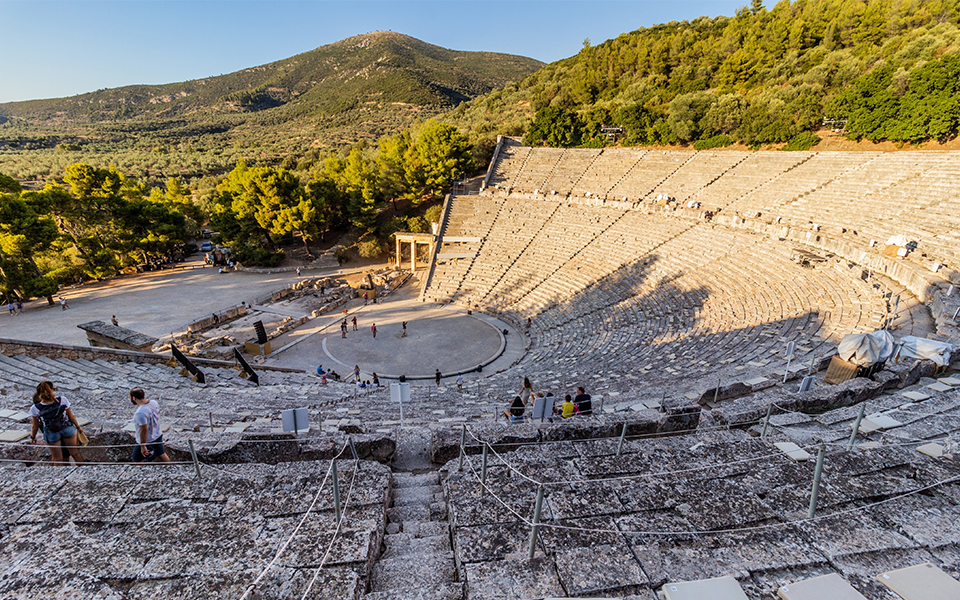
The iconic Ancient Theater of Epidaurus can seat 12,000 spectators.
© Shutterstock
The Athens Epidaurus Festival, Greece’s largest cultural institution, is underway with a 92-day program featuring 104 productions and more than 2,500 artists and collaborators from 26 countries.
Running from May 29 through August, the festival’s 71st edition marks the beginning of the three-year tenure of Artistic Director Michail Marmarinos while also celebrating the 20th anniversary of Peiraios 260, the industrial venue that has become the beating heart of the festival’s contemporary program.
This year’s festival also carries special significance as the Odeon of Herodes Atticus hosts its final season before extensive restoration and conservation works begin.
Since the 1950s, the iconic Odeon of Atticus Herodes has been the festival’s flagship venue. Set beneath the Acropolis, the 1,800-year-old Roman theater will host its last festival season before restoration begins.
Among the upcoming highlights is the ERT National Symphony Orchestra’s World Music Day concert on June 21, featuring violinist Leonidas Kavakos and violist Ilias Sdoukos in a program devoted to the works Mozart and Beethoven, conducted by maestro Michalis Economou.
Ancient drama returns on June 25 and 26 with director Stathis Livathinos’ production of Euripides’ Hecuba. Subtitled In the Shade of Plato’s Republic, the work places the 5th-century BC playwright’s devastating account of war, justice, and political collapse in dialogue with questions of civic responsibility and moral order – concerns that remain strikingly relevant today.
The Herodeion’s June program also includes concerts, dance performances, and special events before the venue closes for lengthy restoration works, expected to last several years. For visitors hoping to witness this landmark venue before its closure, advance booking is highly recommended.
Marking its 20th anniversary, Peiraios 260 once again serves as the festival’s hub for contemporary theater, dance, and interdisciplinary work.
The season includes Badke(remix) by Amir Sabra and Ata Khatab (June 20-21), a performance inspired by the traditional Palestinian “dabke” dance, as well as Medea’s Children by Swiss director Milo Rau and NTGent (July 4-5), one of the major international theater productions of the summer.
Dance lovers should look out for the return of China’s celebrated TAO Dance Theater on July 13 and 14. Internationally renowned for its precise, hypnotic choreography and distinctive movement language, the company presents 16 and 17, the latest works in its acclaimed Numerical Series.
Another major international production arrives with Brazilian director Christiane Jatahy’s A TRIAL. Drawing inspiration from Henrik Ibsen’s An Enemy of the People, Jatahy combines live performance and cinematic techniques to examine questions of truth, public opinion, and political accountability.
Ancient Greek tragedy and comedy remain at the heart of the festival’s program at the Ancient Theater of Epidaurus. Built in the 4th century BC and renowned for its extraordinary acoustics, the theater remains one of the ancient world’s greatest surviving monuments.
The season opens on July 3 and 4 with Aeschylus’ The Persians, directed by Christos Theodoridis. The oldest surviving complete Greek tragedy, the play examines the aftermath of the Persian defeat at Salamis through the eyes of the vanquished.
International productions include Bulgarian director Javor Gardev’s collaboration with British musical trio The Tiger Lillies on Euripides’ The Bacchae (July 10-11), performed in English with Greek surtitles.
The National Theater of Greece returns to Epidaurus twice this summer, first with Euripides’ Alcestis (July 17-18), directed by Dimitris Karantzas, and The Trojan Women (July 31-August 1), directed by Eleni Efthymiou.
Among the season’s most anticipated productions at Epidaurus is Norwegian director Alan Lucien Øyen’s interpretation of Sophocles’ Antigone (August 7-8), while the program concludes on a lighter note with Aristophanes’ Lysistrata (August 21-22), presented by the National Theater of Northern Greece and directed by Asterios Peltekis.
The Little Theater of Ancient Epidaurus continues its tradition of presenting music, performance, and experimental work in an intimate seaside setting. Overlooking the Saronic Gulf and framed by pine-covered hills, the beautifully preserved ancient theater, located just 30 minutes from Nafplio, offers one of the festival’s most distinctive experiences.
The season opens with TOURNÉE by Euripides Laskaridis (June 26-27), followed by Polish director Marta Górnicka’s choral work Mothers: A Song for Wartime on July 4.
Other highlights include The Oranges of Palaia Epidaurus by Thodoris Gkonis (July 17-18), inspired by the history and landscape of the region, and 1961 (July 24-25), a collaboration between composer Kornilios Selamsis and director Haris Fragoulis that draws inspiration from Maria Callas’ legendary 1961 appearance in Medea at Epidaurus
As the festival enters a new artistic era under Michail Marmarinos, this year’s edition combines major international productions with new interpretations of classical drama while marking a turning point for one of its most iconic venues.
For the full program, schedules, and ticket information, visit the official Athens Epidaurus Festival website.
Experience the very best of Greek…
From July 12-25, internationally renowned artists…

The Acropolis Museum in Athens marks…