Yorgos Lanthimos’s First Major Photography Exhibition in Greece
The internationally acclaimed Greek filmmaker presents…

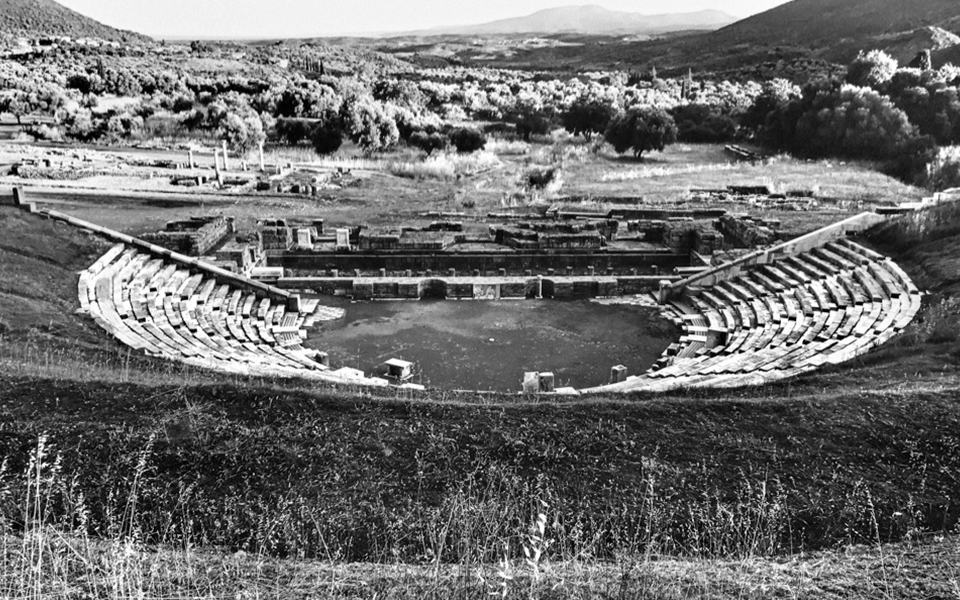
© Stella Nastou
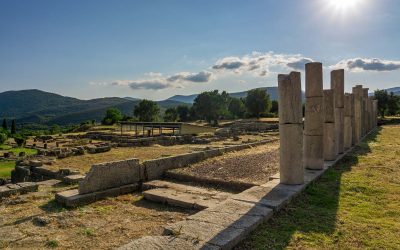
The setting of dry weeds, marble ruins and open skies may seem unchanged in Ancient Messene, but beneath this tranquility lies more than 2,000 years of history.
Photographer Stella Nastou visited the archaeological site in the southwestern Peloponnese in May 2017 and created a “still journey” stretching from 369 BC to the present. She did not approach antiquity as an impressive setting, but used the forms of the ruins to convey a sense of unmoving time in the exhibition “Messene or The Power in the Silence of Time,” running through August 30 in the entrance of the Athens Concert Hall (megaron.gr; free).
The ancient city-state of Messene, or Ithomi, was founded in 369 BC as the capital of the Messinian state after its liberation from three-and-a-half centuries of Spartan rule that drove many locals into self-exile to avoid becoming slaves. Much more than a new city, its establishment, achieved with the help of the Thebans, was an invitation to those exiles to return and to rebuild a new collective identity. Over four centuries, the city evolved into an important center for politics, religion and the arts. Today, its monuments still form a coherent urban whole, making Ancient Messene one of the most important and complete archaeological sites in Greece.
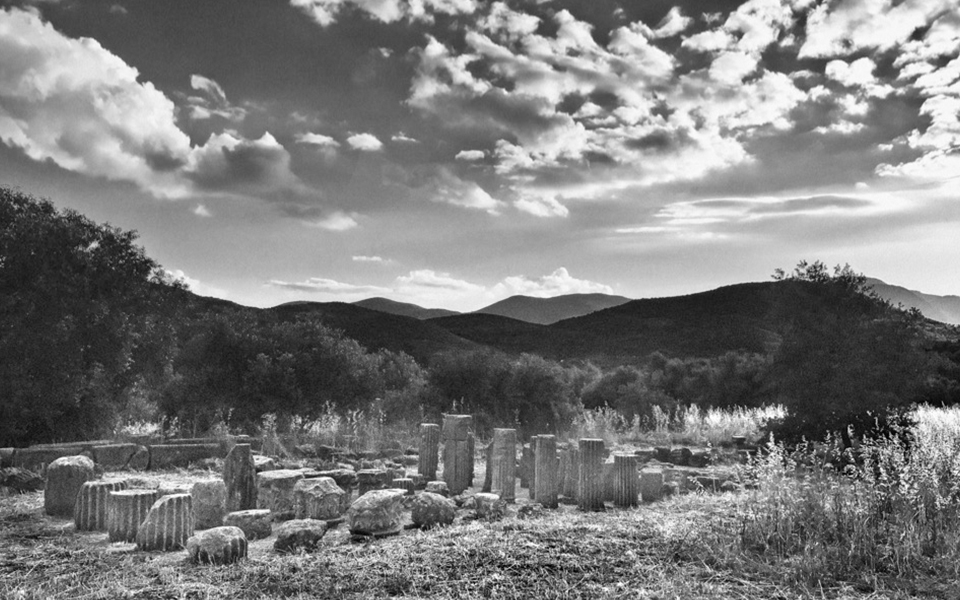
© Stella Nastou
Much of what we see today is the result of the decades-long excavation work of the late Greek archaeologist Petros Themelis. The first systematic investigations began in the late 19th century, but it was Themelis who led the major modern excavation project, which ran for more than 30 years. Gradually, the theater, the asclepieion, the stadium, the agora, the ekklesiasterion, the odeon, the sanctuaries and the fortifications came together to reveal the shape and character of the ancient city. Speaking of the site to which he devoted so much of his life, Themelis once said: “I have known great happiness at Ancient Messene.”
Nastou’s work conveys a similar spirit. Her glance is drawn to simplicity: a piece of marble, the wild vegetation growing in the crevasses of the rocks, the light, the horizon. She stands in front of the monuments observing what stays when people go.
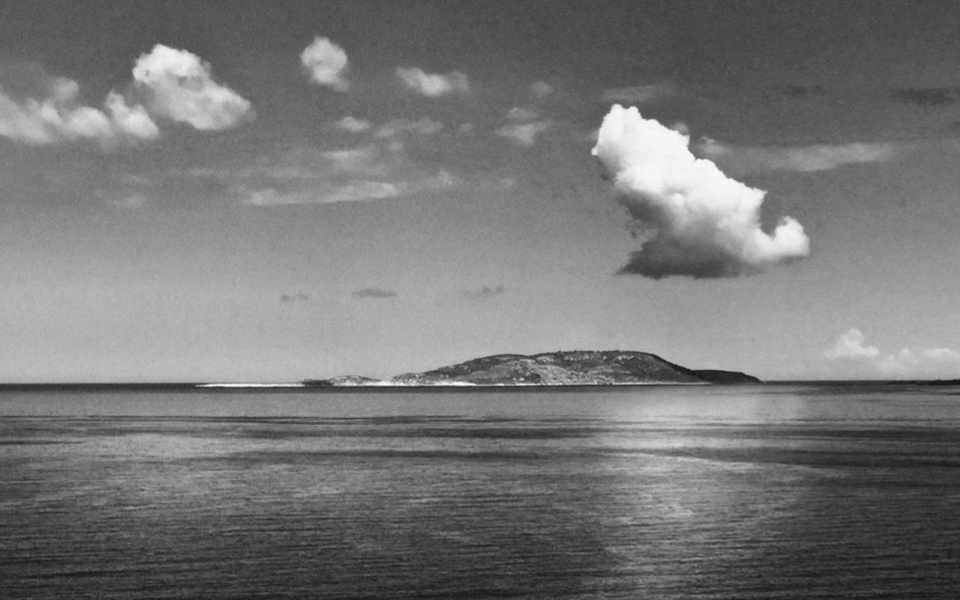
© Stella Nastou
The hill slopes down to the sea from the archaeological site and the islet of Sfaktiria is visible on the horizon. It’s geography connecting two important moments in Greek history: the establishment of Messene in 369 BC and the 1827 Battle of Navarino where the allied fleet of the English, French and Russian navies defeated the Turks, marking a turning point in the Greek War of Independence.
This history needs no illustration in Nastou’s photographs; it’s right there in the geography of the landscape. The fight for freedom, the loss of the homeland, the return, the creation of the city and, centuries later, another battle for independence all come together in his singular location.
Originally published at ekathimerini.gr
The internationally acclaimed Greek filmmaker presents…

Discover the enchanting Mykonos of 1959-1979…
Greece's Ministry of Culture has approved…

The French School of Athens commemorates…