Athens’ Ancient Cemetery Gets a New Look
Kerameikos, the potters’ quarter and great…

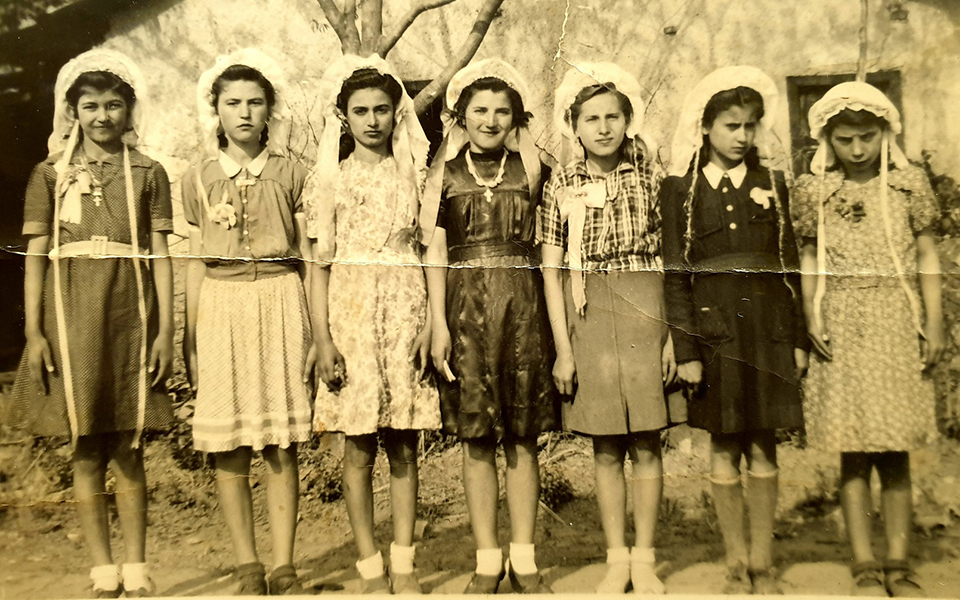
Lazarines in Livadia, Serres in 1947.
© Hellenic Ministry of Culture
Greece’s cultural heritage isn’t confined to ancient temples and museum galleries. It lives in the songs women sing together at Easter, the handmade pasta prepared for a village wedding, the stonemasons passing on skills honed over generations, and the faithful who walk through the night carrying a sacred icon. These are traditions that connect people to their communities and their past, keeping local stories, beliefs and ways of life alive in a world that often seems intent on moving ever faster.
Ten more living traditions have now joined Greece’s National Inventory of Intangible Cultural Heritage, bringing the total to 199. Part of Greece’s implementation of UNESCO’s 2003 Convention, the initiative safeguards practices, knowledge and skills that communities recognize as their cultural inheritance. The new entries span religious celebrations, music, food, craftsmanship and seasonal rituals.
Here are the 10 traditions that have been added to the National Inventory:
Every September 20, thousands of faithful accompany the sacred icon of the Panagia Voulkaniotissa on a 20-kilometer journey from the Monastery of Voulkano to Messini, in the southwestern Peloponnese. Leaving at 1 am and arriving at 10 am, the procession commemorates, according to local tradition, the area’s deliverance from the plague in the 17th–18th century. The icon travels in a gold-embroidered pouch beside an oil lamp kept lit throughout. Its arrival at the chapel of Zoodochos Pigi marks the start of a historic nine-day festival.
In Archangelos, Rhodes, female relatives gather at the bride’s home before the wedding to make “koulouria,” a traditional local pasta, singing songs and offering blessings for the couple. Spread on cloths across rooftops to dry, the pasta is cooked on the wedding day in large cauldrons of meat broth. Topped with grated cheese, it is served as the first course of the wedding feast.
In Pentalofos, Vythos, Dilofos and Avgerinos, in Kozani’s Voio area, a handful of master craftsmen preserve a stone-working tradition encompassing quarrying, carving and construction. Their legacy survives in local buildings, while their knowledge, stories, songs and customs remain part of village identity. A local saying captures this bond: “We had stone, and we worked stone.”
The “Kavontoritikos” is danced at celebrations in southern Evia, particularly in Kavontoro and Karystia, by men and women, many of Arvanite descent. Its distinctive melody is played on violin, lute, local lyre or “tsampouna,” a traditional bagpipe. Usually instrumental, the music can also include singing in Greek or Arvanitika.
On December 24 and 25, young men in Kavili, in the Evros region of Western Thrace, perform the “Koli,” singing traditional carols accompanied by musical instruments. Part of the Twelve Days of Christmas, the ritual expresses wishes for prosperity and a plentiful harvest in the year ahead.
On Lazarus Saturday in Livadia, Serres, girls in traditional bridal costumes visit homes, singing praises for each family’s firstborn child. Boys accompany them with flower-decorated baskets to collect flour and eggs. Householders then roll a sieve, interpreting its fall as an omen for the harvest. On Palm Sunday, the girls cast palm fronds into the river. The one whose frond travels farthest becomes their “koumbara,” or ceremonial godmother, and hosts an Easter Sunday meal.
Every July 26, villagers from Kalarrytes, Ioannina, gather at a cave chapel at an altitude of 1,740 m, six kilometers from the village, to honor Saint Paraskevi. Celebrations follow in a mountain meadow and, in the evening, the village square. Locals associate the festival with a miracle in which the saint saved and multiplied a flock, linking it to the area’s tradition of seasonal livestock movements.
In Krania, Karditsa, Karagouni women perform the “sergiania” ritual dance during Carnival and Easter, accompanied only by their collective singing. Once among women’s few opportunities for public expression, the custom continues to bring together younger and older participants.
Every June 24, the Sarakatsani Traditional Museum Settlement in Rodopi, Thrace, hosts a public reenactment of “Kalogiannia,” a folk ritual honoring Saint John the Baptist. It recalls the customs of Sarakatsani communities in Eastern Macedonia and Thrace, whose seasonal movements with their livestock once took them to areas near Constantinople.
In Kastoria’s Apozari neighborhood, the “rodani,” a handmade wooden carousel with seats, is erected in the central square for Easter. It starts turning on Holy Thursday, pauses on Good Friday and resumes on Holy Saturday, traditionally continuing until the Sunday of Thomas, the first Sunday after Easter. In recent years, it has remained in operation for an additional two weeks.
Kerameikos, the potters’ quarter and great…

An initiative supported by the Museum…

“Industriana,” the new exhibition at the…
Greece’s summer cinema tradition earns global…